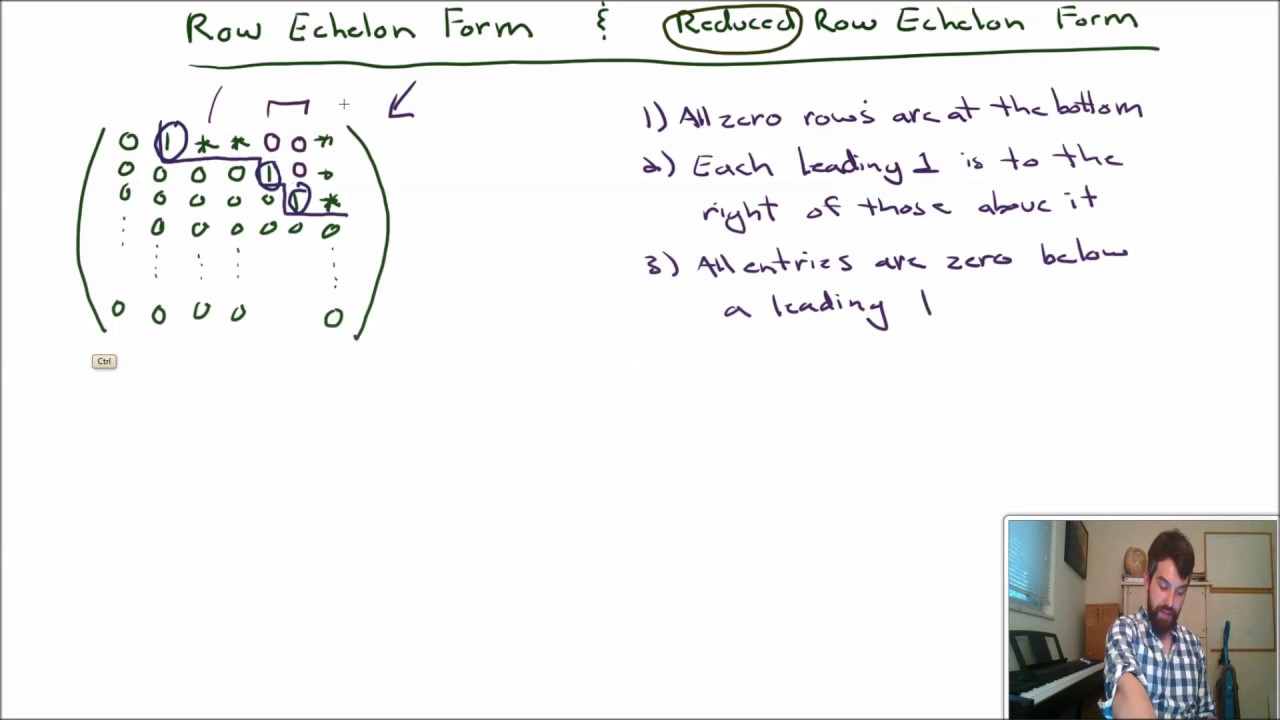
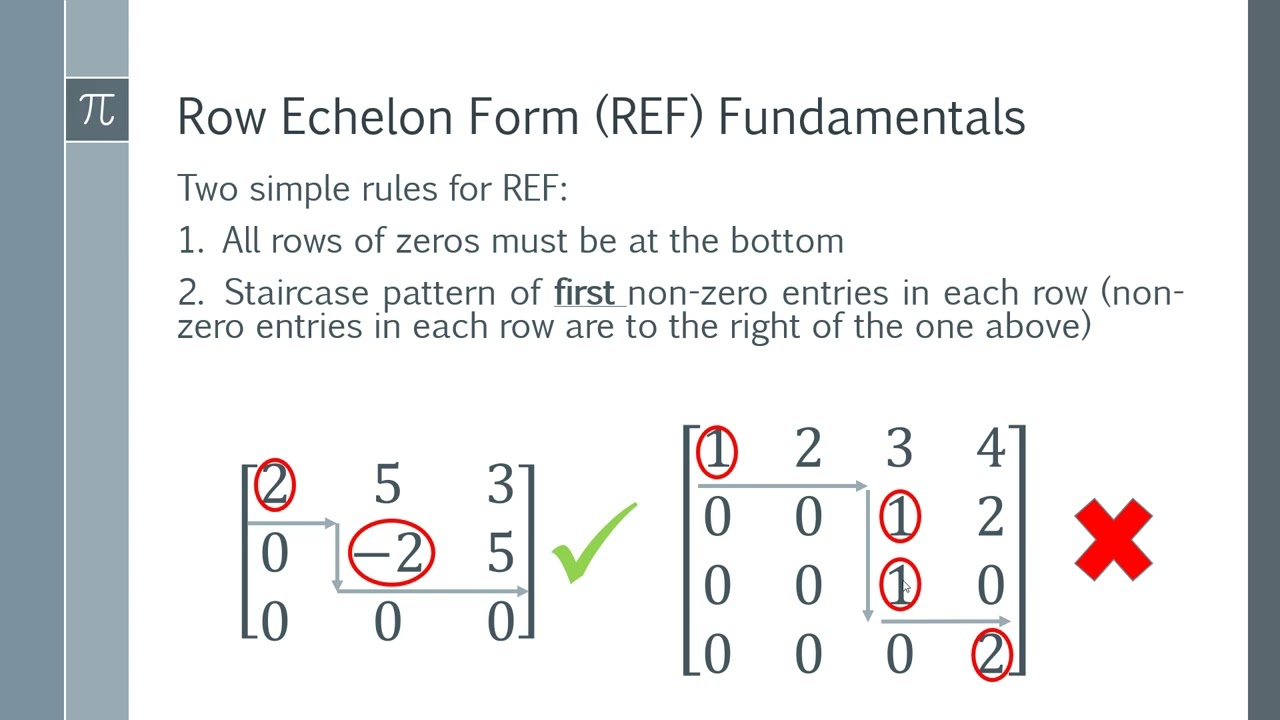
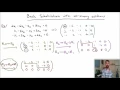
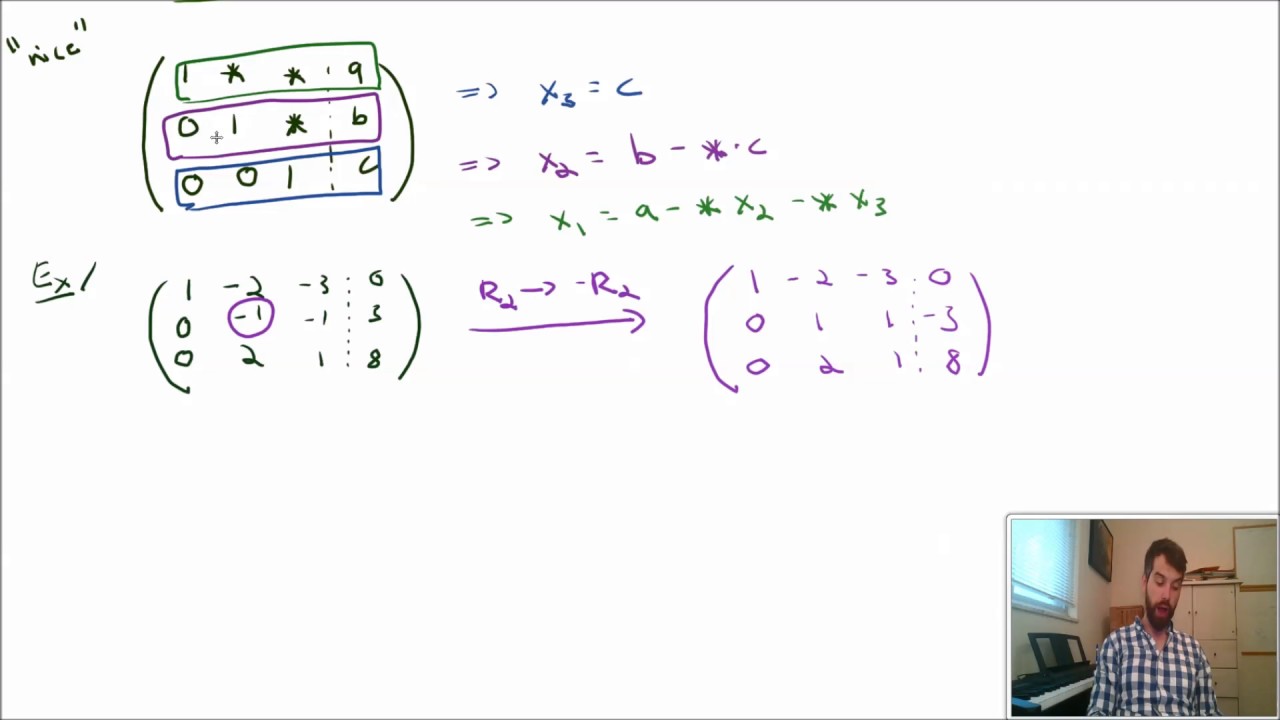
so far our process to find the solutions to a system of linear equations looks something like this step one put it into a matrix step two we're going to do a bunch of Elementary row operations to manipulate that Matrix and then what we' just learned is that the the ideal goal is to take this Matrix and Via those Elementary row operations turn into this nice form either the row Echelon form or the reduced row Echelon form so in this video I'm going to do a little bit of that we're going to take the system of
linear equations we're going to put it into a row Echelon form and then after that what we're going to do is figure out how do I write out the solutions if I have it in row Echelon form how do I know whether there's the zero the one and the infinitely many and if like in this example there's there's infinitely many solutions is there a nice way to write that down and to describe these infinitely many solutions and indeed we're going to see in this example that there's actually going to be two different infinite families of
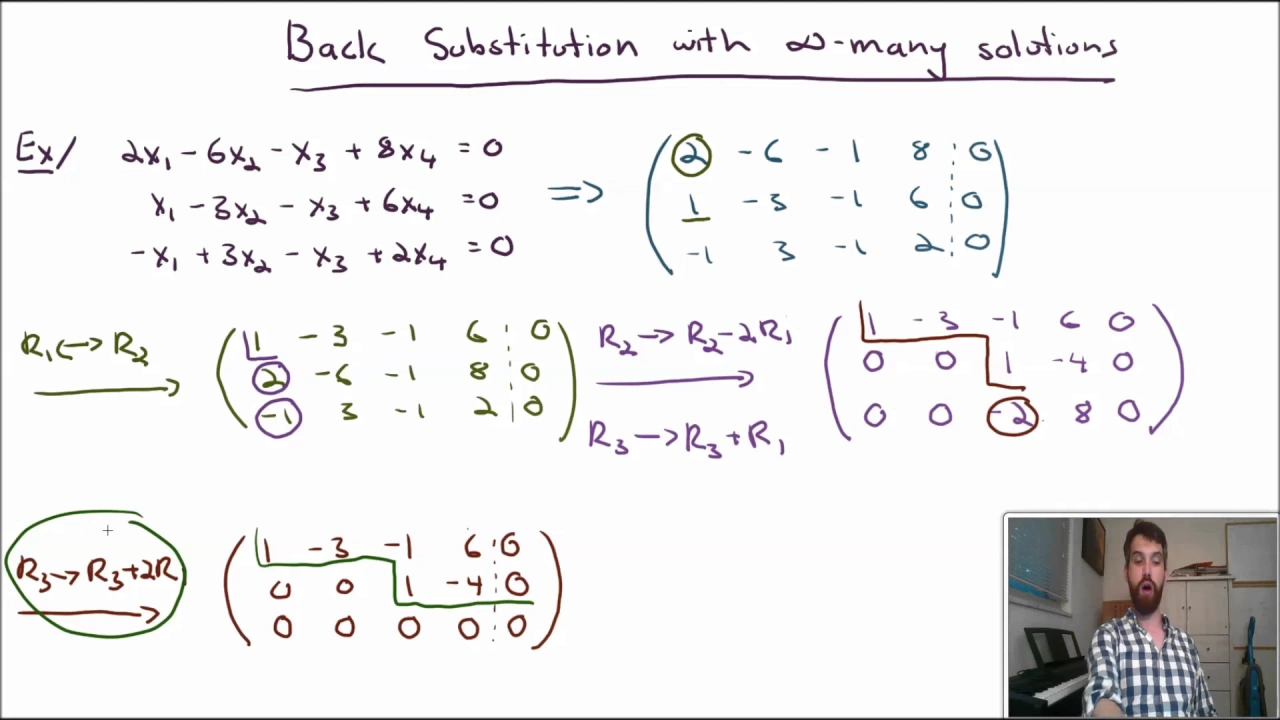
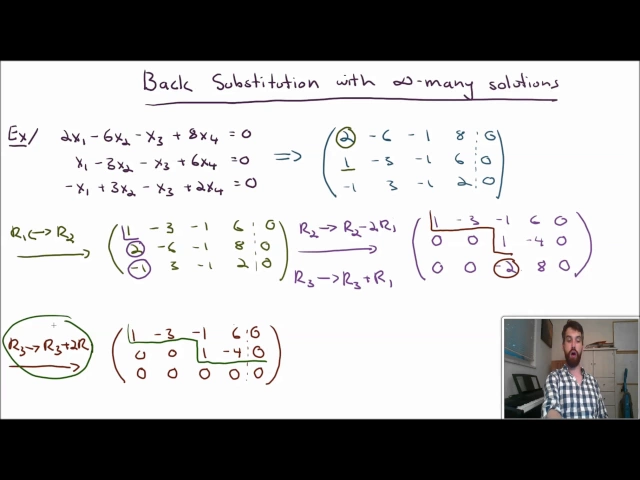
solutions so the first part is the somewhat tedious process of putting it into row Echelon form that we are going to see an enormous amount of times in this course and we need to become very efficient at First Step let's translate it from a system into a matrix by getting rid of the different variables and just looking at the coefficients and that constant of zeros on the right hand side all right all right there we go now if I want to put it into Ron form remember our first goal is to have that leading one
in the top left corner if possible either that or a full column of zeros I don't have a full column of zeros here so I want a leading one in the top left corner I want to look here now there's one way I could do this I noticed down here in the second row I already have a one so why don't I just alternate Row one and two and that's going to put a one up where I want it to be so I'm going to put a wrong error Arrow I'm going to write down my
instruction it's that Row one is going to Interchange I use a double arrow to denote that with row two and therefore that is going to give me this note that here I haven't changed the third row at all I just copy and pasted that it was only the first two rows that switched all right so I've got the beginning of my staircase going on I've got this leading one now next up I want to have zeros beneath this leading one in other words I want to have a zero where this two is and I want
to have a zero where this minus one is now I think we can do this I'm going to do these two steps at the same time uh so I'm going to draw an arrow let's do the first of them first so I'm going to take my row two and I'm going to replace it with the old row two and because I have the value of of two here I'm going to subtract off twice Row one and 2 minus 2 * 1 will be zero so that's what I'm going to hope for and this is going
to give me well the first row doesn't change at all 1 - 3 -1 60 I didn't touch that now it's the second row that I'm changing this does matter I have a zero here that was by Design and then I have Min - 6 minus twice -3 so this is like - 6 + 6 in other words zero then Min -1 minus and I'm going to multiply this minus one that I have here by two so minus a minus two which is like plus two and so this is going to give me a one
and then 8 - twice of 6 this is like a 12 so 8 - 12 a minus 4 and finally a zero now I'm going to do the the row three adjustment at the same time I'm allowed to do this sort of at the same step because both the change to row two and Row three are only involving Row one there isn't any weird like logical dependency going on there so I can sort of do them independently so it's my Row three that's changing and I notice here that if I take Row one which is
a a one in that First Column plus Row three which is a minus one in that first column one and minus one add up to zero and so that's going to work so I'm going to send this to the old row three plus Row one 1 and - one is 0 -3 and + three is another zero Min -1 and -1 is a -2 6 and 2 is 8 and finally a zero now if I look at what I have here I'll notice that my staircase is is looking a little bit more staircas like there
we go I have a leading one I have zeros beneath it it goes over to the other one but I don't have a zero beneath that that's my next problem my next challenge that I want to deal with so let's deal with that I'm going to take my Row three here that's the one I want to fix and it looks like if I take the old row three because I got a minus two here if I add twice Row one that should make it be a zero here okay let's see what we get here copying
and fating the first two rows and then for the second well nothing's changing here in the first two entries just a bunch of zeros by the way this this convenience where I don't even have to think about these and these are zeros are partly why row ealon form works in the first place then by construction I have a zero here that's what I was going for and then I'm taking my8 and I'm adding twice the minus 4 so that's a minus 8 it happens to be a zero there as well and so I get this
Matrix and then if I want to sort of look at what my my staircase has become I Come Along come along and that's what I have so I get this row of zeros at the bottom now I want to note a couple things first of all if we looked back over here in a prior step we we had this leading one that appeared no that was just by coincidence that happened to become a one if it had been some other number like seven we would have had gone through a step like divide Row Two by
7 so sometimes you can get kind of a little bit lucky when you're doing your row Echelon form sometimes you can make choices that result in it working out easier or more challenging the other thing I want to knowe is that you notice how I've I've written down these arrows and I've given the instruction well in a sense you don't have to do that you could do these manipulations and if you were correct that' be okay however I would caution you to do them even though we're going to do an enormous number of computations like
this it makes it way easier at least in my mind to have the explicit codification of what I'm doing it makes it less likely for me to make mistakes and more likely that I'm going to be able to understand what it is that you are doing and I can follow a LW so I really like going in and writing the sort of instructions in off on the side now that was the routine part we have successfully put it into an RF form if we wanted to we could go along we could put ones excuse me
we could put zeros above those leading ones as well if we wanted to go to the reduced R Echelon form but as we'll see this is going to be sufficient now how do I actually solve this how do I go and figure out what are the solutions I think there's probably going to be infinitely many because I have this row of zeros here but how do I do it now I first want you to note you see I have a leading one here and I have a leading one here and then I have these two
different columns uh the second and the fourth column that don't have any any leading ones I'm going to refer to these as free columns so these are columns that do not have a leading one and the idea is I have four different variables X1 X2 X3 X4 I have two different equation that puts constraints on them and then sort of two degrees of freedom if you will I've got the second and this fourth column where there's sort of no constraint so here's what I'm going to do I'm going to take my second variable and I'm
going to set it to be a free variable so this is s that's a free variable and I'm going to take X4 that's the one in the fourth column which also doesn't have a leading one and I'm going to make that being T and these two things are going to be referred to as free variables or free parameters and then my claim is that that given this sort of arbitrary choice where I can let X2 be whatever and X4 ever then my X1 and my X3 are going to be constrained by the two equations that
I have so for example if I look at the second equation then what I can say is that my x3 - 4 * X4 is equal to 0 or in other words X3 is equal to 4 and then since X4 was denoted T it's going to be equal to 4 * t T so now I've translated my X3 is now written in terms of these free parameters and then if I look off the first equation what I'm going to get here is that X1 - 3x2 - X3 + 6 X4 is equal to zero that's
what reading off of that first equation is going to give me and then I can come from here and I can substitute a few things in so okay my X2 is just an S so X1 - 3s and then I have a uh an X3 but X3 we know is 4T and then plus 6 and and X4 is also just T so that is what I've done I I've translated everything but X1 into S's and T's and I can manipulate it even one step further and say my X1 is equal to 3 * s -
4 t + 6 T is 2T so + 2T and that equation together with my original equations that I have over here is a prescription for X1 X2 X3 and X4 all in terms of these two free parameters s and t so when we have this scenario what we're going to say is there are two infinite families of solutions if you give me any value for S and T I can figure out what my X1 my X2 my X3 and my X4 is going to be so there's infinitely many solutions but they they they're clustered
they're clustered into these two different families and the constraints of the system put these constraints on my outputs of the X1 the X2 the X3 and the X4 and then in general if I have say a 100 different free columns I'm going to get a 100 different free variables and I would have a a hundred families of infinite solutions



![Parametric Vector Form and Free Variables [Passing Linear Algebra]](https://img.youtube.com/vi/OnCLWE-ohSE/maxresdefault.jpg)