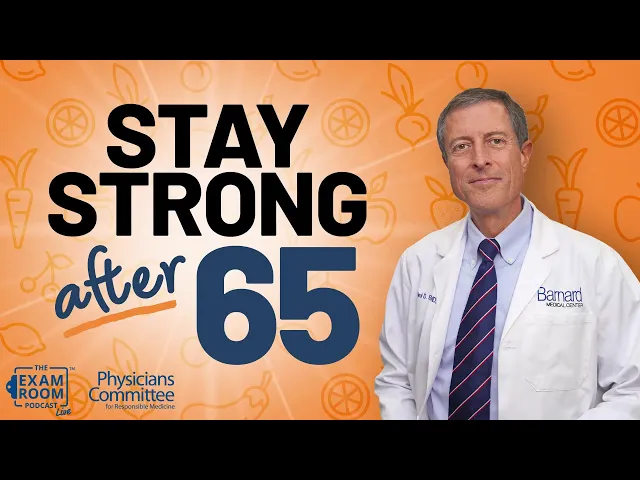
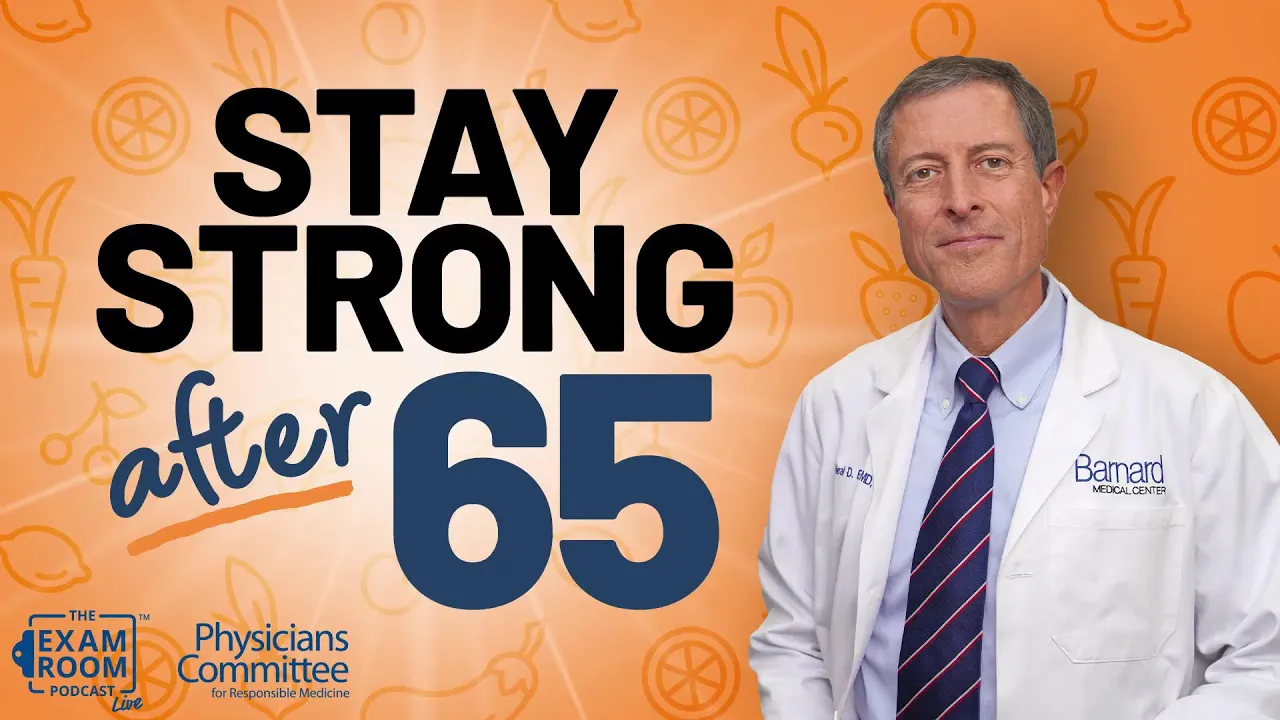
Staying healthy as a senior. When you hit 65, what needs to change? We're going to talk about it right now on The Exam Room. And welcome to The Exam Room Live, brought to you by the Physicians Committee. Hello, I'm the weight loss champion, Chuck Carroll. Thank you so very much for watching and downloading in more than 150 countries around the world and making the exam room one of the most consumed nutrition podcasts anywhere on the planet today. And today to specifically, we're going to be talking about 65 and up, the older crowd, the seniors. I
know time just happens to roll by, but we get so many questions here wondering, "What can I do to improve my diet? Do I need to add extra supplements? Do I need to exercise more, exercise less? Do I need more or less protein once I hit that 65 number?" Well, today we're going to talk about that uh with someone who does not look a day over 45, Dr. Neil Barard. Thanks for being here, my friend. >> Thank you, Chuck. Great to be with you today. >> Uh really important topic and I'm not I'm not joking
when I say that we get inundated with messages from people here on the exam room live uh asking for help because you know they're feeling their age so to speak and they've been doing the same thing they've been doing their entire life and they had felt fine up until now. So what gives when you turn 65? They say what do I need to do to change to get away from those aches and pains and feel like uh their 45year-old self again. So, how much at 65 like does a senior need to implement wholesale changes? >>
Well, in some cases we think we're kind of doing what we always have, but we may not exactly be. Um 65 is an age where often people are less physically active. And if they're not as physically active, then we're not eating quite as much. So, we may not be getting the nutrients that we're having before. Um 65 is also the age where some people are economically actually better off than they were before. So they can splurge a little bit more than they were doing earlier. So you may not be doing exactly the same thing. But
the other thing, let's face it, you know, time does take a toll. >> And so if a person had a little bit of a cholesterol issue, it might be uh affecting them. If they've had higher blood pressure, it might be affecting them too. When I say affecting them, it can affect the heart, affect the arteries, affect the brain. And so some of those things, those effects are real. That said, 65 is not old age. Let me be clear. It seems like old age when you're 18, but 65 is an age where people should be vigorous,
sharp. If you could run a marathon when you're 45, you should easily be able to run one when you're 65, if not faster. Um, you are not old yet. >> Wow. So 45, you and that's like honest to goodness, if you ran it at 45, you should be able to run it at 65. Maybe not at the same speed, but a person physically should still be able to do that >> at the same speed. >> Yeah. Really? >> Absolutely. There there is no biological reason why your muscle should be broken down at 65, >> man.
>> No, absolutely not. >> Oh, you're making me like feel all kinds of good right about now, man. Cuz I'm about to turn 45 and like if I can keep that for another 20 years, I'm feeling real good about life, >> Chuck. It doesn't last forever. But this but >> Well, now you break my heart. >> But the fact of the matter is 65 is not old age. >> Okay, good. Good. Put that on a bumper sticker. All right. If you have a question for Dr. Bernard today, drop it in the comments or in the
chat. We're going to get to as many as we can here on the program today. Um, let's start with a question that Bill sent in earlier. Um, he wants to know when you you hit 65, is that the time that you should start looking at maybe taking that multivitamin, some supplements? I know if you're eating a plant-based diet, B12 is mandatory, but what else for seniors? >> Okay. Uh, they are exactly the same for as they are for people who are younger or the same the same supplements. U same supplement issues. B12 you should take.
Everybody should be taking B12 really regardless of diet. >> And the RDA, if you look it up, is 2.4 micrograms. You need it for healthy nerves. You need it for healthy blood cells. Um, if you don't have it, you're going to become anemic and your risk of dementia is going to be higher. You absolutely need B12. It is supplemented in some foods. Some breakfast cereals, soy milk may have it added. Don't be a hero. Just take a pill. That way you've got it. Uh, the amount that I would recommend is not just the 2.4 micrograms.
Take a 100, 200, maybe 500 micrograms. You go into the health food store and they're going to sell you 10,000 micrograms, you know, okay? Um, break that in half or have it every other day or something because that's more than you need. But if you get 100 or 200, 500 micrograms per day, that's fine. Uh, vitamin D, it's not really a vitamin. It comes from the sun. But if you're living in a place where there's not a whole lot of sun, like New York City in February, um, and just about anywhere else these days, unless
you're at the equator, you took your shirt off, um, you are probably not getting vitamin D from nature's source. And so, most doctors nowadays would say take 2,000 international units of vitamin D. What what that does is it protects your bones. Obviously, >> vitamin D facilitates calcium absorption from your foods, puts it in your blood. your bones can can use that. But vitamin D does a heck of a lot of other things, too, as I know you've talked about on this show before. Um, couple of other of other things for a little bit extra credit.
One is iodine. We haven't really talked about iodine a whole lot, but your thyroid needs that iodine. And the reason nobody thinks about it or talks about it is because 1924, 1925, Morton, the Morton Salt Company said, "There shall be iodine in our salt." Because up until that point people were running low on iodine and they were they were getting hypothyroid as a result. That means you've got no energy. It increases the risk of various diseases. Morton put iodine in the salt and they wiped out iodine deficiency but practically overnight. But nowadays because we are
so clever we are having him salt >> or you know other kinds of salt uh that are not iodized unless unless it's marked on the label. And so we're seeing iodine deficiency and the way you experience it is >> I'm not myself. What's wrong with me? It's kind of the picture you painted. Yeah. Now that I'm 65, I guess I'm run down. No, you're not. It's it has nothing to do with a calendar, buddy. It has to do with the fact that you're not getting any iodine. And your endocrinologist or internist can spot it like
that. Um and so the RDA for iodine is 150 micrograms per day. You don't have to measure this, but um you can go to the store and get iodized salt or you can get um at most health food stores, they will sell iodine supplements as kelp. >> Um but you and you see this regardless of of diet. Um it's a it's a big issue. Or if you're Japanese, you don't see any iodine deficiency because because seaweed salads, the seaweed around the the nori around your sushi roll, >> nature's big source of iodine. >> Big fan.
I like seaweed salad on its own. I think that that's quite tasty. Uh but I do love a good vegan sushi roll, too. Oh my goodness. There's >> Oh, man. Wrap up the the cucumber or the asparagus or the sweet potato in a sushi roll. You're going to get iodine. And the last one I would think about is omega-3. Um, there are omega-3s. Uh, they're healthy fats. Um, and they are in lots and lots of foods, including green vegetables. There's not a lot, but there's some. Uh, I don't recommend that people take fish oil at
all. But there's the equivalent algae derived DHA and EPA, just like fish oil without the stink, so to speak. >> They do. Like, have you ever opened up a bottle of fish oil supplement? like it really does smell like a fish market in there. >> Don't think about it. Um, forget it. But anyway, the the reason that I I don't know that everyone needs this. So, to determine if a person should supplement or not, what some people will do is they'll go online to a company like Omega Quant that says, "Send us 50 bucks or
whatever." And they'll send you a little card. You put a drop of blood on that card, mail it back in, and they'll say, "Here's your omega-3 levels." They'll tell you your blood level of DHA and EPA and if you're low you can supplement and few months later do the test again. I'm not necessarily pushing people to do that because your own doctor can work with you on all of these things. But um that's an easy at home method that people are using and apart from that if you're in the normal zone it's hard to make
an argument for for for supplementing. What are some of the symptoms somebody might be on the lookout for? It to wonder, well, maybe I am a little bit low on B12, maybe I am a little bit low on iodine. >> With B12, the big problem is there are no symptoms until you get into trouble. >> Um, the symptoms are neurological symptoms. Uh, you can have um some funny neurological symptoms like pain that's unexplained. Um but because B12 is involved in uh nerve the health of nerves and when your nerves are not working you've got sensory
nerves and motor nerves and and sometimes the ner neurological squelli of B12 deficient are permanent. >> So that's why you don't >> don't want to mess around with it. Now with regard to to iodine deficiency when people are are low in thyroid they very often feel >> sluggish. >> Uh your hair and skin will not look healthy. Um doctors can kind of spot this. It's it's vague symptoms with many of them as with fatigue, hairs changes, skin changes, um sometimes blood sugars will come up. Um lipids will come up. So it's easy easy to test
for and easy to treat. >> All right. Uh Tina's wondering, all right, now let's say that uh we are at a point in life where things are starting to add up kind of like you were talking about. You haven't changed. It's just the culmination of all these years of eating some unhealthy things. She's wondering, "Are there any risks associated with seniors transitioning to a healthy plant-based diet?" >> I mean, after years of eating rotten and deciding, I want to get my cholesterol down, I'm going to I'm going to be on a healthy diet. Are there
risks? >> Yes, exactly. >> There is a risk. You're going to have to buy new clothes. You know, it's you know, you're gonna I mean, yes. Um Chuck, this is really important. Some people will say, "You're too old to change." and people don't want to change, you know, whatever. This is the biggest lie I got to tell you. I was when my parents were alive, they lived in a senior center. >> And uh my mother had gone vegan because she'd had a high cholesterol and she had went vegan and and I mean it cured her.
They move into this place. There's nothing healthy. So I I sat down with the management. I said, "You should really be serving vegan food. At least make them available." He said, "Old people don't want to change. They're set in their ways." Thought that is not true. I gave a talk then I gave a lecture um and every hand went up when I said would you like to try vegan foods? Would you like them available? Older people are on a sack of pills. Their doctor has given them worries and they're ready to change. We do a
lot of studies with older people. They are eager to swap recipes and get on a healthier path. So, are there risks? Yes. um there aren't bad risks, but but one of the issues is let's say you're taking medication for your blood pressure and now you're treating it with food and your blood pressure can come down, but you're still on the same medicine, so your blood pressure can get too low. If you have diabetes and you're treating it with insulin and now you're on a healthier diet and your blood sugar comes down, that insulin will drive
it too low. So, it's not really a risk of the diet. It's a risk of the drugs that you're on, but those drugs risks become accentuated when you have less need for them. So, the answer is just tell your doctor, I'm about to start I'm going to make a big diet change and the doctor's going to say, good. I want to see you back in three weeks and we're going to we're going to see where you are. Um what some things are not problems, >> right? >> Like, oh, if I'm senior and and I go
vegan, will I get enough protein? Will I get enough calcium? Those are not issues. They are they are not an issue anymore at age 60 or 70 or 80 than they were when you were 20. Um it it can be an issue if you're not physically active anymore and you're just not eating at all. You need to get your quantities of food back up, but it's the same same kind of nutri nutritional prescription that we would make for any age. >> I got to go back. I I want to know what what what the ending
was for after you gave the lecture at the the facility where your parents were. Did they wind up making some menu changes? They did not. >> Aha. >> But I do want to say there are places that have been inspired based on this to make big changes. Uh I want to say a big shout out to the Ericson senior centers um which are it's a a chain of of terrific places where we've been working with with management and I I want to credit the management for saying we're going to provide healthy food people including vegan
choices for for for people and educational uh sessions and it has been wonderful to see that people who are going into a center like that they're not giving up >> their past they're entering into a new and vibrant phase of life so healthy food can support that >> and and the patients they're opting for it or the the residents I should say not patients they really they're enjoying this huh >> love it um a a you know this I mean the food is delicious well-made healthy food tastes as good as it is for you >>
no question >> uh but the Second thing is when you're able to get off those medications, you're getting rid of the side effects of all those medications. >> Yes. >> And that is huge, >> man. I wonder then if somebody like really gets their health back on track, if anybody's like moved in and then moved back out because they started eating the plant-based diet. I mean, I know that that's kind of a pipe dream, but I can see it happening. I mean, I've seen some pretty epic transformations. >> Chuck, I want to tell you a
story. Um, we learned 10-15 years ago that in rare cases statins could cause dementia. Now, now a statin, statins are generally safe cholesterol-lowering drugs and they do lower cholesterol and a lot of doctors will correctly advise people to save them, but a rare side effect is they can make your brain go funny. So what we have discovered is that there are people who in a nursing home with a di diagnosis of dementia, they were able to get off their statin because they had wanted to see if they would get better. Get off the statin, their
cholesterol might bounce around a little bit, but then they control with diet and slowly but surely their cognition comes back and they pack their bags, Chuck, and they go home. >> Wow. >> Yeah, >> that's powerful. That I like those stories. I would love to get somebody on this show that experienced that. That is incredible. Um, Jen, can someone in their 80s reasonably expect to extend their life by eating a healthier diet and exercising more? >> Yes. Um, you can. You're not going to live forever. But keep in mind, what is it that what is
it that truncates life? I mean, it's cardiovascular disease, it's cancer, it's diabetes, it's Alzheimer's. All of these things have a nutritional component. So Dean Ornish showed back in 1990 that age was no barrier to the benefit of a healthy diet and lifestyle. He brought in people plant-based diet, lace up your sneakers, and you know, you weren't running a marathon. It was a 30-minute brisk walk every day. Uh stress reduction, do not smoke. And after a year, 82% of people saw their arteries reopening. Their chest pain was gone inside of five, six weeks. I mean, you
don't need any other reason, you know, to change your diet to have that elephant get off your chest. >> Yeah. >> Um, and so the arteries are opening up again. And so, yes, you're going to extend your life because the things that kill you aren't are less likely to happen. Now, you're not going to live forever, but it's it's fine. Um, the other thing about it is I don't care how old you are. Your quality of life is what's on your mind every single day. So, if you can get rid of the things that are
keeping you feeling bad, um that's great. And that happens each day. When people are are changing their diets, their blood sugar can come down, they feel better. >> Yeah. And I think it was Gwen Whitaker at Greenfair and I were having a conversation and she's like, you know, the body wants to be healthy. The body absolutely fights to be healthy every single day. And so, you talk about the arteries unclogging. I almost think of that like as springtime in the body and your body's coming back in bloom, you know, and and you're just getting that
quality of life back, which is absolutely huge. And again, no matter what the age and health span or lifespan, you're going to be feeling better. >> Harvard researchers added an interesting part to this. Uh they started the nurses health study back in 1976, I think it was. And then after that, they they started the the um the health professionals follow-up study. The nurses study was women, the health professionals were were men, and they started tracking them. And I mean, it's been a gold mine of wonderful research findings over the years. But when people started to
reach old age, they were finally able to see something they had never been able to see before, which is what was the effect of food on your mental status, on your cognitive status. Because when you're 75, 80, 82 and you're thinking, "My memory is starting to sputter a little bit." It turned out that certain foods were actually associated with people being able to keep their cognition longer. And so, yes, it makes an enormous difference. And it's the kind of foods that you would expect. Um it was green leafy vegetables, cruciferous vegetables. Um and also berries
particularly uh in that study and in the Chicago studies, strawberries, >> straw, >> not the blueberry, >> blueberries came in too, but but I want to say some thanks to strawberries too because they they kicked in. So if our if our question is, can I not only live longer but live better? The answer is yes. >> Frozen berries work just as well. >> Any kind. >> Any kind. Exactly. I like that. Uh, all right. Let's do a follow-up to what it was we were talking about from Jessica. As a senior transitioning to a plant-based diet,
what are the best ways to make sure that you are in fact getting adequate amounts of vitamins and nutrients? >> Well, we start with the basics, which is those four food groups that we shouldn't forget. Fruits, vegetables, whole grains, beans. The bean products mean not just the beans themselves, but things made from them like all the products made from soybeans. um whether that's soy milk or tempeh or tofu, those are all good. So my we start there and then the only thing to really add make sure about is the supplements we talked about earlier. B12
is the only one that I'm going to say you really should definitely have. So it's so we're going to be easy, but you should think about D and uh as I mentioned, think about iodine if you got certain symptoms. That's really going to do it for you and it's regardless of age. >> All right, Sarah, protein question time. you knew it was coming. Uh, research shows that plant protein can in fact support senior healthy aging. All right, Sarah, on track there. But what are some of the best plant-based protein sources for seniors? >> Um, the
bean group is right up there. And I mentioned the the things made from beans. So, as you know, if you take some uh soybeans and you turn them into soy bacon or soy sausage, what they're doing is they're intentionally concentrating the soy protein. And the fa the fact that they are indeed processed foods does not mean they are healthy that they are unhealthy foods. Let me say that clearly. Um the fact that say soy bacon or soy milk is processed is not a reason to rule it out. Right? >> They are not associated with cancer,
heart disease, diabetes or any of those things. In fact, I mean if you take pig bacon, throw it out and substitute the soy bacon in its place, it's a it's it's a very very good move. Should the salt and oil that's included in that the plant bacon, is that still alarming? >> Um, it's still an issue. Um, so you want to look at it. Sodium is not so much of an issue. Um, oil would be an issue if there was a lot in there, but there really isn't. Okay. Um, look at the label and you'll
see. But I'm not saying you need these things. You don't. But they happen to be very high in protein. If you are looking for protein, you will find it there. Um, if you have just beans in your diet every day along with grains and even vegetables, vegetables are very low in calories, >> but of those calories, protein is comes in big. Um, so >> Christopher, oh boy, he's going for his PhD today. Just be prepared. >> You sound so excited. A vegan diet has been shown to support muscle protein synthesis. How can seniors balance meals
to maintain muscle strength? So get enough protein again. >> Well, the answer is really iron. >> Oh, really? >> Okay. >> Yeah. Iron in your hand. >> Ah, >> at the gym. >> Ah, here we go. >> Weight bearing, not iron that you take. Um, iron in your going to the gym. Weight bearing exercise is really, really, really important. Um, you are probably getting enough protein already, but that pro your your muscles and bones have to have a reason to live. Um, so if you were giving them weight bearing exercise, that's gonna preserve your muscle
mass. >> All right. Uh, I I like a lot about, you know, when we I like when we talk a lot about eating the rainbow. It's important to have the different varieties of fruits and vegetables that have all these different colors on there. And to that point, Ashley is wondering which brightly colored fruits and vegetables should seniors prioritize for antioxidants that specifically will help out with skin and inflammation. >> Okay. Um, look look at the colors. Uh, everybody knows orange is beta carotene. So that's carrots and it's sweet potatoes. And there's a little bit in
the cantaloupe and in the papaya and the mango. You know, nature's painting box is not huge. And so the orange color keeps showing up again and again and again. Its cousin is lycopene. They're both carotenoids, but lycopine is red and beta carotene is orange. The lycopine is in watermelon. And the big motherload of lycopine is tomatoes. And don't say anything bad about ketchup, Chuck, because because ketchup is loaded with leycycopine, too. >> I would never say anything bad about ketchup other than it's controversial to put it on a hot dog, vegan hot dog, obviously, or
even a carrot dog. It's a very controversial thing. That's all I have to say about ketchup. >> Put it on. It's great. It's got lycopine in it. >> Eat the ketchup on the hot dog. >> Absolutely. Why not? It's Anyway, it's good source of lycopine. Um, so we've covered orange and red. Now, there is another red. I mentioned a strawberry earlier. Yeah, that's not lycopine that makes it red. That is something called pelargon. Uh, this will not be on the test, but it's an anthocyanin. It's a cousin of the blue in a blueberry. >> And
these these anthocyanins are all over the place. Blueberries have them. Uh, strawberries have a variant. The autumn leaves, those are all anthocyanins that you're seeing, the yellows and oranges in the trees. >> Uh, kidney beans, those are all anthocyanins. eat those colors because they are yes they are antioxidants but they are also strongly associated with maintaining cognitive health. >> Wow. >> So um we talked about red orange yellow sorry red orange and um the anthocyanins that are >> a different red and also blue and so forth. Let me say another word for green. Um greens
have I'm talking here about broccoli and all its cousins. calcium. They're a good source of protein as we mentioned earlier and a good source of iron in the form that you can absorb more iron if you are low but will not absorb too much iron if you're high and so unlike uh meat or liver where that iron in there just comes into your body even if you're overloaded which is dangerous. It's bad for your brain, bad for your heart but greens give you iron in a healthy form along with calcium. So, those are a few
colors to start with. >> What about white as in cauliflower, which is the cousin to broccoli? Is that missing some key nutrients because that's white as opposed to green? >> Uh, there are people I used to know doctor would say, "Don't eat anything white." And he meant don't eat sugar, don't eat flour, don't eat potatoes or whatever. I think that's going too far. I think there is nothing you could say bad about a cauliflower. >> Uh, yeah. I was about to say like you can't you can't lump white bread and cauliflower in the same bucket.
Like, you just can't do it. >> You can't. But even white bread is not poison, I have to say. Um, it really is not. And if you look, if you look in research studies, people who are eating bread as opposed to pork chops, the bread eaters come out ahead every time. >> All right, we're kind of bouncing around here. Let's take one from Matthew. How does eating whole grains, legumes, and vegetables support both gut health and cardiovascular health specifically in older adults? >> Well, it's it's really the same for older and younger people. Um, if
you are My analogy here, if you going to try to grow roses and you use cactus soil, you went to the store and said, "Give me some soil for my garden." And they give you cactus soil, your roses are not going to do so well. Um, if you want a healthy gut microbiome and you are putting into your body, meat and cheese and so forth, that is not going to grow your healthy microbiome. You're not growing any roses, buddy. Um, so, so what you want to have going down your gut is not probiotics that you
bought at the store or something like that. What you want is whole grains, vegetables, fruits, beans. Those foods provide the fiber. Fiber is just a fancy word for things that are still in your digestive tract as it moves along. >> And then the healthy bacteria say, >> "That's something, some soil that I can flourish in." And if instead you put down your digestive tract, meat for example, uh you're favoring the growth of unhealth of an unhealthy microbiome. And that's that's true if you're five years old and it's true if you're 95. >> Yeah. And kind
of same type of question here. Amanda wondering what unique health benefits do seniors gain from avoiding the red uh red and processed meats as well as an abundance of junk food. Is it the same again at 85 as it is at 25? Uh, it is except that you're starting to see people paying the price, right? And the older they are, the more likely they are to pay the price. And I liked what you said about processed meats because I mean that is the worst of the lot. The hot dogs, the salami, the the bacon, those
processed meats are strongly associated not only with colarctal cancer, but also breast cancer. >> New research shows that they're associated with COPD, chronic obstructive pulmonary disease. You think meat affects my lungs? >> I thought that was a smoker's disease. >> It is a smoker's disease. That's that's the big the big problem. Smoker's disease and working in a coal mine, that kind of stuff. >> But, uh, what we've seen is that it is much more likely when people are eating processed meat. And apparently it has to do with with nitrate metabolism that causes the fragile tissue
of the lung to get damaged much more easily. But let me come back to what Amanda was saying. It's not just red meat you want to avoid. >> The white meat that that chicken drumstick is is not your friend either. It's got as much cholesterol as red meat. Let me say that again. Chicken has as much cholesterol as red meat. >> I don't think a lot of people realize that at all. >> Send it to a lab or just look on look on the package. You will see it's got the same cholesterol content if not
even a little bit more. Cholesterol is in the lean portion of the meat. M >> now you the fat is not so good. The fat causes your body to make cholesterol but the cholesterol itself in the meat is in the little cell membranes around the muscle cells themselves and there's more cholesterol in the lean than in the fat. So people will be saying wait a minute I'm eating chicken breast and I'm taking the skin off. Isn't that a good move? Yes, that is a good move. And if you take the meat off and put it
down your garbage disposal, that's better, too. Um if you avoid the meat altogether, you're going to be fine. >> Absolutely. >> You're going to be better. So, so we don't want to just say red meat is bad, eat the white meat. No, meat is meat and it's better to avoid it all. >> Same. I mean, you say we were just talking about hot dogs, whether it's a beef frank, a pork frank, a chicken frank, a turkey frank, all of that. It's processed meat. It's all garbage. >> It's Yes. And it's all been indicted by the
World Health Organization as well. When they said that processed meat is associated with cancer, they did not make an exception for chicken sausage, you know, or turkey bacon and that kind of thing. No, those are all included. >> Yeah. It's a funny thing. Uh I was up in New York with my dad recently and um I was talking to him about processed meats and uh you know he was going on about you know going to the store going to get some healthy turkey and you know I told him about you know how processed meats were
considered carcinogenic by the World Health Organization and despite the fact that this came out what a decade or so ago now it was still breaking news to him and so I I still don't think a lot of people realize that >> we are currently suing the state of California over exactly this issue. There is a law in California that says if something is a carcinogen has been identified by the World Health Organization body that picks out carcinogens that there must be warnings about it. Now as you know these health warnings are pretty minimal. They'll say
uh chemicals in this used in this hotel may be associated with you know with health risks or something like The warnings are not very good. But there is currently there are warnings now for cigarette smoke or for asbestous exposure, things like that. There is no warning anywhere. You bring your seven-year-old kid into um a store and you might get some bacon or something like that. Nobody will tell you. By the way, do you know that that child's risk of cancer is going to be higher if this is the the habit that they get into and
they eat that during their life than if they didn't eat that? So anyway, the state of California is specifically not putting processed meat on the list of carcinogens. Uh they don't want to and we are suing them. We've been suing them for years to say, "Let people know. Let people know. Let them make the decision." And they're fighting us on it. We We're going to win. Don't get me wrong, Chuck. We're going to win this. >> I can't see how you would lose it. But of all the states to be fighting this, California to me
doesn't make sense. I would think that they would sign up voluntarily because they're so and I don't mean to get political here, but they're so progressive in so many other instances. >> I think that's why they have this law. It was to protect people from chemicals that you might be exposed to. And so they they passed this. But once you said, wait a minute, the World Health Organization health organization says it's not just various chemicals you can be exposed to, it's also processed meat. And once the World Health Organization said this was true, they were
obligated by law to issue warnings. They have refused to do it. >> I think they're tipping their hat to um farmers. >> Yeah. >> Or they are afraid that um they're going to open the floodgates to a lot lot more warnings on other commercially sensitive products that they don't want to do indict. Whatever their reason is, uh we're holding our feet to the fire on this. >> Well, I'm not going to say if. I will say when we win this because California is such a a large state and has such a vast economy, would there
be a trickle down effect to the other 49 states? Do you expect? >> I think so. I I I think that's going to be the case. That's what we saw when we uh were able to get a a ban on animal tested cosmetics in the state of California. Once that happened, I mean, if you couldn't sell a lipstick in that state, if it had been animal tested, you can bet that the people had a fac who had a factory in New Jersey would not animal test it because that meant they had to say goodbye to
the entire California market. >> So, yeah, I you know what what happens in California kind of becomes uh the case everywhere. >> I I would think so. I mean, it is among one of the world's largest economies on its own if I'm not mistaken. >> It's about 20% of the whole US economy. >> E Louise. Uh, let's do a follow-up question from an episode I did with Dan Bututner recently. He was on here talking about the new Blue Zones cookbook, which is amazing. 100 recipes to help you live to 100. Uh, just amazing stuff in
there, and he was kind enough to send me a copy. Thank you, Dan. Um, Amanda, uh, in Costa Rica, meals center on the three sisters beans that Dan was talking about and squash and corn as well. How can that combination benefit seniors here in the United States? >> First of all, let's say a word about about Dan's new book if you don't mind. Um I looked at this book. >> Yeah. >> And it is a a beautiful book. >> Yes. >> B the recipes are great. C um >> there are probably no better tested recipes
in the universe than the things that the Blue Zones have been consuming for hundreds of years. So they know what's going to turn out. So anyway, um I was looking at this and I just thought it's a great book. >> Yeah. >> Um it's called the Blue Zones one pot meals. >> That's it. One pot meals. >> Yeah. And it's it's really pretty, you know. So if I had three of them, I would just give them away as as gifts. So anyway, Dan Butner's book is great. Okay, but that's not what you asked me. >>
That was not >> uh you know, Dan's got done great work in the blue zones. And for people who for for the probably one person listening who doesn't know what we're talking about, >> Dan Butner and his research team went to different areas where people were most likely to live to be 100. And the question was, "What are you doing?" Yeah. >> And a big part of what they were doing was eating not necessarily perfectly, but better than people do. in North Dakota where I grew up, >> right? >> Where which is not a blue
zone. Um, but the three sisters comes originally really from the southwest US and Mexico where the Native American tribes, people from for centuries were raising corn and eating it with beans and squash. And those three in combination give you great protein, great nutrition, uh, and there's no cholesterol. >> They're high in fiber. So, it it's it's really an American tradition, if I can put it that way, or or American Mexican tradition >> and great for people to to learn and to use. So, whether you turn this into chili >> or, you know, all the things
that you can turn corn and beans and squash into, it's great. And you know after Columbus arrived and the all the people invaded from Europe, they took back with them corn which then became pollenta and other things in in other cultures. >> Yeah. History lesson, nutrition and history right here on the exam room today. By the way, that is a delicious combination. The bean squash and corn. >> Yeah. >> All carbohydrates, by the way. Fear not the carb, my friend. >> Fear not the carb, but it's they're really well balanced. There's a lot of protein
in there, too. All right, Sarah. Blue zone centinarians don't hit the gym but stay active naturally. She is spot on there. How can seniors add more natural movement to their daily routine? Um I think going to a gym is a fine thing to do actually. Um or the equivalent which is any way that you can be doing something with someone else because if it's just yourself, it's pretty easy to say ah you know I'm not going to go for a walk. Okay. But if somebody was depending on you, like we're gonna meet somewhere and we're
gonna go for a walk. You're going to show up. >> Yes. >> And you're gonna get all the benefits which are psychological as much as they are physical. But for many people, the gym is their thing. And that's cool because all right, I'm going to sign up for a class because maybe that'll help me to, you know, preserve my muscle mass, whatever. You're also getting a big dose of togetherness and and you're with other people. And so that means I want to show up. I want to get that dose. These are my these are my
folks. And for older folks sometimes, you know, let's face it, I mean, we're sometimes we do get more socially constricted. That's partly because our obligations may be less. Some people may have retired from their work or you may have had deaths in your family. So that your social circle really is constricted. So whatever you can do to to build exercise is great. Doing it by yourself is fine. Extra points for doing it with someone else, whether it's at a gym or something done informally. And that's something Melissa was wondering is, you know, how can seniors
rediscover that purpose as they age because she, you know, she's read Dan's work. She knows how important that sense of community is. So for someone who has unfortunately seen a lot of their friends pass away, a lot of the family pass away. What are some ideas that they might want to try? >> It is true in the blue zones, people have often talked about this sense of purpose. And what purpose are we thinking about? I I often think that the category where purpose really matters is anything where compassion comes to the four. Um if you're
working for say the welfare of animals or the welfare of other people um it's something bigger than ourselves and that can mean a small thing. It can mean uh volunteering with an organization or it can mean working from your home and doing letters to the editor or whatever that may be. But um but the more that I think people have some compassiondriven cause that's bigger than yourself, that's bigger than your family, um that I think keeps people pushing harder. >> Two more. Uh Jessica, plant-rich blue zone diets are linked to healthy telmir. She's another one
going for her PhD. How about that? What does this mean for slowing the aging process? So let's start with what are telomeres? Dean Ornish, I think, gave a really terrific um example of what this is. Your your DNA, the genetic blueprint of who you are in the in the center of each cell. Your DNA is a little strand and at the end of it, kind of like your sho strings, there's that little plastic cap on the end of your sho strings to keep it from unraveling. >> TieRes are at the end of your DNA to
kind of keep them from unraveling, too. And what he showed is on a that on a healthy plant-based diet along with other healthy lifestyle changes, those tieumirs are protected and lengthened and that's what you want. So put your diet together and you won't live forever, but those tieumirs are going to be protected and that is associated with longer life. >> I'm going to be selfish. I'm going to take that last question. How has your view on aging changed since you've been in this arena? I would imagine it's probably a lot different than when you were
growing up in in North Dakota. >> Well, when you're a kid, you know, I mean, when you're eight, you think the 11 year olds really have it together, you know? So, >> they're so mature. >> Exactly. And then when you're 14, you think, "Oh, those college seniors or those high school seniors at 17, 18, they really know it. I mean, don't they look good in their powder blue tux at the prom?" Um, >> nobody looks good in a powder. >> But then, and then I remember thinking, okay, 30, I mean, you're definitely an adult. When
you're 40, you know, you're over the hill and when you're 60, you're elderly. And my my mother's father was dead at 62. >> Um, he was a physician in little Iowa town. Um, and of course, the older you get, you realize, um, wait a minute, I feel the same as I did earlier. And so you you you kind of extend uh your ruler of of of what age is. >> Yeah. So >> yeah, I you know, for what it's worth, this show has really altered the way that I I look at getting older. And I
thought that, you know, after you know, I'd had the weight loss surgery and and lost a lot of weight. Like I learned a lot, but this whole experience has just been kind of like next level. and just to see how it could be and you know to have that backed by science and not just like Joe's random you know longevity blog, right? >> Um it's it's pretty powerful and and we do hear that a lot from viewers as well. And so I think that that's one of the cooler aspects of doing this show is just
adding a little sense of reality of what could be. >> Chuck, let me tell you something. You deserve the downloads that you have had and the streams that you have had which I I have seen the numbers and it is explosive. You are all over the world because you are extending people's expanding what they know. You're expanding what they think, what they can put to to use. You are extending their lives. You're helping them prevent disease. But you're doing something more than that. You're giving them something they can give to somebody else. I guarantee you
people say, "Here's what I heard on the exam room. Do you want to hear the episode? Yeah. Or whatever. So anyway, good on you. You are doing exactly that work. >> Thank you, my friend. Building a sense of community, giving people purpose. Tune in twice a week, my friends. Uh can't can't wrap up today without saying a huge thank you to the Gregory J. Ryder Memorial Fund for their continued support of all the work that we're doing here at the Physicians Committee, not just the exam room, but they do support our entire organization. And it's
a that organization is built on the principles that the physicians committee is is that we want to make this planet a healthier place for people and animals alike. And I just I love the work that Allison is doing. And I know that as we always say like it's it's near and dear to her heart. >> You know, Greg Ryder had such a wonderful perspective and such a warm heart and Allison has really carried that forward in exactly the way that you said. Let's make the world better. Let's make the world healthier, but let's be sure
to start with compassion. Yeah. because that is the the secret sauce that really makes it work. >> Get compassionate with them. Check out Gregory Writerfund.org. That's gregory writer re ei fun.org. Sign up for the newsletter. Check out all the organizations that they're involved with and tell Allison and the gang that we say hi from the Physicians Committee. Dr. Barer, appreciate your time, my friend. >> Thank you, Chuck. >> All right, and to the crew behind the scenes, thank you guys for making the magic happen. On behalf of everybody here at the Physicians Committee, I'm the
weight loss champion, Chuck Carroll. We will talk to you again very soon, but until then, keep it plant-based.