in this video we're going to focus on dna replication the first thing that you need to know is that dna replication is semi-conservative what does that mean so looking at the strand on the left that is the original strand you can call it the old strand and on the right it was replicated we have two new strands in each new copy we could see there's one red strand and one blue strand so we have one old strand that's the red one and one new one that's the blue one so this dna replication is semi-conservative each
new strand retains one original copy and it has one new copy number two the two dna strands are anti-parallel this means that they run in opposite directions so from left to right one of the strands run in the five to three direction and the other one goes in the three to five direction from left to right now the dna strands are also complementary they have complementary base pairing so for instance let's say that the nucleotide sequence of the first strand is a t t g a t c if we know the sequence of one strand
we can predict the sequence of the other strand now in dna you need to know that a always pair up with t and g always pair up with c and vice versa so here we have a a is going to pair up with t t is going to pair up with a g is going to pair up with c a is going to pair up with t and c will pair above g so given the information of one strand we can write the nucleotide sequence of another strand and so that's the idea of complementary base
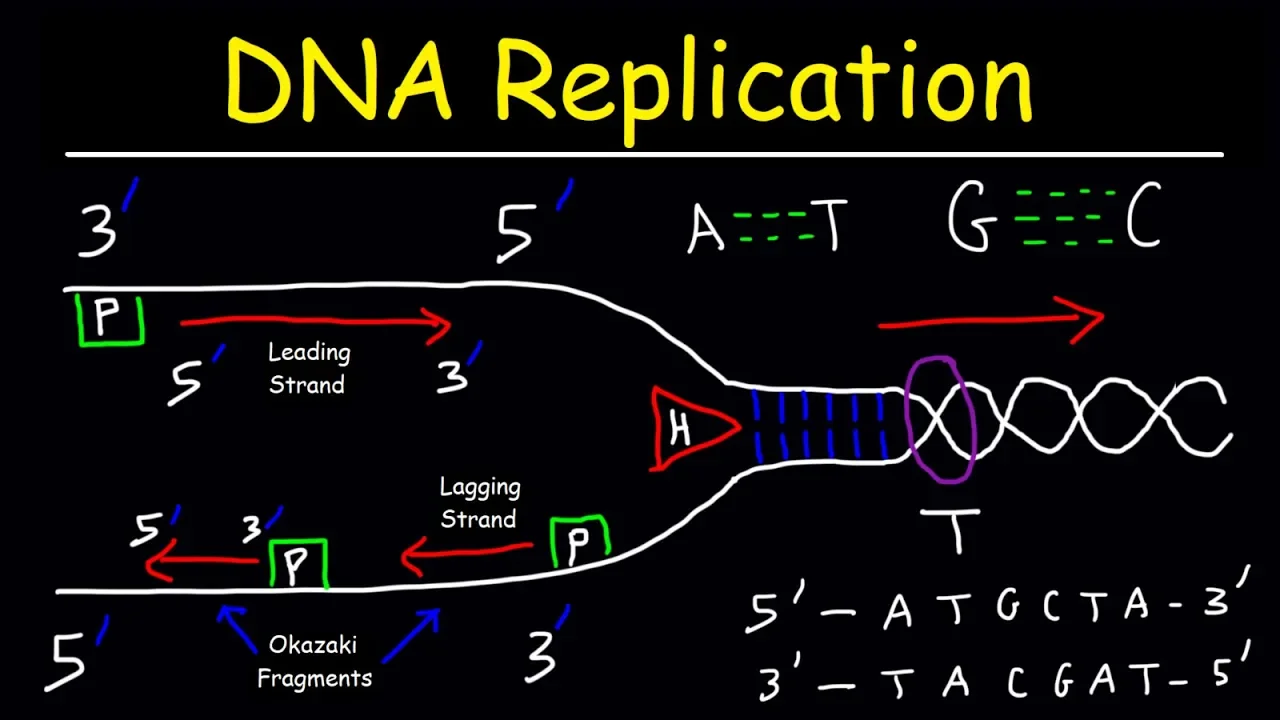
pairing in dna now the next thing you need to know are what holds nucleotides together and the answer is hydrogen bonds between adenine and thymine there are two hydrogen bonds and you need to know that between guanine and cytosine there are three hydrogen bonds holding them together so those h bonds are holding the dna strands together now there's a lot of other stuff that we need to talk about one of which is that dna replication usually proceeds bi-directionally so what does that mean well let me draw a picture that will illustrate this concept so this
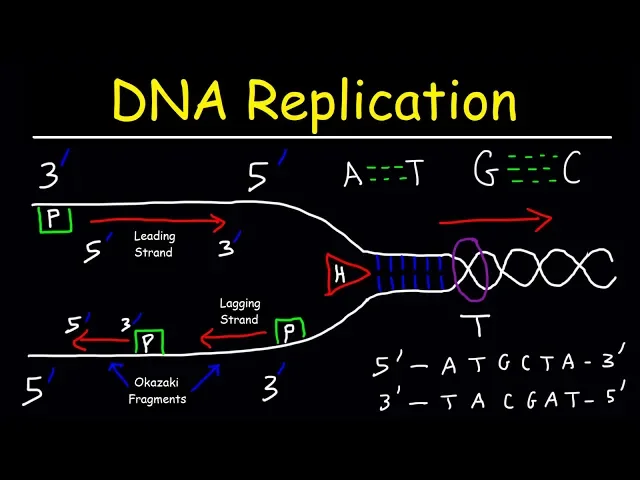
bubble that you see between the two strands that is the origin of replication in red this is a new strand being produced now in bi-directional dna replication the strands can be produced in both directions by means too now another example of replication is unidirectional replication so that occurs when the strand is being synthesized in one direction so here's a picture of the replication fork that i decided to draw ahead of time and the first thing that we're going to talk about is the helicase enzyme helicase separates the two strands and it does so by breaking
the hydrogen bonds that hold the nucleotides together as helicase separates the two strands torsional strain is created ahead of the replication fork and as a result an enzyme is needed dna gyrase which is a type of topoisomerase and these types of enzymes they can reduce the torsional strain and even relieve positive supercholine that could form in the dna strand ahead of the replication fork so i'm going to put t for a topoisomerase enzyme so you might see dna gyrus here as well but keep in mind that dna gyrase is a type of topoisomerase enzyme next
we have the ssb proteins the single stranded binding proteins these ssb proteins they protect the two strands from cleavage they also stabilize the two strands preventing them from snapping back together now dna replication requires an rna primer to begin so i'm going to draw the rna primer in green the rna primer is basically a sequence of rna nucleotides dna polymerase 3 once it sees the rna primer it begins to synthesize the new strand in the 5 to 3 direction this strand here is called the template strand and that strand runs in the three to five
direction but dna i mean dna polymerase three is going to build the new strand in the five to three direction so make sure you understand that dna polymerase 3 adds nucleotides in the 5 to 3 direction now the enzyme that creates the primer is known as primase now dna replication is semi-discontinuous now what does that mean what does it mean that dna replication is semi-discontinuous well we need to talk about the other strand so the first template strand on top runs in a three to five direction which means the template strand on the bottom runs
in the five to three direction dna polymerase iii only adds nucleotides in the five to three direction so once a primer is added to this strand dna polymerase 3 is going to work in this direction that is in the 5 to 3 direction now notice that this strand this strand by the way is called the one in red this is called the leading strand and this one here is called the lagging strand the leading strand moves in the same direction as the replication fork the lagging strand moves in the opposite direction of the replication fork
so as the replication force continues to move forward you're going to have more space here so what's going to happen is a new rna primer is going to join here and then dna polymerase is going to start there producing or adding nucleotides in this direction so in the leading strand dna is synthesized continuously it only needs one primer to start and it just keeps on going it follows the replication fork on the lagging strand it doesn't synthesize a new strand continuously the replication is discontinuous as you can see here with that uh that empty space
so that's why dna replication is said to be semi-discontinuous it's continuous in the leading strand but discontinuous in the lagging strand the prefix semi means half so it's half continuous half discontinuous so technically you could say semi-discontinuous or semi-continuous both words will accurately represent dna publication now dna polymerase 1 removes the rna primer and replaces it with dna so after replication when it's almost finished this part this rna primer gets removed and so i'm gonna replace that with a red color so it's been replaced by dna polymerase one whoa i mean dna polymerase one replaces
the rna primer with dna material now once that happens you're going to have some spaces in between by the way these fragments are called okazaki fragments hopefully i spelled that correctly now another enzyme called dna ligase seals the nick between the okazaki fragments and so there you have dna replication so that's the whole process there now some other things that you want to know is that dna polymerase one and three they have three to five exonuclease activity an exonuclease enzyme is an enzyme that can remove nucleotides from a strand starting at one end of the
strand so this three to five exonuclease activity it describes the proofreading ability of these two enzymes so when dna polymerase iii is synthesizing a new strand if it makes a mistake it can stop remove the wrong nucleotide and replace it with the right one so that would be the proof reading ability of dna polymerase three now dna polymerase one not three has the five to three exonuclease activity which plays a role in dna repair so those are some things that you want to know with regard to dna replication so just to review dna ligase is
the enzyme that seals the nix between okazaki fragments and then dna polymerase one is the enzyme that removes the rna primer and replaces it with dna material prior to ligase cylinder nyx and then also dna polymerase 3 is the enzyme that builds the new dna strand during elongation so make sure you understand the functions of those enzymes and so that's basically it for dna replication now let's work on some practice problems for the sake of review feel free to pause the video if you want to try this mini quiz number one which of the following
statements is false so let's look at a dna replication is semi-conservative would you say that's a true statement or a false statement now that statement is true dna replication is semi-conservative if we recall we start with an odna strand and once we create two copies each copy will have one old dna strand and each copy will have one new dna strand so it's semi-conservative in that each new copy has one o strand and one new strand some other ideas of dna replication are conservative and dispersive replication now b helicase is the enzyme that separates the
two dna strands during replication is that true or false so that is also a true statement helicase is the enzyme that breaks the hydrogen bonds between the nucleotides that are holding the two strands together and that's how it separates them during replication here is a visual illustration of that so here are the hydrogen bonds holding the two strands together and here is helicase which is about to break those hydrogen bonds this is going to open the dna strand and separate into two parts now dna replication is continuous is that true or false so this is
a false statement dna replication is semi-discontinuous or you could say semi-continuous the leading strand is produced continuously in the direction of the replication fork the lagging strand is produced discontinually in the opposite direction of the replication fork because the leading strand is produced continuously and the lagging strand is produced discontinuously overall dna replication is said to be semi-discontinuous so we know the other statements must be true dna polymerase iii adds nucleotides on the leading strand in the five to three direction and e okazaki fragments are short sequences of nucleotides found on the luggage strand during
replication so these would be the okazaki fragments so the answer for this problem is c and that is the false statement number two which of the following enzymes is used to reduce torsional strain during dna replication is it helicase primase dna ligase dna polymerase 1 or topoisomerase what would you say so feel free to pause the video to work on it so we know the answer is not a as we said before helicase is the enzyme that breaks the hydrogen bonds thus separating the two strands so a is out primase is the enzyme that synthesizes
the rna primer representing green ligase is the enzyme that seals the nicks that are formed in between the okazaki fragments so ligis will be here dna polymerase 1 is the enzyme that removes the rna primer and replaces it with a dna material the answer is e the topoisomer let me say that again the topoisomerase enzyme is the enzyme that relieves the torsional strain that is build up when helicase separates the two strands so e is the correct answer number three which of the following statements is false so let's go through each one one at a
time looking at answer choice a dna strands possess complementary base pairing is that true or false this is a true statement so if the first strand has let's say the nucleotide sequence a g t t g c a t g what's going to be the nucleotide sequence of the other strand it's going to run in the other direction a always pairs up with t c always pairs up with g so we'll get this sequence and so this is an example of complementary base parent and don't forget that there's two hydrogen bonds between adenine and thymine
and there's three hydrogen bonds between guanine and cytosine now b dna strands run in antiparallel directions that's the true statement if one strand goes in the five to three direction the other strand is going to run in the opposite direction so they're anti-parallel now looking at part c dna gyrase can reduce positive supercoils in dna replication that's also a true statement keep in mind dna gyrase falls in the category of topoisomerases i always have issues saying that word so dna gyrus a type of topoisomerase can reduce positive super coils and can reduce torsional strain ahead
of the replication fork in dna dna replication sometimes my words just don't flow smoothly off my tongue what can i say it just it happens now let's move on to part d ssb proteins or single-stranded binding proteins stabilizes the two dna strands prevented them from snapping back together that is a true statement so earlier in the video the ssb proteins were here and they prevent the two strands from snapping back together they also protect the strands from cleavage so keep that in mind and then e dna polymerase 3 has 3 to 5 and 5 to
3 exonuclease activity because it's the last one we know this has to be the answer so there has to be something false with this statement so what's the part what's wrong with that statement you need to know that dna polymerase one has both three to five exonuclease activity and five to three exonuclease activity dna polymerase iii only has three to five exonuclease activity it doesn't have the five to three exonuclease activity the three to five exonuclease activity has to do with the proof reading functions of dna polymerase 1 and 3. they can both do that
dna polymerase 1 can remove the rna primer and it can also function in dna repair this is due to the five to three x nucleus activity of dna polymerase one and so that's why e is false it's because dna polymerase iii doesn't have the 5 to 3 exonuclease activity