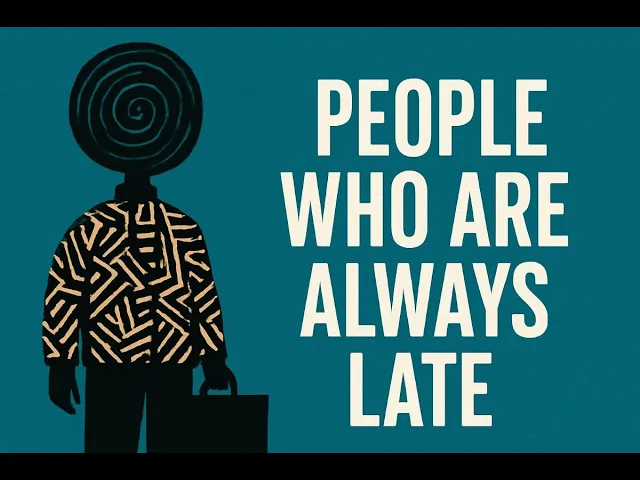
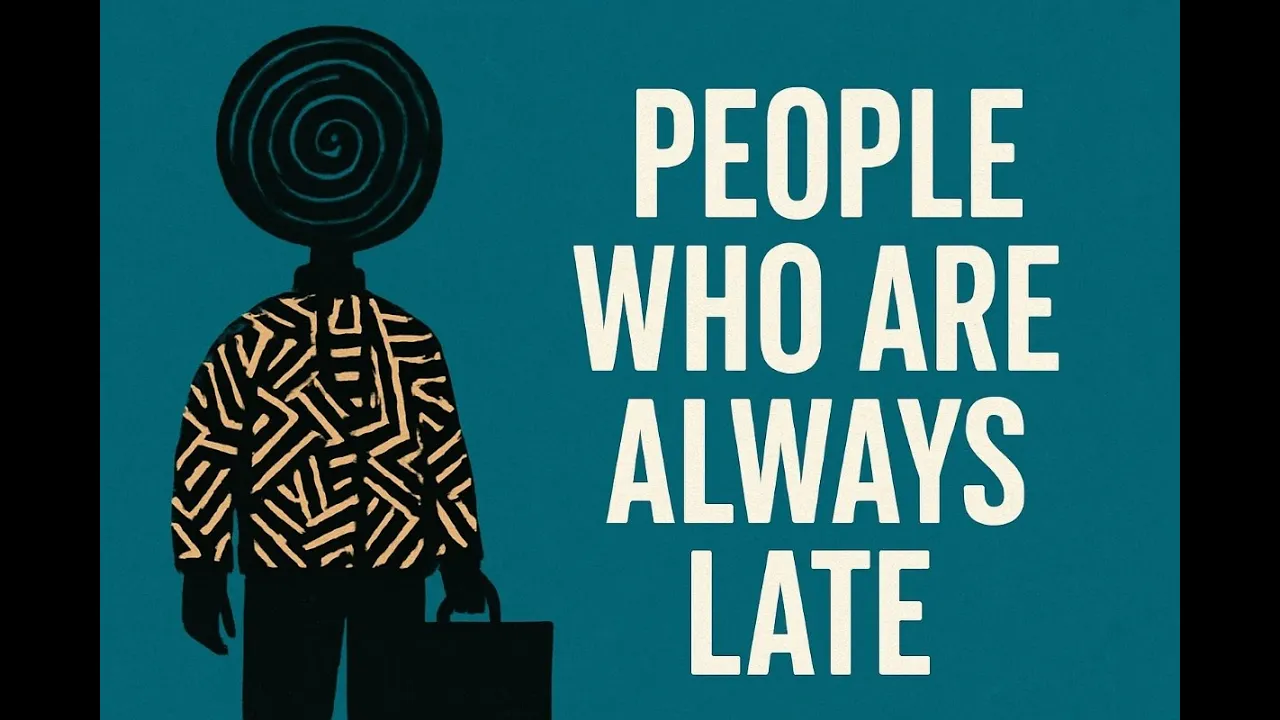
[music] There's a moment you've probably lived through without even realizing it. A moment when you were standing near a door or waiting at a table or checking your phone for the third time in 10 minutes and the person you were supposed to meet still wasn't there and you told yourself something quiet, something you didn't want to admit out loud. You said, "They're late again.
" And maybe you sighed. Maybe you smiled because you were used to it. Or maybe something inside you tightened just a little.
Because lateness is interesting. It's personal without trying to be. It's the kind of behavior that seems small on the surface, almost harmless, almost ordinary until you start noticing the pattern.
And what's strange is that everyone has a story about it. Everyone knows someone who is always late. And some people, if they're honest, are that person.
Here's [music] [music] the part most people never talk about. Lateness isn't really about time. Not at its core.
It's about psychology. It's about emotion. It's about identity.
It's a quiet reflection of how someone relates to the world, to themselves, and to the pressure of expectation. And if you lived long enough around people who show up late, not [music] once, not twice, but consistently, you've probably felt that something deeper is going on. [music] Because patterns don't build themselves, something builds them.
The truth is this. Chronic lateness has less to do with clocks [music] and more to do with invisible internal clocks that tick differently inside people. Some people move through life like they're racing a countdown.
Others move like time is a river that will always keep flowing, so there's no need to rush. And then there are people stuck somewhere between those extremes, where time feels like both a friend and a foe. And those are the people who are almost always late.
There's something almost poetic about the way time bends for them. They don't mean to cause inconvenience. They don't wake up thinking, [music] "Let me make someone wait today.
" Most of the time, they're fighting a silent battle inside. A battle that revolves around pressure, fear, avoidance, hope, and sometimes even a subconscious longing for a little more space, [music] a little more comfort, a little more room to breathe before facing the next thing life is asking from them. And if you really want to understand these people, you have to pause and imagine what their morning feels like.
Imagine someone waking up thinking they have more time than they actually do. They get ready slowly, talking to themselves about what they need to do. They tell themselves they'll finish everything just in time.
[music] But then they remember an email, a message, a small task they forgot yesterday, and [music] they think it'll take only a minute. But time doesn't work the way they imagine it. Their internal estimate is almost always off, not because they're careless, but because their brain calculates time based on intention [music] instead of reality.
Psychologists sometimes call this emotional miscalculation. It's when someone estimates time not by what will happen, but by what they wish would happen. It's like planning a trip based on the perfect scenario where nothing slows you down.
[music] No traffic, no interruptions, no distractions. But life rarely gives anyone perfect conditions. People who are always late usually live inside that hopeful version of reality.
[music] They think the world will cooperate today, even if it hasn't cooperated in the last 100 days. This isn't irresponsibility. It's optimism.
Sometimes too much of it. Yet, that's only one layer. There's also something else happening inside them, something deeper.
Many people who are habitually late struggle with emotional transitions. When they're doing something they like, it's hard to pull themselves away. When they're doing something stressful, it's hard to begin the next task.
Starting and stopping both require mental energy. And for some people, that shift feels heavier than others realize. You might think, "But everyone struggles with that.
" And you're right. But for some people, that struggle isn't a moment. It's their entire day.
Imagine living in a world where every transition feels like a small emotional negotiation. Getting out of bed, leaving the house, finishing a conversation, ending a task, starting the next one. [music] Each moment feels like it needs a breath, a delay, a second attempt.
And those seconds over time grow into minutes, then 10 minutes, then 20. And before they know it, they're late again. So when someone says, "I didn't mean to be late," they're usually telling the truth.
They genuinely didn't. But this doesn't make lateness easier for the people waiting because lateness has a social weight. It feels personal even when it isn't meant to be.
It feels like a tiny broken promise. [music] Even when the intention was good. And yet, if you look closer, the psychology of lateness often comes from the opposite of disrespect.
It comes from self-p pressure. It comes from overcommitment. It comes from fear of disappointing someone.
It comes from trying to do too much in too little time. It comes from wanting to be everything to everyone and forgetting that time is a limit no amount of kindness can stretch. Some people who are always late are perfectionists.
They tweak a small detail before leaving. They adjust something one more time. They want to show up prepared, presentable, ready.
But that extra detail costs them minutes. and those minutes cost them punctuality. Their lateness isn't lack of care.
It's actually too much care directed in the wrong moment. [music] Others are emotional avoiders. If an event makes them nervous, they delay.
If a meeting feels heavy, they move slower. If a situation feels overwhelming, their mind tries to protect them by stretching the time before they face it. Not consciously, not intentionally, is a quiet psychological defense.
a soft buffering of reality. Then there are dreamers, people who move through life with big [music] thoughts and wandering minds. They lose track of minutes because their imagination is louder than the clock on the wall.
They forget time not because they don't value it, but because they're pulled into ideas so easily. They live more in inner worlds than outer schedules. And then there are the emotionally overloaded individuals.
The ones who carry too much on their plate, too many responsibilities, too many pressures, too many expectations from others. Their day is a long list of obligations that pile up. And lateness becomes an unintentional side effect of trying to hold everything together.
They're not late because they don't care. They're late because life is pulling them in 20 directions at once. And if you've ever watched someone like this rush out the door, breathless, apologizing, promising to do better next time, you might notice something in their eyes, a mixture of guilt and exhaustion.
They're trying. They really are. But time keeps slipping.
And here's something personal you might relate to. Sometimes the people who are always late grew up in environments where time didn't matter as much. Maybe the household was chaotic.
Maybe routines didn't exist. Maybe clocks were suggestions, not rules. So as adults, they continue living in that soft, flexible version of time.
Not because they choose to, but because that's the rhythm they learned. Other times, lateness is emotional rebellion. Not dramatic rebellion, quiet rebellion, the kind where someone grows up feeling overly controlled or constantly monitored or pressured to meet everyone's expectations.
And as adults, they reclaim control in the only safe way they know. By dragging time a little, by resisting the schedule without openly resisting it, lateness becomes a small whisper of independence. Then there are people for whom [music] lateness is tied to selfworth.
They underestimate how long things take [music] because they underestimate themselves. They think I can do this quickly when deep down they fear they can't. They rush into too many tasks.
They stretch themselves thin. They stand in front of the mirror fixing small imperfections [music] because they worry about being judged. They try to do everything perfectly and end up doing everything late.
And maybe, if you're honest, you've seen parts of yourself in these descriptions. Or maybe you felt the frustration on [music] the other side of it. Maybe you've waited for someone you care about and wondered why they can't just be on time.
[music] Or maybe you're the one who walks in apologizing, feeling like you're arriving not just [music] late, but already behind in life. But the deeper truth is this. People who are always late usually [music] don't value being late.
They value something else more. Comfort, care, approval, calm, escape, imagination, or quiet emotional processing. Time becomes the thing they sacrifice to protect those [music] deeper needs.
But there's another layer, one most people never realize. People who are always late [music] often live in a state of micro optimism. They believe they can do more in less time than reality allows.
They believe things will go smoothly today. They believe traffic won't be bad. [music] They believe they can fix one more thing before leaving.
They believe this time will be different. [music] And it's ironic because this optimism, while charming in many areas of life, becomes the exact reason they fall behind schedule. [music] Their relationship with time becomes a cycle.
hope, underestimation, rush, [music] regret, repeat. And this cycle creates a quiet emotional burden because behind every apology, behind every late arrival, [music] behind every I'll do better next time, there's a quiet self-criticism forming inside [music] them. They feel disappointed in themselves.
They feel embarrassed. They feel frustrated. And sometimes they even feel misunderstood because their lateness has nothing to do with how much they care.
And here's where it gets even more interesting. [music] Many chronically late individuals are actually incredibly reliable in deeper ways. They show up emotionally.
They show up when someone needs them. They stay up late helping a friend. They remember birthdays.
They care intensely. Their punctuality doesn't reflect their loyalty. It reflects their internal rhythm, not their internal values.
But time doesn't see intention. Time sees action. And so these individuals end up caught between who they truly are and how their behavior makes others feel.
[music] And if you peel one more layer back, there's something else hidden beneath the surface. Many people who are always late genuinely believe they can change. [music] Every time they walk out the door late, they tell themselves, "Next time I'll get it right.
" [music] And that hope keeps them trying. It keeps them optimistic. But until they understand the psychology underneath their lateness, time continues slipping through the cracks.
[music] Now, here's the part no one talks about. There's a reason lateness feels so emotional, both for the person who is late and the person waiting for them. [music] Time is one of the most respectful gifts we can give someone.
It's limited. It's irreplaceable. [music] And when someone is late, even unintentionally, it feels like a tiny imbalance in that exchange.
Not a betrayal, just a misalignment. [music] But the deeper truth, lateness is rarely about disrespect. It's about a mind trying to protect itself or catch up or stretch reality or stay comfortable or avoid discomfort or live at a pace that feels natural to them.
And the world doesn't always understand that. [music] And that's where the real story begins. But if you really look closely at people who are always late, you'll notice something else.
something subtle, something [music] quiet, something hidden behind their rushed footsteps and hurried apologies. Lateness often reveals how they cope with the emotional texture of life. Some people experience the world as a series of gentle steps.
[music] Others experience it as waves, and those who are always late often live in waves, [music] moments of intensity, moments of calm, moments of overwhelm, moments of escape. Their timing doesn't follow the clock. [music] It follows their emotional rhythm.
This is why trying to fix lateness by simply telling someone to set an alarm earlier [music] rarely changes anything because the issue isn't the alarm. It's the internal landscape that person is navigating. It's [music] the weight of their thoughts, the pressure they feel, the way their nervous system responds to expectations.
[music] For some, time feels like a race. For others, time feels like a suggestion. [music] And for people who are always late, time often feels like a story they're trying to rewrite.
Moment by moment, [music] hoping today will be the day it finally bends in their favor. Imagine someone preparing to leave the house. [music] They look at the clock.
They know they need to go, but then something happens internally. A thought appears. A distraction pulls them.
A task they forgot yesterday suddenly demands their attention today. Their mind whispers, "You can finish this quickly. " And then 5 minutes pass, 10 minutes pass.
The clock keeps moving, but their awareness drifts. This drift [music] isn't carelessness, it's emotional absorption. When they get pulled into something, they fall into it completely.
Time disappears because their focus is intense, [music] even if the task is small. Then the moment arrives, the realization, [music] the sudden hit of awareness, I'm going to be late. Their chest tightens a little.
They move faster. They rush out the door. Their mind goes into urgency.
And in that moment, they promise themselves again, like they've promised countless times before that [music] they'll do better next time. And the cycle repeats. But if you gently look underneath this [music] cycle, there's often an emotional belief hiding there, something they've never said out loud.
[music] Some people who are always late feel uncomfortable with being early. It feels awkward. It feels like wasted time.
>> [music] >> They worry that being early will make them look too eager or out of place or like they don't have enough going on. Being just on time feels perfect, so they try to time things perfectly down to the minute. But perfection is fragile.
One small delay is enough to break that balance. [music] Others have a very different relationship with time. They don't see minutes as units.
They see them as moments. They live inside experiences, not schedules. They don't notice minutes passing because their attention is completely wrapped inside whatever they're doing.
Their mind doesn't measure time linearly. [music] It measures time emotionally and emotional time doesn't always align with the clock. And some people are late because their days are built around survival, not structure.
When your mind is juggling stress, responsibilities, worries, [music] and expectations, time slips faster. When you're constantly mentally overloaded, your sense of time becomes blurry. A mind under pressure doesn't track minutes the same way a calm mind does.
[music] It's not avoidance. It's cognitive overwhelm. And then there's the part of lateness people rarely admit.
Fear plays a role, too. Not dramatic fear. [music] Soft fear, the kind that whispers rather than shouts.
Fear of being judged when they walk in. [music] Fear of awkward moments. Fear of starting something, fear of committing to a task, fear of disappointing someone, [music] fear of being noticed, fear of not being enough.
For some people, lateness becomes a protective delay, a buffer between themselves and the moment they're walking into. [music] It's interesting how time becomes an emotional shield, not consciously, just instinctively. And there's another side to this, one most people never think about.
Some chronically late individuals use time to create space for themselves, space to think, space to breathe, space to finish what they feel they must, space to calm their thoughts before stepping into a situation that feels unpredictable. Their lateness becomes a way of managing their internal world before facing the external one. And if you've ever met someone who is consistently late, you may notice something else.
They often have beautiful qualities hidden beneath their struggle with timing. They may be deeply creative. They may be incredibly empathetic.
They may be the kind of people who lose themselves in conversations and forget the world around them. They may be dreamers who see life in colors, textures, and possibilities rather than numbers and deadlines. They're often warm, thoughtful, imaginative, and emotionally expressive.
Time slips for them because they're immersed in the richness of the moment. But here's the thing. Just because lateness has psychological roots doesn't mean it's harmless.
And many late individuals know this. They feel the consequences, the embarrassment, the guilt, the subtle tension it creates with people they care about. They feel responsible for it even when they don't fully understand why it keeps happening.
This inner conflict creates a kind of emotional exhaustion because being consistently late isn't relaxing. It's stressful. It's a rush of adrenaline.
It's a constant feeling of catching up. It's the weight of apologies. It's the worry that others might misunderstand their intentions.
It's the fear of being seen as unreliable, [music] even though in deeper ways they are incredibly dependable. And if you look closely at their life, you'll often find a recurring pattern. They're not usually late to things that bring them relief or excitement.
They're late to things that bring pressure, expectation, or emotional weight. The more emotional energy something demands, the more likely they are to delay the moment they have to face it. Even if it's something positive, even if it's something they want.
This emotional delay isn't a flaw. It's a coping mechanism, a quiet way of managing their inner world. And here's something else that may surprise you.
People who are always late often have a distorted relationship with future time. Their mind believes the future is more spacious than it actually is. They think they will have more time later, more energy later, more clarity later, more motivation later.
This belief makes them overcommit, overpromise, and underestimate the time required for even simple tasks. It's not a lack of responsibility. It's an overestimation of their future selves.
Many psychologists call this planning fallacy, but in everyday language, it simply means they think tomorrow will be a better version of today. And that hope while [music] comforting becomes a trap because when tomorrow arrives they are still the same person with the same habits, the same emotions, the same struggles with transitions and pressure and perfectionism. But something important shifts once someone begins to see their own patterns clearly.
When they realize that lateness isn't about clocks, it's about the stories they tell themselves, the emotional beliefs they carry, the invisible pressures they feel, the sense of responsibility they hold, the quiet avoidance they never named, the perfectionism they try to hide, the hope they cling to, the overwhelm they struggle to manage. Understanding this doesn't magically fix everything, but it gives compassion to a behavior often misunderstood. And compassion is the beginning of awareness.
Awareness is the beginning of change. Imagine someone who has been late their whole life suddenly realizing why the patterns, the emotional triggers, the internal stories. [music] They begin to see how their mind estimates time, not based on minutes, but based on how they feel about those minutes.
They see how their transitions require more emotional energy than they realized. They see how they stretch time to protect themselves or avoid discomfort or calm their thoughts or hold on to moments they don't want to leave. Understanding this creates a shift, a quiet one, [music] but a powerful one because now instead of fighting themselves, they can work with themselves.
Instead of telling themselves, "I just need to try harder. " They can tell themselves, "I need to understand what makes time feel for me. " Instead of forcing punctuality through pressure, they can build it through self-awareness.
Instead of seeing lateness as failure, they can see it as a signal, something that reveals where their emotional friction lives. And if you've ever struggled with lateness or loved someone who does, there's something important to remember. People who are always late usually carry more internal weight than they show.
Their lateness isn't a reflection of disrespect. It's a reflection of where their emotional world and the structure of time collide. And maybe this is why lateness feels so human because it touches the part of us that struggles to keep up.
The part of us that feels overwhelmed. The part of us that gets lost in thought. The part of us that avoids discomfort.
The part of us that hopes for better days. The part of us that overestimates what we can handle. The part of us that fears being judged.
The part of us that longs for a few extra moments before facing the next chapter of life. But something powerful happens when someone who is always late begins to understand themselves. They start finding patterns in their own behavior.
They notice which moments make time slip. They realize they rush most when they're trying too hard to be perfect. They notice they delay most when they feel anxious.
They see that their timelind optimism, while gentle and hopeful, often works against them. They begin to understand why the last 10 minutes before leaving always get lost. They begin to see how emotionally difficult transitions shape their timing more than any schedule does.
And once awareness enters, small changes begin to grow. Not because someone forced them, but because the person finally understands themselves. And understanding creates a new relationship with time.
One where they begin asking, "How do I feel right now? " instead of, "Why can't I do this right? " They begin preparing earlier, not out of fear of being late, but out of compassion for their future self.
They begin noticing the moments that trigger avoidance and gently work through them. They begin telling themselves the truth. I need more time than I think.
They begin planning not from optimism, but from reality. And slowly something shifts. People who were once always late begin arriving on time for things that matter.
Not because they changed their nature, but because they learn to work with their nature. They understood that time isn't an enemy. It's a partner, something to align with, not chase.
They stop making promises to be perfect. Instead, they make promises to be present. [music] And that changes everything.
Because when you understand your relationship with time, you understand a part of yourself that most people never examine. You understand your fears, your habits, your emotional rhythms, your pressure points, your self-beliefs, your hidden hopes. And something even deeper happens.
You begin to notice that people who are always late aren't flawed. They're human. Their lateness is a reflection of the part of all of us that struggles to align our inner world with the outer world.
The part of us that wants to slow life down. The part of us that wants to hold on to moments. The part of us that feels overwhelmed by expectations.
The part that wishes time would give us more space to breathe. And maybe that's why lateness is so relatable. Because even if you're not the kind of person who is always late, you know what it feels like to fall behind in life.
You know what it's like to feel like time is moving faster than your heart can keep up. You know what it's like to rush into moments. You know what it's like to carry quiet guilt for not being the person you hoped you'd be.
You know what it's like to overestimate your future self. You know what it's like to hide your exhaustion behind a smile and a promise that you'll do better next time. Lateness is human.
It's emotional. It's psychological and it's deeply intertwined with the way we experience the world. But the beautiful part [music] is this.
No one is stuck. Not with time, not with habits, not with emotional patterns. Once someone understands the emotional meaning behind their lateness, they begin noticing opportunities to shift.
And the shift doesn't need to be dramatic. Small awareness creates small adjustments. And those adjustments create new rhythms.
New rhythms create new habits. And new habits create a new relationship with time. And maybe the most powerful part of all is this.
Punctuality isn't the real goal. The real goal is emotional clarity. It's understanding yourself in a way that gives you back control over your life.
It's knowing what you avoid, what overwhelms you, what triggers your optimism, what drains your mental energy, what makes transitions harder for you, and what makes them easier. It's learning how to be honest with yourself about your own patterns. Not from judgment, but from compassion.
Because time becomes more manageable when your emotions become more understood. And for the people who have spent their entire lives running a few minutes behind, there comes a day, a quiet day, usually unexpected. When they realize they're no longer living in that constant rush, they feel something new, something calm, something grounded.
They show up to something on time, not because they [music] forced it, but because they allowed themselves to understand the truth about their own rhythm. And maybe that moment becomes a turning point. Not a perfect one, not a permanent one, just a gentle shift in the story they've lived for so long.
Because at the end of the day, lateness isn't just about minutes. It's about self-awareness. It's about emotional patterns.
It's about internal stories. It's about the way someone moves through the world. And when someone finally sees themselves clearly, even time begins to feel different.
They start living not behind the clock, not ahead of it, but with it. Side by side, step by step, moment by moment. [music] And that alignment, soft, human, imperfect, is what changes everything.