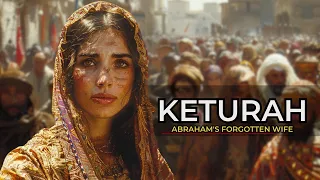
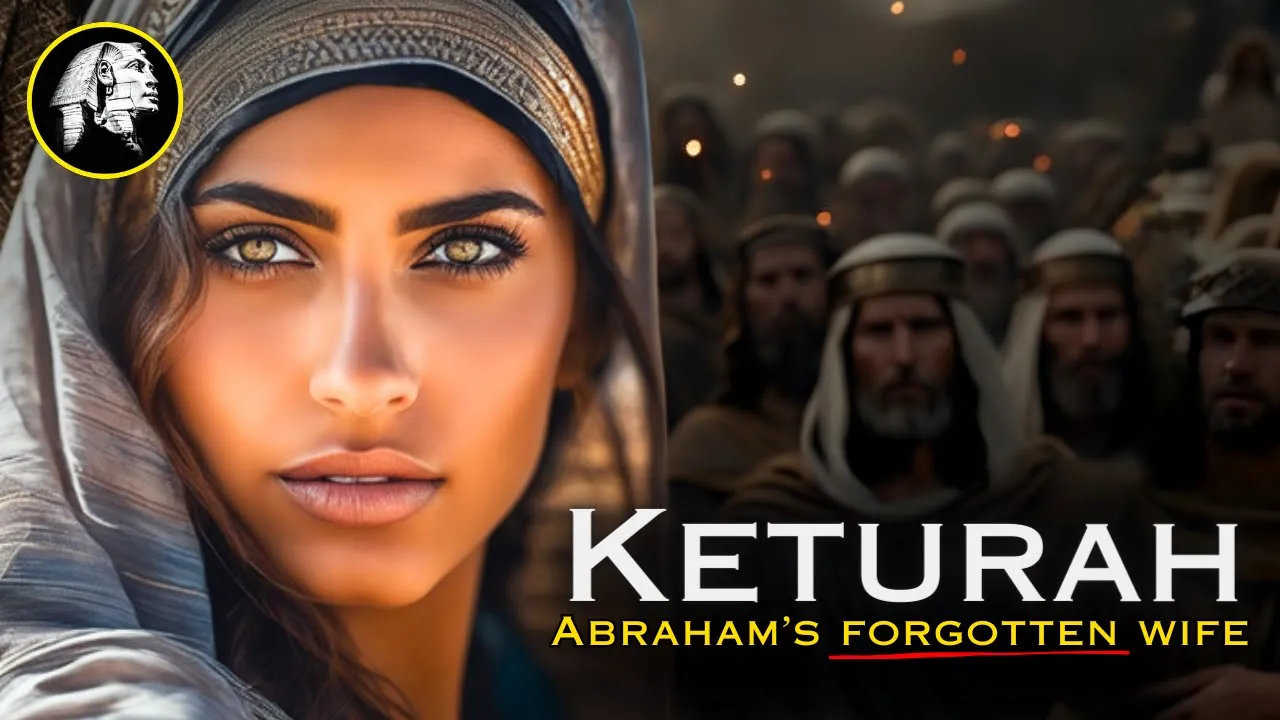
The Book of Genesis tells us that Abraham married another woman named Keturah after Sarah, his beloved wife, died. As it is written in Genesis 25. Abraham had taken another wife, whose name was Keturah.
Genesis 25:1-2 We will try to find out what really drove Abraham to marry another woman. And Did he marry her or did she have a concubine? Keturah is explicitly described as Abraham's concubine in the Book of Deuteronomy.
The sons born to Keturah, Abraham’s concubine:Zimran, Jokshan, Medan, Midian, Ishbak and Shuah. The sons of Jokshan:Sheba and Dedan. 1 Chronicles 1:32 Their names stand for groups of people who lived in the Land of Israel and the Arabian Peninsula.
Many commentators argue about whether Keturah is Hagar or another woman. According to the Book of Chronicles, it's clear that Keturah and Hagar were concubines of Abraham. Looking at the family tree of Abraham and Keturah and considering what's in the Book of Chronicles, the children of Keturah were involved in trading goods like spices and gold internationally.
Even though the Bible doesn't say where Keturah came from, it gives details about Abraham's other wives, like Sarah Abraham's brother's daughter, and Hagar the Egyptian woman. Keturah, on the other hand, stays quiet in the Bible, and there's no detailed description of her. Whether Keturah is Hagar or not, the argument ends with the words in Genesis chapter 25.
But while he was still living, he gave gifts to the sons of his concubines Genesis 25:6 It appears Abraham had more than one concubine, Hagar, and Katorah, as indicated by the plural word concubines. There are several interpretations of why Abraham married another wife after Sarah died, and why he had so many children with her. Let's return for a moment to the verse where Abraham distributes the blessings and gifts to his sons to understand the first interpretation: Abraham left everything he owned to Isaac.
But while he was still living, he gave gifts to the sons of his concubines and sent them away from his son Isaac to the land of the east. Genesis 25:5-6 According to the scriptures, all the property was given to Isaac only after the sons of Abraham and Katorah were born. Next, the sons of Katorah were given gifts, and Abraham sent them to wander.
What is the reason for Abraham not giving everything he owned to Isaac before Keturah's child was born? Are there any reasons for the wait? After Isaac's binding, Abraham was worried and took care to find his son a wife.
Isaac brought her into the tent of his mother Sarah, and he married Rebekah. So she became his wife, and he loved her, and Isaac was comforted after his mother’s death. Genesis 24:67 According to the biblical story, several years go by, and Rebekah isn't having kids.
This worries Abraham because he's well aware of the problem - barrenness - and the risk of his family line not continuing. So, Abraham decides to take action. He's worried about not having kids from Isaac and Rebekah, so he goes and marries Keturah as a backup plan.
And begets as many children from her as possible. If Rebekah has kids with Isaac, then the family line goes through Isaac. But if Rebekah doesn't have kids with Isaac, then the family line goes through Keturah's children.
Abraham married Keturah when he was 140 years old. His marriage to Keturah comes right after Isaac gets married to Rebekah. During the 20 years of Rebecca's barrenness, all the children of Abraham and Katorah are born.
Meanwhile, with the uncertainty about who will continue his family line, Abraham holds on to all his stuff. Then, Rebekah gets pregnant, and Esau and Jacob are born. It's only then that Abraham figures out Isaac is the one to carry on the family line.
Only then does he give everything he has to Isaac and send Keturah's children over to him. But why does Abraham question the promise from God that his family line would come through Isaac? This promise was made to Abraham when Hagar and Ishmael were sent away.
But then there's this event where Isaac almost gets sacrificed. After this event, Isaac almost gets sacrificed, which May proves to Abraham that the divine promise has changed. There is no repeated promise of a seed in the name of Isaac after Isaac's binding, but an inclusive and less focused promise: I will surely bless you and make your descendants as numerous as the stars in the sky and as the sand on the seashore.
Your descendants will take possession of the cities of their enemies, Genesis 22:17 Another interpretation of carrying another wife is found in the verse where the angel appears to Hagar and claims that He will be a wild donkey of a man; his hand will be against everyone and everyone’s hand against him, and he will live in hostility toward all his brothers. ” Genesis 16:12 Abraham realized he needed more sons who were like Ishmael in character. He loved all his sons, so he didn't bless Isaac as his successor, unlike how Isaac blessed Jacob or how Jacob blessed all his sons.
All of Abraham's sons, except Isaac, had something in common: they didn't form nations but lived in tribal societies, wandering in the desert. The angel announced to Ishmael that he would be a wild man with all his hands and all in him. That is, he will not be a partner in the resettlement of the world and its correction.
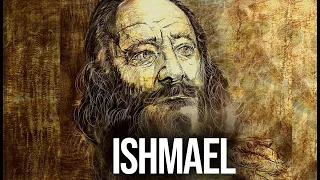
The verse then continues to emphasize that Ishmael will not live alone in the wilderness but in a wide family. "And on the face of all his brothers, he will dwell. " Later, Abraham was also informed of Ishmael's life.
Afterward, Abraham asked God if Ishmael would live and keep his inheritance, and God answered him: And as for Ishmael, I have heard you: I will surely bless him; I will make him fruitful and will greatly increase his numbers. He will be the father of twelve rulers, and I will make him into a great nation. Genesis 17:20 Thus, the seed of Ishmael will live in tribal societies and not in organized kingdoms headed by a king.
Ishmael did fulfill these prophecies: He lived in the desert and became an archer. While he was living in the Desert of Paran, his mother got a wife for him from Egypt. Genesis 21:20-21 Therefore, The children of Keturah were later sent to the deserts of the East by Abraham: But while he was still living, he gave gifts to the sons of his concubines and sent them away from his son Isaac to the land of the east.
Genesis 25:6 The sons of Keturah teamed up with their brother Ishmael. One of Keturah's sons, Midian, played a big role in starting the Israeli nation. Eventually, Ishmael and Midian mixed and became one nation.
After that, all of Keturah's sons lived like Ishmael, and that's why Midian's children are called 'Ishmaelites': Keturah's sons, as per the Bible, were the only ones, apart from Israel, who had to get circumcised. Many generations after the birth of the sons of Keturah, during Gideon's war, the Midianites fought Israel. When Gideon went down to the Midian camp, he understood their language, meaning their language was similar to Israel's.
Sons of Keturah are special and have a connection to Israel's holiness, which helps us understand their character and fate. We meet them in the tale of selling Joseph. So when the Midianite merchants came by, his brothers pulled Joseph up out of the cistern and sold him for twenty shekels of silver to the Ishmaelites, who took him to Egypt.
Genesis 37:28 Their name also shows up in Gideon's story about the spoils from the Midianites. “I do have one request, that each of you give me an earring from your share of the plunder. ” Judges 8:24 As a tribal life, the life of the desert is not a life of houses and vineyards, it is a life of wandering and transience.
Most of Abraham's descendants, except Isaac, choose this kind of life. Abraham himself led a wandering life, and this lifestyle has deep roots in his own way of living. As a father of many nations, not just his own tribe.
Abraham felt a strong connection to all creatures, no matter where they were, so he didn't settle in one place but kept moving. His main routes were as follows: Ur Kasdim to HaranHaran to the Land of IsraelLand of Israel to Haran (again)Haran to Alon MoraAlon Mora to Beth ElBeth El to EgyptEgypt to Bat ElBat El to HebronPersecution to Dan and DamascusDan and Damascus back to HebronHebron to GerarGerar to Be'er ShevaBe'er Sheva back to Hebron Abraham crossed borders and went to different countries because he believed it was his divine calling. This wandering lifestyle became the main way of life for his descendants, even the sons of Keturah.
They chose this life because they didn't want to tie themselves down to building a specific nation. The sons of Keturah and Ishmael preferred a nomadic life because they didn't want to be enslaved to cities and homes with all their materialism. It wasn't forced upon the son of Keturah; it was a choice.
The sons of Ishmael disliked the idea of being slaves to possessions, which they saw happening to city dwellers. Living freely in the wild allowed them to preserve their independence. The idea that his hand will be against everyone, and everyone’s hand against him, suggests a life of expansion.
As a result of such a life, Abraham's universality is preserved. Now we see that when the Midianites attacked Israel in Gideon's time, it wasn't about stealing and robbing. It stemmed from a deep ideological disagreement.
In Midianites view, Abraham's descendants, the Israelites, deviated from Abraham's path, while the Ishmaelites, the sons of freedom, were his true descendants. When Abraham sent Keturah's sons away from Isaac, he didn't designate a specific land but rather "to the land of the east" — which doesn't refer to a particular place but implies wandering. Abraham knew they wouldn't settle in one spot but roam through vast, uninhabited areas.
That's why the Bible emphasizes "to the land of the east," indicating a general direction, not a specific place. When Midian confronted Israel in their conflict with Gideon, they approached from an ancient region linked to the Land of Israel, as written in the Psalms. Do to them as you did to Midian, as you did to Sisera and Jabin at the river Kishon, who perished at Endor and became like dung on the ground.
Psalms 83:9-10 As a result of their general nature and methods of operation during Gideon's days of occupation, it is clear that if they had been success, they would have inherited God's promise. They conquest was reflected in the destruction of the land, not in its construction. It was their desire to live the nomadic lifestyle in the Land of Israel.
By doing so, they wanted to emulate Abraham, who wandered the land continuously. Israel's war against Midian reveals the truth. Midianites had a lot of property, meaning that in the end, they clung to material things, while the Israelites had less.
Abraham died at the age of one hundred and seventy-five, according to the Bible. His burial was attended by his sons Isaac and Ishmael, but the sons of Keturah were absent. perhaps they did not hear the news of their father's death due to their distant location.
It is possible that the sons of Keturah came to pay their last respects to Abraham afterward, but this is not mentioned in the scriptures. We hope you learned something new today! If you did, give this video a like and share it with your friends.
You can Share with us what you know by leaving a comment belowAnd don't forget to subscribe to our channel for more informative and entertaining content. Thank you so much and see you next time!