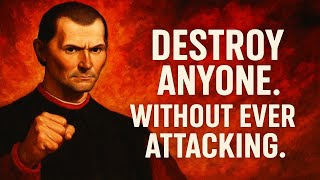
Hey warrior, look around you. The people who get respect aren't the nicest ones. The ones everyone listens to aren't the loudest.
The ones who always win aren't the smartest. They know something you don't. They learned a secret that's been around for over 500 years.
A secret from a man whose name became famous for influence itself. Nicolo Machavelli. Most people think influence is bad.
They're wrong. It's just a tool. And like any tool, it's not good or bad.
It's about who knows how to use it. Today, you'll learn the nine psychology weapons that make someone untouchable. These aren't feelgood tips.
These are the dark truths that separate those who manipulate from those who get manipulated. By the end of this video, you'll see why some people naturally command rooms while others fade into the background. You'll understand why certain people never get fooled and why they always get what they want through psychological manipulation.
Now, I want you to drop this affirmation in the comments. I choose power over being liked. But here's the catch.
Most people will watch this video, nod their heads, and change nothing. They'll go back to being victims of other people's manipulation games. Don't be most people.
Let's reveal the manipulation secrets. Number one, the mirror trap. Here's something that will blow your mind.
People don't fall for what's different from them. They fall for what's similar to them. Most people try to impress others by showing how special or unique they are.
That's exactly backwards. The real power move is becoming a perfect mirror of whoever you're dealing with. Think about it.
Who do you trust most? People who are just like you. Who do you feel most comfortable around?
People who share your values, your speaking style, your energy level. Makaveli said, "Men judge generally more by the eye than by the hand, for everyone can see and few can feel. " The mirror trap works because people's biggest obsession is themselves.
When you reflect their mannerisms, their pace of speaking, their interests, you become irresistible to them. How to become a human chameleon? If they lean forward, you lean forward 3 seconds later.
If they cross their arms, you do the same. If they speak slowly, you slow down your speech. This creates unconscious rapport.
Use their favorite words back to them. If they say awesome a lot, start using awesome. If they're formal, be formal.
If they're casual, match their energy. If they're excited about something, get excited, too. If they're concerned, show concern.
People want to feel understood, not challenged. Find out what they care about most and show genuine interest in those things. Don't fake it.
Find real connections to their interests. Once you've established this mirror connection, you can slowly start leading them in new directions. They'll follow because they trust you.
You're just like them. Watch how powerful people do this. They make everyone feel like they're talking to their best friend.
That's not accident. That's strategy. Number two, the scarcity illusion.
This is where most people get it completely wrong. They think being available makes them valuable. The opposite is true.
Being scarce makes you precious. Think about the most desirable things in your life. Are they the things you can get any time?
not they're the things that are limited, exclusive, hard to get. The same psychology applies to you as a person. The more available you are, the less people value you.
The more scarce you are, the more they want you. Makaveli said, "Since love and fear can hardly exist together, if we must choose between them, it is far safer to be feared than loved. But this isn't about being mean or rude.
This is about strategic scarcity that makes people respect your time and attention. How to create the scarcity illusion. Don't always be available immediately.
Even if you're free, sometimes say, "I can talk Thursday. " People value what they have to wait for. Don't give everyone your full attention all the time.
Save your deep focus for people and situations that matter. When you do give someone your complete attention, it becomes special. Don't be the person who's always on for everyone.
Have boundaries about when you're social and when you're not. Don't tell everyone everything about yourself right away. Let people discover layers of you over time.
Mystery is magnetic. Instead of texting back immediately every time, vary your response times. Sometimes respond quickly, sometimes take a few hours.
This creates uncertainty and uncertainty creates interest. The key is being inconsistent in your availability, not consistently unavailable. You want people to feel lucky when they get your time, not ignored when they don't.
People always want what they can't have. Make yourself something they can't always have. Number three, the emotional puppet master.
Most people try to control others through logic, arguments, or force. That's amateur hour. Real masters control through emotions.
And the person being controlled never even realizes it's happening. Every decision people make is emotional first, then justified with logic later. Control the emotion, control the decision.
Machaveli said, "The lion cannot protect himself from traps, and the fox cannot defend himself from wolves. One must therefore be a fox to recognize traps, and a lion to frighten wolves. Here's the secret.
You don't control people by forcing them to do what you want. You control them by making them want what you want. " the emotional states that control decisions.
People will do almost anything to avoid loss. Frame your requests around what they might lose, not what they might gain. Everyone wants to feel important and special.
Make people feel like heroes for doing what you want them to do. Humans can't resist incomplete information. Give them part of the story and let them fill in the blanks.
Nobody wants to be left out. Create the feeling that everyone else is already doing what you want them to do. People procrastinate unless there's a deadline.
Create time pressure, real or artificial. How to apply this ethically but effectively. Instead of saying you should do this, say I'm curious what you think about this approach.
Now they feel smart and consulted, not controlled. Instead of giving orders, ask questions that lead them to your conclusion. What do you think would happen if we tried this?
Let them think it's their idea. Instead of arguing when they disagree, acknowledge their point and redirect. That's a good point.
I wonder if there's a way to get the best of both approaches. The person who controls emotions controls everything. But the real power is that people enjoy being led when they don't realize they're being led.
Number four, the information asymmetry game. Information is power, but most people give away their power for free. They tell everyone everything they know.
They share their plans, their strategies, their weaknesses. Smart people collect information like squirrels collect nuts. They hoard it, protect it, and only share it when it benefits them.
Machaveli said, "Everyone sees what you appear to be. Few experience what you really are. This isn't about being secretive for no reason.
This is about understanding that knowledge is currency and you should spend it wisely. " The information collection system. Listen more than you speak.
Ask questions and actually listen to the answers. Most people are so eager to talk about themselves that they'll tell you everything if you just ask. Keep mental notes or actual notes about what people tell you.
Their fears, desires, problems, goals. This information becomes valuable later. When multiple people tell you things about the same situation, you start to see the real picture that no one else sees.
Pay attention to how people behave when they're stressed, excited, angry, or comfortable. These patterns predict future behavior. The information sharing strategy.
Share some useful information to encourage others to share with you, but always give less than you get. The same information can be worthless at one time and priceless at another. Learn to recognize the right moments.
Give people enough information to be helpful, but not enough to be dangerous to your position. Before any important conversation or negotiation, research the other person. Know their background, their current challenges, their recent wins or losses.
This gives you massive advantages in understanding how to approach them. Remember, the person with the most accurate information makes the best decisions. The person who makes the best decisions wins the most games.
Number five, the status elevator. Most people try to make themselves look good by making others look bad. This is stupid and shortsighted.
The real power move is making yourself look good by making others look good. When you elevate others, they become invested in your success. When you put people down, they become invested in your failure.
Machaveli said, "The first method for estimating the intelligence of a ruler is to look at the men he has around him. " Smart leaders understand that surrounding yourself with strong people makes you stronger, not weaker. Weak leaders surround themselves with weak people and wonder why nothing great ever happens.
Always give others credit for good ideas, especially in public. This makes them loyal to you because you made them look good. When someone makes a mistake, address it privately if possible.
Public humiliation creates enemies. Private coaching creates allies. Notice what people are good at and acknowledge it.
Everyone has something they're proud of. Find it and compliment it genuinely. Help others get opportunities they want.
When you become known as someone who helps people succeed, everyone wants to work with you. Introduce people to each other when it benefits them. Become known as a connector and people will share valuable information with you.
When you make someone look good, they associate those good feelings with you. When they think about you, they feel positive emotions. When they feel positive emotions about you, they want to help you succeed.
Choose carefully who you elevate. Elevate people who have potential to be valuable allies. Don't waste energy on people who can't or won't return the favor.
The most powerful people are those who have armies of people who want to see them win because those people know their own success is connected to that person's success. Number six, the inevitable force. Momentum is everything.
People want to join winning teams and avoid losing ones. Once people believe you're inevitably going to succeed, they start helping you succeed because they want to be on the winning side. Most people focus on their current problems and limitations.
Winners focus on creating the perception of inevitable success. Start with victories you know you can achieve. Each small win builds credibility for bigger claims.
Keep track of your improvements and share them strategically. People love to see measurable progress. Talk about your goals as if they're already decided, just not yet completed.
Instead of I hope to achieve this, say when I achieve this. Give specific timelines for your goals. I'll be doing this by next year sounds more inevitable than someday I want to do this.
Visibly build the tools, skills, connections, and resources needed for your goals. When people see you preparing, they believe you're serious. Don't hide your challenges.
Instead, present them as temporary roadblocks on an inevitable journey. This is just the next problem to solve on the way to the goal. Humans have a deep instinct to join likely winners.
When people believe your success is inevitable, they start investing in your success because they want to benefit from it. But this only works if you actually deliver on your promises. False inevitability gets exposed quickly and destroys your credibility forever.
The goal is to create a self-fulfilling prophecy. When people believe you can't fail, they help ensure you don't fail. Number seven, the dependency web.
Most people focus on being independent. That's good for personal strength, but bad for influence. Real power comes from making yourself the center of other people's success.
When people depend on you for things they value, you become irreplaceable. When you're irreplaceable, you have massive leverage. Machaveli said, "He who neglects what is done for what ought to be done sooner affects his ruin than his preservation.
" This means focus on what people actually need from you, not what you think they should need. Develop abilities that are valuable, but that others don't want to learn themselves. Become the go-to person for something important.
Become the person who knows what's happening and who connects people with the information they need. Gain access to or control over resources that others need regularly. Become known as the person who can solve difficult problems that others can't or won't tackle.
Build relationships with many different types of people. So you become a valuable connector. You want people to depend on you, but you don't want to depend heavily on any single person.
Create multiple income streams, multiple relationships, multiple options for everything important in your life. When you depend on one person for something critical, they have power over you. When multiple people depend on you for different things, you have power.
Become really good at something. your friends or community needs regularly. Maybe you're the person who can fix technology problems or plan events or give great advice about specific topics.
Build a network where you know people in different industries and situations. When someone needs help outside their usual circle, they come to you for connections. Develop rare knowledge or skills that are valuable, but that most people don't want to invest the time to learn.
The key is making yourself valuable without becoming a slave to other people's needs. You want to be helpful by choice, not obligation. Number eight, the reality architect.
Most people accept reality as it's presented to them. They let others define what's possible, what's normal, what's acceptable. That makes them followers, not leaders.
Leaders shape reality. They don't just respond to the world as it is. They influence how others see the world.
Makaveli said, "Men are so simple and so ready to obey present necessities that one who deceives will always find those who allow themselves to be deceived. " This isn't about lying or creating false realities. This is about understanding that perception shapes behavior and helping people see better possibilities, present situations in ways that emphasize the aspects you want people to focus on.
The same situation can be a challenging opportunity or a dangerous problem depending on how you frame it. When you do something new or different, present it as natural and normal. Don't apologize or ask permission.
Just do it confidently as if it's obviously the right approach. Use specific words and phrases that shape how people think about situations. The words we use determine how we feel about things.
Paint pictures of possible futures that inspire people to work toward those outcomes. People need to see where they're going before they'll start walking. Gradually change what's considered normal behavior in your environment.
Start with small shifts and build toward bigger ones. Instead of saying this is a problem, say this is an opportunity to show what we're capable of. Same situation, different reality.
Instead of asking permission to try a new approach, just try it and then share the results. Sometimes it's easier to ask for forgiveness than permission. Instead of accepting limiting beliefs others have introduce new possibilities, what if we could actually do this?
What would that look like? The person who controls the narrative controls the decisions. The person who controls the decisions controls the outcomes.
Remember, reality is more flexible than most people think. The people who understand this shape the world. The people who don't get shaped by it.
Number nine, the immortality strategy. Here's the ultimate secret that separates temporary influence from lasting power. Immortal influence comes from building systems and ideas that continue working even when you're not there.
Most people focus on personal power, being important, being needed, being respected. That power dies when you die or even when you leave the room. Real power comes from building something bigger than yourself that carries your influence forward forever.
Makaveli said, "Since love and fear can hardly exist together if we must choose between them, it is far safer to be feared than loved. " But here's the evolution of that idea. It's even better to be remembered.
Fear and love both fade. Systems and ideas last forever. Build processes, methods, or frameworks that solve problems reliably.
When people use your system, they're extending your influence. The ideas you put into other people's minds continue working long after you're gone. Your students become extensions of your influence.
Write down your insights, strategies, and lessons learned. Knowledge that exists only in your head dies with you. Knowledge that's documented lives forever.
Create groups, communities, or institutions that operate according to your values and vision. Organizations can outlive their founders by centuries. Focus some of your energy on people who influence others.
When you influence an influencer, your impact multiplies exponentially. Instead of just solving problems yourself, create solutions that others can use to solve similar problems. Instead of just succeeding yourself, help others succeed using your methods.
This serves two purposes. First, it multiplies your positive impact on the world. Second, it creates a legacy of people who benefit from your thinking and want to see your ideas succeed.
If you develop a great way to handle a common problem, document it and teach it to others. Now, dozens of people are using your method. If you build a successful approach to something, create a framework that others can follow.
Now, your thinking influences people you've never met. If you have valuable life lessons, share them in ways that others can learn from and apply. Your wisdom continues helping people long after you share it.
The most powerful people in history aren't remembered just for what they accomplished personally. They're remembered for the systems, ideas, and organizations they built that continued accomplishing things after they were gone. Think bigger than yourself.
Build something that lasts. You now possess the nine psychological weapons that have been used by the most influential people throughout history. But here's what separates those who learn these secrets from those who master them.
Immediate action. Knowledge without application is just entertainment. Right now you have two choices.
Choice one, close this video, feel good about learning something new, and change nothing. Go back to being influenced instead of being influential. Continue letting other people shape your reality while you react to theirs.
Choice two, pick one of these strategies and start using it today. Not tomorrow, not next week, today. Most people will choose option one.
They'll watch this video, maybe even share it, and then return to their old patterns of thinking and behaving. They'll wonder why nothing in their life changes while doing nothing to change it. But you're not most people, are you?
Choose the strategy that resonated with you most. Maybe it was the mirror trap. Maybe it was the scarcity illusion.
Maybe it was building systems that outlast you. Whatever it was, find one opportunity in the next 24 hours to apply it. Test it.
See what happens. These strategies work. They've worked for centuries.
They're working right now for people who understand them. The only question is whether you'll be someone who knows about them or someone who uses them. Remember the affirmation I asked you to post at the beginning?
I choose power over being liked. That wasn't random. Most people spend their entire lives trying to be liked by everyone and end up being respected by no one.
They're nice. They're agreeable. They're forgettable.
The people who shape the world make a different choice. They choose to be respected over being liked. They choose to be effective over being popular.
They choose to be remembered over being comfortable. What choice will you make for the next 30 days? Apply one of these strategies consistently.
Document what happens. Notice how people respond to you differently. Pay attention to how your influence grows.
Then come back to this video in 30 days and leave a comment about what changed because something will change. These principles are laws of human psychology, not suggestions. 500 years ago, Machaveli wrote about power and influence because he understood that these forces shape everything in human society.
The people who understand these forces control them. The people who don't understand them get controlled by them. You now understand them.
The question is what will you do with this knowledge? Will you use it to build something meaningful? Will you use it to help others while helping yourself?
Will you use it to create positive change in your world? Or will you let this knowledge sit unused while you continue living the same life you were living before you watched this video? The choice is yours.
But remember, choosing not to use influence is still a choice about influence. You're just choosing to let others influence you instead of learning to influence wisely. If this video opened your eyes to how influence really works, hit subscribe and ring the notification bell.
More content like this is coming and you don't want to miss it. Drp this affirmation in the comments. I choose power over being liked.
and share this video with someone who's ready to stop being a victim of other people's influence games and start playing at a higher level. Your future self, the one who commands respect, who gets what they want, who shapes reality instead of just reacting to it, is waiting for you to take the first step. That step starts now.
Welcome to real power.