In 1919, Ernest Rutherford first discovered the proton by bombarding nitrogen atoms with alpha particles, finding that oxygen atoms and protons were the resulting components of the bombardment. This experiment led to the total restructuring of the nucleus of the atom, and scientists now knew that it was possible to break the nucleus up, creating new combinations through bombardments with alpha particles. However, the process in which this happened was well beyond Rutherford's and others's control at the time.
The apparent randomness at which kinds of reactions happened was an issue Rutherford was eager to resolve. One of his biggest goals after his 1919 experiment was to find a way to aim specific atomic particles at others and according to the terminology of the time, transmutate elements into specific other elements, essentially enacting controlled modern alchemy. This was a task Rutherford did not set out to resolve himself, though.
Rather, he set two of his pupils, John Cochraftoft and Ernest Walton, on a mission to for the first time, breaking Adam apart, and they would successfully do so in 1932. John Cochraftoft was born in 1897 in Todd Mortyn, England. He received both his bachelor of science in electrical engineering and his master's degree from Manchester in 1920 and in 1922, respectively.
In 1924, he won a research scholarship and began his doctoral thesis at Cambridge under Ernest Rutherford. Cochraftoft completed his PhD the very next year with a thesis entitled on phenomena occurring in the condensation of molecular streams on surfaces. Ernest Walton, his future collaborator, was just a few years behind Cockraftoft.
He was born in 1903 in Dungarvin County, Waterford, Ireland. Walton received both his bachelor's and masters from Trinity College Dublin in 1926 and 1927 respectively. Immediately after graduating, he received the very same research scholarship won by Cochroft a few years prior and followed his exact same path.
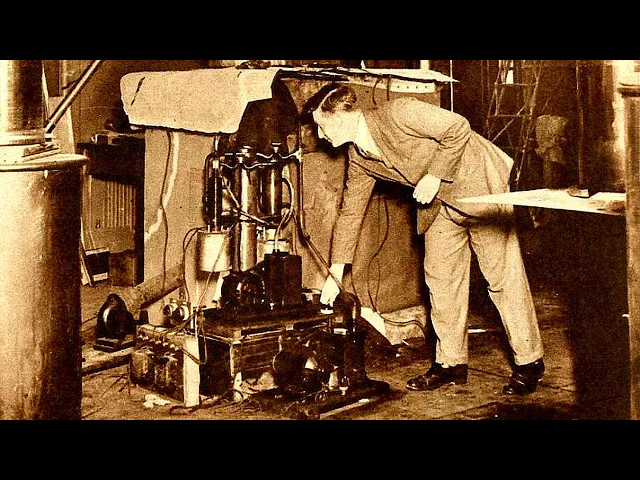
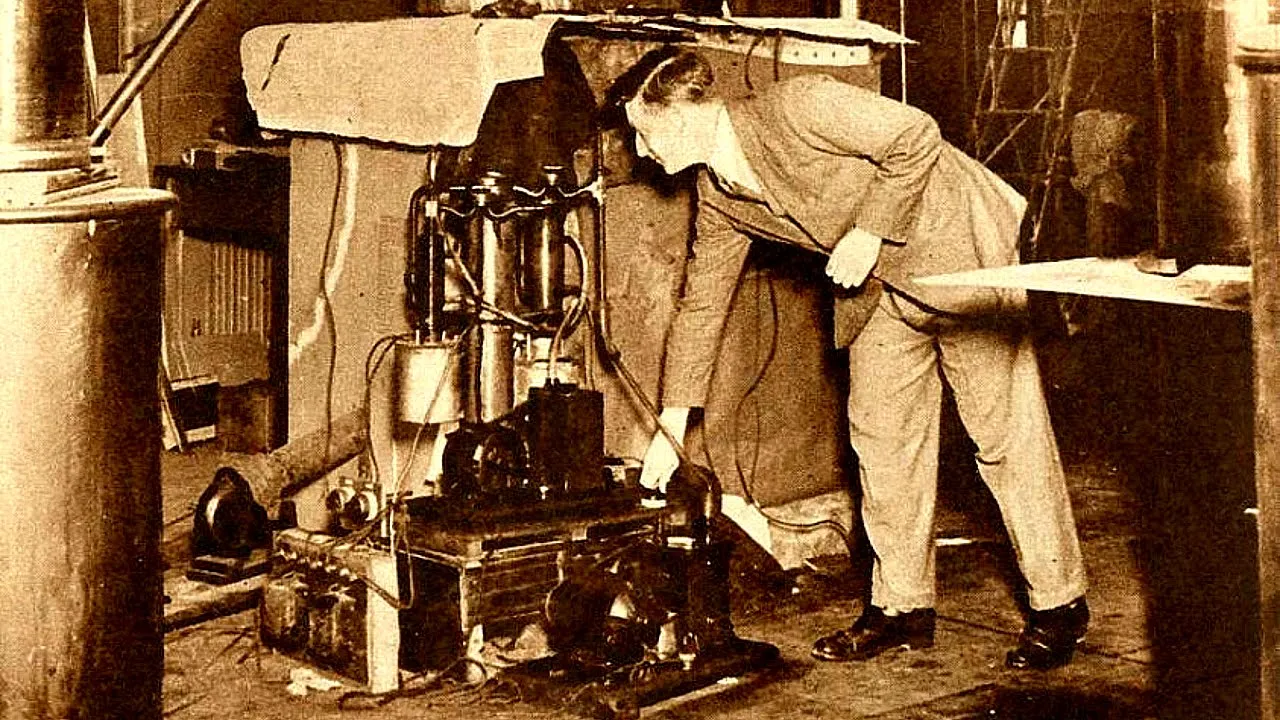
He completed his thesis under Ernest Rutherford, earning his PhD in 1931. The two of them would begin work with one another right upon Walton's arrival at Cambridge, beginning construction on a massive apparatus that would eventually be recognized as the world's first particle accelerator. The apparatus that Cochraftoft and Walton built was known at the time as a Cockrotof Walton generator, but when they first began concepts of building such a structure, they referred to it simply as a voltage multiplier.
The idea was to put a proton in a large tube and apply a massive amount of voltage to it, upwards of 500,000 electron volts. The amount of funding that the Caendish Laboratory had during the construction of this accelerator, though, was less than ideal. So, the two of them had to get creative and very efficient with their design if they wanted to even have a chance at gaining the ability to accelerate protons at will.
They started with generating an alternating current and used a series of rectifiers and capacitors arranged in stages to manipulate it. Rectifiers are electrical devices that convert alternating current into direct current. And capacitors are electrical devices that store energy via two close electrically charged plates insulated from one another.
Through their setup, they could multiply the voltage across the capacitors over and over to reach massive amounts of electrical potential. The issue though that arose from creating so much voltage was the fact that the insulation would start to break down and ruin the capacitors among other things. To build capacitors that were capable of withstanding 500,000 electron volts, they needed to be massive.
So, the two built massive isolated rectifiers and capacitors, eventually filling an entire room with their voltage multiplier. Protons would start at the top of the tube and would be launched down onto a target surrounded by a box protecting it from light from the outside. The entire process of constructing this accelerator, from primitive failed brainstorms to building the massive components, and then to working out the kinks, took several years.
and it wasn't ready to be tested until February of 1932. The first tests Cockraftoft and Walton used their voltage multiplier for were on quite a popular research topic at the time. They bombarded the element burillium with accelerated protons, hoping to find gamma rays released from them in order to advance studies first recorded from an experiment done by Frederick and Irin Julio Curi earlier that year.
However, they failed to replicate gamma rays. And upon the recognition that same year by James Chadwick that the emissions weren't gamma rays, but rather a new particle, the neutron, they switched their focus to splitting atoms. In April of 1932, they inserted lithium into the dark box and fired up the machine, directing a beam of protons toward it.
Upon looking at the centilation screen, Walton saw a bath of flashes indicating that massive amounts of alpha particles were hitting the screen. The exact reaction that occurred was as follows. A proton would hit a lithium atom, increasing its atomic weight from 7 to 8 and transforming it into an isotope of burillium.
This now unstable burillium isotope would undergo alpha decay, releasing an alpha particle. The leftover nucleus though is also an alpha particle. So bombarding lithium with proton beams produces a tremendous amount of alpha particles which is why Walton saw so many on the centilation screen.
Within 2 days of seeing this, Cochraftoft and Walton sent a letter off to nature entitled Disintegration of Lithium by Swift Protons. For the first time, the atom had been split through means of controlled accelerated atomic particles. The impact the Cockroth Walton generator had on the scientific community was immense.
Many replicas of it were built and used in major science labs in the coming decades with droves of scientists using it to advance their research in particle physics. 2 years after this invention, Walton withdrew from his cuttingedge research and returned to Trinity College in Dublin to be a professor. Teaching was his lifelong passion and he just so happened to be rather good at it.
He remained at Dublin for the rest of his career. Cockraftoft continued cutting edge research and was one of the many esteemed members of the British Maud committee researching the possibility and feasibility of a nuclear weapon. In 1951, Cochraftoft and Molton shared the Nobel Prize in physics for their pioneer work on the transmutation of atomic nuclei by artificially accelerated atomic particles.
Nuclear physics has a series of significant figures, but perhaps none bigger than Cochraftoft and Walton, for they took Rutherford's atomic bombardment one step further. They demonstrated that not only can atoms be transmutated into others through sheer luck, but they are also capable of being broken up and changed at will. Their new device was a stunning feat of cuttingedge technology and ushered in an entirely new era of research in nuclear physics, leading to an explosion of scientific and technological advancements in the short years to come.
If you enjoyed this video, please consider liking and subscribing. Click here if you want to see more scientific progress made during this time period. Thank you for watching and I will see you in the next video.