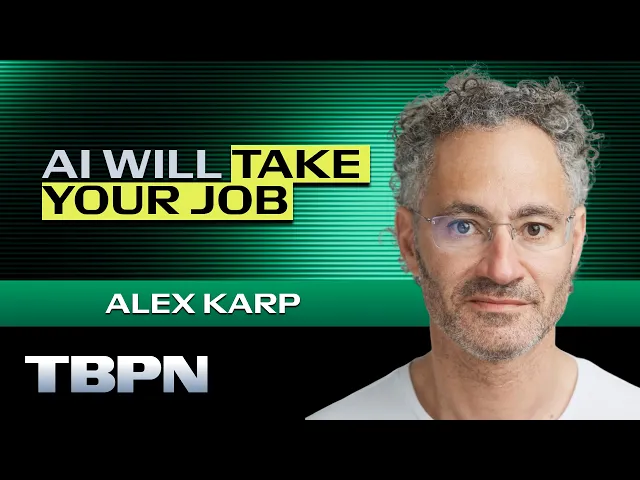
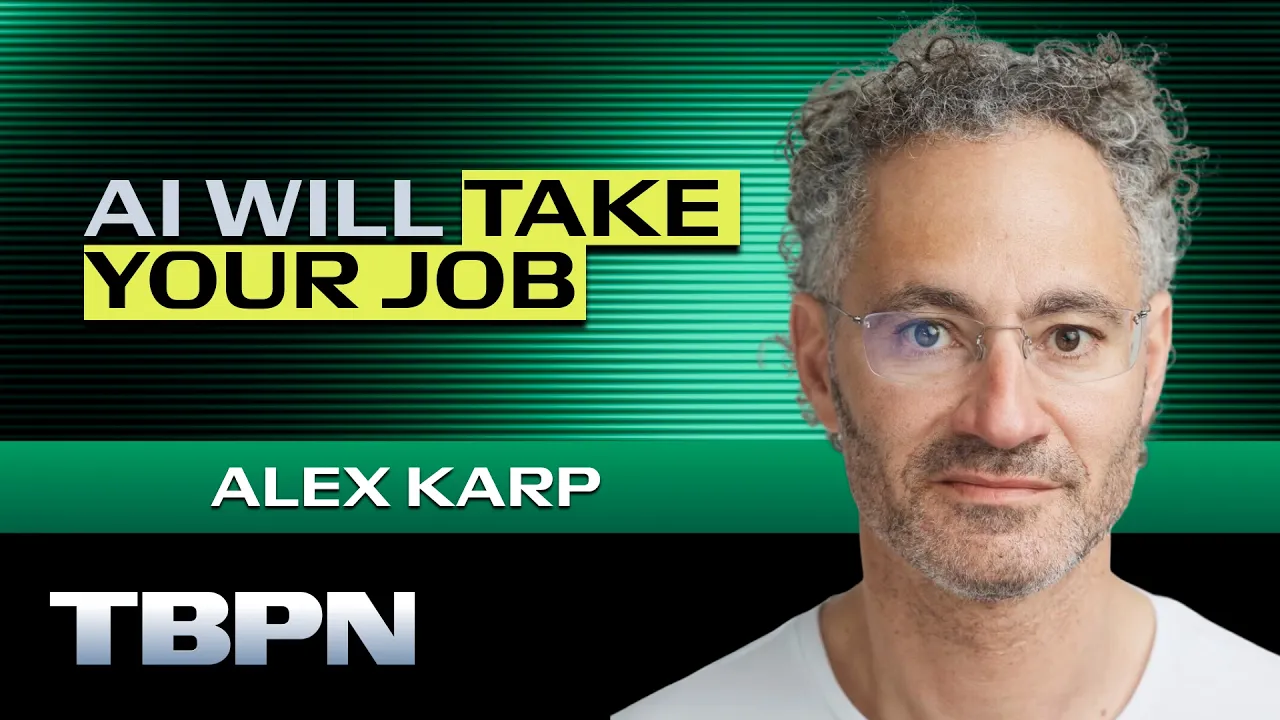
Well, we are joined by Alex Karp. Welcome to the show. Thank you so much for taking the time with or without hat.
>> Uh, whatever is comfortable for you. You can do that. >> It's cold out here.
>> Keep your hat on. >> I feel like this is an average day for you. You're always out skiing.
>> We should have done it. Yeah, we need to get We're close to getting skis. Look, >> we could Well, you know, we were supposed to do something physical.
>> It's starting to stick. >> It's starting to stick. Oh, I like this.
But now I feel like a newscaster. I feel important. >> This is good.
>> You're like 8t tall. don't realize that he's not standing up because it would be like he's like counterulate for all of us. >> He's like 8 foot.
>> Last time we talked to you, I think you were doing four minutes on the dead hang. What's it up to now? >> 50 55.
>> 505. What about in the cold though? That's going to >> We need to have a special minute for that.
50. For those of you who haven't done a dead hang, first of all, go do it. >> Why is it important?
>> Um, well, there there are very few things that are proxy indicators that are accurate for health. Yeah, >> it's like dead hang, farmers walk, body weight, and V2 are the three ones that count. >> I don't think anyone really >> one rep match bench bench press.
That's all I focus on. >> Okay. Well, you know, it's like >> I feel like I feel like as long as I have a really impressive bench press, I'll I'll live a short but glorious life.
I don't know. >> Did they say something about that? Who want to live a long glorious life when you can live a glorious short life?
>> Yeah, I think that's what they tell you before they give you a bad salary and something like that. I think I think it's like Yeah. or it's like, "Yeah, my social life is so great.
I only have a bot, but I enjoy it kind of logic. " No. Um, but no, it's um, >> dead hang is important.
>> Dead hanging is crucial. Okay. >> And you really need to go work on it.
Especially anyone watching your podcast >> is likely to outperform. >> Yeah. >> You want to have some, you know, you want to be able to do something with that outperformance.
>> Yeah. Like dead. >> Like, yeah.
Well, the dead hang may be a proxy indicator for other things you could do with your outperformance, you know, but you know, not everyone is Yeah. Not everyone is like 6' n like you may not need a dead hang, but the rest of us >> Well, the I can cheat because most of the pull I just stand on the floor. That's right.
And I can hold forever as long as I can. That's right. That's right.
>> Um but but when you're not dead hanging, uh what should people be doing with the new coding agents? How important is it to learn to code? How important is it to >> look there there are two that everybody's worried about like their future but there are basically two ways to know you have a future one you have some vocational training okay >> so it's like or two you're neurode divergent and and I when I say neurode divergent I mean broadly defined like >> you guys are sitting here you could have had a corporate tool job yeah >> you could have been like I don't want to pick on Goldman but like just say you know like a job >> I applied there they turned me down >> well yeah I did work at a little bit you could you at a job where you're like it's like yeah no actually maybe they didn't know the right way to test >> like it's like yeah they were like like you know whatever I'm not picking on one or the other I'm just saying you you you know the like you are probably here you think you're here because duh but it's actually you probably wouldn't have been able to do that [ __ ] cuz there's like it's the same thing as sit down in class and learn some [ __ ] >> like and you just regurgitate it like >> that's not a valuable thing >> if you are actually have insights into anything and and you have real technical expertise.
Yeah. >> Like you know you can look at a company but you actually can look at it because you know something about how these things work or something about how clients work you know then all the other stuff that used to be precious like being able to do low-end coding being able to do low-end luring being able to do low-end reading and writing. I mean got this is like I feel like Odin came down and was like I'm going to make the world just right for a dyslexic.
It's like it's like yeah Odin has come down from or Locky has come down and said you know what carp you suffered so much as a kid >> I'm just going to make the whole world so everyone else can suffer >> I don't want that it's like now but it's really an inversion like everybody with like the normal shape skills are dyslexics cuz like >> the meaning the thing they can do that used to be valuable is not so valuable. The thing that they need to learn to do is like be more of an artist look at things from a different direction be able to build something unique. M I like and you see this on the battlefield like one of the most underappreciated things about fighting a war which is the I mean there are basic core things civilizations do like build technology for war >> is every society fights differently every component of the society fights differently and when like American as allies we do not even approach these problems in the same way what it makes America lethal more so than any currently country is like a combination of obviously the technology which we're super interested in and and and believe are paying a huge part in um but it's like 20 years of like operators figuring out what worked what not what worked in a manual like what worked in reality also even selection if you look at the selection of people like you meet like tier one operators >> they don't look anything like what people would think it's not like the movies they're like these like these they're like this big and like you know it's like because we have >> yeah we have we have we have specialized ways of doing that all that is crazy valuable as a proxy indicator.
People who are getting their news from you are just likely to massively outperform. People are getting their news from something that's a regurgitation of you got to vote for one party or the other. >> Um >> and then the the real problem we have in society is not your listeners or pounders customers or our partners.
It's like well what happens to everyone else? Are they going to lynch us? >> Cuz like that's the real problem.
like these products like what we're building like our our our agents mean that like the most I mean the most powerful people in the Democratic party are highly educated female voters and these technologies like they love they I mean like yeah I actually get along with all these people in private and there's a public dispute but like largely I've talked to Dar over and over again it's like yeah you love one company because they they're not proTrump that company's taking your job >> how are you going to feel about that company when you find out you have no job and What what what do you think the Republican part is going to do to products that do not support our military? What do you think the Democratic part is going to do to products even if you're voting for them that are taking away the jobs of every one of your constituents and saying, "Oh, people are going to love you so much and you're going to be poor. " >> By the way, we love you so much, we're going to give you a little handout once a month.
>> Yeah. >> Yeah. So, apply that to the the SAS apocalypse narrative, the enterprise SAS.
There's an idea that uh the first jobs that will be taken might be the enterprise software products that exist, haven't really innovated, have lock in, and they're going to be replatformed. >> If you that the the thing that these technologies do is they also make it harder to lie about. This is what part of the political problem.
If something's not creating value or something's not working or there's corruption, you can't lie about it. M >> and nobody believes that all software companies actually create value. I mean the famous thing that we all learned was that we rejected that you were learned and people taught you is like your software company is supposed to give the client the feeling they're getting laid while they're getting [ __ ] >> Yeah.
>> Now if that's how your products actually are, you are now it's you who are going to get [ __ ] like and this is going to happen so quickly. And the simple test for people who are looking at this is does this product or in our case we were never pure software. We're actually like a hybrid of like humans FDEES uh augmented humans so AI FDES and then orchestration and then >> and essentially what we would call primitives like taking the tribal knowledge of institution coding it into logic and then using that to be extended in LMS.
Okay. >> But we don't have to explain that to our clients you know. So, so, so there's there was always this, oh, is Palunteer a consulting firm?
Is it all just people? Is there any real software? I feel like that narrative went away.
>> They they couldn't invest in us because we were a service company. Exactly. >> And now now it's like and now >> but but is is is actually having that service better in the future.
>> No, no, it's not better. It's >> underrated. It's crucial.
>> It's crucial. Like all these places that made fun of us, they're running around and trying to get FD. Of course, getting an FDA is like Yeah.
It's like yeah it's not as easy as it sounds because you have to know how to manage it where to put the person how to extract value and then you need all these products that augment the FD what are those products ontology foundry FDI AI things that we've built >> what we being able >> so so the value of the business is not a monolithic codebase that never changes it is the people it is the deployment is the relationships is that how you're thinking about the business these days >> well actually the way I I'm telling you like when you walk around here Yeah, >> they only care they don't care about any of that. >> What they care about is you transformed my business in 3 months. It would have taken 3 years and I would never have happened.
>> That's what they care about. Now then there's a question of how do you do that? And that is a that is a concatenate.
It's artistry. It's like >> select client, select where you would start, select ways in which and innovate in ways they would not accept, innovate in places they do not understand you should innovate. Uh learn to manage these very complex.
By the way, it's not just culturally complex. It's tribal knowledge. And much of that tribal knowledge is in rules that they have to apply because there are all sorts of rules about manufacturing, hospitals, war, um rules that are applied that they're not saying they apply, laws, >> like all sorts of regul regulatory things on top of all that.
All that has to happen very rapidly. So you would need and like without going into details like I'm in the middle of like every single one of these discussions in almost every breakdown it's like people do not understand how institutions work. They don't understand how the software would work.
They don't know how the LLM would work. They don't have the product that would actually work in that environment. And they still at the end of the day are not saying we're going to charge on value.
>> Okay. How do institutions work? Why is it that we get these genius models that are 160 IQ?
They can solve incredible math and they're not just like everywhere all the time. What is slowing down? >> I mean the simple version is they're 160 against a test.
Yeah. >> But the test isn't it's a concatenation. The simple math would be it's 160 on one test but you've got to pass differentiated tests over a long period of time.
So it's a thousand tests. So de facto by the 50th step it's zero IQ. But then there's also there's also Yeah.
I mean it's like it's it's it's insane. Like no, I love when I hear about all this is going to replace and then I go to our clients and they're like could we have more? We don't even have the capacity.
Like it's like it's a surreal thing like would you guys like to be FDs cuz we need some help. >> If you're in the audience completely seriously and you're aligned broadly speaking with America is a great country. You don't have to agree about anything else and you're out there and you're technical or just smart.
Apply. We need you. >> Okay.
America is a great country. Put aside Democrat. put aside Republican.
Is democracy the correct formulation to decide the future of AI? Should the American people be voting to Should that be handled by private companies? >> No, America.
Well, it depends like like Yeah. Great. So, in the war fighting context, >> the Department of War Yes.
has to be the arbiter of what gets deployed now. >> But as a citizen, I vote for the Department of War. Right.
>> Exactly. Yeah. Okay.
But but I'm just saying no. So I I want to split domestic and and foreign because like we in this country have god-given rights literally given to us by a higher being. There's a right of free expression which >> we're exercising all the time and is very important to us.
Uh there's a second amendment which I exercise. I I shoot very well. I would encourage you guys and other people to listening to avail yourself of the second amendment.
Yes. >> Uh it it was not it is there to protect ourselves in case the first amendment fails. >> That's the reason it's there.
There's a a fourth amendment which is essentially we have a right to privacy. Okay, >> we have those rights. >> Adversaries trying to kill us in Iran do not have those rights.
>> And I don't believe I've never believed in extending our rights to foreign countries that are adversarial to us. >> I don't even really believe I don't like, you know, in Germany where I lived half my life, they don't have a first amendment. >> They don't believe it.
And by the way, they've never believed in a first amendment. They have other rights. That's great.
I'm not going to dispute that. But I want our rights here >> in this country. Uh if you're going to tell the American people you're building what is clearly a dangerous technology, it's dangerous because it it will likely take your job, especially if you're white collar.
So >> if you're voting, you know, you're highly educated. >> Have you flipped on that in the last like six months or so? Because I think I think the last time we talked your general mindset was like high agency, highly productive people will be able to continue to leverage the tools to deliver value with an organization.
>> Yeah. I think if you're neurode divergent and high agency and you're highly educated, that's great. But if you're not neurode divergent and you're like lawyer 14506, that's a problem.
>> Okay, but let me get to this and they're linked, but it's okay. on domestic stuff. Uh I we have rights that are not subject to major majority rule like I the majority can vote against us having fourth amendment rights.
I want that I want that litigated at the Supreme Court because I we are not our constitution is not about majority right. It's actually about the rights of the minority and it's our right all I bet you the three of us have opinions that are very much in the minority >> that we want to be able to say at least in the privacy of our own home right and so so that those are real issues I'm super sympathetic with >> restrictions around the use of these products in a domestic context even though it's funny people out there every conspiracy theorist thinks yeah it's insane I'm the only one >> conspiracy theorists you may hate this but there's one person protecting your right to be a conspiracy theorist that actually has a seat at the table and that person is me. >> You may not you may not want to hear that truth, but it's it is [ __ ] true.
And maybe do a little more reading before you pontificate on your absurd and obviously illformed and many times stupid opinions. Okay? So, cuz like you're attacking the person who's protecting you, idiot.
Uh it's like [ __ ] so stupid. Do do use one of the bots to correct your opinion. It's like I'm being attacked online now.
He's like Dr Karp is anti-progressive versus I progressive my whole life. I'm the only just telling you the truth. These things are going to take your job.
Okay. So then but in the war fighting context and it's the primary justification for these procs has to be it's it's there are two relevant powers now. US and China.
>> This is a half have not world. It's going to be either us or them. It's basically deciding the world order because like these other countries and maybe India will will will get involved, maybe the Arab, non-Arab, Middle East, but currently on the trajectory we're on now, there are two places where these things are being developed and deployed.
It's us or them. And I'm not particularly, you know, I'm not I'm not out to hurt China. I'm just out to I think we should win.
I'm not trying to hurt them. And in that context, you can't say we're not going to do X, Y, and Z. I mean I give you examples but like >> there are data sets that are publicly available in the US market that should I don't think should be used against you and me >> in a law law enforcement context more than with the help of say AI agents and ontology.
>> Yeah. >> But if you don't use it on the battlefield you obviously Iran's going to use them. You don't think they can go online and buy those products.
Yeah. And and by the way, without going into somewhat classified idea, those things are in combination with other things lethal. Like a lot of people who want to hurt America on the battlefield end up dead because of our ability to aggregate and then figure out what's going on in the battlefield before they can figure out what we're doing.
>> And so like I'm very much in favor of it for moral reasons, but I'm also in favor of is like I don't know how else you explain this to the American people. We're we're going to take your job. we're going to take away you're going to eviscerate your ability to to to have money and power but that we're not going to defend you on the battlefield just seems like yeah well they're gonna you know what's actually going to happen >> that nobody believes me in tech but there's going to be a movement in this country that gets very strong very quickly to nationalize these things first it's going to be take away all our money the bill billionaires are evil you may not have heard that super evil and if you take away their money it'll help poor people that's really important to understand making rich people miserable is the only way to help poor That's obviously true.
So once you've learned that, the next thing you're going to learn is we have to nationalize a techn they're going to quote you on that. >> Well, it's like you on >> So So I mean it sounds like you're you're you're closer to Daario on, you know, potentially 50% of early stage white collar job loss. Like you're you're you're aware that there's a risk at least ability.
You're aware of it. What do you see as the solution? Um well first we just have to I mean well I mean the obvious thing is okay we can't have any migration here like how are we going to create more jobs like it's like you have to what the problem in fairness not that people want to be in the business of being fair to policy leaders but >> the we are dealing with technologies that will determine the policy decisions.
So you can't just pretend they're not happening. Like step one is like >> we it's going to be hard but possible to make this society work given that transforming it requires these technology in some cases but it's like a long trip and we're here and I'm the only one who likes this weather is great weather. I brought it for you.
It's uh uh but um they're here because they've seen their business being transformed and this is happening in America more than so we have to win those battles but the costs are going to be very high and so you have to work back from okay the costs are going to be very high >> we we can't put oil on the fire it's like you know it's like well getting jobs for all Americans is going to be hard and people maybe who become Americans but >> it's like you have to have different policies around migration you have to different policies around how we train people like currently if you're a young kid in high school and you're neurode divergent they're literally tra chaining you into your chair and feeding you medication so you can have skills that are not valuable. >> Yeah. >> Like it's so it's like and then we'll probably over time have to have like a discussion of like yeah if you go into this career >> you're not going to have a job >> like a really honest discussion about that.
These are the places where you will likely have a job. >> Mhm. And yeah, >> help me.
>> What uh you know, it seems like we as a country will probably head down a more European path where it is becomes very very difficult or near impossible to let people go. Do you think that's correct? >> In Germany, in Germany, it's much harder to to lay someone off.
>> And that does impact I mean, that does impact the the growth of of companies. >> Mhm. But I think many Germans would argue that's probably >> yeah, you know, Germany's I mean I won't I'll answer your question.
Germany's interesting place. I did this thing in German where I basically told the truth which you're not allowed to do in Germany. It was like you know it's kind of really bad situation and the economy sucks.
The migration thing's a complete disaster and the energy situation is like compounds everything. And I got thousands of people literally saying thank god someone told the truth. Um, and there are a lot of people like you guys, young people building things that feel hampered and and and are correct to feel hampered.
I I think the American version, if we're not careful, is not going to be the German version. I think it's going to be hang the rich. >> I It's like I think it's going to be not protect everybody else.
It's going to be like, look, this is too dangerous and we're going to hang the rich but not really help the poor. And in fairness to the German version, like you know, German like health insurance, insurance, all that stuff, it works. Yeah, >> like I was I was poor in Germany for like a decade.
And like I had I had the best life on the planet. Like it was like being poor in Germany is like being better than being rich here in some days. >> So basically policies that lift the floor, re-education, training.
>> You're So if you want to do what we could do here, yeah, >> we the things we could adopt from Germany are Germany has three high schools. Yeah. Two are vocational.
>> Sure. >> One is academic, >> better education, >> better programmatic vocational. Vocational.
It also has a bad like a weird vibe here. Like vocational training in Germany is very technical. Like the people building the cars at BMW or even in the French version Airbus like very complicated jobs.
They didn't go to college. They went to a very very high-end high school and they come out without any debt. And that stuff is really valuable.
So if you want you you have to completely transform our educational system and and go very young into like training people to do things. You also need to change our testing system like different forms of intelligence. All of our tests are built around things that were valuable in the industrial revolution.
It's like you want to pull out all the dyslexics, all the neurode divergence. Everybody who can't sit or needs to build or wants to build have to go into a a separate slot of like yeah we should have gotten you before you got turned down at Coleman and like said this is like that's a waste of your time. You could be building something important.
>> And uh what else goes would be a part of the good outcome? Well, the the the most important part of a good outcome is we show our adversaries you can't [ __ ] with us and we're the best we have the best military in the world. Hope I believe we're doing that right now.
On the good outcome side, we yeah, we go around and then on the commercial side, we go to all these high infrastructure, you know, hospitals, manufacturing, all these things, complicated infrastructure and we AI enhanced all of them. So the products are legitimately the best in the world and we rebuild manufacturing in this country. Like a big problem for us including on the battlefield is our manufacturing just is not up to where we have to be and that by the way requires reskilling uh scaling humans and we're doing this all over the place.
I mean the guy writing a lot of the scripts for the target these people they're like high school college grads the people building batteries and all these things using our products. These are high school college grads. There's a lot of opportunity there.
But you know, one of the things I told the Germans and I would say to us is we I was like, you know, Germany, you have to call it a crisis. We do need like this is a crisis moment. America is tomorrow is not going to look like it looked at all or we're going to have radicalism on right or left.
The the problem, the danger is if we don't do these reforms, you are going to get the pitchforks because that then the only solution people are going to have is well, you know, let's go after the unlikable rich people in tech, especially AI tech. And then but but then what can work is yeah close the borders keep them closed start doing huge vocational efforts change how we test aptitude like so we have an accurate diagnostic of where you could be slotted uh be ruthless in like you know it's like in in certain find out new ways to test and do ruthless testing and slotting and then also go around to universities and just I mean you know how when you like you want to smoke a cigarette it's like this this cigarette may be harmful health maybe we should be putting that in universities this university. This this university is harmful for your investment.
You know, I'm libertarian. You want to go to university. >> Student debt may be harmful to your future financial for and your personal life.
Explain to someone you got a million dollars in debt. A million dollars in debt. I mean, maybe if you're 69 and you you can get away with that, but the rest of us have to provide.
>> That's funny. Uh uh help me square this idea. You you were you were talking earlier today about uh people misunderstanding your business and >> Yeah.
What's it like to read about your business? >> Oh, I mean, first of all, it's I mean, the part I I I hate it, but then the part I love is and it's like your valuable your your value is pretty directly con uh convergent with people's inability to understand what you're doing. >> Yeah.
>> So, it's like it's like all these technologies are potentially commodifying everything. Yeah. >> Okay.
So if you are a business that is you know not services not product but both but also works on tribal knowledge on data and every single business you make is individual and so yeah that's a crazy valuable business. >> That's true in a lot of industries where if the broader business community doesn't understand your business, you might have a short report but you'll have way less competition because people aren't copying you. They don't understand.
impossible to copy certain like like and and and we we neglect this like you know um >> almost like you even see it culturally like luxury products dominated by the French watches dominated by the Swiss currently certain kinds of war fighting dominated by America and it's like it's it's very hard for people to evviscerate these cultural advantages and our products augment that which makes it >> uh you know it augments the the differentiated specific over the generalizable and and and that's where literally all the value is going to go and it's going to be like a waterfall and that that's the problem with a lot of software companies. It's like it's like product ABCT but um but but then when you read it it's like like one of the more depressing things that you guys probably confront but it's like a market market huge market opportunity for you. It's like where are the experts?
Like it's like, you know, it's like there's it's like, you know, you you hope and pray. Like I'll tell you the funniest thing about my life now and people internally know almost every day I'm like wait a minute I'm the adult in the room here. It's like everywhere I go it's like it's like wait a minute I like I and it's like there it's like and and it's so it's it's surreal when you read about these things but and it's it used to really frustrate me but now I kind of just think well like I can't believe we're still viewed as crazy.
It's like everything we're doing is the only thing that's working. I mean like I don't want to like spend a lot of time on our baller accentual essentially baller numbers from last year but it's like you know clearly our [ __ ] works clearly nothing is working at that level and you would think they would take like I don't know 10 minutes to think okay well the thing I believed and I thought would work didn't work at all this thing I thought was insane is has like a rule of 127 when like no one like 40 is considered like and like but they don't and and And then and I Yeah, but it's sometimes frustrating honestly. And the hard part actually is I kind of view it as a feature.
Uh internally we get these brighteyed kids. So it's so funny. I mean the one get the best people in the world.
>> But you know just like I was probably at 21. They're very romantic. It's like but why does the adult >> not understand this?
>> It's like but but but the adult expert tells me. is like I don't know when you guys had the drop the shoe moment when you realized that like the adults are like you know on crack or something like >> okay uh last question would you rather have $10 million or access to chatbt in 2012 it's a viral question that's going viral right now >> I have to choose one or the other like I mean okay I'm just >> I don't think he needs I don't I don't think he needs can I could I have my social life in grad school. >> Oh, there we go.
Okay. So, that's on your >> new pick. >> We just have to ask >> like, you know, it's like great.
I I got to take something I valued. >> Okay. Yeah.
The most valuable thing, your social life and grad school. Well, thank you so much for taking the time to come with us. It's fantastic.
Love you.