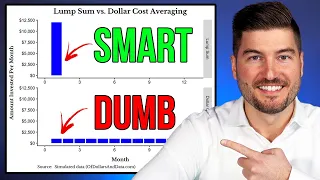
we got a showdown we got lump sum investing in one corner we got dollar costs averaging what's best for you [Music] Brian I am so excited about this episode because we get asked this question all the time someone will come to us inevitably and they want to invest some money something has happened in their life where they want to get that money to work but they don't know the best way to do it they don't know how to approach it and they've heard things on both sides of the equation telling them hey you should do it this way no no you should do it this way we wanted to spell that Myth today we're going to jump into this really quick but I think before we can even give answers tell them what the definitions are of these two things lump sum investing dollar cost average investing yep so when you think about dollar cost averaging all that means is it's the act of investing periodically on a regular schedule so like monthly regardless of the price of your investment so if I'm going to put money to work I'm going to buy on the 15th of every month I'm gonna buy every Friday or I'm gonna buy on some fixed schedule whether the Market's going up down left or right that is dollar cost averaging well the other alter when it comes to investing is lump sum investing and it's exactly what it sounds like it's when an investor decides to invest generally a large sum of money into the market all at once right now today yeah we're going to find we're going to jump right into this in a minute with with we're going to talk about a case for lump sum investing then we're going to talk about a case for dollar cost averaging here's what I want you to take away from today there is a time and a place for both of these strategies but a lot of times in the investment world people just won't give you a rule they won't give you a hard and fast of how do I actually decide what's best because as we're going to talk about what is going on in the future is directly what impacts what's the best decision here and so let's lay these out right let's lay out a case for both let's look at the case for lump sum versus the case for a dollar cost averaging because you already said that like they both can make sense but a lot of times people don't really just want to know okay well what could make sense is there a mathematical answer to this there a probabilistic answer that this one method does make the most sense and I think some academics out there some research would suggest that probably one of these does generally make more sense than the other when you look at historic outcomes yeah what's in the background of all this is Vanguard every few years does a a research study now the data that Vanguard used in this group was 1976 all the way through 2022. and here's what they found and by the way this is not unusual we they've done this research report I mean years now matter of fact when Daniel said hey they've got a new research report I was like is the answer X and he's like yeah pretty much so they've updated the data and that's great but we know this lump sum investing because we we've shared all the time if you're looking at like the S P 500 8 out of 10 years typically it makes money now Vanguard actually used the msci world index and they came in with 68 percent of the time lump sum investing is better so that makes sense hey look we understand with this ever expanding economy the law of accelerating returns with Innovation it makes sense to be an investor hence that's what actually drives the money guy show and why we all want our money to work as hard as we do and this kind of makes logical sense you already said it Brian if the market more often than not is going up the sooner we get those dollars to work probably the better it's going to work out for us you know if you look at a day over day basis I want to say the market is generally slightly more than 50 percent of the time positive but if you look of it over a year over year basis you just said 8 out of ten years the markets are going up so if you get that money working there's a really good chance that it's going to work out more advantageously for this Vanguard article found that it was 68 so we said okay well let's let's look at a case study let's assume that we have two folks that are going to invest in a specific time time period and so what if you are going to invest a hundred and twenty thousand dollars in March of 2009 is a lump sum versus dollar cost averaging over 10 months so doing 12 000 every month for 10 months which one if we look at it today would have been better well you can see the lump sum investor that invested all 120 000 of that in March would have a portfolio value now of a little over a million and twenty thousand dollars the person that dollar cost averaged through that time would have about 730 so it's almost a three hundred thousand dollar spread between the two yeah it's actually around 28 now look this is the extreme we uh when when Daniel and Megan were putting together the data we had a conversation about it and I said look let's go ahead and give lump sum it's best option so we we kind of Cherry Picked this on purpose we went with we knew the recovery of the Great Recession started in March of 2009 so we went ahead and said let's start lump sum investing and you can see that it was a big difference now look I want to be honest if we had just gone back and said hey why don't we start this on January of 2009 we ran the data on that they almost came in exactly the same so timing matters you can imagine if you're hitting the market when it's in a recovery and you've got that think about the the the rubber band effect when you're returning to the norm meaning that markets when they're getting crushed typically that velocity of recovery is some of your best performance it makes sense lump sum investing is going to do really really well but that's not what happens all the time there's another side to this coin just like we just showed markets up makes sense to have lump sum investing but what if you were buying if we were cherry picking this when markets were the peak volatility of losing money what does that look like yeah let's lay out now the case for dollar cost averaging because you already said academically the Vanguard study said that about 70 of the time the mark lump sum investing would behave however we as investors are not incredibly logical rational creatures we know that eighty percent of personal finance is behavioral so perhaps some of the behavioral things come into play and it's just like you said Brian what about during those bear markets what about during those downturns what about during those frightening times in the market is lump sum necessarily the best suggestion well I think we we this is why you have to be careful of Statistics because they don't have real life always in them and the fact that you you might behave completely different with tying into what you said when you see a stat that's 68 of the time markets make money you're like wow that's that's that's that's the Lion's Share that's the majority but you ought to ask yourself do the simple math if 68 of the time it makes money that means 32 percent of the time it's actually potentially could lose more money but by by doing it all at once that's almost a third of markets so if we have a huge sum of money life-changing money you're going to probably be pretty sick and if you put in million dollars and it loses a big chunk of money all at once and that's what we're trying to protect when you look at strategies like dollar cost averaging how do we make sure you don't make the worst decision of selling because emotionally you get rocked when the mark when your portfolio loses 20 30 percent but during a volatile period and actually do the worst thing you can is actually just walk away from it and sell it go to cash because you want Comfort that's what we want to do a case study of let's see what happens when you hit a volatile period when and make a case now for dollar cost average so previously we looked at investing a lump sum versus dollar cost averaging in March of 2009 well what if we back it up a little bit and we look at the same type of scenario but we do it in October of 2008 just a few months prior we're gonna have one investor who invests 120 000 as a lump sum another investor that starts in October of 2008 investing twelve thousand dollars a month for 10 months well now you can see that it's flip the lump sum investor who put all the money in work in October now that portfolio is only only grown to about six hundred and twenty seven thousand dollars however the individual that was easing it into the market over that 10-month period has a portfolio value over 810 000 so again that's almost a two hundred thousand dollar spread in the other direction from the previous case study now I want to make sure because it's fun to look at the numbers but we need to put a little context and perspective on this for somebody who'd made this they're kind of that worse investor look you're just unlucky in the fact that you invested at the wrong time because it was you put your money in and then all of a sudden you get the Lehman Brothers announcement and the market goes crazy because you hear about Lehman Brothers bear Stearns this is what was going on during the Great Recession we were worried the is the financial system about to collapse now before we get caught up in just this strategy of lump sum dollar cost averaging I still want you guys to notice both of these strategies are up six Sevenfold from what the original investment was so I mean that's why even if you're a losing investor on your strategy if you just stick with it for the long term you're going to be rewarded but I just want to make sure you the stick with it actually sticks because a lot of people are going to get if you get crushed like this in the beginning you might just give up so I think what we've shown here is that in in times when the market is declining dollar cost averaging is likely to be more advantageous than lump sum investing but in the times when the market is already at the bottom and it's going to rise then some investing is going to do better the problem is none of us have a crystal ball none of us know exactly where we are in the market cycle so it makes the decision on which one to do pretty difficult not knowing what the future looks like yeah and I also want to just add that when it rains it pours you know you I've I've shared with you guys that a lot of bad things that happen when you hit Market volatility you have um they're extroverts I like the hang out together and the fact that you've got job losses real estate market goes bad you also have the stock market losing over 20 percent going to Bear Market status and look we have a stat that shows that typically and and all economic Cycles it you know if you look at the returns the S P 500 you lose one percent or greater in the S P 500 12 of the time on an annual basis however when you hit bear Market status it's twice as off double so you can quickly see that it's very likely that 32 percent where markets are going underperformed through if you did dollar cost averaging would be better than lump sum investing they're going to be grouped in with other volatile periods so just be careful and and that's kind of what we want to talk about there is we love dollar cost averaging but even you can screw that up by doing it too much yeah I think one of the things that you might be hearing is okay guys I hear you I'm a little nervous uh about investing out you know maybe I just came into an inheritance or I sold a business and I want to do this but I'm nervous and what I'm hearing you say is that if personal finance is behavioral perhaps I ought to put a behavioral Block in place to protect me so I'm going to dollar cost to average but I'm going to kind of take it to the 18th degree I really want to do that well that may not actually be the best scenario either let's look at A Tale of Three investors let's look at Dixon Kim and Saul Daniel thank you so much for the names that's awesome uh so Dixon receives an inheritance of one million dollars and decides hey you know what I'm going to invest everything in the market right away I'm going to be a lump sum investor Kim receives an exact the exact same inheritance a million dollars uh but she says you know what I'm gonna do I'm at a dollar cost average and I'm gonna do it over 12 months I'm going to invest 83 333 every month the same day of the month over the next 12 months well then we have Saul and Saul says you know what I also receive that inheritance of a million dollars but I'm a little more nervous I'm gonna do it even more slowly instead of easing this in over 12 months I'm gonna take two full years I'm gonna take 24 months and I'm going to invest about 42 000 each month so that I can really take this thing nice and slow now Saul probably did that because he's behaviorally worried what if I get the timing raw and what if it doesn't work out uh I think that he'll be surprised to find though the results are a little bit different than maybe what he thought well yeah because if we know that 10 to 12 months is a good time to dollar cost average a big lump sum like a million dollars why not it make it even better by going out to two years and we're gonna see that doesn't necessarily work so when we look at the rest of the story you can see how they all played out you can see that Kim actually ended up with about 1. 5 almost 1.
53 million dollars again this is starting in January of 2020 coming all the way out until now present day you can see that Dixon who did the lump sum while his ride was a bit more volatile ended up in almost the exact same place about one and a half million dollars just putting all the money to work at once and then you have Saul who decided to spread it out who wanted to be a little bit longer term on his dollar cost averaging strategy only has about 1. 33 million so not only do you have to decide when it comes to how you're going to invest your dollars am I going to do lump sum or am I going to dollar cost averaging you have to make the decision okay how long am I going to do this and when do I know how and when it makes sense for me yeah this is what I love this illustration because it actually really cuts the heart of the behavioral side of this I love how close because 2020 was an uncertainty that's when the pan endemic kicked in is that what I like is is how close lumps I'm investing and then dollar cost averaging less than a year came in with each other they were they were just within two percent of each other um that's great because now you can see this is the way the strategy is supposed to work but if you did too much of a good thing with dollar cost averaging you had tremendous underperformance several hundred thousand dollars instead of having 1. 5 million dollars or greater you're now at one point a little over 1.
3 this is why it makes sense to to understand the math and the historical context of how you can use this as a tool to get you through all things now here's some good news Bo a lot of people are going to be dollar cost averaging just because that's the way the system is set up with employer plans other Investments where you might be investing just monthly by the structure of these type of investment opportunities yeah even if you're not coming into an inheritance if you don't have a million dollars coming your way if you're someone who's putting money in your Roth IRA or your HSA every time your payroll cycle hits your dollar cost to averaging if you're someone who is participating in your employer-sponsored retirement plan and out of every paycheck paycheck a little bit goes into your 401k your dollar cost averaging if you're someone who's employer also puts money into your retirement plan if you're doing step number two of the financial order of operations and you're getting that free employer money that is an example of dollar cost averaging happening in your life or if you're someone who's even out in Step seven out in Step a to the financial order of operations and you are saving into an after-tax brokerage account you have that thousand dollars two thousand dollars a month just flowing into that account you are dollar cost averaging so you may be taking advantage of the strategy without even knowing it without having to sell a business without having to receive an inheritance you might very well still be taking advantage of what Brian you have this saying you always say it the best thing you can do as an investor is to always always be buying that's right make it work and I think that this is um I will I love that we've done this show but I do I do worry we're we're kind of like your typical YouTube Financial show at this point where we're feeling somewhat lukewarm because we just gave you advice on lump sum is usually the best strategy because 68 of the time it's going to work out best but then we said hey but if there's if you think there's any chance of volatility the the you know you might want a dollar cost average so we have now shown you both of these strategies can work and then we even go leaned in harder and said and by the way if you do too much dollar cost averaging it it can blow it up too so now we have just completely muddied the water but this is the difference between the money guy show we said this is a ripe situation where we could actually create some structure we could create a process because why do you guys love us is because you love like the financial order of operations we're trying to take the behavior out of things as much as possible so we've created processes we've created systems and by the way they usually or I'll just say they are supported by the math we always we we eat our own cooking but we also show you the numbers and we came up with a money guy Rule and this is important because I think the big thing to understand as I've already shared lump sum investing wins but you do worry about what if I have once in a lifetime money coming my way through an inheritance I sell some land I sell a business this is a big chunk of money that came my way so that weight of the money should change my decision matrix it's not like if you were just funding a Roth IRA or something you're trying to figure out this dollar cost average lump sum usually it's probably going to be okay to default to lump sum but bigger material decisions you should potentially spread this out so we've actually come up with some rules with percentages to help guide you make the best decision but lay that out for them yeah so here's the rule and it's fairly simple what you want to do is you want to think about first you're in total Investment Portfolio one of the things you ought to be doing is you ought to be doing an annual net worth statement so you actually know what the size of your current investable assets are and then as you have a windfall come in how big that windfall is relative to your invested assets should dictate how long you should dollar cost average so at the very Baseline if the money that you're going to invest is less than 10 percent of your investable assets then you should really consider lump sum investing I think it's okay to put that money to work however if it's greater than 10 percent then you should probably start some sort of dollar cost averaging strategy and thinking about the optimal strategy and where that lives and what we've seen in our experience we would say if it's ten percent you should dollar cost average over the course of five months yeah so then what you want to do is for every five percent more that sum represents of your total investable port folio you want to add an additional month until you get to a maximum dollar cost averaging period of 12 months so what this does is this takes away the guesswork this takes away the uncertainty around okay how should I approach this how should I put this money to work if you receive if you have a million dollars invested and all of a sudden you have another million dollar inheritance come your way or you sell a business or you sell a piece of land there is nothing wrong with dollar cost averaging that into the market into the portfolio over the next 12 months if you have a million dollars but you get a ten thousand dollar inheritance there's nothing wrong with lump summing so hopefully this money guy rule will help you figure out based on your circumstance which is the right strategy for you well what I love is it solves the Goldilocks problem because it's very often that you get questions that come to you and you're looking is it too hot is it too cold what's just right and that's what we've tried to address we give you the metrics of what's big enough that it's material to have an impact on me on the long term and then it also answers because a lot of people when you hear about dollar cost averaging versus loan some you go okay well I see that it's nuanced but how how long I mean that's the second part of the what you've got to have addressed we've taken out the guesswork on this by the size of the investment opportunity compared to your investable assets but then also we've even taken care of how long by giving you a metric that ties into that this hopefully will give you guys the guidance that you should hopefully be able to use and maximize the opportunity without going too far out there that you've turned the value of investing in that 80 that 68 days 80 percent of time markets make money that will keep this fully centered so that you are maximizing every moment that you're that your money has so it can work just as hard as you do with your back your hands and your brain now okay A word of caution or just something worth mentioning don't overthink this don't allow yourself to get into analysis paralysis trying to figure out how you're making this decision I can't tell you how many times we've spoken with potential clients who said yeah you know I made the mistake and I got really nervous during covet and I went to cash and I've been trying to figure out the best time to get back in but I haven't done it oh or 2022 was a really bad year and I have some money that I want to put to work but I just don't know when to do it and all of a sudden that inertia that analysis paralysis prevents them from making a decision one of the things you probably noticed is that in every one of these scenarios you already said this but I need every one of the snares whether it was dollar cost averaging where it was lump sum investing whether it was dollar cost averaging over too long of a time period all of them had the common thread of people recognizing that they could put their money to work and if you put your money to work time in the market matters exponentially more than time in the market so do what you need to do so that you actually begin making the decision to begin moving in the direction you need to be moving I also love Beau that we educated people this is this is an important concept to understand and there's a lot of people out there that are choosing camps and I think that this shows no it's not you don't choose either or it's understanding how this tool this valuable tool is used and here's where now that you have this knowledge think about this Vanguard has been doing this study I think this is probably the third time I've read one of their research reports because they updated every few years when Daniel brought this to my attention I said hey is the spread still two percent and he goes I don't know let me go check and sure enough he went and read in the the research report and found that the spread between if you went from 1976 to 2022 and then kind of came up with the medians difference between dollar cost averaging versus lump sum the difference in performance was an edge to lump sum of about 2. 2 percent so it's back to this is why now you know this whenever you find out somebody's kind of nudging towards a camp you can say well guys don't we don't split the the hairs here let's remember this is one of those situations where you just need to understand the variables know how to process them and find the most efficient way to be a financial mutant to maximize the opportunity and that's why the money guy rule on how you can find your own personal Goldilocks situation on the strategies of lump sum versus dollar cost averaging we've laid it all out and now you can go conquer that so that gets me so excited as you know Bo and I love creating content we'd encourage you if you love what you're hearing because I know I told the team in this meetings this month's meeting that YouTube gave me my summary seventy percent of you are brand new from last month we had a really good month last year typically 40 to 50 percent of you are brand new but last month we had a lot of new people come through the door so it was 70 so I'd encourage you go to moneyguy.