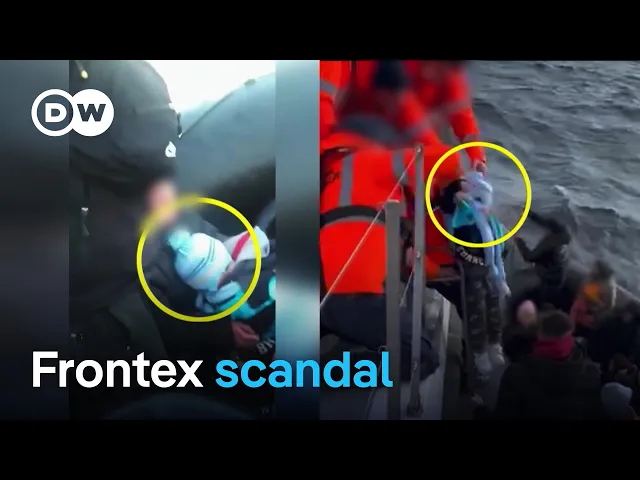
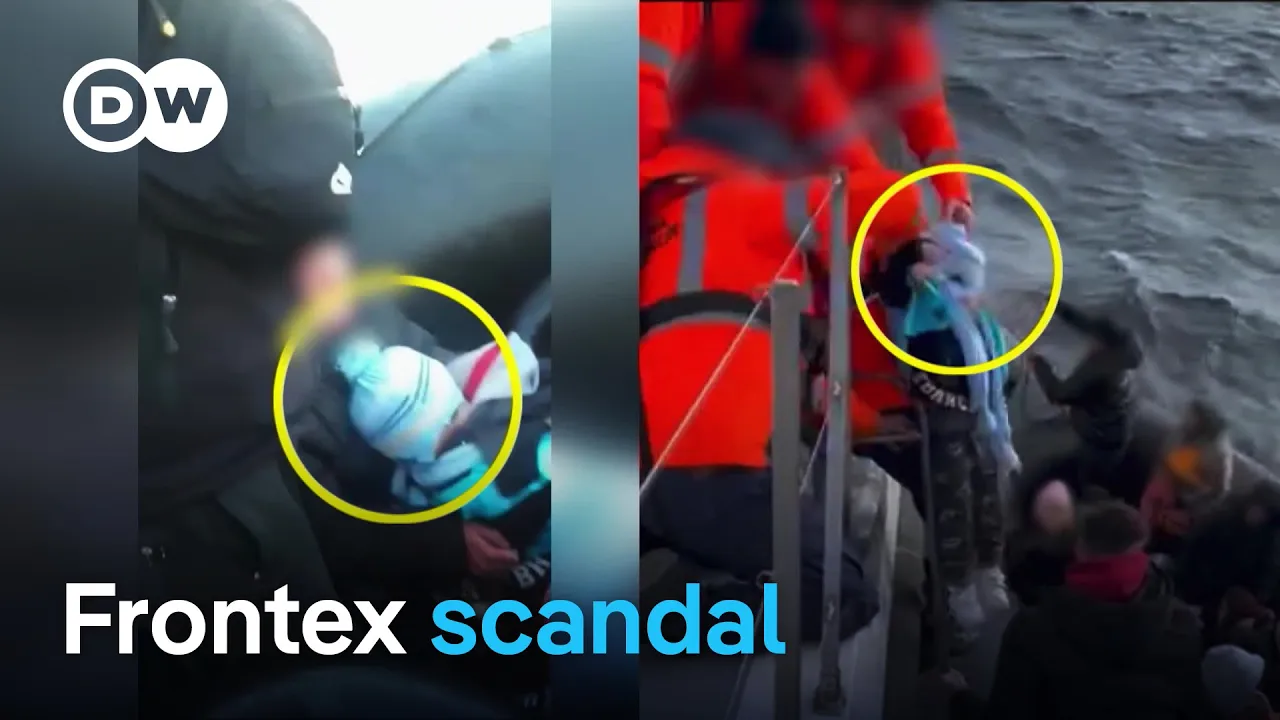
February 19th, 2024. On the Mediterranean Sea between Turkey and Greece. An inflatable boat carrying migrants is confronted by the Greek coast guard and forced to turn back.
Grab his stick! Grab his stick! In the background, a boat that’s been deployed by the EU’s border protection agency, Frontex.
These kinds of encounters shouldn’t be happening anymore. The EU’s external borders are patrolled from here. Our reporters are at Frontex, in Warsaw.
The border protection agency has been plagued by negative headlines for years. Frontex must defend itself against serious allegations. Frontex officials have been hiding insights on human rights violations.
Frontex is also accused of taking part in illegal pushbacks of refugees on the exterior borders. The former director has now become a far-right member of the EU Parliament. And Frontex’s new boss says he wants to change things for the better.
So, I’m responsible for the fact that my people don’t participate in anything called a pushback. Can Frontex successfully rebrand itself? Did you do anything concretely since you took office to prevent this from happening?
Did you tell them ‘Stop this! ’ A briefing in the “Operations Center. ” Information on the EU’s outer borders is collected here, in Warsaw.
Soon, a Frontex aircraft will take off from the Italian island of Lampedusa to patrol the Mediterranean and transmit live footage back to base. On the left, is Alessandro Zagaria, the team leader. He served in the Italian police for around 30 years.
Weather is good. So we are expecting many sightings And we have already four events ongoing which we detect in the previous flight. And, we will go on that target to update, to make an update and, assess the situation.
By event and target you mean refugee boats or migrant boats? Yes. Migrant boats.
After about ten minutes, the pilots spot a boat in the water. Around sixty passengers are on board. Is it a new one?
Yes, it’s a new one. We are making an assessment on the people on board, the buoyancy if its good or not. We check if the boat is a adrift or, if it’s sailing?
We check also if they have, like um, life vests. Some information, like, about the people on board. Now his asking if there are some patrol boat in the vicinity in order to get closer and save them.
In this case what makes you decide they have to be saved? You could just say keep them go. Every boat of migrants needs to be saved.
Because, they are usually sailing with you know, these boats are not… So sure… Not so safe. You can see it’s overcrowded and it’s very low on water, very close to the… so obviously they need to be saved. But it’s not that simple.
National authorities located in their respective countries are the ones who ultimately decide what happens to a boat that gets blocked. Do you kind of decide what to do? So if the migrants should be saved or brought back to another country or whatever?
No no no, no, it's not our decision. Okay. So this is a service provided to the member states.
So what we are doing here in this room when it comes to surveillance activities is done upon request of the member states, but we are not in charge of classifying events or of their response. So Frontex is something like a service provider for the EU member states. Let’s take a brief look at its history.
In 2004, Frontex was founded as a small EU agency with a few staff and a modest budget . It was originally intended to support the border patrols of member states with its expertise. Then came 2015.
The EU received 1. 3 million applications for asylum. Nearly all of them through unofficial channels.
Since then, there’s only one thing European policymakers have been able to agree on regarding migration: Frontex must be strengthened! …with even more Frontex support. That’s why it’s important to strengthen Frontex.
…to expand Frontex even more. Frontex is THE instrument. Frontex.
Frontex. …with help from Frontex. Policymakers wanted to look tough on border protection — pouring more and more money into the agency over the years.
Since its establishment, the annual Frontex budget has increased from six million euros to more than 900 million. Images of another boat arrive at the Operation Center in Warsaw. Most of these migrants arrive to the EU via the route across the central Mediterranean, by way of North Africa, heading for Italy.
In 2023 alone, Frontex recorded more than 150,000 unauthorized entries by this route. Can we have a picture? We are trying to understand if it’s a new one or it’s one of the boats we already detected in the morning.
We need to compare. But sometimes it’s not easy. It looks the same that we already detect in the morning.
So we are going to do an update to the siting that we already made this morning. This maritime refugee route to Europe is known as one of the deadliest in the world. According to the UN refugee agency, more than 4,000 people either died or went missing attempting the journey in 2023.
In the last decade, around 29,000 people have died or disappeared. Have you witnessed tragedies from here? Yes.
Unfortunately, yes. We have to, deal with this kind of situation, and it's not always easy. Because sometimes you see also kids on the boats, and, it's not easy to left them in the center of the sea and just go home and, do, like everything is okay.
You're always thinking about that. And maybe the day after, when you come at work, you, the first thing you do is checking, what is the situation that with the boat that you left the day before. Have you witnessed like a drowning?
Yeah. It happened. It happened.
Obviously it's not easy, but, you have to focus to what you can do, not on what you can’t do. And, if I can save ten lives, I did well. On that day, the plane spent around three-and-a-half hours in the air.
Alessandro asks about the first boat, the one that the pilot sighted shortly after the patrol began. Do we have any information about it? Not yet, Okay.
Okay. Oh, no no, no. Yeah.
So we don’t have information. Yes, there is information. Rescued from Charlie Papa 319.
Ah, it has been rescued from, Italian Coast Guard. So they will be brought to Italian shore? Yes.
And now we consider this event closed because they have been rescued. Frontex is facing a major challenge. On the one hand, it’s supposed to prevent unregulated migration – while rescuing and safeguarding the basic rights of people in distress at sea.
But the number of unregulated entries is still high – and people’s basic rights haven’t always been upheld. Serious allegations of misconduct by the agency. The EU Border Protection Agency, Frontex, is working more closely with sketchy Libyan coastguard officials than previously known These so-called pushbacks are illegal.
But according to an international research study, the EU border agency Frontex is also involved, or at least aware of them. In recent years, there have been multiple reports of Frontex being involved in human rights violations. Usually, nobody at the agency would talk about how Frontex covered up their involvement.
But we found someone who will. Rear Admiral Kenneth Neijnes says he spent nearly 40 years in the Swedish coastguard. He was also one of the officers responsible for Sweden’s international missions for several years.
On several occasions, he even commanded Swedish crews operating on behalf of Frontex to patrol the external EU border around Greece. That was the case in 2020. So I was, sleeping in Piraeus back in my hotel, and, the, quite early in the morning around 5:00 o’clock my phone rang, and, the captain from the Swedish, patrolling boats called me and said that there were an incident with the migrants.
The crew he led found a boat at sea. They took this photograph. According to a Frontex investigative report, the boat was in Greek territory, and therefore, inside the EU.
The Frontex crew contacted the Greek coastguard, which arrived on the scene. The Greek says that we are needed a further north and, that we should go there as fast as possible. So, the Greeks sent Frontex away.
A short time later, the Frontex crew sees on their instruments, that the Greek vessel and the migrants’ boat are moving towards Turkish waters. Later, in a Frontex internal investigation, the Greek coast guard claimed that the migrants evaded police efforts and steered into Turkish waters on their own. But Rear Admiral Neijnes doesn’t believe that.
He says, what he saw broke the law. The problem is it's, it's, it's not according to the human rights. You should be able to have your case, tested if you come to a European country.
And it’s all in these different operational plans, How we should act and what should happen, and we can’t we can’t do this, actually, according to the laws and regulations that is stated. People in distress at sea must be rescued. And sending back anyone already in EU territory before they can claim asylum is almost always illegal.
This is known as refoulement, and it’s a direct violation of the Geneva Refugee Convention of 1951. — A regulation established after World War II. Around 900 Jewish refugees fled Nazi Germany aboard a ship called the St.
Louis. But many countries refused to take them. They were forced to return to Europe.
Many of them were killed in the Holocaust. This principle is enshrined in international law, with very few exceptions — one being, when a border is breeched by force. Otherwise, refugees have a right to have their asylum claims reviewed.
So, from the captain and the crew, they were quite, upset over this because they saw what happened. And it was quite far in the Greek territorial. So: As a classic pushback, we could say.
An illegal pushback would qualify as refoulement. Neijnes wanted to report the incident. He went to his superiors at Frontex.
And he, immediately reacted very negative to this information and started to say that it could be a problem for me if I did this. And I said, okay, what kind of a problem you’re talking about. And then he said, Kenneth, this will have some consequences for you if you do this.
Immediately after this, the boat that Sweden had with two crews, they were sent to the other side of the Chios and to patrol mostly at night times. And it's much harder wind and waves on the other side and absolutely no migrants. I think we all felt that it was, kind of a punishment.
According to an internal investigation, Frontex officials later disputed the report’s suppression. For Kenneth Neijnes, the incident is a matter of principle. All of this, from my point of view, is, decreasing the safety at sea and, and we would never do that.
We should be there and try to help out, make sure that we have a controlled immigration and make sure that the people are saved. In the end, yes, I think you should always stand up for what you think is right. And, I feel that, if I don't do that, how should I look myself in the mirror the next day?
What Neijnes described has been common practice at Frontex for years. An internal report by the EU’s anti-Fraud office, OLAF was published in various media outlets, backing him up. Officials at OLAF say it’s been proven that Frontex management committed “gross misconduct and other irregularities.
” They also say that Frontex management obstructed its own border guards: From fulfilling their own responsibilities, in particular to ensure the respect for “fundamental rights as enshrined” in the EU Charter of Human Rights. We have an appointment with the main target of the heinous allegations detailed in the report: the former head of Frontex. Nobody has come with suitcases yet… It’s the end of April, and EU election campaigning has just begun.
Here he comes. After the allegations, Fabrice Leggeri resigned. Now, he’s running for a seat in the EU parliament for France’s far-right, National Rally party.
Manuel Bewarder, Hello. Hello. Did you have a good trip?
Yes, I had a good trip. We're in Perpignan, right. It’s the first day of campaigning in the region.
Ok. Leggeri was born in Alsace and grew up near the German border. The deputy mayor of Perpignan is picking him up.
It’s campaign time in the EU! Polls in many countries already show there’s been a rise in support for the extreme right, especially in France. I’m really impressed that you can feel the momentum.
I believe the French already have had one eye opened. Maybe both eyes now, I’d say! We’re almost there.
Here, in the south of France, the National Rally already has a majority in many places. In Perpignan, too. Surveys reveal that migration is one of the most important issues for many French voters.
And, it is THE issue for the far- right, pretty much everywhere. As long as Europe has no barricades against millions of illegal migrants, Germany must act on its own. Unregulated mass immigration worsens security in our country.
And that’s why we reject mass immigration. Illegal mass immigration. A return ticket and mass deportations for all illegal immigrants.
The former Frontex boss introduces himself to the party base. He visits the mayor of Perpignan, who is also a member of the National Rally. Mr Leggeri, pleased to meet you.
Thank you for the reception. Welcome to Perpignan. My wife.
Hello. Nice to meet you. Other members of the National Rally are here as well.
Does your political role now allow you to share what you believe to be right and what you couldn’t say when you were the boss of Frontex? When I was an official, I had reservations and couldn’t speak freely. I was ordered to enforce a political stance that wasn’t right—well, I certainly tried to change that and to turn the agency into what it is theoretically supposed to be: A border and coast guard outfit that supports EU member-states.
I admit that’s why I voted for Marine Le Pen in the 2022 presidential elections. Of course, I didn’t say that when I was director of Frontex. We had a longer conversation with Leggeri.
What did he say about EU investigations alleging he concealed and collaborated with Greek authorities to commit human rights violations? How do you react to this accusation? In February 2020, Greek authorities officially informed me that Greek national security was under threat.
That’s why I cooperated closely with the Greek authorities. Leggeri is referring to one month in 2020. Back then, the Turkish president opened the borders to Greece and thousands crossed over.
Greece suspended new asylum applications for one month. If that had been arranged in agreement with you, then it’s ok, so to speak. Say, Frontex approved it and you said together, okay ‘We’ll send the people back.
’ We didn’t agree on all the details. We agreed on the legal framework and that meant interception was possible. With these two options.
Intercept or send back? Either arrest them — or intercept them and notify the people on the boat they’re not allowed to enter. Leggeri said that, as Frontex boss, he and the Greek officials agreed to send migrants back, which denied them the opportunity to submit an asylum claim as a result… right on the open sea.
The EU investigation indicates that the month-long state of emergency in February 2020, wasn’t the only time this happened. But let’s look at this specific case now, which we’ve seen time and again in Greece. The boats are discovered and they… well, there are various reports about these illegal pushbacks, that these people are being driven back.
That’s what happens. Well, that’s more like taking the law into your own hands, right? So, if we’re rescuing these people, that means we’re bringing them back.
Maybe they’ll stay in a European reception center in North Africa to have their cases reviewed. Let’s say, the member states of the EU will assess whether these people really need protection. During our conversation, Fabrice Leggeri did not suggest the law should be broken.
Instead, he proposed that asylum applications should be carried out at European consulates abroad. That sounds good, but for years, it’s been clear that implementation isn’t realistic. In April 2024, two non-governmental organizations filed criminal complaints against Fabrice Leggeri.
The NGOs accused him of abetting “crimes against humanity” on account of his involvement in pushing back asylum seekers. It’s not clear if the case will go to trial. According to the EU anti-fraud agency, investigations have not led to any professional or criminal consequences so far.
Campaigning in Béziers. Representatives from the National Rally, together with police officials, are holding a meeting. During all these appearances, Fabrice Leggeri recounts an alleged meeting with EU Commissioner Ylva Johansson, in which he informed her of delays in arming Frontex.
And she interrupted me and said, “Don’t worry. It doesn’t matter if they’re late to provide weapons and uniforms. You don’t need them.
Your job is to collect the migrants and welcome them. Europe is ageing and we’ve got a plan to support the population. Whether you like it or not, you’ve got to take them in, and you don’t need uniforms or firearms to do that.
Because they’re coming out of love. We don’t know if this conversation really happened. A spokeswoman for the EU commissioner said their policy is not to comment on these kinds of statements.
Here, Leggeri adopts the narrative of the Great Replacement Theory, classified by German constitutional experts as a far-right conspiracy theory. It’s clearly an immigration policy meant to replace Europeans in their own territory. And to create a major birth plan.
And to replace our culture. I wanted to say that, but I didn’t. I was Frontex director at the time and I told myself, ‘Keep your mouth shut, because otherwise there will be trouble.
’ The narrative that white people are being deliberately replaced by migrants is being spread by the extreme right around the world. But when asked, Leggeri denies pandering to far-right ideologies. There are seven weeks until the EU parliamentary elections.
Because his policy line as Frontex director wasn’t successful, he now intends to push through refoulement politically. The current Frontex director would consider that an illegal pushback, if someone applies for an asylum claim and it’s rejected. Like I said, it’s a question of political will.
Of course certain aspects of the law can emphasize this for political reasons. But I think what’s missing now is the political will at the EU level. Leggeri is essentially saying that there should be less emphasis on human rights.
And the political will to make this change should begin at the EU-level, which is what is he running for now. Finland is also taking a tougher approach. Here, the government wants to take things a step further.
Frontex invited us to the Finnish-Russian border. Finland is in the spotlight because the country shares a border with Russia that is more than 1300 kilometers long. In December 2023, Russia deliberately brought asylum seekers to the border.
Some were on bicycles. Moscow was putting pressure on the EU. Using migration as a weapon — a practice referred to by the EU as “hybrid warfare.
” Finland closed its borders! Since then, crossing into the country here has been impossible. We’re in the restricted area.
Frontex is proud that it has deployed 50 troops to Finland in just a few days. The visiting Frontex deputy director, says that having Frontex on the border also sends a clear message. To be honest, it’s important to me that we show a European border can be secured with European forces.
Russia is just a few meters away. Since the Finns closed the border, everything here has been quiet. And as a result of this, it calmed down the situation that, since the full closure has been now in place, that, since then, we have not had, such a immigration flow at all.
But in the end, what does that mean for European Law? And for the right to asylum? Finnish parliament has even passed a law that legalizes refoulement — even if someone requests asylum.
The Finnish draft law openly states this violates international law, EU law, and even its own constitution. Frontex’s image was in ruins after the Leggeri era. The new director promised to respect basic rights as soon as he was appointed.
So, I’m responsible for the fact that my people don’t participate in anything called a pushback. I think that is absolutely clear. He’s made a big promise: Frontex will no longer take part in pushbacks.
And — Frontex is going to change. One year after this promise, the new boss reported success. And since I’m in office, I receive no, I repeat, no reports, on misbehavior from Frontex officers.
He emphasized that, since he’s been in this role, there have been no reports of misconduct. But is that true? The Norwegian NGO Aegean Boat Report shared several videos taken in early 2024.
These are children, these are children… Please help me. Around 25 people, many of them women and children, are sitting in a black inflatable boat. They’ve encountered other boats and are calling for help.
Help, help, please! We need your help… we need your help… Help! We need your help!
We wanted to know: What exactly happened here? And who operated the two ships that the refugees were asking for help? We analyzed the videos with help from experts at the research agency Forensis.
We cross-checked them with geographic and weather data. According to our research, the first incident took place on February 19th, 2024. The people on the boat sent the Norwegian NGO their location using a WhatsApp message.
From Greek territorial waters. Forensis checked this again. By conducting a visual comparison of the mountain ranges in the video with the real landscape, they were able to determine the location more precisely.
Everything indicated the boat was in Greek waters. The people on board had a right to claim asylum. According to a handbook in our possession, Frontex officials are also required to proactively inform the asylum seekers of their rights.
But it looks like the people here were probably towed back into Turkish waters. We don’t have any videos to prove this. Nevertheless… …the inflatable boat later showed up on the same day in videos made by the Turkish coast guard.
Apparently, with the same people on board. For example, this child is wearing a distinctive hat. On the dinghy… Then, with the Turkish coast guard.
It’s the same with this boy… First, he’s on the migrant boat, then he’s being rescued. This man contacted the Norwegian NGO from the boat. We called his cell phone number.
Journalists from the ARD TV studio in Istanbul met him in an empty house. He is from Afghanistan and is hiding with his wife and three children. The Turkish authorities want to deport him back to Afghanistan.
He doesn’t want us to show his or his family’s faces. Or to use his real name. I’m very afraid that I might be the only one deported while my family stays here.
I won’t survive in Afghanistan. We speak with him, his cousin and his wife. All three say they were forced back into Turkish waters on that day in February 2024.
I’ve developed mental health problems because of all the difficulties when we fled by boat. The situation on the water was horrifying. I was so shocked.
The children cried so much. It was terrible. When asked, the Greek government flatly denied carrying out illegal pushbacks.
But there are numerous reports, including from UN organizations, indicating that Greece has been carrying out violent pushbacks for years. And where did the two boats that initially intercepted them come from? On the larger boat, we see the number 524.
Forensis searched in Greece, and found it in March, in a port in Lesbos. Boat ‘524’ bearing the flag of the Bulgarian Coast guard, paid for by the EU—and working for Frontex. We also see a small inflatable boat on the ship.
Presumably, the dinghy. It’s also part of the Bulgarian crew working for Frontex. So Frontex was there.
And Frontex didn’t bring the migrants to safety, despite their cries for help. According to our research, Frontex also failed to report the incident. We wanted to know what the new boss had to say.
He had promised a fresh start. We showed Hans Leijtens videos of this case and another incident from January 25th, 2024. The second case also involves a full rubber boat on its way to Greece.
This time, there is footage showing the alleged pushback. Masked men chasing a boat full of migrants, threatening them with sticks. Grab his stick!
Grab his stick! The boat is flying the EU flag. The characters LS 800 are visible — an abbreviation for the Greek coast guard.
Forensis was also able to identify the ship in the background. It belongs to the Latvian coastguard and is on a mission for Frontex. This rubber boat was also later picked up in Turkey — and confirmed by local authorities.
Hans Leijtens told us Frontex takes these cases very seriously. The agency’s fundamental rights commissioner has started an internal investigation. If Frontex was there, he said, that’s a problem.
If we are there, we are implicated or we are involved in a way, even without doing something, because it's also a question. Okay. Could we or should we have prevented it, for example.
So we have we have a responsibility, even if we are not the perpetrators or the alleged perpetrator ourselves. We have a responsibility because again, we are the European Border and Coast Guard Agency. We uphold European values.
We uphold European law. I understand concretely, I understand you that you want your officers to kind of step in if they see that the Greeks are performing a fundamental rights violation. You want them to prevent that?
If possible. And again, let's be realistic. If you are 100 meters away, you have your means of communication.
I want them to do something indeed. And not just sit back and relax because it’s, well, another country doing things. The new director says that he wants his people to intervene.
But apparently, they didn’t. What is he doing about that? Did you do anything concretely since you took office to prevent this from happening?
Because this is not the only case. Of course, there’s reports all the time about Greek and Coast Guard performing pushbacks, and so did you kind of tell them, “stop this? ” No, no.
But yeah, I told them, but the thing is preventing it, I cannot because that's not realistic. What I can do is to build a common understanding that’s even more than that common, shared value that we in Europe have to uphold European values whilst protecting the borders. Because it all starts with protecting borders.
We have a joint responsibility. That means that feedback, from our side is important. We have to acknowledge that the command and control is with the member state.
The member state is in charge of the operations. And member states won’t allow their sovereignty to be stripped. So, Frontex doesn’t have that much power on the border.
And in case of doubt, they can be sent away. Can Frontex actually change how migrants are treated at the border? A case from the summer of 2023 shows just how powerless Frontex actually is.
This footage arrived at the operations center from a Frontex aircraft. July 13th, 2023. 9:47 a.
m. A Frontex aircraft is filming this ship in the Greek rescue zone. The boat is crowded with nearly 750 people on board.
Frontex has also been informed that there are dead children on the vessel. In hindsight — it’s a clear emergency. But what can Frontex do?
They fly over the ship and inform the Greek coast guard. An internal Frontex report that we obtained, shows Frontex offered Greek authorities support several times. But they did not respond.
Instead, Greek officials sent Frontex away to handle another case. In the end, the boat sank and at least 500 people died. The Frontex director told us the agency did not have any rescue workers on the water.
And Greece was in charge of the operation. Now, they’re waiting for the results of the Greek investigation. There are two trials underway in the maritime court in Piraeus.
But according to our research, there have never been consequences for pushbacks by the Greek coastguard or police. When will Leijtens take action? We have to assess all these, let’s say, contributions we deliver, and indeed we have to balance this with alleged pushbacks.
And at the end, I might arrive at a conclusion that there’s no longer a credible cooperation possible, and have not arrived at that point yet but we have to assess this frequently and all the time. So what does that all mean? Has Frontex changed?
The two cases we researched show: The new Frontex director apparently cannot keep his promise. Pushbacks are still happening, and Frontex seems to be involved. But, our interview with him shows that he is also calling for a new approach.
And that’s not easy to do when Frontex is the service provider while countries like Greece actually control the operations. It’s the day of the European elections. We’re at a National Rally party in Paris.
The party emerges with decisive victories. And Fabrice Leggeri becomes a member of the EU Parliament. The former Frontex official will now use his position in the EU Parliament to put pressure on Frontex.
So, the politicians… because they’ve been elected, they must decide. We will have many political allies in the European Parliament. It looks like many governments in Europe want the same thing.
What does that mean for the future of Frontex? The current leadership has promised to offer more protection for basic human rights. But a loud far-right movement in Europe wants the opposite.
These two visions will be difficult to reconcile.