foreign welcome back in this presentation we will focus on the introduction to AES the advanced encryption standard let's dive into the outcomes first upon the completion of this session the learner will be able to outcome number one understand the basics of AES outcome number two we will know the basic differences between Des and AES outcome number three we will know the AES structure and outcome number four we will know the AES parameters let's first step into the topic of the day the AES and we will see the basics of AES now AES stands for the
advanced encryption standard as we have already seen in the last presentation that this is a powerful alternative to Des which is not a secured encryption standard and AES was published by the National Institute of Standards and technology in the year 2001 and what kind of encryption standard is this AES like this a is also a symmetric block Cipher so symmetric means obviously the same key is used for both encryption and decryption and AES is not only a symmetric Cipher it is also a block Cipher where it is going to take a group of bits as
the input and produces a group of bits as the output so it's not going to take one by one bit or one byte at a time rather it is going to take a group of bits to be precise it's going to take 128 bits as the input that is the playing text size and 128 bits as the output which is the ciphertext size and because of the many powerful features in AES this AES is widely used even in today's world let's now see the AES structure here is the AES structure can you see here the
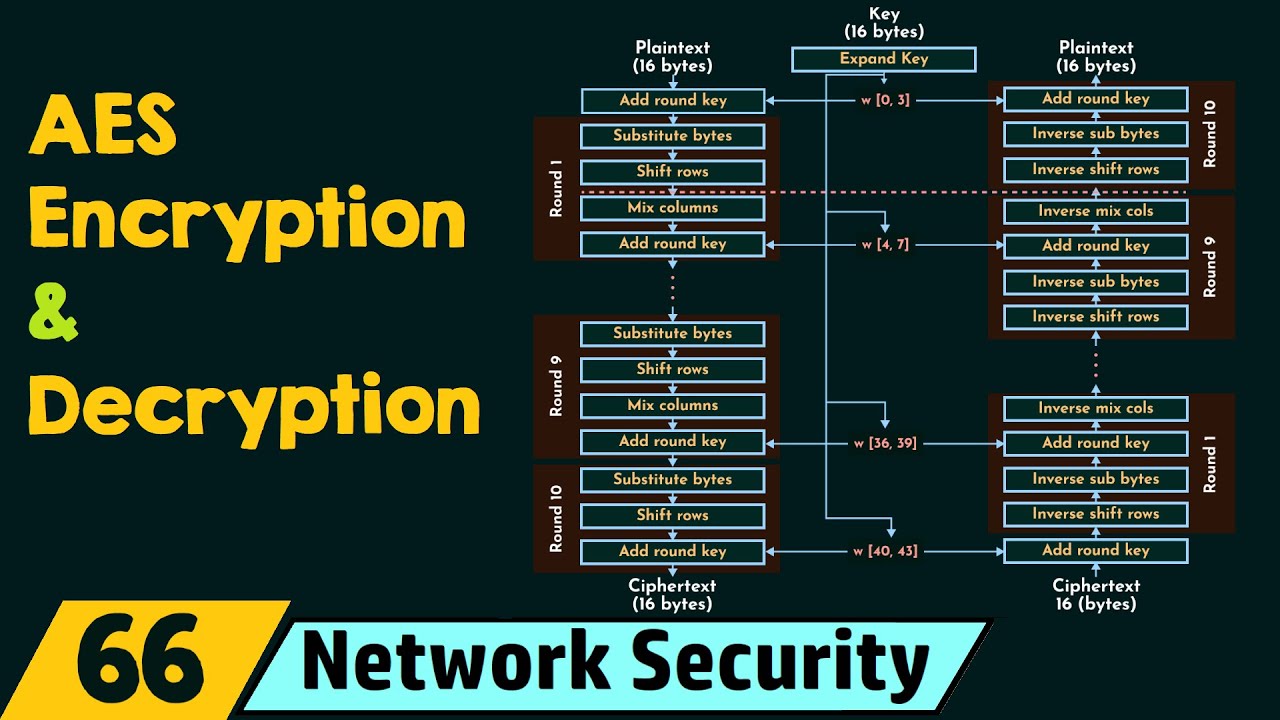
input which is the playing text which is of 128 bits now what is going to happen to this plain text actually this playing text is going to be converted into the cipher text which is also of 128 bits so the 128 bits input which is the plain text is going to be converted into a 128 bit output which is the cipher text now how this conversion is happening this is happening through this many operations let's see that now so firstly the input is actually stored in a state array can you see here there is a
16 byte State array and this is also referred as an input State array where these 16 bytes or 128 bits are stored in the state array one byte is equal to 8 Bits so obviously 128 bits means 16 byte so can you see here this is one two three four four into four which is 16 byte array is there and we can store 16 bytes of information in the salary where this input state is currently storing the playing text now this input state is actually given to an initial transformation where this initial transformation is going
to do some operation with the input State array values and then that transformed value is going to be given to round 1 where in round 1 we have four Transformations if you compare this with the days we can notice that the size of the plain text is of 64 bits whereas here it is 128 bits and in this we had the initial permutation whereas here we have initial transformation and then this is given to round one round two likewise we have 16 rounds in this but here how many rounds we have this is round one
then round two this is round n minus 1 one and this is round n why it is mentioned as n instead of a number like 16 or 10 or 12 or 14 because the number of rounds are going to be varying based on one criteria what's that let's demystify that later for now you just understand there is an initial transformation which takes the input State and which does some transformation on it and then that transformed value is given to round 1 and in round one there are four Transformations let's not focus on the four Transformations
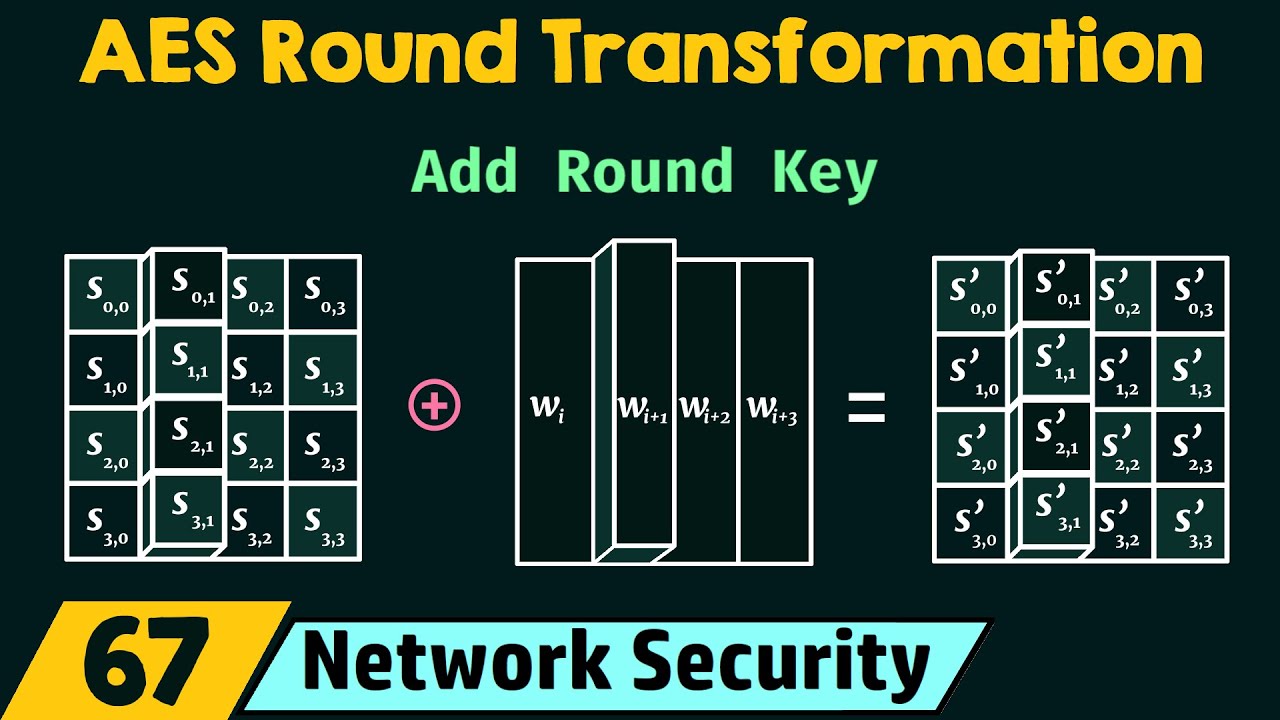
now for now I will just reveal the names of the Transformations let's not go too deep into the details now the four Transformations are substitute bytes shift rows mix columns and add round key these are the four Transformations that are happening in this round then the state after transformation is the output State now and this output state is given to round two in round 2 also there are four Transformations happening then the output is given to round 3 round four up to round n minus 1 why I am not simply mentioning it as simply round
n rather I am mentioning it as round n minus 1 is that in round n minus 1 we have four Transformations and in the last round that is round n we have only three Transformations so this is a very important point to be noted here suppose we have 10 rounds of operations then round 1 to round nine we have four Transformations whereas in round 10 we have only three transformations in case we have 12 rounds then round 1 to round 11 we have four Transformations and the last round that is round 12 will be having
only three Transformations after coming out of this round n whatever we get is stored in the final State this is also going to be 128 bits or 16 bytes and these 16 bytes are the actual Cipher text that we are looking for so simply what is happening the plain text is stored in the input State array this is given to the initial trans transformation function and after performing the initial transformation the state array is given to round 1 which contains four Transformations round two round three and up to round n minus 1 these rounds are
containing four transformations in it and after that whatever we get is the output state after round n minus one that output is given as the input to round n which is the last round where that takes only three Transformations and after coming out of round a and whatever we have that is also a final state only this is also going to be 16 bytes or 128 bits and these 128 bits are the ciphertext and if you compare this with the dash in this we had exactly 16 rounds whereas here we have n rounds where n
minus rounds with 4 Transformations and nth round with three transformation and also in AES for initial transformation we need round 0 key for round one we need round one key for round two we need round two key up to round n minus one we need round n minus one key and also we need round n key for round n transformation so if you note here we need round keys for processing every round also for initial transformation also we need a key which is referred as round 0 key and one more thing is that all these
round keys are 16 bytes in nature 16 bytes mean 128 bits so all the round keys are 128 bits but what about the original case size if you can see in the diagram that the key size is mentioned as M bytes which is not referred with any number this is simply mentioned as M bytes in the Des algorithm if you compare we have the key size the original key size has 64 bits and the sub key is of 56 bits which is referred as the effective key for this algorithm from the 56 bits we can
generate the 48-bit round case whereas here we have simply mentioned it as M bytes which means there is some relationship between the key size and the number of rounds to be performed in AES so if the key size is a different value then the number of rounds are also going to be differing so before revealing that let's understand there is a key value and this key is going to be of M bytes and this key is used by the key scheduling algorithm in order to generate the sub keys or the round keys that are actually
required for every round for initial transformation it needs round 0 for round one round two up to round n it needs round one key round two key up to round and key and all these key are actually scheduled by the key scheduling algorithm by taking the input key value let me now demystify what is the relationship between the number of rounds and the key size if you see here if your key size is of 128 bits so here I have mentioned it as M bytes right in other words it is 128 bits that is 16
bytes right so if the key value is 128 bits or 16 bytes then obviously the number of rounds is going to be 10 so it means this algorithm will behave like this round one round to up to round nine we have four Transformations and in round 10 we have only three Transformations what if the key size is 192 bits that is 24 bytes or 192 bits then the number of rounds will be 12 12 means round 1 round 2 up to round 11 we will have 4 transformations in each round whereas in the last round
that is round 12 we will have only three transformations in case the case size is 256 bits or 32 bytes then it takes 14 rounds so round 1 to round 13 with 4 Transformations and round 14 with 3 transfer let me elaborate on this now AES comes in three variations AES 128 AES 192 and AES 256 so in all the cases or in all the variations the input size and the output size remain the same that is the plain text size and the ciphertext size is going to be 128 bits only for any AES variation
whereas the key size is actually differing aes128 means it's going to be taking a key which is of 128 bits in size whereas AES 192 means it's going to take 192 bits as the key size and the AES 256 takes 256 bits as the key size and the number of rounds is going to be differing for AES 128 the number of rounds is going to be 10 where 9 rounds with 4 transformation and the last round with three transformation AES 192 takes 12 rounds and AAS 256 takes 14 rounds where in the 12 round operation
it's going to do 4 transformations in 11 rounds and 3 transformations in the last round whereas in AES 256 it's going to take 4 transformations in 13 Rounds and the last round with three Transformations and the round key size is going to be 128 bits in all the case whereas the input size of the key is going to be differing in all the three AES variations and that's it guys I hope now you understood the basics of AES we also have seen some differences between Des and AES we also have seen the AES structure and
the AI es parameters I hope the session is informative and thank you for watching [Music] [Applause] [Music]