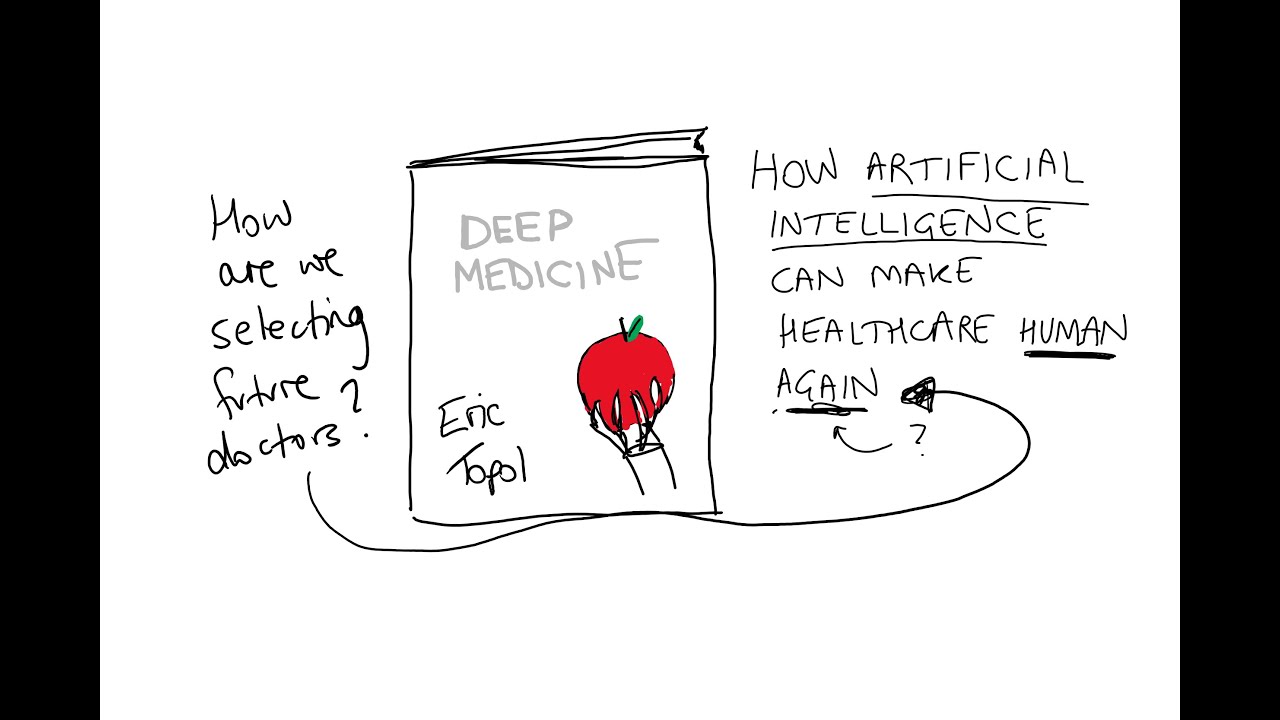
Eric tople deep medicine how artificial intelligence can make Health Care human again narrated by Oliver Maines and Alex Vincent today we find ourselves on the brink of a technological Revolution in the coming years artificial intelligence is bound to impact almost every industry and Endeavor forever changing the way we live and work in the field of medicine is no exception does that mean we're headed towards a world where if we get sick we're seen by robotic doctors and nurses well no not exactly we may eventually be able to see total control to other types of AI say driverless cars but medicine will always require some form of human oversight the best possible future for medicine is one in which humans and algorithms are able to use their strengths and work together to improve patient care and Health Systems one day AI may be able to make accurate and complete medical assessments but will need humans to apply those assessments and establish the Deep trusting bonds with patients that are so often missing today foreign [Music] of eight Robert was a fairly healthy 56 year old but one afternoon he experienced what doctors call a mini stroke his face went numb and he began having trouble seeing his doctor told him to continue taking aspirin every day as he had been before unsatisfied with this prescription Robert went to see a neurologist who then referred him to a Cardiologist that's when he found out that he had patent for ramen ovali or PFO a tiny hole in the wall separating his two heart chambers the cardiologist claimed that this condition was the cause of Robert's mini-stroke and that he needed surgery to close the gap in his heart but Robert wasn't so sure the key message here is Health Care requires a shift from shallow medicine to deep medicine after seeing the first cardiologist Robert came to see the author Eric topel also a cardiologist for a second opinion topple was shocked about the original assessment one in five adults have PFO and the condition isn't connected to Strokes so he and Robert worked together to determine Robert's real issue and found it was atrial fibrillation which can be treated with a simple blood thinner Robert's situation exemplifies what topple calls shallow medicine in which burned out depressed doctors don't take the time to develop real connections with their patients and make holistic assessments average clinic visits in the United States for example last just seven minutes perhaps as a result there are about 12 million significant misdiagnoses per year across the country and up to one-third of medical operations performed are unnecessary patients are suffering but so are the people who treat them one in four young Physicians experiences depression and almost half of American doctors today have symptoms of burnout this condition greatly increases the risk of medical errors and even leads to physician suicides to address these issues we must start the shift from shallow medicine to deep medicine this shift occurs in three fundamental ways first medicine will require Physicians to deeply Define each individual with as much of their relevant personal history as possible second it will require deep learning on the part of artificial intelligence to augment doctors diagnostic abilities and automate repetitive tasks and finally deep medicine will require doctors to practice deep empathy seeing patients as real people not just as problems to be diagnosed blink 2 of a of eight artificial intelligence in medicine may seem like part of some distant future but in fact it's already being used to save lives in one case a healthy baby boy went home three days after his birth five days later his mother rushed into the emergency room of Ratty Children's Hospital in San Diego the newborn was experiencing constant seizures that were only getting worse as things were looking bleak a sample of the boy's blood was taken to the lab for Rapid whole genome sequencing in just 20 seconds AI processed the boy's entire medical record then machine learning algorithms sifted through the data eventually hitting upon one rare genetic variant that could be causing the boy's seizures treating him with vitamin B6 and Arginine supplements could override this Gene's effects the key message here is artificial intelligence could greatly benefit health care but it has its limitations thanks to this treatment and the rapid work of AI the newborn seizures ended he's now perfectly healthy this case shows that AI working with human doctors has life-saving potential but before waxing two rhapsodic about ai's capabilities it is essential to consider its limitations first and foremost AI depends entirely on the quality of its data this is all it can use to learn and make predictions most AI works with structured data that's standardized and searchable Medical Data however is often unstructured and narrative in nature inaccurate or incorrect labels can easily mess with an algorithm's output also AI isn't creative it can't dream up new solutions to problems once toppo was treating a 70 year old man suffering from extreme fatigue a CT scan revealed that his right coronary artery was narrowed by 80 percent topple was confused since this issue doesn't normally cause such severe fatigue he explained the situation and offered to put a stent in the blocked artery which the patient agreed to the very evening of his operation the patient could already walk several blocks without feeling fatigued he reported that he felt stronger and better than ever a computer algorithm could never have recommended that procedure since there were no precedence for this man's specific situation current AI has some critical limitations that will never allow it to fully replace human doctors but it can still greatly benefit medicine Blank Three of eight many people think of doctors as infallible almost superhuman but just like everyone else doctors have implicit biases that cause errors in both Diagnostics and treatment take the representativeness heuristic a bias that causes people to make decisions based on their past experiences it might lead a doctor to misdiagnose one illness for another especially if he isn't carefully examining all of a patient's symptoms perhaps even more Insidious is the overconfidence bias which causes Physicians to believe their diagnoses are correct more often than they actually are all of these biases come into play when people use intuition to make snap judgments as doctors often do when diagnosing patients it can take years of experience to lessen the impact of these biases or perhaps the help of AI the key message here is doctors can use AI to help improve their diagnoses what do you do when you're experiencing symptoms but don't know the cause most likely you turn to Google or an online symptom checker there are a lot out there but they aren't particularly accurate just yet a 2015 study of 23 online symptom Checkers found that only 34 percent of them could come up with a correct diagnosis at the moment it's difficult for machines to make comprehensive holistic diagnoses but they do well when diagnosing specific types of illnesses take the face to Gene app which can help diagnose more than 4 000 different genetic conditions by recognizing particular facial features associated with them sixty percent of medical geneticists and genetic counselors are already using the app in their practice to make broad use of AI for medical Diagnostics we must transform the practice into a data-driven science this will require a massive amount of information to be collected on each individual ideally starting from the prenatal stage and continuing throughout the entirety of Our Lives of course data collection on a mass scale brings up valid concerns if they had access to detailed data about patients insurance companies could use AI analytics to partition People based on their health risks and create steep differences in coverage rates for higher risk patients undoubtedly government regulations will be necessary to prevent these abuses of patient data but we shouldn't let the concerns outweigh ai's potential contributions in the next few blinks we'll look at how AI can assist specific types of Medicine blink 4 of 8. have you ever gone to a doctor who barely even looked at you during your visit who instead spent most of her time typing notes into a computer if so she was probably updating your electronic health record or EHR ehrs were developed to make clinicians lives easier instead they have become a barrier to doctor-patient communication fortunately things like the EHR are ripe for automation a type of machine learning called natural language processing could be potentially used to tape and transcribe all the words exchanged during a doctor visit doing so would free up doctor's time so they could focus instead on the person sitting in front of them processing huge amounts of data is ai's Ultimate talent and there are several types of specialized doctors who can truly benefit from it the key message here is Diagnostics based on pattern recognition could make great use of AI every year two billion chest x-rays are performed worldwide these scans can be difficult to read given that scarring or collapsed lung tissue can obscure other issues but AI with its ability to quickly process and interpret terabytes of image data could potentially read these scans with a high degree of accuracy one study trained a machine learning algorithm to classify over 50 000 chest x-rays as either normal or abnormal used widely this algorithm alone could help Radiologists determine which scans deserve a closer look and which don't with all the time saved Radiologists could perform other valuable work like speaking directly to patients something quite rare in current practice when used in tandem with human Radiologists algorithms can help achieve greater diagnostic accuracy than either one operating alone this is also true for pathology and dermatology Pathologists who interpret samples of human tissue to diagnose disease can make use of path AI a tool for analyzing slides this tool boasts an error rate of 2. 9 percent on its own but when working with a human pathologist that number drops to just 0.
5 percent in dermatology there's a slightly different problem the US has relatively few practicing dermatologists so about two-thirds of all skin conditions get diagnosed by primary care physicians instead as a result error rates are astonishingly High here machines could step in to diagnose specific skin conditions in fact one 2017 paper has already determined that an algorithm can outperform dermatologists at classifying cancer and identifying melanoma blink five of eight algorithms thrive on data the more and richer the better after all it's from this data that they identify patterns and determine answers much of what goes on in the clinical environment however doesn't involve patterns doctors are constantly making assessments creating plans and communicating with patients and their families so where does AI fit in well we know that current AI works best when it's applied to narrow functions instead of broad ones and there are certainly plenty of narrow functions involved in the everyday lives of most doctors the key message here is doctors who don't primarily work with patterns could delegate some routine tasks to AI there are many different types of doctors who stand to benefit from AI but for now let's just look at cardiologists a recent deep learning neural network has been proven to diagnose heart attacks at around 90 percent accuracy other Technologies are also helpful when it comes to measuring heart rhythm one device the irithm zeopatch is a band-aid-like device that's placed on the chest inside it is a chip that captures information about every one of the wearer's heartbeats for 10 to 14 days with this information cardiologists can more easily assess heartbeat irregularities and other issues transforming heart rate and Rhythm into digital information is one thing it's much more difficult to do the same for a person's mental state yet AI can also be used to assist mental health professionals and people with mental health disorders many factors including cost and the availability of psychiatrists in a particular region prevent people from seeking mental health care mental health chat Bots however can provide a feasible alternative to therapy in such cases these chat Bots often make use of cognitive behavioral therapy or CBT which is traditionally based on in-person conversations but can instead be brought to our devices some Studies have found that people even prefer to speak about sensitive personal issues with chat Bots over actual humans in addition to chat Bots AI can be used to help diagnose mental health conditions like depression which over 10 percent of people experience globally one algorithm called Deep mood for instance was able to predict depression with high accuracy just by studying a person's smartphone keyboard patterns so far we've looked at how AI can assist in specific types of Medicine now let's look at how it might impact entire Health Systems blink six of eight will humans always require hospitals the answer might seem obvious but while it's true that we'll always need icus in emergency rooms regular hospital rooms May soon become obsolete one virtual hospital already exists in the United States the virtual Care Center in St Louis nurses and doctors work there and have individualized extended interactions with patients but there are no hospital beds to be found all of the hospital's patients are monitored remotely staying either at home or in intensive care units AI surveillance algorithms in their rooms can detect possible heart failure or sepsis and send warnings to clinicians this virtual hospital is an anomaly today but that may not be the case for long AI is likely to transform not only hospitals but other Health Systems as well the key message here is artificial intelligence can help reform Health Systems and improve scientific research remote monitoring will become increasingly important as hospitals go more virtual and similar technology can be used to support seniors for instance sensors embedded in a person's floor can alert staff if they've Fallen given that each night in a hospital costs an average of forty seven hundred dollars anything that helps mitigate the financial burden is welcome today just the cost of accurate medical billing adds a whopping 25 percent to the price of an emergency room visit clearly AI could step in to cut those costs automation might improve efficiency and workflow at hospitals in the future but it's already having an impact at the lab AI has helped scientists unlock the mysteries of the human genome algorithms have successfully identified 2500 genes that contribute to or cause the symptoms associated with autism for instance and its usefulness doesn't stop with just identification AI can also be used to edit the human genome and eliminate diseases like hemophilia and sickle cell anemia drug Discovery is another important use for AI after all there are far more chemical combinations possible than the number of atoms in the entire solar system one painkiller Discovery project used an algorithm to narrow a list of three million potential painkilling compounds down to just 23. so AI can help with much more of the behind the scenes work in healthcare and research it can also benefit patients directly blink 7 of 8.