Hello. I'm Terry Fisher. This is the fourth of 12 lectures on the subject of copyright.
The topic I'll be discussing today is the welfare theory of intellectual property in general and of copyright law in particular. The topics of all 12 lectures are listed on the slide on your screen. If you're viewing this lecture after having watched the first three, then you'll recall that in lecture number one, I examined the foundations of copyright law.
More specifically, I began by discussing the multilateral treaties that constrain the freedom of each country in the world to set its own copyright laws. I then discuss the originality doctrine and the distinction between ideas and expression, which is fundamental to the copyright systems in all nations. In the second lecture, I discussed two theories of copyright-- the fairness, or labor dessert theory, which tends to have greater salience in countries influenced by the common law tradition, and the personality or personhood theory, which is greater salience in countries influenced by the civil law tradition.
Although it's gaining in strength outside that region. In the third lecture, I surveyed the types of works that are subject to copyright protection. I showed how the rules of copyright law vary significantly by type, and consequently that the business models that have developed on the basis of those rules differ considerably.
Today, we return to copyright theory. I'll be examining the third of the four general approaches to copyright law, which is known as the welfare theory. You can see from the list of topics on the screen where we're going after this.
The first segment of today's lecture, will describe the overall framework of the utilitarian perspective that underlies the welfare theory. The second segment will examine how, viewed through the lenses of the welfare theory, copyright law functions. In the third and last segment, I'll explore a few of the many applications and implications of the welfare theory.
On your screen now should appear a map, specifically the second of the two maps I've been employing in this course. This one, as you can see, addresses theories of intellectual property. The map itself, as I've indicated, is available in several formats on the CopyrightX home page and on my personal home page.
The fairness theory, which I discussed two weeks ago, centers on the proposition that labor gives rise to a natural property right in the fruits of that labor. Somewhat more specifically, creative or intellectual labor, so the argument goes, gives rise to a natural right to a reward or a set of entitlements proportional to the amount of labor invested. Law, the argument continues, should recognize and enforce that natural right.
In lecture number two, I discussed some of the implications of the labor theory and the ways in which it finds expression nowadays in many copyright systems, including that of the United States. I also discussed some of the difficulties, complexities, and ambiguities associated with the theory. The second of the four main approaches, also considered in the second lecture, is the personality or personhood theory.
Its premise is that law should provide people, especially but not exclusively artists, property rights over objects or intangibles that they need in order to fully realize theirselves. This argument is grounded in the writings of Kant and Hagel. In the second segment of lecture number two, I examined some of the contemporary applications of the personality theory.
In particular, the ways in which it has informed the practice in European countries of moral rights. I also discussed some difficulties for complexities associated with that argument. Today, we turn to the welfare theory, which has a very different heritage.
The foundation of the welfare theory is, as I mentioned, utilitarianism. Its patron saints are Jeremy Bentham and John Stuart Mill, who established starting in the late 18th century a distinctive approach to political thought and eventually economics. The key idea of utilitarianism, undoubtedly familiar to most of you, is that government and law in particular should be organized so as to promote the greatest happiness of the greatest number.
Somewhat more specifically, law should be organized to induce people to behave in ways that redound to the benefit of the public at large. How? Primarily by creating combinations of incentives and penalties to nudge people in socially beneficial directions.
Two characteristics of this orientation bear emphasis and cause it to contrast sharply with the fairness theory, its primary rival. First, the utilitarian approach is prospective in orientation. In other words, it looks forward in time.
It seeks to craft the law in a way that will induce people in the future to behave in a fashion that will increase overall happiness or welfare. By contrast, the fairness theory, as we saw, is retrospective in orientation. It seeks to create rights that appropriately reward people for their conduct in the past.
The second characteristic of the utilitarian approach that differentiates it from the theories we've discussed thus far is that it's collective rather than individual in orientation. It focuses on the welfare of society as a whole rather than on doing justice to or serving the human needs of its individual members. So that's the starting point-- the foundation of this approach.
The way this venerable broad perspective is brought to bear on intellectual property is through the concept of public goods. This is a phrase common in economics, although less familiar outside the field of economics. I'll begin by defining it and then discuss its implications.
A public good economists tell us, is a good that has two related features-- it's non-rivalrous and nonexcludable. By way of contrast, consider an apple. An apple is said to be rivalrous because consumption of the apple by one person is inconsistent with consumption of it by a second person.
If I eat the apple, there's nothing edible left for you. Partly because it's rivalrous in this sense, it's naturally excludable. In other words, as long as the apple is in my possession, it's difficult for you to gain access to it.
A non-rivalrous good is one whose consumption is not inconsistent with its availability to other people. A classic example of this phenomenon that figures prominently in the literature of economics is a lighthouse or other navigation aid. Suppose that I erect a lighthouse on a rocky headland.
The purpose of the lighthouse is to warn ships not to come close to the rocks, thereby enabling them to avoid catastrophe. The benefit of that warning can be provided simultaneously to a nearly unlimited number of ships and their captains. Making the lighthouse signal available to one ship does not diminish its availability or benefit to other ships.
The lighthouse is for that reason said to be non-rivalrous. For a related reason, it's also said to be nonexcludable. As should be apparent by now, it would be difficult for me, the creator of the lighthouse, having made the signal available to one ship to prevent others from benefiting from it.
Consequently, it would be very difficult for me to charge for access to the good. In theory, I suppose, I could construct a fence of some kind 10 miles out from the lighthouse-- in other words, on the horizon this photo-- and then charge ships who want to enter the gates. But that's plainly impracticable.
These two characteristics of lighthouses largely explain why there are almost no privately constructed lighthouses or other navigation aids anywhere in the world. The reason is that no private party has an appropriate financial incentive to construct such a socially beneficial facility because the builder would be unable to charge the persons and organizations who benefit from it. Navigation aids are the example of public goods most commonly deployed by economists.
Here are some others. National defense. Once the benefit of an army or navy is made available to one resident of a country, it can be enjoyed by everyone else in the country.
Roads can be used by a very large number of drivers simultaneously without impairing usage by others. Now, as any commuter can attest, there's an outer limit to the number of cars that could use a road simultaneously. But short of that limit, roads function as public goods.
Most important for our purposes, the kinds of things that are at issue in intellectual property, specifically inventions and reproducible art, are classic examples of public goods. Here's a simple illustration. Suppose that I'm a poet.
I write a poem. I make it available to one poetry lover. She reads it and likes it.
She's likely to want to share it with others. Why? Well, partly, of course, because of the natural human impulse to share things.
But also partly because by sharing it, she would not be giving up anything. Even after sharing it, she could reread or recite it anytime she wants. The practical result is that I will have great difficulty charging successive readers for access to my poem.
Instead, it is likely to spread from one reader to another without my knowledge or permission. Public goods, such as-- as we've seen, lighthouses, roads, and poems, are special in a couple of ways. First, usually though not invariably, they have especially large social benefits.
Second, they're likely to be under produced. In other words, to be generated at socially suboptimal levels. In this respect, I, the hypothetical poet, am in the same position as a private party considering building a lighthouse recognizing the difficulty of collecting money from readers unlikely to be discouraged from producing the poem in the first instance.
And society at large will consequently suffer. If lawmakers wish to prevent this unfortunate outcome, they have to act in some way, have to provide a special stimulus for the creation of public goods. How governments can provide so such a stimulus we'll consider in just a minute.
Before doing so, however, we have to consider several circumstances that will either exacerbate or mitigate the hazard that public goods will be under produced and thus increase or decrease the need for governmental intervention. Listed on the screen are some circumstances that are commonly said to exacerbate the public goods problem. First, high cost of creation.
If a public good cost a lot to generate, the risk that it will be under produced is especially serious. In the intellectual property context, the premier example is new pharmaceutical products, which taking into account the money spent on failed experiments, cost roughly $800 million to $1 billion dollars apiece to produce. The second exacerbating circumstance also true of the pharmaceutical industry is high uncertainty.
If a potential innovator is unsure of success, he or she is especially likely to give up at the threshold. This tendency is exacerbated in social settings where potential innovators are risk averse. By contrast, high degrees of uncertainty are less problematic in social settings where potential innovators are risk preferers, meaning naturally inclined to gamble.
This is an interesting contested theme in the context of intellectual property because some commentators relying either on anecdotal evidence or in a few cases empirical work, contend that some kinds of artists are risk preferers. This matters from utilitarian standpoint because to the extent artists or authors are gamblers by temperament, we should be at least marginally less concerned with giving them strong legal protections. A third circumstance that is said to exacerbate the public goods problem is low marginal cost of production.
If it's easy to make copies of an innovation, then the risk that it will be spread willy nilly without any compensation to the original creator are especially high. Again, drugs provide a clear example. New pharmaceutical products, at least if they consist of so-called small molecules as opposed to biologics, are easy to replicate cheaply.
As a result, the hazards of under production are high. In the copyright context, this worry is even more serious nowadays with respect to digital embodiments of recorded entertainment. Sound recordings, which we discussed last week, or films.
It's virtually costless to reproduce and redistribute digital recordings. In other words, the marginal cost of the copies is close to zero. That creates well known hazards for the creators of such things, increasing the argument for some kind of governmental response.
In the same vein, ease of reverse engineering exacerbates the public goods problem. The easier it is to figure out how a particular product was created, the easier and cheaper it will be to replicate it without permission. Most copyrighted materials are highly vulnerable on the score.
Reverse engineering a poem, for example, is a simple matter. There are, however, a few exceptions. I discussed one of them in the previous lecture-- software.
Software enjoys a modest, natural shield against some kinds of copying. After a program is written in a language comprehensible to people, it is compiled into so-called object code-- the sequence of ones and zeros comprehensible to computers. Proprietary software is typically distributed to the public only in object code form.
In other words, the source code, the human readable code, is not contained in the CD-ROM you purchase or the copy of a program that you download. Now, there exists things called decompilers-- devices that enable one to infer source code from object code. But they remain imperfect.
As a result, software developers are able by keeping the source code secret to discourage replication of that code. Members of the public can, of course, make verbatim copies of the object code. That's what the term software piracy usually refers to.
But they have a harder time getting at the source code, and thus a harder time modifying or adapting the program. The key to this modest amount of natural protection is the difficulty of reverse engineering. Last but not least, the public goods problem is especially worrisome when the product in question has strong positive externalities, meaning that it confers benefits not merely on immediate consumers, but also on third parties.
The context in which this issue arises most often is with respect to informational products that have infrastructure or generativity benefits, to use terminology developed by Brett Frischmann and Jonathan Zittrain. The key example is the set of protocols that underlie the internet. The reason that such externalities matter is that would be especially tragic if the incentives for the creation and improvement of such things were insufficient to foment them.
So to review, there are five main circumstances that can exacerbate the public goods problem and thus heightened the need for governmental intervention to overcome it. Those circumstances are high creation costs, uncertainty, low marginal cost of production of copies of an innovation, ease of reverse engineering, and strong positive externalities. On the other side of the ledger are circumstances that mitigate the public goods problem and therefore reduce the need for governmental involvement.
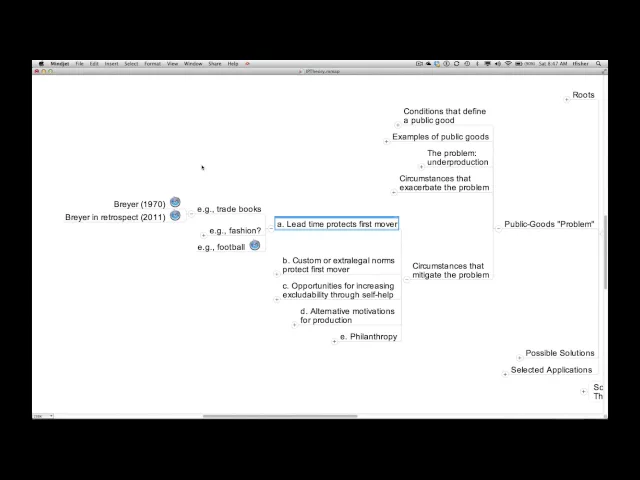
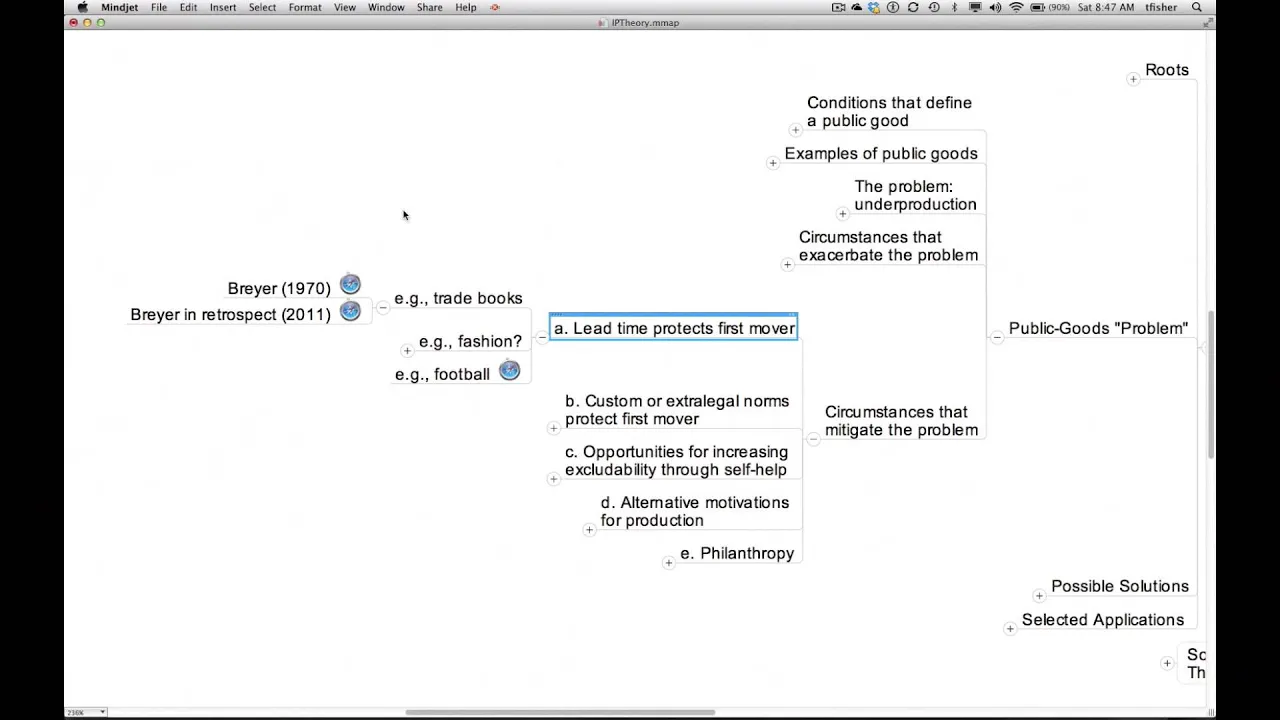
First, in some contexts, innovators obtain through lead time enough of an advantage over copyists to enable them to recover the costs of their innovations, thus reducing the need for a governmental stimulus. Justice Breyer of the United States Supreme Court, long ago when he was an assistant professor at Harvard Law School, wrote an article developing this argument in the context of trade books. One of Breyer's contentions was that the writers and publishers of so-called trade books-- for example, the textbooks that are used in US high schools-- enjoy at least a moderate lead time advantage.
It takes a while, he contended, to reproduce and redistribute books of the sort. During the window of time before competitors can enter the field, the first publisher can earn quite a bit. Perhaps enough to render uncertain the social need for copyright protection with respect to such books.
Hence the title of Breyer's famous article, "The Uneasy Case for Copyright. " Another context in which lead time may be sufficient adequately to support innovation is fashion, meaning the design of high end clothes. At least until recently, a fashion designer enjoyed a window of time between the first introduction of a new design and the moment when knock offs became available.
During that window, the designer could and did sell his or her dresses and suits for a very high price to wealthy and fashion conscious, or perhaps prestige conscious, consumers. As a result, innovation has long flourished in fashion, despite the fact that in many countries, including the United States, new clothing designers do not enjoy copyright protection or indeed any other type of intellectual property protection. Now, this argument, I hasten to add, is controversial.
Some commentators and designers disagree sharply, and most commentators acknowledge that the lead time window is getting shorter as the technologies for quickly reverse engineering and replicating fashion innovations are advancing. Another circumstance that may reduce the public goods problem and therefore reduce the need for governmental involvement is the presence of customary or extra legal norms that forbid or discourage unauthorized, uncompensated usage of the good in question. Again, trade books may be an example.
If there is a custom adhered to by all of the publishers in the field not to knock off each other's works, then the need for legal intervention diminishes and indeed may evaporate altogether. This argument may also be found in Breyer's article. Another potential example of extra legal norms is stand-up comedy.
Professors Dotan Oliar and Chris Sprigman argue in a recent article that comedians have a fairly elaborate set of customs that discourage so-called stealing jokes. Not all comedians abide by those norms. Robin Williams, for example, is famous for defying them.
But most do. To the extent these customs are effective, then legal intervention may be less necessary to provide an incentive for the creation of new jokes. A third circumstance that can mitigate the public goods problem consists of opportunities for increasing excludability through self help.
That's a somewhat cumbersome phrase, but here's the basic idea. In some contexts, innovators can use self help maneuvers to prevent promiscuous reproduction-- the creation and distribution of knockoffs of their innovations. Innovations in the fields of soft drinks and chocolate, for example, are usually protected by keeping the formulas for the innovations secret.
Think Willy Wonka. Encryption is a modern analog to secrecy. In some contexts, innovators nowadays are able to impede reproduction of copies of their innovations by encasing each copy in a technological wrapper of some kind.
Think Blu-ray disc. I'll return to this strategy in just a minute. Yet another self help technique relies on contracts.
An example-- in the United States, in contrast to many other countries, the primary databases for legal materials are not free. Instead, they're hosted by private companies, specifically Lexus and Westlaw. And those companies charge a fair amount of money for access to their databases of judicial opinions and statutes.
How? How do they protect themselves from competitors who have an obvious incentive to copy their databases and make them available more cheaply? Well, for the most part, not by relying on copyright law.
In the United States, in contrast to many other countries, governmental works including judicial opinions and statutes are not covered by copyright. They are in the public domain. Anyone is free to copy them.
The way in which Lexus and Westlaw nevertheless discourage competition and maintain their business models is by requiring subscribers to agree to limitations on copying and redistributing the materials. Violation of those agreements is not copyright infringement, but it's actionable as a breach of contract. The net result, Lexis and Westlaw don't need intellectual property protection to maintain their business models.
The fourth circumstance that mitigates the public goods problem is that with respect to some kinds of innovations, alternative motivations for production can substitute for governmentally organized incentives. A non-exhaustive list of such alternatives is set forth on your screen. The most obvious, passion.
Many artists love their work and would continue to do it even in the absence of any monetary reward whatsoever. To the extent that's true, the utilitarian argument for intellectual property or any other governmental intervention falls away because the good in question will not be under produced. Assume for the moment that all poets write for love, not for money.
That, from the utilitarian standpoint, would provide a compelling argument for withdrawing copyright protection from poetry. Now, there are other arguments reviewed previously in this lecture series for affording poets strong intellectual property protection. But from the utilitarian standpoint, the fact, the possible fact that a particular producer is motivated by non-monetary incentives reduces the need for law.
Prestige, fame, tenure-- these play powerful roles in academic communities. Most scholars make no money whatsoever from their articles. Some make money on books, but from articles, almost never.
So why do scholars write them? Well, first, to get tenure. And then, in some cases, to increase their prestige or renown.
Less selfish is the next entry on the list-- the norms of science. Specifically, truth seeking. This figures, at least to some degree, in all fields of scholarly endeavor.
Most people who work in research universities are primarily focused on contributing to human knowledge, not on earning more money. Scholars who've written powerfully about the implication of this fact for patent law and about the risks we run by contaminating this ethos with monetary incentives include Arti Rai and John Golden. Advertising-- I mentioned this in a previous lecture.
In some contexts, intellectual property products will be generated even in the absence of legal protection because they serve as advertising for other things. For example, it's sometimes said controversially that sound recordings function as advertisements for performances, specifically for concerts, and thus that we should not be troubled from a utilitarian standpoint by the decline in the monies that could be earned by selling copies of the recordings themselves. Next, collaborative voluntary creation.
In some contexts, people love to contribute without monetary rewards to collective creative enterprises. A rich array of such settings is examined by my colleague Yochai Benkler in the two articles listed on your screen. Perhaps most familiar modern example is Wikipedia, which now rivals in influence and accuracy proprietary encyclopedias like the Encyclopedia Britannica.
The people who have built Wikipedia don't make any money. So why do they do it? Well, primarily because it's fun.
It's fun not just to contribute to knowledge, it's fun to engage in a collaborative enterprise of that sort. Again, the general point is that to the extent such motivations are operating, the need for governmental incentives diminishes. Finally, that need is also reduced to the extent that innovators in a particular context are supported by private philanthropy.
For example, as Mike Scherer emphasizes, once upon a time, philanthropy was a main way in which musical composition was funded. Another example-- in the United States today, the news, gathered and broadcast by Public Radio stations, is funded in significant part by listeners who voluntarily contribute funds. Again, to the extent that's true, the need for governmental support is reduced.
So to review, we've identified a special and especially important category of goods known by economists as public goods that are subject to a unique danger. The danger is that unless government stimulates in some way their production, they will be generated in socially suboptimal quantities. There are, with respect to some such goods, circumstances that exacerbate the hazard of under production and thus intensify the need for governmental engagement.
Conversely, there are with respect to other types of public goods circumstances that reduce or mitigate the difficulty, and thereby reduce the need for governmental engagement. So let's assume that we're dealing with one of the many types of intellectual products where the public goods problem is serious. Say, full length entertainment films or new vaccines.
If a government recognizes the risk that such things will be under produced and seeks to overcome it, how could it do so? Well, over the centuries, governments have attempted to resolve the public goods problem in five different ways. They're listed on your screen.
I'll survey them briefly and then zero in on the one that's most relevant to this course of lectures. Number one-- the government can provide the public good itself. Recognizing that it will be under produced by private parties, the government can produce it.
An example is space research. In most advanced countries, government agencies conduct space research. In other words, governments don't rely on private parties to do the research.
Rather, governments take on the task themselves. In the United States, this approach may be corroding a bit, but it's still the dominant one. Similarly, much agricultural research is currently conducted in government labs.
Likewise, the provision of national defense is almost always done by a government. Mercenary armies are rare, at least in the modern world. The final example mentioned earlier-- navigation aids.
Throughout the world, almost all lighthouses and buoys and so forth are built and operated by governments. Not surprisingly, the density of those aids varies with the amount of money each government is able and willing to devote to the project. So there are many more buoys per mile along the coast of the United States than, say, along the coast of Croatia.
Number two-- instead of providing the public good itself, a government can select and subsidize private parties who are able and willing to provide the good. The premier example of this strategy in the United States is the $27 billion per year that the National Institutes of Health pay to private parties-- typically universities-- that, in the government's view, are likely to conduct socially beneficial medical research. Much smaller scale is the grant program of the National Endowment for the Arts, which subsidizes some kinds of cultural production.
In Europe, governments commonly subsidize private filmmakers. In other words, give them grants that supplement the money they can earn from box office revenues, performance licenses, and so forth. Where do the European governments get the money that they then pay to the filmmakers?
Well, sometimes from general tax revenues. Sometimes by taxing television stations or television advertising. Implicit in this portion of the system is a controversial judgment that film is a more worthy art form than television programming.
Finally, sometimes the European governments get the money through taxes on box office receipts. That at first seems very odd, until one realizes that the governments are trying in this fashion to diversify the kinds of films that are produced. In other words, a portion of the ticket prices paid by the patrons of mainstream films are used to subsidize films that are less popular, perhaps because they're unconventional, or because they're made by first time filmmakers.
Arguably, the ultimate objective is to elevate the tastes of moviegoers. Whether the European governments are justified and successful in this regard is a question to which we'll return later in this lecture series. Number three-- instead of giving private parties grants in hopes that they will then generate public goods, the government can offer to give the private parties prizes if they generate socially beneficial public goods.
In the context of inventions, the former Soviet Union and the People's Republic of China have pursued this strategy aggressively. In the United States, it's used much less often, but innovations in atomic energy are stimulated by the government in this fashion. In the artistic context, the Audio Home Recording act in the United States contains a mechanism for distributing government funds to the owners of the copyrights in popular songs.
Several European countries have much more extensive levee systems that work essentially the same way, all reliant prizes to induce innovation that arguably would not otherwise occur. Solution number four consists of legal reinforcement of self help strategies. A few minutes ago, I mentioned that in some contexts, secrecy or encryption can substitute for governmental funding and supporting innovation, specifically by providing innovators protection against competition and thus helping overcome the public goods problem.
Secrecy and encryption are not perfect, however. They're threatened by economic espionage, by faithless employees, and by encryption circumvention. So governments can come to the innovator's aid not by paying them money, but by establishing and enforcing penalties for evading the innovators private self help strategies.
That's basically what trade secret laws do. It's also the essence of the Boat-hull Protection Act in the United States, which forbids certain ways of reverse engineering the design of recreational boats. Last but not least, this approach underlies the recent addition to the copyright universe of so-called anti-circumvention rules.
In brief, these rules impose fairly strong penalties upon non-permissive trafficking in circumvention technologies, and in some cases, upon the act of encryption circumvention itself. The idea behind these rules is to buttress encryption as a strategy for discouraging non-permissive reproduction of cultural products. I mentioned these rules in the first lecture.
And we'll come back to them and examine them in detail in the 11th lecture. This brings us finally to the fifth, and for our purposes here, the most important of the approaches. The fifth strategy for overcoming the public goods problem is that governments sometimes protect the producers of public goods against competition through law.
So here's a quaint example. In the 19th century, governments would sometimes authorize private companies to create toll roads or bridges. In other words, to construct turnpikes or bridges over rivers, and then charge the travelers who wanted to use them.
But here's the key feature. When doing so, governments would frequently promise the companies that no competitor would be permitted to construct a rival road or bridge, at least for a certain period of time. The purpose and the effect was to enable the companies to charge high tolls, at least for awhile.
High enough to defray the construction costs and to make a tidy profit. Now, a footnote. The governments didn't always make good on their promises.
For example, the famous Charles River bridge case in the United States arose out of a breach of a promise of this sort. A promise to limit the set of bridges across the Charles River here in Cambridge to the first developer. Investors expectation that governments might renege in this way limited the effectiveness of this approach.
Putting that important nuance to one side, the key point is that governments sometimes encourage private parties to make socially beneficial things not by giving them grants or offering them rewards or helping them to lock up their ideas, but by suppressing competition, giving them for limited periods of time monopolies. Intellectual property, and the law of copyright and patent in particular, constitute an application of this approach. At least when viewed through the utilitarian glasses, the point of such laws is to give authors and inventors exclusive rights to make and distribute copies of their creations, and thereby to charge high prices for them.
High enough to offset the cost of creating them in the first instance and, even more importantly, to induce creative people to become authors and inventors rather than lawyers or financiers. In the next segment of this lecture, I'll examine in detail how the copyright system works, how exactly it functions to overcome the public goods problem.