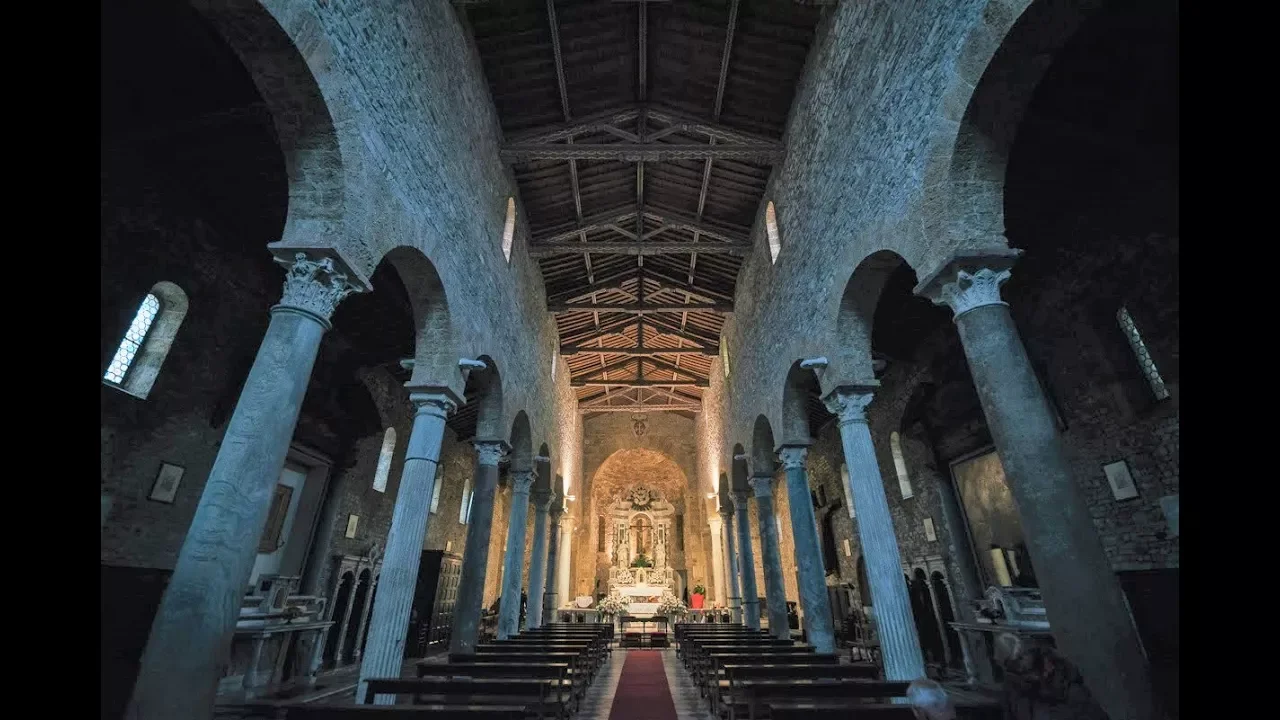
The next achievement to those narrated by epigraphs of the cathedral is the expedition of 1087 against Al Mahdia in the current Tunisia which he saw the triumph of the Genoese and Pisan fleet 6 August day dedicated to San Sisto since then taken a protector the victories of Pisa in this case is the entire church to be monument to the enterprise It is a kind of story for objects intense and complex relationship Pisa between the Islamic world in the Middle Ages we start from the front where we can noted in the profile of the gabled form
a series of ceramic basins used as ornament it is a practice that is found in other medieval churches of but particularly in the cities as Pisa They had a strong propensity to Mediterranean trade of Pisa Romanesque churches it is in fact rich in these ceramic basins that they were placed at the top the outside of the facade and of the side walls as many jewels on the end of a crown actually had quite the function to shine like jewels reflecting the sunlight falling on the inner surfaces of the basins for this reason they were chosen
for the decoration of Islamic origin plates extremely valuable because of the invoice refined and decorated with colors and glazes particularly reflective Today the originals of these basins are preserved in the National Museum of San Matteo and the church's façade we can only observe the copies are objects that tell relations between Pisa and north africa eleventh century in a somewhat 'different from tones It is found in the inscriptions of the cathedral not only hate war reprisals robbery They characterized the contacts between the two worlds The Mahdia in the eleventh century was under the rule of Zirids
a Berber dynasty linked to the Fatimid caliphate egypt and it was with his suburb zavila one of the key steps of business Mediterranean with warehouses walls and stocks of goods It was also very popular with merchants Christians certainly amalfitani but also Pisa since a letter of 1063 says that is normally used for trade even the money of Pisa it was these exchanges that good we have to assume part peaceful to lead to large amounts of Pisa goods from North Africa and between these even the ceramic basins who went to decorate the church of St. Sisto
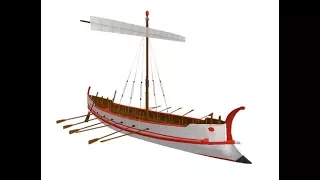
and other churches as well as the families canteens more wealthy however The Mahdia was also an active center of piracy the constant danger posed by Saracen pirates and a set of political circumstances internal He pushed Pisa in 1087 to set up a joint fleet Pisan Genovese and Amalfi with the task of recovering the Christian prisoners present in the domain of Zirids and reduce the meekness their king as he takes us on contemporary poem "Carmen in victoriam Pisanorum" "With its Saracen He is ravaging the gallia all nations made prisoners of Spain and troubled all the Italian
coasts raiding up Empire of the East and alessandria there is no place in the world nor Sea Island that the horrible perfidy not disturb rhodes cipro clay and Sardinia and with them Noble Sicily " The punitive expedition took place in the summer of 1087 but his training had to take a few years given that the overall fleet numbered 300 to 400 ships the goal it was the same time political and economic the victorious Christians asked fact sovereign Zirid not only the release of prisoners the promise to cease all activities corsair and the commitment to pay
taxes to Rome but also relief from rights customs to Pisa and Genoa and the payment of a heavy indemnity I sell used just part of the booty to build the church of San Sisto the saint of the day of victory and partly to continue the factory cathedral that undertaking had a tremendous impact on his contemporaries because he projected the collective Christian-Islamic the idea that Pisa and Genoa they were if united unbeatable sea and then they represented the coalition winning for each undertaking Mediterranean which are to be undertaken the enterprise against Al Mahdia and the church
itself However, they also tell another history the city in 1087 did not have a common and consuls but certainly she had the strength to organize and fund a military enterprise enormity perhaps for this reason San Sisto It became not only a monument to a great military victory but also for the town church excellence to build it It was in fact chosen a place in the heart the city probably close an ancient seat of the Marquis power the church was home from the start important civic meetings There were written solemn public acts and it was subjected
to the patronage of the reggittori common in short was born as a civic church that whole town recognized as a building symbolic for the exercise of power municipal probably for this very strong bond with glories of the city and the common It decided to put in it another important war rake Arabic inscription stolen from Balearic in 1115 "In the name of god the merciful the merciful men what God promises it is true that the worldly life do not deceive you the deceiver deceive you about God He died the Emir Al Murtada God already makes his
face shine " These are the opening lines of the beautiful funerary inscription in Kufic script junta unfortunately mutilated thanks to the transcription and studies we know it was in honor of Emir Al Murtada died Saturday, January 7, 1094 since the company Pisana against balearic She took place between 1113 in 1115 the emir was therefore not killed by the Pisani but the plaque was stolen as booty War after the victory and publicly exposed, as happened then, over next or in public buildings an impressive example of this practice is also the griffin that until 1828 He was
on the outside of the cathedral on a capital at the height of the gable apse now it preserved in the museum of cathedral It is one of the most bronze works important Islamic production between the tenth and the twelfth century Incidentally his sides and chest with religious invocations It is stylishly decorated although we can not know when and in that occasion the Griffin He came into possession of Pisa for we know only that it is an object of Hispano-Arab invoice Full eleventh century many scholars believe it to be like the epigraph of San Sisto the
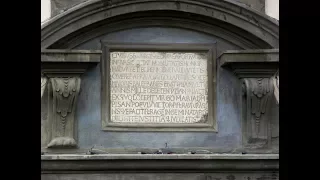
result of the battle of the Balearic the story of Emir Al Murtada and her beautiful epigraph binds to another human story recently rediscovered also engraved with marble letters on the facade of the Duomo that of the ill-fated queen of mAJORCA "I became the father of royal offspring Pisa kidnapped me I with his son I was war booty I had the kingdom of Majorca now I lie closed in stone that you see having reached my end whoever you are, therefore, remember your condition and pray to God for me prayerfully " inclusion then we know that a
queen Majorca was both Arabic epigraph probably to Griffin and who knows how many other rich objects taken prisoner by the Pisani staying in the Christian land did convert to the point that his death He was even buried in Cathedral thanks to Giuseppe Scalia studies we know that most likely this Queen was just a niece Al Murtada Arab Emir epigraph and the wife of another king of the Balearic Abu Rabi also known as King Burrabe last independent ruler archipelago of course Pisa to have as a guest or as hostage a character so influential and also be
able to get his conversion He represented a success not indifferent to display the universal authority era Pope and Emperor we do not know clearly what was the true condition of this woman he was a guest or hostage? it was honored or humiliated? the epitaph today placed on the facade of the Duomo as all epigraphs do not tell the story but only the official version of the history of the city as they saw the Pisani era