when it comes to transportation of cargo and ship it is not just about loading and discharging there are several other operations involved such as navigation, mooring, maneuvering, anchoring, channel crossing and so on but at the heart of the ship operations is the most important machinery, that is the propulsion plant of the ship or marine engine. The marine engine allows the vessel to maneuver accelerate and stop whenever required now as you all must be aware of, ships do not have brakes which can be used whenever they want to stop. So how do ships actually stop?
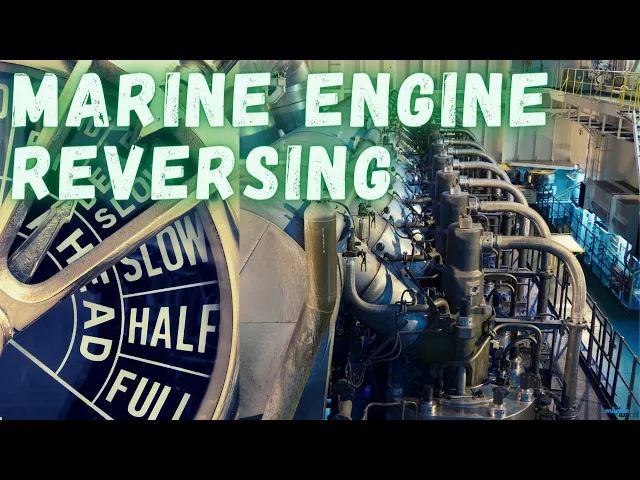
let's understand in this video, but before that please do subscribe to our youtube channel and press the bell icon to view all our future videos. Back to the topic, the halting of the ship is done using the marine engine. Whenever a ship needs to be stopped, reversing of the marine engine or the propeller direction is carried out to generate an opposite thrust which ultimately reduces the ship's speed and makes it stop as required.
This whole process might sound very simple but the engine is a complex machinery and so is the reversing operation it undergoes. Let's understand how the reversing process is carried out. The two-stroke marine engine used in ships is made up of several parts which help it to operate efficiently and safely.
some of these components work together in order to reverse the engine. unlike medium or small sized internal combustion engines the two-stroke marine engine does not have a clutch and gear systems to reverse the direction of the propeller. The entire engine rotation needs to be reversed for change of thrust direction which in turn will reverse the ship motion.
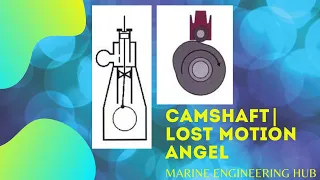
In large marine diesel engines the exhaust and scavenging timing are almost symmetrical in reverse and ahead direction, hence in order to carry out reverse direction, the two important components which needs to be changed are fuel pump timing and air injection timing. Now let's understand how each of these can be done. Fuel pump comprises a camshaft a negative cam and a cam follower which operates the plunger of the pump.
The fuel pump will deliver the fuel when the cam follower operates on top of the cam. Here a pneumatic valve is installed which shifts the cam follower roller to alter the timing when the reverse or astern command is given. Compressed air from the starting system is used to actuate the pneumatic cylinder and piston which displaces each follower unit.
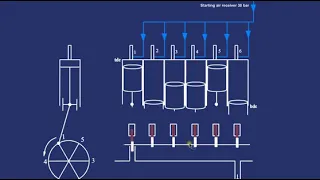
If the position is not properly locked in its place the fuel delivery will be stopped. This is done by a sensor fitted to each pump now once the engine is reversed and cam follower is shifted the timing when the injection happens will change when the fuel pump timing is altered for reversing of the engine that is the firing order is altered it is important to supply the air into the cylinder as per the new reverse firing order else the reversal of engine will not take place for this purpose the large mc engines use a radial air start distributor operated by two cams fixed on the end of the camshaft The pilot walls arranged radially in housing are either pushed by pilot air onto the inner cam profile when starting ahead or onto the outer profile when starting astern. When not in use a spring holds the pilot valve follower clear of both profiles thus reducing wear.
If the engine needs to be moved in forward direction the telegraph is moved to the ahead position. Till now the starting air is not supplied to the air distributor once the ahead signal is given, the air signal goes to the starting air cutoff valve, making it inactive. This allows the starting air to go to the air distributor and all the air starting valves via the air control valve.
Now the air from the air distributor will be supplied to different cylinders as per the firing order. As the ahead cam rotates the plunger which falls on the cam will move allowing the air to pass through, delivering starting air to the combustion chamber. When the astern command is given, the astern air signal will shift the distributor cam and the second cam which is responsible for astern firing order will come into play.
The astern air signal will make the air cutoff valve inactive supplying the starting air from the air manifold to the air distributor. Now the air from the air distributor will be supplied to different cylinders as per the reverse firing order, because the astern cam will operate each unit plunger in aseron firing sequence as it rotates allowing the starting air to go to the combustion chamber. In other engines like mitsubishi, the camshaft contains two cams one for ahead and one for astern direction for each unit.
The entire camshaft is axially moved to change the cam and hence the firing order in Sulzer engines, the cam alone is moved with respect to the shaft by use of servo motor.