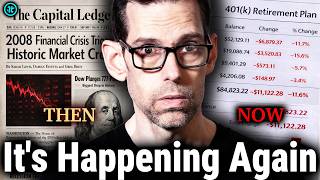
On March 9th, 2009, the S&P 500 closed at 676 points. The financial world was in freefall. Lehman Brothers had collapsed 6 months earlier.
Retirement accounts had been cut in half. Headlines screamed about the worst economic crisis since the Great Depression. Most Americans were terrified.
A school teacher named Margaret did something that seemed insane at the time. She took $50,000 she'd been saving for a house down payment and invested it in a simple S&P 500 index fund. Her friends thought she'd lost her mind.
Her family begged her to wait until things stabilized. Margaret ignored them all. Today, that $50,000 investment is worth approximately $590,000.
She didn't pick individual stocks. She didn't time the market perfectly. She didn't have insider information.
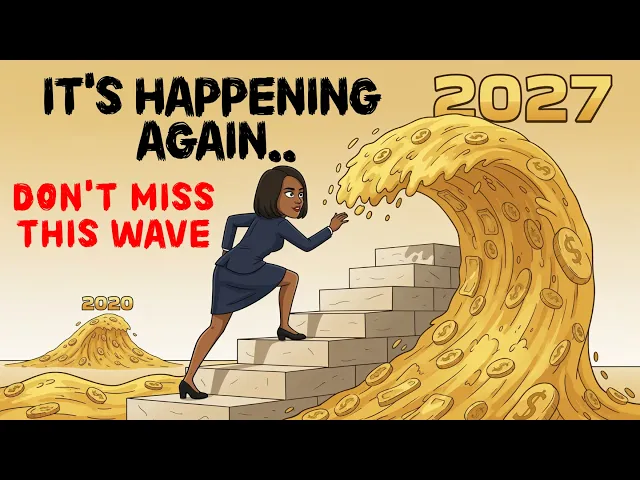
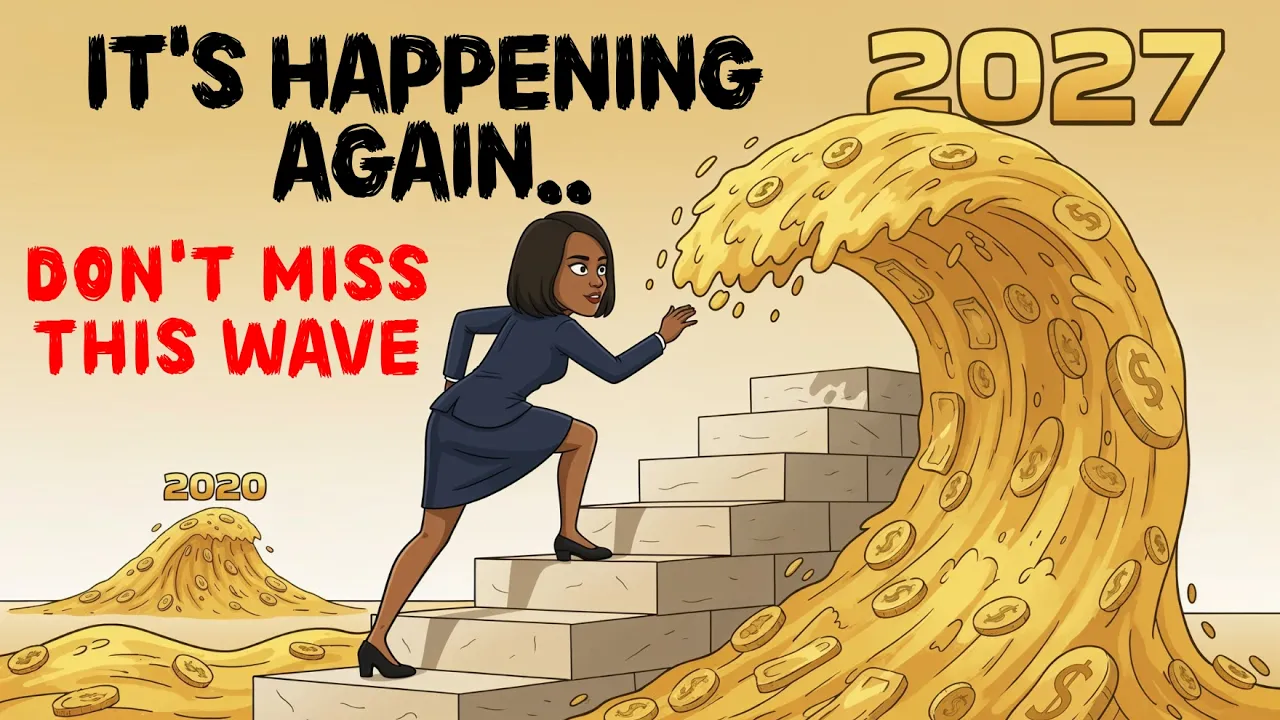
She simply recognized a moment that comes along perhaps once or twice in a generation. A moment when fear creates opportunity that transforms ordinary people into millionaires. Most people don't realize we're living through a similar moment right now.
Not a market crash, but something potentially even more powerful. A convergence of forces that hasn't happened in nearly a century. Forces that will transfer more wealth to regular people than any event in American history.
The number is $124 trillion. That's not a typo. $124 trillion is changing hands over the next two decades, and most people have no idea it's happening or how to position themselves to benefit.
Today, I'm going to show you exactly what's unfolding, why the conditions mirror previous wealth creation events that minted millions of new millionaires, and the specific steps regular people are taking right now to ensure they're on the receiving end of this historic transfer. The story of what happened after March 2009 illustrates exactly how ordinary people build extraordinary wealth. The S&P 500 didn't just recover from that 2009 low.
It launched into the longest bull market in American history. From March 2009 through January 2026, the market rose over 900%. The index recently crossed 7,000 points for the first time.
A $100 invested at the bottom became roughly $1,000. But the people who benefited most weren't Wall Street traders or hedge fund managers. They were teachers, nurses, accountants, and small business owners who simply kept investing through their 401s and IRA while everyone else panicked.
The data tells a remarkable story. In 2010, the United States had approximately 8. 4 million millionaire households.
By the end of 2024, that number had nearly tripled to almost 24 million. The country added over 15 million new millionaire households in just 14 years. Think about that for a moment.
15 million households crossed the million-doll threshold in less than a decade and a half. That's roughly the entire population of the New York metropolitan area becoming millionaires. Where did these new millionaires come from?
The vast majority weren't entrepreneurs who sold companies or executives with stock options. They were regular people who participated in the market's rise through retirement accounts and index funds. According to UBS's global wealth report released in 2025, the United States added 379,000 new millionaires in 2024 alone.
That's more than a thousand new millionaires every single day. Most of them became millionaires not through dramatic windfalls, but through the steady accumulation of assets in rising markets. UBS calls these people everyday millionaires or EM I lis, those with between 1 and5 million in net worth.
Globally, this group has quadrupled since 2000 to approximately 52 million people. They collectively control over $17 trillion in wealth. The path to joining them isn't secret.
It's documented. It's repeatable, and it's about to get easier. What makes the current moment even more significant than 2009 is something called the great wealth transfer.
According to Cerui Associates latest research from 2025, approximately $124 trillion in assets will change hands between now and 2048. This is the largest transfer of wealth in human history. Nothing in recorded economic history comes close.
To put that number in perspective, $124 trillion exceeds the entire annual economic output of every country on Earth combined. It's more than five times the current US national debt. Its wealth accumulated over eight decades of American economic expansion about to cascade through the generations.
The mechanics are straightforward, but the implications are profound. Baby boomers, those born between 1946 and 1964, currently control approximately 52% of all wealth in the United States. That's roughly $78 trillion concentrated in a single generation.
The youngest boomers turn 62 this year. The oldest are approaching 80. Over the next two decades, this wealth will transfer to their children, their grandchildren, and to charities.
Cerulei estimates that approximately $16 trillion will flow to heirs with another $18 trillion going to charitable organizations. Generation X stands to inherit approximately $39 trillion over the next 25 years. Millennials will receive approximately $46 trillion.
Even Gen Z will begin receiving significant inheritances as the transfer accelerates through the 2030s and 2040s. The timing matters enormously. Gen X, often called the forgotten generation, will receive approximately $1.
4 trillion per year over the next decade. This arrives at a pivotal life stage when many are caught between caring for aging parents and supporting their own children. For this generation, the inheritance wave could transform retirement prospects that currently look uncertain.
Millennials face a longer wait but a larger eventual windfall. The $46 trillion heading their way will arrive as many enter their peak earning years, creating multiplicative effects as inherited capital compounds alongside career income. But the critical detail most coverage misses is this.
The opportunity isn't just about inheritance. It's about the cascading effects that massive wealth movement creates across the entire economy. When $124 trillion changes hands, it doesn't sit still.
It gets invested. It gets spent. It gets deployed into businesses, real estate, and markets.
Every dollar that moves creates opportunities for people positioned to capture a piece of that movement. The last time anything remotely similar happened was after World War II when returning soldiers used the GI Bill to buy homes, start businesses, and build the middle class that defined American prosperity for half a century. That wealth creation event produced the baby boomers, who are now transferring their wealth.
We're watching history repeat, but at a scale that dwarfs anything that came before. The parallels to 2009 run deeper than most people recognize. In 2009, three conditions aligned to create extraordinary wealth for those who recognized the moment.
Assets were dramatically undervalued after stocks had fallen 57% from their peak. A massive injection of capital was coming through government stimulus and quantitative easing, and most people were too scared or too broke to take advantage. The current moment shares similar characteristics, though the mechanism differs entirely.
While markets aren't crashed, the transfer of wealth will create both opportunities and dislocations. Some assets will be sold to settle estates. Others will be redeployed by heirs with different investment preferences.
This movement creates buying opportunities for prepared investors throughout the transfer period. The capital injection isn't coming from government this time. It's coming from the wealthiest generation in history passing assets to their children.
The scale $124 trillion exceeds any government stimulus ever attempted. For context, the entire pandemic relief effort totaled approximately $5 trillion. The wealth transfer represents 25 times that amount flowing through the economy over the next two decades.
And just like 2009, most people don't know what's happening. The great wealth transfer receives a fraction of the attention given to daily market movements, even though its impact will be far more significant over the next 20 years. The people who became millionaires after 2009 weren't smarter than everyone else.
They were simply positioned to capture opportunity when it arrived. The same principle applies now. The strategies for capturing this opportunity require understanding several key dynamics.
First, inheritances alone won't create most new millionaires. This seems counterintuitive given the headline numbers, but the math reveals the truth. Cerulei estimates that approximately 62% of the wealth being transferred will come from high- netw worth and ultra high netw worth households.
These represent only about 2% of all households. The wealth transfer is highly concentrated. A small number of families will inherit massive amounts.
Most families will inherit more modest sums or nothing at all. Relying on inheritance alone is therefore a poor strategy for building wealth. Most people won't receive life-changing inheritances.
What they will receive is exposure to an economy supercharged by $124 trillion in moving capital. The opportunity isn't the inheritance itself. It's what the movement of that money does to asset prices, business opportunities, and economic conditions.
Consider the ripple effects. When trillions flow into investment accounts, asset prices rise, benefiting everyone already invested. When heirs purchase homes, real estate values appreciate, benefiting existing homeowners.
When inherited capital funds new businesses, job creation accelerates, benefiting workers across the economy. The wealth transfer creates rising tides across multiple asset classes simultaneously. Second, understanding where the money will flow matters enormously.
Research from Bank of America and Meil Lynch shows that younger investors have dramatically different preferences than baby boomers. According to their studies, 72% of investors between ages 21 and 43 believe it's no longer possible to achieve above average returns solely with traditional stocks and bonds. This represents a generational shift in investment philosophy that will redirect trillions of dollars.
Where baby boomers favored blue chip stocks and bonds, their heirs show stronger preferences for alternative investments, direct company investments, and emerging asset classes. Sectors aligned with younger investors preferences will see massive capital inflows over the coming decades. Artificial intelligence infrastructure is already capturing enormous investment in 2026 with companies like Nvidia driving market returns.
Clean energy, healthcare innovation, and digital assets are all positioned to capture disproportionate shares of redirected wealth. This doesn't mean abandoning traditional investments. It means understanding that capital flows are shifting and positioning accordingly.
The sectors that attracted boomer capital may underperform relative to sectors attracting millennial and gen Z capital. Third, real estate positioning will prove critical over the transfer period. The great wealth transfer will reshape housing markets in ways that vary dramatically by location.
Demand will increase as wealthier heirs seek to purchase homes. Supply will increase as inherited properties enter the market. Markets where boomers concentrated, particularly suburban areas and retirement destinations, may see inventory increases that moderate prices.
Markets where younger generations want to live may see intensified competition as newly wealthy millennials pursue home ownership. The data already shows this divergence. Median home prices have risen over 150% since 2000, but that appreciation has been highly uneven.
Markets attracting younger workers and technology investment have far outpaced markets losing population. The same $500,000 deployed in Austin versus Cleveland will produce dramatically different outcomes over the next two decades. Geographic awareness translates directly to wealth accumulation.
Fourth, staying invested through the transition period remains the most reliable strategy. The school teacher Margaret, who invested $50,000 at the 2009 market bottom, didn't need sophisticated strategies. She needed two things.
Capital to deploy and the discipline to stay invested through subsequent volatility. The market has delivered an average annual return of approximately 10% over long periods. Someone who invested $500 per month in an S&P 500 index fund starting in 2009 would have accumulated over $250,000 by early 2026, not counting any employer match.
But that journey included terrifying moments. The European debt crisis of 2011, the government shutdown of 2013, the trade war of 2018, the pandemic crash of 2020, the 2022 bare market. At each point, headlines suggested the rally was ending.
At each point, those who stayed invested captured the subsequent recovery. The great wealth transfer will create opportunities, but the most reliable wealth-b buildinging approach remains consistent investment in broadly diversified assets over decades. The transfer simply adds tailwinds to an already proven strategy.
Something people often overlook about wealth creation events is how they feel while they're happening. The period after 2009 didn't feel like a golden age while it was unfolding. Constant reasons to worry dominated headlines.
Each crisis generated predictions suggesting the rally was ending. Yet, the market continued climbing. The S&P 500 crossed 2,000 in 2014, 3,000 in 2019, 4,000 in 2021, 5,000 in early 2024, 6,000 in late 2024, and 7,000 in January 2026.
Those who stayed invested through the anxiety accumulated wealth. Those who repeatedly fled to safety missed the gains. Goldman Sachs research shows the cost of missing just the 10 best days in the market since 2009 reduce returns from approximately 17% annually to approximately 12% annually.
Missing the 25 best days cut returns nearly in half. The best days often occur during the most volatile periods when fear is highest. The same pattern will likely characterize the great wealth transfer.
Recessions, corrections, and crises will punctuate the transfer period. Headlines will regularly suggest that this time is different, that the old rules no longer apply. History suggests those warnings will prove premature, just as they did after 2009.
The underlying force, $124 trillion seeking productive deployment, will continue driving opportunity creation regardless of short-term volatility. Concrete numbers illustrate what consistent participation looks like over the transfer period. Consider a 35-year-old today who invests $500 monthly in diversified index funds for the next 25 years, roughly the duration of the great wealth transfer.
At the historical average return of 10% annually, that $150,000 in contributions becomes approximately $665,000. At a more conservative 7% return, it becomes approximately $45,000. The potential boost from wealth transfer tailwinds changes these projections meaningfully.
If economic growth runs even 1 percentage point above historical averages due to increased capital deployment, the 25-year outcome shifts significantly. That 7% becomes 8%. The $45,000 becomes approximately $475,000.
increase the monthly contribution to $1,000, which becomes achievable for many as careers progress, and the numbers scale accordingly. The $665,000 at 10% becomes $1. 33 million.
Regular people reach millionaire status through consistency alone. The numbers might seem abstract, but they represent the difference between comfortable retirement and continued financial stress. The wealth transfer creates conditions that make these outcomes more achievable for more people.
Fifth, the professions and businesses that benefit from wealth movement deserve attention. When 124 trillion changes hands, entire industries grow to facilitate the transfer. Financial planning, estate administration, tax advisory, wealth management, and legal services will all expand dramatically.
Real estate transactions will accelerate. Trust and estate litigation will increase. People who develop skills in these areas will find robust employment and business opportunities throughout the transfer period.
The wealth movement doesn't just benefit heirs. It benefits everyone involved in managing, protecting, and deploying that wealth. The numbers already reflect this shift.
The share of millennial and Gen Z clients at high- networth focused financial firms grew from just 8% in 2021 to 25% by 2024. Adviserss who understand younger clients preferences are capturing business that will compound for decades. Sixth, the spousal transfer dynamic that precedes intergenerational transfers creates its own opportunities.
Cerui estimates that approximately $54 trillion will first pass to surviving spouses before eventually transferring to the next generation. Nearly $40 trillion of these spousal transfers will go to widowed women. This creates a massive and growing market for financial services targeting women.
Advisers, planners, and wealth managers who develop expertise serving this demographic will capture significant business as women become the primary controllers of unprecedented wealth. The full intergenerational impact will unfold over multiple decades rather than happening all at once. The transfer is a marathon, not a sprint.
Those who position early will compound advantages throughout the period. The timing question always comes up. People want to know when to invest, as if there's a perfect moment they're waiting for.
The 2009 bottom seems obvious in retrospect, but at the time, nobody knew it was the bottom. The market could have fallen further. Many expected it would.
The great wealth transfer doesn't have a bottom to time. It's a 25-year process that's already well underway. The oldest baby boomers are 79 years old in 2026.
Transfers are happening right now. Waiting for a better entry point means missing years of compound growth while capital continues flowing. The best time to plant a tree was 20 years ago.
The second best time is now. The same logic applies to positioning for the wealth transfer. What strikes me most about both the 2009 opportunity and the current moment is how public the information is.
No secret knowledge exists. The market bottom of 2009 was visible to everyone with a brokerage account. The $124 trillion transfer is documented in research reports available to anyone willing to read them.
Yet, in both cases, most people failed to act. In 2009, fear paralyzed investors. Today, distraction and short-term thinking prevent people from positioning for a multi-deade event.
The people who became millionaires after 2009 weren't lucky. They were simply willing to act on information everyone had access to. The same will be true of those who benefit most from the wealth transfer.
An action framework based on this research would include several key elements. Maximize tax advantaged account contributions. The $124 trillion transfer will be partially captured by people whose retirement accounts grow alongside economic expansion.
Max out your 401k. Max out your IRA. Use HSS if eligible.
These accounts allow wealth to compound without annual tax drag. For 2026, the 401k contribution limit is $23,500 with an additional $7,500 catch-up contribution available for those 50 and older. Maintain exposure to broad equity markets.
Don't try to pick which sectors will benefit most. Own the entire market through lowcost index funds. As the wealth transfer flows into various investments, broad market exposure ensures participation in aggregate growth.
Develop skills that serve wealth movement whether through career pivots or side expertise. Understanding finance, estate planning, real estate or wealth advisory creates opportunities to capture fees from capital in motion. Build cash reserves for opportunistic deployment.
The wealth transfer will create moments of dislocation when assets temporarily mispric. Having capital available when others are forced to sell provides enhanced returns during periodic disruptions. Extend your time horizon.
Think in decades rather than years. The transfer spans 25 years. Position accordingly.
Short-term market movements matter far less than long-term participation. Consider geographic positioning. If flexibility about where you live exists, research where wealth will concentrate versus where it will disperse.
Real estate in receiving markets may outperform significantly. Have conversations with family. Understanding family plans helps with financial planning.
Whether you're in a position to potentially receive inheritance or leave wealth. Proper estate planning ensures efficient transfers. Historical context puts this moment in proper perspective.
The United States has experienced a handful of wealth creation events that transformed ordinary people into millionaires on a massive scale. The post civil war industrial expansion created the first generation of American millionaires, though this was concentrated among industrialists and financeers. By 1900, the country had approximately 4,000 to 5,000 millionaires.
The postworld war II boom created the first mass millionaire class through housing appreciation, stock market participation, and pension systems. Average home prices have risen approximately 500% since the early 1980s when boomers were forming households. The bull market from 1982 through 2000 created millions more millionaires as 401s expanded and technology stocks soared.
The S&P 500 has risen nearly 3,000% since the beginning of the 1980s. The recovery from 2009 through 2026 has nearly tripled the number of millionaire households as markets reached new highs. The S&P 500 crossing 7,000 in January 2026 marked another milestone in this ongoing expansion.
Each of these events minted millionaires who simply participated in economic expansion. No genius required. No insider access needed.
Just presence and patience. The great wealth transfer represents the next chapter. 124 trillion will move over 25 years.
Economic activity will accelerate. Asset prices will be supported. Opportunities will emerge.
The question isn't whether the transfer will happen. It's already happening. The question is whether you'll be positioned to benefit.
The school teacher Margaret didn't know in 2009 that she was capturing a once- in a generation opportunity. She simply recognized that fear had created value and acted accordingly. The opportunity today is different in mechanism but similar in scale.
Trillions of dollars are moving. Millions of new millionaires will be created. History will record this period as a defining wealth creation event.
You now know it's happening. You know the scale. You know the timeline.
You know the strategies that position regular people to benefit. What you do with that knowledge will determine whether you're among the millions who look back on this period as the moment everything changed.