It is a somewhat unfortunate reality of every student's experience that you at some point are going to have to make notes. Whether this be notes for an exam, notes for a test, or notes because you want to fully understand a particular topic. Now, the problem is most students don't know how to make notes.
Not through any fault of their own, but simply because they were never taught how to make notes that are meaningful, that actually help, and that genuinely allow them to reach the crux of an of a particular concept or process that they are trying to learn. And this means that most of the time that the majority of students spends writing notes is actually wasted time. Now, I'm not going to sit here and argue that taking notes is a bad thing.
I take so many notes. I'm in my second year at the University of Cambridge. I make notes for every lecture that I go to for all my supervisions.
I think they are so so powerful. But they are only powerful if you're able to write them effectively, efficiently, and in a way that is creating meaningful output. And in this video, I'm going to break down exactly how you can be doing that.
As always, I am trying to build out my YouTube. I love making these videos so much and it means the world when you guys subscribe. So, please do that if this helps.
Give it a thumbs up and let me know in the comments if you have any other video suggestions. Let's get into it. The way I'm going to do this is I'm going to start by giving you some general tips about how these notes should be sort of devised and then I'm going to move on to the formatting of these notes.
So, if you're pretty clear on all of these things, then you can move on to the formatting. I've got chapters in the video so you'll be able to figure out where that is. Otherwise, I do recommend that you listen to this bit just because it is very important and it's literally going to take less than two minutes because the first thing is you always need to be writing your notes in your own words.
There are two caveats to this. One, copy out key definitions exactly how they are given to you because a lot of the time you do need these word for word. And two, if there are specific flowcharts or graphs or equations that you need to know, then obviously you're going to be copying these out directly simply because again they are things that you need to know word for word or image to image where it is literally just pure memorization.
For everything else, every concept explanation, every analysis, every sort of case study, you want to be writing it in your own words. So, if you've just been to a lecture and you've got some notes written down from what the lecturer said, if you just watched a YouTube video, if you've got a textbook open, you don't want to be copying sentence for sentence. That's because you're not actually activating any neural pathways in any meaningful capacity by doing that.
You're wasting your time. You might as well be printing off chat GPT generated notes. That is, there is no difference in your brain.
Simply copying doesn't do anything. Now what does do something is when you take an information in one format, you think about it, you process it, and then you try and rewrite it in your own words in a way that makes sense to you. Because the way in which a certain textbook explains a concept or process isn't necessarily the way that is going to make the most sense to you.
The way that's going to make the most sense to you is the way that you will naturally write about this. So you always want to be reformatting things into your own words. Yes, this makes the process longer.
Yes, this is a bit tedious, but the more you do it, crucially, number one, you're actually getting some brain benefits of doing this in terms of memory because of this reformulation. And number two, you're going to get quicker at doing this. And fundamentally, the more you can break down an issue and explain it in your own words, the more you understand it.
So, you're already practicing active recall right from the note-making phase. Whereas, most students will have to wait for weeks to complete all of their notes before they even engage in active recall. And that means all that time is essentially wasted time.
and you don't want to be wasting any of your time. Then tied into that, you really don't want to get bogged down in sentences when you're looking at your source material. So when you're looking at videos, textbooks, class notes, lecture recordings, whatever it might be, you don't want to be thinking on a sentence by sentence basis, thinking how can I, you know, reformulate this particular sentence into my own words.
No, you want to be thinking about chunks. So big ideas, the concepts, the fundamental theories, the case studies, the arguments. These are the big the big ideas that you're then reformulating.
So you're not looking at it on like a small staccato sentence sentence sentence reformulation. You're thinking about the broader ideas and trying to really encapsulate those in your own words. And this might mean you have to go to multiple different sources.
You might have to have up your lecture notes and a lecture recording and also a textbook in order to be able to coordinate them all, get an understanding of the idea and then be able to write it in your own words. Again, yes, this is a much longer process, but it's actually a beneficial process in terms of your long-term memory. So, you're taking longer to write those notes in the short term, but in the long term, it's going to minimize the amount of time you need to be spending on this topic simply because you're going to understand it more right from the get-go.
Now, I'm going to be showing you the format of my favorite ways of taking notes. So, I have three formats that I will use, and I generally do kind of use them interchangeably, but they each have one kind of more specific focus. So, I'm going to start with my most commonly used notetaking method, and this is what it looks like.
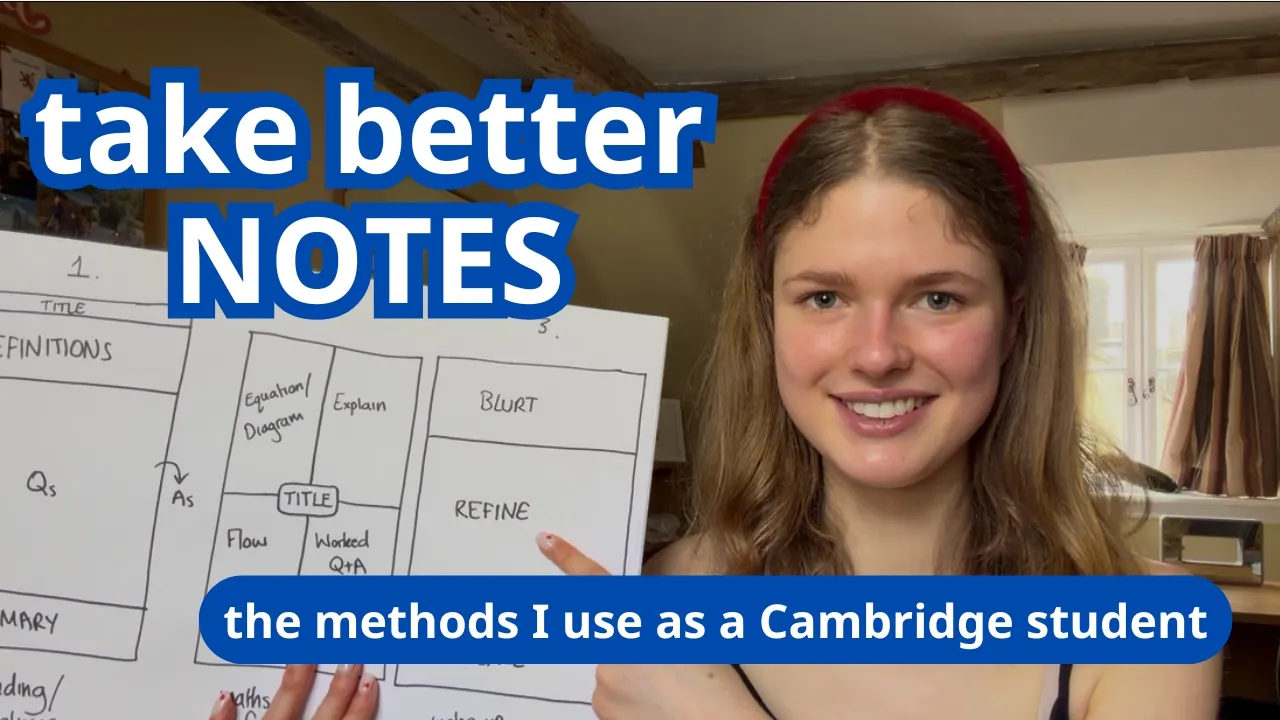
So essentially I write up the title of and this is just whatever concept or idea I'm writing notes about. I think it is worth me taking a quick pause just to mention that when you are taking notes the worst thing you can do is have a note page on a big broad topic. Your note pages should be super specific.
Even if that means you're not filling up the entire page. It's much better to be initially writing notes about these like subtopic areas rather than trying to cover a lot simply because your initial notes should contain all of the information that you have. And then as you move closer towards your test or exam, you're then trying to condense that information and that becomes a learning strategy that you're kind of reading through maybe five or 10 note pages and trying to condense all of that information into one page.
But you don't want to be doing that right from the get- go simply because you want that nuance at the initial moment and then you can refine it based upon what the exam is exactly testing etc etc. So that's your title very very specific. Then I will take maybe three or four lines.
It depends on the specific topic obviously. I will have keyword and its definition. I find this to be really useful.
What I also will occasionally do but I will go on to this more in my other note pages. But occasionally if this is for a specific paper, so I do take note pages like this read the most important papers for my university degree. Then here instead of definitions I will have either like processes or things that sort of key ideas from the paper but generally I would have keyword and its definition.
Then the vast majority of the page is taken up with questions and I have questions numbered on this side and then on the reverse of this page the entire page is taken up by answers to these questions. So, I'm basically making an active recall device as I go. And I find this super useful because then come exams and come like revising.
I can basically just use these as question packs because they're pre-made question packs that I know relate directly to the content that I'm going to be assessed on. It's perfect. And also thinking about breaking down a concept into questions and answers.
Thinking about how could I be tested on this is one of the most powerful sort of exam grade boosting techniques that you can be doing. So, that's why I try and implement it so much. Then at the bottom of the page, I will just have a summary.
And this will be a one or two sentence overview of this particular topic area, whatever the notes are on in a way that's like if I had a question and the question was just explain and then whatever my title is, this summary would be the answer to that. I should add that this first way of making notes I use primarily for when I need like deep understanding or when I'm going to be tested through some version of analysis. Now moving on to my second style of note-taking.
This is more for sort of formulaic approaches. So I use this much more when I'm being assessed on application or for maths based things. So you can see it looks very very different and I'm quite proud of this because I find this helps me so much with these more numerical style subjects where it can be quite hard to make notes but it can be very useful to have those notes as well.
So I put my title instead in the middle of the page. Again very specific on the specific area that I'm looking at. Then I split it into four quadrants.
In the first quadrant, I will have either the equation that I'm looking at that is related to this particular area, this particular subtopic or a diagram. So for me, I'm studying land economy. So I have quite a lot of real estate finance.
I also have a lot of economics. Real estate finance has a lot of equations. Economics has a lot of graphs and diagrams.
So that's what goes in there. And I break down what are all the variables, what are the axes, you know, just making sure I know what everything is related to that specific graph and equation, units, all of these things. Then next to it I just break down an explanation of what that equation is actually saying or what that graph is actually showing.
Now this is not what it is used for. It is what it is saying or showing. Do you understand that distinction?
So saying and showing is specifically like what actually is the goal of this particular equation completely in isolation. What is it telling me or completely in isolation? what is this graph kind of showcasing?
So if it's the supplied demand graph, you know, the most basic thing ever, line up, line down, then what is it showing? It's showing market equilibrium. And I develop that basically.
And then in this flow, I basically draw a flowchart. So one step arrow, another step, arrow, another step that explains what the equation or diagram is used for. So how do you apply it in a specific question?
And then here I will have a worked question. So, I will pick a pass paper question and I will have the question and then I'll have my worked solution to that question as well. Sometimes this can be quite long in which case I will generally like have the flow cover the entire bottom of the page and then have the worked solution on the reverse side of this page if needed.
But a lot of the time I can fit it all into this. And once again, super useful for mathsy things, economicsy things. There's a lot of geography, geographical processes where you have like diagrams of coastal erosion or something like this that you can also use this format for.
So, those are my two main note-taking strategies for when I am initially taking notes. Now, this is one that I do when I'm like moderately familiar with a concept and I basically want to wake up my brain before I delve into some practice questions or problems or using like the fineman technique or something like this. And essentially, this is blurting in note-taking form.
So, the way that I do this is I will set a five minute timer. I will draw like maybe a third of the page and I will cut that off. And in that page, in that space, I'm going to blurt down, but I'm not going to blurt down everything that I can possibly remember.
I'm going to try and blurt in an effective and efficient way. So, I'm going to think how can I most clearly communicate the idea that I am focusing on. So whether that looks like breaking down a process or a complex idea into a couple of sentences, whether that looks like taking an equation or a graph and explaining it and its use case, that's what I'm going to do at the top.
And I will set a timer for generally 5 minutes and do this in 5 minutes. Then I'm going to take up probably about half of the page refining. So I'm going to go to a resource, video, lecture notes, whatever.
Normally when I'm doing this, I will have one of these pages already pre-made for that particular um topic or subtopic area. So, I will get out my note sheet and I will use my note sheet to create a refined version of what I blurted before. So, that might mean changing some information.
I might have got some things wrong. It might mean adding things in. It might need mean using more specific language.
Whatever it might be, I'm going to do it in this section. Then, I'm going to put this to the side and I'm going to do a bit of work and I will go through my practice questions or whatever it is I had planned to do for that particular subtopic. Then once I have done the bulk of my revision of that particular session, I will return to the sheet of paper and I will condense.
I will basically fold it over at this line so I can't see what I blurted and refined. And then I will attempt to make a much better version of what I did at the start, but basically the same prompt. So I'm still trying to as clearly and concisely as possible communicate the idea that I'm focusing on with this sheet.
And I will do this and then I will compare it with my refined version that I'd written previously. and hopefully it's going to be much better than my first blur and include all of the kind of correct terminology, etc. that I came upon when I was refining.
So, that's how I create notes that actually work. I really hope this video has been super helpful for you. Um, I've been working on these kind of note styles for a good couple of years now, and I really think they work effectively for me.
So, I'd be super interested to know whether or not you feel they work just as effectively for you. As always, please do subscribe. Give this video a thumbs up if it was helpful.
Comment if you have any video suggestions.