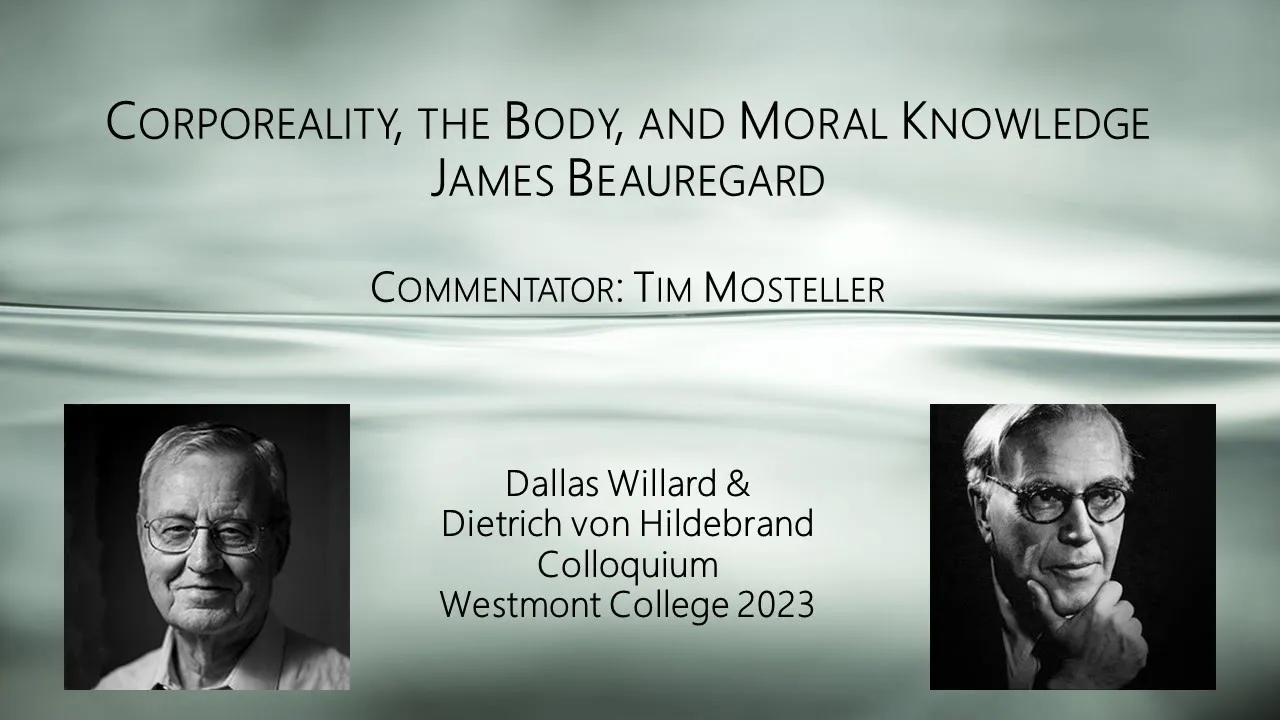
[Music] thank you so I was in that reading group for Willard and Hildebrand it was my first introduction to Willa's work and it was an awesome group and you know clearly taught me that I need to read more about him and as this conference what it came to be I found myself turning to the spiritual writings of which there are many holder brand wrote transformation in Christ themes emerge in his work Willard has quite a few books and one of the first things I think I was really struck by in his work is how practical
it is he's not kind of talking in this realm of theory he says okay here's the issue this is what you do this is how it works and that that's that's refreshing in uh in a lot of spiritual reading today so what I'm going to talk about is corporeality the body and moral knowledge I'm just mentioned by kind of my way with my background I am a clinical neuropsychologist by training my undergrad degree was in philosophy and I was uh being fed personalism without knowing it because we read John Paul II um it was right
after he became Pope so the entire Catholic Rose reading the acting person and trying to figure out what the hell was going on um so we did that but I've been sort of exposed to that tradition in many ways for a long time and my own Mentor in you know personalist work is the Spanish philosopher Juan Mo borgos I was located in Spain and Connections in Central and South America so I learned a lot from him as well and I'll be talking a little bit about his model of the person tonight but I want to
start with um I'm gonna turn to some poetry along the way T.S Elite is one of my favorite poets and I think he's relevant to Willard and Hildebrand both in his major work of wasteland which talks about the problems and in his four quartets which talk about the solution when I started looking into Willa's work the first comment I came across was this spirituality it has been said is for the very old and for the very dead nobody here has attained those two goals yet I think but it was a striking comment I found it's
in the spirit of the disciplines they're talking about you know why we don't talk about spirituality why uh why it's a difficult thing to talk about and why in many ways it is disappeared it certainly disappeared from many of our universities and he's talked about The Disappearance of moral knowledge the stuff that's just not there and not being handed on now which he saw is a major major problem and you know I would agree that personalism provides some some answers to that problem so this is a conference about those two philosophers Willard and Hildebrand and
it grew out of that reading group which was just really excellent uh in 2018 The Disappearance of moral knowledge came out and Hildebrand also talks about moral knowledge and across his books if you read Hildebrand you very quickly find out that you can't there's no one place you can go through to find what he says about X you have to read all of his books and say okay it's here and it's here and it's here it's here and it's here um Sophie Hildebrand that includes sources like the ethics morality and situation ethics the dethronement of
Truth and graven images his thoughts on the spiritual life kind of course through of course through those Works Dallas will it is much more focused in um in his writing and in many ways much more practical about it than Hildebrand is both philosophers lamented what they witnessed as a progressive Vanishing of moral knowledge across the 20th century but this conference also needs to be about how that Essential Knowledge can be reclaimed I think now what do we do about it we can you know we can say it's it's disappearing how do we help bring it
back how do we reinsert something into the public debate into public life that isn't really there now in this talk I want to focus on one particular place where moral knowledge has been lost and that is the human body I'm taking a course right now and uh we're going to Masters in philosophy at the University of anahua in Mexico and the course I'm taking it's fascinating when it's some personalism and sexual identity and the professor has taken us kind of a grand tour of feminist Theory from about 1900 1910 through today and and kind of
illustrated The Grand split that's happened in human sexuality with the Advent of widespread contraception and how sexuality has been divorced from procreation the two are not talked about each other as linked anymore what are the consequences of that Ben you know as a psychologist also I often deal with people who are doing all sorts of nasty things to their bodies and so very concerned about of the body in general I want to consider the consequences of that loss of moral knowledge in that area without two philosophers and I'll do this in three stages first I
want to consider a comprehensive vision of the human person that I've been working with for some time now a model developed by my mentor hormone Mo borgos in his work in integral personalism it's a philosophical Vision grounded in the ongoing project in the 20th century bringing together tomism and phenomenology so he's very much in the tradition of otiwa Evita Stein and and other Scholars who tried to bring those Traditions together he's not sort of a separate character in this if you look at his model of the person in a moment everything he says about AB
activity is drawn straight from Hildebrand so it's it's like the whole thing it's all right there so we know from the outset there's a common phenomenological thread between Willard between Hildebrand and Borgo so I'll say a little bit about along the way and we'll look at what will will Willard and Hildebrand have said about our bodies the way moral knowledge has disappeared there and how it's affected Us in that in that domain so in order to speak about our two philosophers I'm going to begin with my teacher Juan Manuel who has developed a model of
the person that I found to be very useful across across disciplines and the work that I've done I've just published a second book in neuroethics that I call personalist neuroethics and in which I've argued that utilitarianism probably isn't enough to develop a an ethics of Neuroscience in a little something more than that um and personalism I think is a place where that needs to be introduced as well um I don't have a slide to put it up but I'm going to tear this out and pass it around so they're done with the page the support
goes as model of the person um he talks about and this is very consonant with full of and with Hildebrandt talks about the person as being composed of many different aspects of an integral Unity body psyche Spirit knowledge wisdom affectivity all integrated none of those things separate and that each of those areas interacts with resonates with the others so it's an attempt by him to to really bring an integral vision of the human person and to talk about what that means and moral knowledge has to be integral to that model so I've torn on my
page John Henry if you want to send that around one thing I'll point out is that the internal lines of the model the box in the middle they dotted he talks about all these different aspects of person there's nine of them in there but they're not distinct any place where you enter the model you're entering the person he makes the comment very explicitly and one of his works that to touch the body is to touch the person the touch of the body is to touch the person and so when we talk about persons we need
to include thinking about um think about what that means we can temporarily lift one dimension or another out but it always gets sort of pulled back in so let's turn briefly to Willard Willard addresses the spiritual life of the body initially by recognizing many a misapprehension about the relation between spirituality and our physicality a lot of the personals I work with don't want to talk about the body they want to talk about corporeality and the notion that it's not just the physical stuff it's not just Corporal it's just for over said it's it's a living
aspect of ourselves that resonates throughout you know we never get away from our bodies it's an integral aspect of Who We Are as I said at the beginning spirituality has been said is for the very old and the Very dead well it said so this is where the popular idea that that spiritual and spiritual life frustrates even harms the body originates he says this jaundice view of the body is unfortunately well attested in Christian tradition virtually from its Beginnings we as Christians are sometimes at our best and oftentimes not at our best you know the
moral tradition in the first five centuries of the church was an integral whole then there was a long period of Decline and in the Catholic creation that was reconstituted by Thomas Aquinas and then there was another period of decline reconstituted Again by Alphonsus ligori and then another period of decline until in one one line in one document on Priestly formation said at Vatican Council said moral theology ought to be renewed that's the only comment that the Council made about the moral life and people pounced on that so good things have been happening since then so
you know we know about the dualism in the platonic tradition drawing on orific tradition before that and the view that the body is a prism something we fall into and that we are in some way separate from our bodies and what's the goal get out of it get back up into the world of the ideas it can get worse than this and dualistic Notions to see all matter is evil but something was stuck with in this life it can be an obstacle to reaching God in this view something that must be then overcome Willard rightly
recognizes this as a distorted notion of the body and of our corporeality something instead that has been created by God and that therefore is good by definition it's good by definition that's how we need to approach it yes we're falling we live in a post-fall state but that state also includes Redemption a reintegration of who we are so we're not just trapped or held prisoner by an enemy we live with a friend who refers to this tradition Willow does as repressionist the repressionist view of the human body and one that stands in direct opposition to
the Incarnation and to Christianity at its best he takes a more balanced and fully Christian view stating that the spiritual and the bodily are by no means opposed in human life they're complementary he recognizes the human person as a Unity practically speaking then this means that both body and spirit the human person are called the sanctification I don't hear a lot of talk about sanctification of the body when I hear about kind of moral Theology and spiritual practices and things like that it's usually something to be overcome it's it gets in the way it's it's
a block it's just trying to make spiritual progress and this is sort of yanking us back and making it harder one might ask or object it did not the early Christians especially the desert fathers of the fourth century and later view their Retreat to the desert as a spiritual battle against the body in their extremes yes one of the interesting things when you kind of read that tradition is there there are folks who kind of went out on a limb there was Simon the style light people who just did bizarre things the community reeled them
back in no no this is not it come back in and take a more balanced view of of who you are including who your body is so the foundations of monasticism actually held the body in reverence and recognized that it was something that we needed to include in our search for salvation was the whole person who went to the desert that didn't leave their body behind didn't go out to the desert of Egypt it went with them and yes sometimes it was a problem but yes also they realized they had to struggle with this to
make it whole so what do we do with our bodies Willis speaks of what Hildebrand names the metaphysical situation of man a situation that cannot exclude a corporeality metaphysical situation of man is is our post fall condition fallen and redeemed as Christians both men recognize us as fallen and redeemed free and able to choose the path will follow open to Grace and at the same time often resistant to it both philosophers could immediately recognize the human condition that T.S Eliot depicts in his 1922 work the Wasteland it's an extended depiction of the inward fragmentation and
spiritual death of the human person in modernity like Dante's Inferno that poem is set in hell where Elliot quotes Dante directly at the beginning a crowd float over London Bridge so many I had not thought death had undone so many it's from the third Canto on The Inferno Ellie speaks also with a fragmentation that is that is within us out of this Stony rubber son of man you cannot say or guess for you know only a heap of broken images where the Sun beats and the dead tree gives no shelter the cricket no relief and
the dry Stone no sound of water each of us knows directly in our own experience that we are not whole not always integrated and that we can be a heap of broken images fragmented in so many aspects of our being fragmented as we Catholics say my thoughts into my words and what I've done and what I've failed to do we say that at the beginning of every Mass Hildebrand points that out saying you know our metaphysical metaphysical situation of us just put right out there on the table at the beginning let's be honest about who
we are and then move forward as Christians we also know that the possibility of integration and of healing exists and in fact this has already begun for the life death and resurrection of Christ and for a long and sometimes arduous journey in the light of Grace to a loving Union with God in this life and in the next one Christian realism demands of us that we recognize the fragmentation of our metaphysical situation but also the way that it has at the deepest level been healed There's Hope then and a path forward made possible by Christ
and strengthened by Grace toward a loving Union with God that also promotes loving Union with each other they are always connected so both Willard and Hildebrand understand our metaphysical situation they understand the big picture they offer diagnoses and solutions and there's an explicit common denominator to their thought in this regard has captured by a word both philosophies used frequently transformation transformation hildebrink put that title on one of his books we are in the view of both of them and persons on the way in the Journey of this life broken healed and being transformed Willard offers
a diagnosis of a situation and renovation of the heart beginning with the problem he says quote we must see the soul and the person in this ruined condition with this malformed and dysfunctional mind eek dysfunctional mind feelings bodies social relations before we can understand that it must be delivered and reformed and how that can be done end quote they're examples of this fragmentation in Elliot's Wasteland the breakdown of cultural institutions after the first world war captured there as evident in each of the characters that Elliott depicts fortune tellers the young typist Homa tea time for
a disconnected sexual encounter Mr eugenity is a smarter Merchant looking for a lost weekend the Metropole the young woman in the poem who was just had an abortion it's not sort of explicit in it but it says I can't help what you said pulling a long faces some pills I took to bring it off she said she's had five already and nearly died of young George the chemist said it would be all right but I've never been the same we also see the fisher king in his woundedness in the poem as well a rat crept
softly through the vegetation dragging its slimy belly on the bank while I was fishing in the dull canal on a winter evening round behind the gas house music upon the king my brother's wreck and on the king my father's death before him have you seen the movie the fisher king of Robin Williams and Jeff Bridges it's a great movie so we are in a moral Wasteland as Tia Salvia sorry and will it I think would accept the situation only expanded and deepened across the 20th century he named several reasons for this a general Retreat from
religion and theology profound changes in higher education where moral knowledge was once reliably passed from generation to generation and the general Zeitgeist of secular society is failure to find a secular basis for moral knowledge and the changing nature of our view of ourselves understood quote in terms of the soul and its nature and function end quote in this context will it give substantial attention to the human body and I'd like to follow his thinking for a bit here he does not mince words he writes we must see the soul and the person in his ruined
condition as I said we need to see that it can be reformed and we also need to think very practically about how this can be done we have to begin from where we actually are and this includes our redeemed State as well after speaking of transformation of the mind and the will will it turns to the body an object of spiritual transformation as well in his view the context of transformation of the body he writes spiritual transformation into Christ likeness as the process of forming the inner world of the human self in such a way
that it takes on the character of the inner being of Jesus himself the result is that the outer life of the individual increasingly becomes a natural expression of the inner reality of Jesus and of his teachings this transformation must include transforming the body which is chapter nine of his renovation of the heart he begins realistically and then turns to practical matters well that recognizes in the fallen and redeemed human condition that the fact that our free will still has a tendency to pull us to a disintegration toward evil he writes in the body the inclinations
to wrongdoing that literally inhabit its parts must be eliminated the body must come to serve us primarily as an ally in Christ likeness different from what you often hear in contemporary visions of the body I find you know working in the sort of Neuroscience world as I do and thinking more recently about transgender issues that you know the body has been split off and reduced to raw material for our use if your gender doesn't fit change your body and it fits will it wants our bodies to be fully at God's disposal for a life of
Grace and sanctification he gives four recommendations and renovation of the heart the how this process of bodily transformation can begin and continue I'm not going to ask you to do them here but think about doing them when you're home alone it's a matter of not just seeing the body in an isolated way but the whole person has four recommendations of these you must actually release your body to God you must actually release your body to God second no longer idolize your body Hildebrand wrote a book called graven images about idols do not misuse your body
and fourth the body is to be properly honored and cared for this may sound theoretical initially but he quickly moves to the Practical you must actually release your body to God we need specific concrete actions well it says to open our bodies to transformation in Christ practically speaking you don't have to do it now he encourages us to quote lie on the floor face down or face up and explicitly and formally surrender your body to God then take the time to go over the main parts of your body and do the same for each part
what you want to ask what you want to do is to ask God to take charge of your body and each part of it and to fill it with his life and use it for his purposes so we don't just think of not sinning with the body there's more to it than that as he says remember a sacrifice is something to be taken up in God something to be taken up and transformed that's not meant to be a one-time event for him but a periodic one something we should do regularly he also says no longer
idolize your body the body cannot be to use hildebrand's phrase a Graven image something we sculpt and fix and make perfect in sort of some image that we're we're thinking that we should look like something we idolize and make an object of ultimate concern as Willard says we take care of our bodies but not as an end in itself but rather connected with a point just mentioned to be taken up by God for God's purposes thirdly he says do not misuse your body for Willa this means first to not use the body solely as a
source of sensory gratification in a way that manipulates or dominates other persons that does it instrumentalizes others this in his view is the Royal Road to addiction this counsel is to not use our bodies to intimidate others and not to abuse our bodies through overwork and equally practically to make sure we get enough sleep I say that to my graduate students all the time and I remind them that you know if you look at sleep Neuroscience one of the things they often say is that if you need to be woken up by an alarm clock
in the morning then you are by definition sleep deprived and you have a problem four the body is to be properly honored and cared for it's not just a matter of what we do and do not do with our bodies but positive actions we take and it's here that Willis speaks of the Holiness of the body of the need for refraining from engaging in wrong thought and action nourishment exercise and rest are essential for this aspect of transformation we can't transform ourselves we can't be transformed if we're just too tired here he makes a striking
statement one that many ways has been forgotten in in the moral vision of Christianity as well he says the prop the Practical Center for proper care of the body is the Sabbath the center for care of our body is the Sabbath I'll return to this after we've looked at Hildebrand lastly for Willard he speaks of the body's plasticity this is the term one often hears a neuroscience about the way the brain can change its structure and connections by new learning experience but he speaks to the body as plastic in this way too he says that
with God's grace and our cooperation the body God has given us is one that is plastic in the primary sense of being pliable and capable of being formed in various ways this means he says that the very substance of our bodies is shaped by our actions as well as by Grace into Pathways of good or of evil it's the spiritual disciplines that guide us on the way he writes what then is the specific role of the spiritual disciplines the role rests upon the nature of the embodied human self they are to mold and to shape
it not just to shape ourselves for our inner life but to shape our body as well and our partner Redemption is through specific and appropriate activities to yield the plastic substance of which we are made to ways that a new life which is imparted To Us by the spirit can take root and grow mental health brand what's clear now from Dallas wildebrand is also clear in the work of DJ from Hildebrand they don't always say it the same way but they're often talking about the same things about the consonants of the the two thinkers the
body is never separate from our relationship but God forhold the brand never separate from a spiritual life it is integral to it at every stage of life including the stage after we die when our bodies will be rejoined with us hildebrand's vision of the person in regard to the spiritual life has an aspect that focuses on the body he recognizes the body as an aspect of the person created by God and therefore good as well he also recognizes the medical metaphysical situation of persons is created fallen and redeemed and in need of assistance along the
road to God both Hildebrand and Willard are concerned with human action through the body and they approach it different ways it must be said that will it exhibits the more practical and concrete concerns with regard to the spiritual life where hildebrain kind of spreads himself everywhere I have to go through all those works like I said both philosophers are written explicitly about the heart Hildebrand if I may make a comparison tends to turn his attention Inward and to focus on our moral attitudes in the spiritual life though without neglecting the reality of the body his
major work on the spiritual life transformation in Christ which he wrote when he was fairly young and then a fairly recent Catholic is subtitled on the Christian attitude this tells us where his focus is going to be on the attitudes of Christ as they impact our life and our transformation the outlines of hildebrand's moral Vision I think are unknown to many if not all of us here his moral vision is a philosophy of value and specifically a value response to arrive at Value he names the three types of categories of importance things that motivate us
to thought and action the first is the merely subjectively satisfying that which I find pleasing in some way a good meal good glass of wine good company the second is the objective good for the person that which is necessary for the first and Beyond any specific desire or satisfaction so food clothing and shelter kind of come under that category these two categories have a specific reference to kind of the individual person the objective of good for me which might be different from the exactly good for John Henry of good for Tim it's still kind of
grounded in in US but there is a third kind of importance and this he calls the important in itself something that is important apart from us something that has an objective importance that we can come to recognize and respond to this is his definition of value that which is important in itself not dependent on some aspect of me and take a look say at the artworks around us in this room they are not me I can look to them and I can recognize Beauty there I can recognize aesthetic value and a variety of things those
are not dependent on me they call to me and I can respond to them an appropriate response to the aesthetic value of beautiful painting or beautiful scene in nature can include things like Wonder awe Delight the appropriate response to the value that is a human person Hildebrand says includes reverence respect and love was personalistic Norm is the person is the kind of entity two toward whom the only proper response is love now this response to value is connected to hildebrand's vision of the person he describes what he calls the three spiritual centers of the person
the sources of our responding there is a loving value responding Center the good stuff and the two sources of trouble for us which he kind of boils down to Pride and concupiscence lust kind of written but unless it's easier to say than cubicles so I didn't talk so you should say that instead and everybody knows what I mean when I say it so hold your brain names these three spiritual centers and all three of them can bear fruit and Human Action but the goal of the spiritual life is to transform into that loving value and
responding Center so that is our fallback position in thought and action and feeling and will this is Dante an aspect to hold the Brand's work as he describes the consequences of living out of those centers of Pride and concupiscence they hold their brand the goal of the spiritual life is to live out of that free loving Center Willard mentioned the Sabbath in his work as we knew from our reading group and subsequent contacts with each other it's not enough to Simply Lament The Disappearance of moral knowledge that's an important First Step then you got to
do something about it and a lot of the conversation the group is okay what do we do about it those who are aware of the laws who have striven to keep moral knowledge alive in their work have responsibility to do what they can in a given Zeitgeist which will not always be receptive to the work for the restoration of moral knowledge we can certainly do this in our own lives and in the lives We Touch and while that's necessary we need to be have it to give it to others we can't give what we don't
have and so our own transformation is integral to the transformation of the world now the Willen of Von Hildebrand will be satisfied if we simply stop with a lamentation they'll both say yes and then what I thought about this question in light of Willard's twofold Insight that the route back to public moral knowledge in our culture first must be to avoid the pitfall of introducing moral knowledge and appropriate and inappropriate ways that we that will repel rather than attract how you say it matters how you present it matters second we need a constant primary subject
to be the focus of that process and for Willa that is the good person he speaks at length and disappearance of moral knowledge about the notion of the good person the good person is a central subject of moral theory at the conclusion of The Disappearance of moral knowledge this is very much in keeping with the gospel message as well Jesus talked relatively sparingly about rules and regulations but he talked a great deal about the type of person he wanted us to be it's a very practical project Willard notes that it's essential in our current circumstances
to identify a good person as the central subject of moral theory so what does that mean what does it mean to be a good person in real life the good person stands out as one who characteristically evokes trust admiration support and a desire to be associated with and to imitate it provokes a value response I think is the way that Hildebrand would put that we are confronted with a good person someone who radiates goodness and we respond to that in these ways many of the key moments in John's gospel often occur in direct face-to-face conversations
with individuals there's The Sermon on the Mount is not in John's gospel it's in Matthew in John Jesus has direct conversations with single individual people and amazing things happen there they all come to him thinking they know everything they're asking the questions jesus takes their questions transforms them and then gives them back to them and all of a sudden they become a different kind of questioner Nicodemus the Samaritan woman of the well the woman caught in adultery in intimacy face to face transformation happens I know there are some of you here in the group who
um become Catholic for the years and be willing to bet that it was not because you read a good book in moral theology as I read I Came Upon something in Willow's renovation of the heart that caught me by surprise and his chapter transforming the body right after speaking about those four points of spiritual formation that I mentioned earlier we find this statement the Practical Center of proper care for the body is the Sabbath and that got me thinking will it cause the Sabbath a celebration of God and says that Sabbath is inseparable from worship
and indeed genuine worship is Sabbath I suspect for most of us two things come to mind when we hear the word Sabbath we don't work that day and we go to church that's true but it is a beginning it's indeed about rest and the rest that Willard writes of is he says that rest is one primary Mark of the condition of Sabbath in the body require a sufficient amount of rest to be able to let God transform us unrest is a mark of its absence and transformation does not happen though the absence of rest has
an immediate effect on the body's transformation in this case as well it says it's regression and our regression along with it if we are not rested on the other hand the body moves to the center of our focus and makes its presence more strongly felt and the Tendencies of its parts fall out more strongly for gratification the sensual desires and ego demands will have greater power over us through our desperate bodies in addition our awareness of what they are doing and it's very subtle what's happening around us will be less sharp and decisive foreign for
the Journey of transformation in Christ This Is The Way backwards when we don't give the body sufficient attention we don't give out reality in an integrated way the chance to rest and the chance to worship we move backward instead of forward will it further comments the body must be weaned away from its Tendencies to always take control to run the world to achieve and produce to attain gratification Hildebrand approaches the question of the Sabbath from a liturgical perspective centering his attention on the transformative aspects of the Liturgy in a more objective way you know Sunday
mass is what it is it doesn't change kind of from week to week for us Catholics there's probably 10 years ago they translate one phrase in the mass and so instead of at the end of the the readings they they used to say this is the word of the Lord and we'd all say thanks be to God they changed that to the word of the Lord because that's what the Latin text like oh my God something changed it stays the same we come to it and let ourselves be transformed by it there's some unpublished work
of of hildebrands that I think John Henry will talk about these a little bit later he used to have people come to his home and uh would comment on some aspects of liturgical year the readings for the day the liturgical season and he would talk about the mass and with regard to the Sabbath he said that the actions and words of the Liturgy are instrumental in creating habits of mind that direct both mind and body toward God along the spiritual journey if his Willard says the way back to moral knowledge is to focus on the
good person that also means focusing on what the good person does the type of person that he is and lives in the type of life that he or she leads and with Hildebrand the fundamental moral attitudes that underlie and give impetus to that wife I often find it curious in Modern Life that some of the Ten Commandments we follow to the letter I think probably no one in this room is habitually stealing committing adultery things like that but many of us take this honor the Sabbath is kind of an optional commandment I've been to lots
of Sunday morning soccer games because that's when they schedule them as a daughter's soccer and then and so there are a lot of things that impinge on the weekends that we have to make choices about whether or not we're going to do them remember the Sabbath day to keep it holy we need to give some thought to what that means to us as Christians because as Abraham heschel says who we are depends on what the Sabbath is to us it's a matter of identity who we are depends on what it is depends on how we
live it he describes the Sabbath not as an interlude but as a climax of living the other days of the week are just for the Sabbath not the other way around they're the build up to it and it's the climax of the week we live however in a contemporary Zeitgeist materialism accumulation utilitarian attitudes I think both Willard and Hildebrand would agree and the Amber heschel's work heschel's words the Sabbath teaches all beings whom to praise teaches all beings move to praise not a Graven image but God Dallas Willard and teacher from Hildebrand both recognize the
roots of the loss of moral knowledge and both of them meet well as criteria of the good person there's very much agreement there there are models of good persons we can look to learn from and seek to emulate along a road that they themselves have already traveled leaving a signed force signposts in their writing and their example of where the road is and how the journey is to be made I never got to meet either one of them and I wish I could have it would have been amazing at least and that's what I hear
from folks who knew them in terms of the models of person we've considered today we know that persons are an integral reality and that what happens in one aspect of us resonates throughout impacting everything in ways both conscious and unconscious to be a person is to be whole and it's the ultimate end of the Journey of integration Willard and Hildebrand both understood that this journey was in it from its Inception to its end journey of love that leads to the integration of ourselves and a journey toward a loving Union with God that yes will be
consummated in heaven but already exists here they both arrived at the end of life's journey and they can say the tsle eat at the end of four quartets and all shall be well and all manner of things shall be well when the tongues of flames are enfolded into the crown knot of fire and the fire and the rose are one thank you [Applause] thank you Jim and thank you to the organizers of this event it's just a real joy to be together this this week Professor Beauregard's paper focuses on the importance of understanding the way
in which the embodied nature of the human self is connected to being a good person with practical application to the use of spiritual disciplines especially the discipline of Sabbath rest he calls us to pay careful attention to the centrality of the human person's bodily effective nature as it ought to be directed toward what Hildebrand calls the important in itself this is done in order to provide a path toward the reappearance of moral knowledge beginning with the individual practice and moving toward institutional change Beauregard's emphasis on the need for the relationship of the psychological and spiritual
and bodily elements of the human self are especially Salient in this project in fact Willard begins similarly in his work on The Disappearance of moral knowledge by listing six or seven major causes or reasons for The Disappearance of moral knowledge the second of which is directly related to Beauregard's paper here are Willard's lists of causes of The Disappearance of moral knowledge one the discrediting of religion is a source of knowledge of reality and specifically moral reality and number two is The Disappearance of the human self from acceptable domains of knowledge three variations from morality from
culture to culture for moral standards seeing as power plays Five morality is harmful six the fear of resentment of knowledge itself and maybe a seventh morally wrong to make more judgments it's from The Disappearance of moral knowledge in the first few pages I think that was part of our reading as well for for this week but regards paper really does an excellent job of prodding us to consider how the human self might need to make a reappearance as an acceptable domain of knowledge as parallel or maybe even a prior task in the project of the
restoration of moral knowledge there's a great deal of work to be done here especially for psychologists and philosophers focusing on theoretical foundations in the discipline of psychology there's a real need for a clear defense of the human person understood as a body Soul composite the resources of Aristotelian may be optimistic substance dualism coupled with a robust realist personalist philosophy might be the right step as a major alternative to what Willard calls the dominance of empiricism Beauregard's paper deals quite a bit with the body and disciplines that moderate it in a sense8 culture like ours it
is not so much the existence of the body and our current is that we in our current institutions struggle with rather it's what counts as good when it comes to the use of our bodies just as a side note Carl Truman's recent book The Rise and Triumph of the modern self I think is a very important recent work on the intellectual and practical history of the loss of the self in our current condition which explains I think in part he's a historian so this is more I think situated for a historical understanding but there's a
rich philosophy in it as well that explains in part the impossibility of moral judgment in many areas of how we act with our bodies in relation to others the older view of a substantial self understood as a body Soul composite is now lost Willard writes the inner Dynamic of a non-physical Soul or person weaving its own life together by choosing to follow rationally grounded moral insights disappeared from possible cognitive view it wasn't scientific and with it moral knowledge that had such a person as its subject matter moral knowledge naturally disappears when its subject matter disappears
Willard also adds that since moral knowledge is if the great tradition I would add Aquinas and Aristotle are especially important here was correct knowledge of the human soul or self it is only to be expected that with the loss of knowledge of the self moral knowledge would lose its subject matter and disappear along with the self the return of the Soul and Spirit of persons is in an embodied self is a necessary precondition to the restoration of moral knowledge this involves the defense of the immaterial nature of the soul and mind and an account of
the relation between the soul and the body no small task but the task itself shows the way in which moral knowledge is connected to knowledge of the self I think that this is especially relevant to the types of models that of the South that Beauregard offers at the beginning of the paper as part in that diagram that's passed around exploring the ways that burgos's diagrams are connected to Willard's view of the self might be especially helpful in moving forward with the relation between models of the self and moral knowledge Willard describes itself as a tightly
unit quote as a tightly unified and substantial field of conscious intentionalities and intentions of thoughts feelings and dispositions which had always been primary to ethical judgment sentiment and understanding from The Disappearance page 10. defending this view coupled with burgos's model might offer better and clear descriptions of the self which have greater greater explanatory Power Scope and fecundity to the various contemporary naturalist materialist options at hand these naturalists and empiricist options that Willard describes as ones in which quote the treatment of the self is governed by unconscious and irrational forces of various kinds or possibly something
just non-existent the significant names here are schopener Kierkegaard Marx Dostoevsky nietzsa Freud along with Mill Ernst Mock and William James later running aside in Warren Pierce's vein along with behaviorism positivism logical behaviorism and then DNA and brain chemistry which currently is perhaps most favored as the Avenue for understanding human beings following Willard's Point here I believe that the application of Beauregard's work in this in this paper to a reductionist quote unquote neuroethics everything's neuro now I don't maybe it'll be AI eventually AI that's already here that's right yeah I think that's very important in this
respect to this idea of a reductionist neuroethics one way to see this is to think about how Beauregard's use of burgos's model of the self relates to the very notion of psychopathology without a defense of this model beginning with and including a robust realist metaphysics of the soul and body and the proper relation between the two the very notion of Psychopathology is impossible to defend and any moral judgments that may go with it how can there be a pathology of the soul and body composite Unity if there's no knowledge of the real self upon which
both psychological and moral knowledge rests knowledge of the nature of the self and moral knowledge are inseparable if there is a knowledge if there is a knowable essential nature to Being Human then then we can know how it ought to be let me turn to a few ways that I believe Beauregard's paper can be strengthened first I think that the paper can be strengthened by connecting the sabbatical practice back to the bodily and both of those back to the models of the self presented at the beginning of the paper perhaps following Willard and Hildebrand one
might start with an actual negative case of a psychopathological condition stemming from a lack of sabbatical rest and tracing it to a disorder in the self as understood in burgos's model perhaps pointing directly to A disruption or disorder in burgos's diagram caused by a lack of rust and then showing how the discipline of rest ameliorates that disorder would strengthen the paper by making the problems and the solution more explicit second it might be interesting to show how Sabbath rest fits into hildebrand's view of importance so here here are a few questions I think these were
kind of addressed in the paper I think maybe addressing them again in our conversations might be fruitful number one does resting on the Sabbath fall into the merely subjectively satisfying I personally don't have to imagine that I find naps on a Sunday incredibly subjectively satisfying something I don't have to imagine can't but can I Sabbath in the wrong way and for the wrong reasons number two is keeping a Sabbath just an objective good for the person to use hildebrand's notion just like eating my veggies it seems like Jesus had a few things to say about
this to the Pharisees who maintained that the Sabbath arrest was an important objective good three is resting on the Sabbath important in itself is a Sabbath rest a real value does a Sabbath rest call us to quote call us call to us and demand from us in a pro demand an appropriate response from us as Hildebrand rides on the search question it's fascinating to see the parallels between hildebrand's ethics and Lewis's abolition of man what Hildebrand calls real value the important in itself Lewis calls the doctrine of objective value or for brevity and inclusion the
Tau this is the idea that certain beliefs and attitudes are really true and others really false to the kind of thing the universe is and the kinds of things that we are and Lewis writes that to recognize the Tau objective values to recognize the quality which Demands a certain response from us whether we make it or not the conference like this getting Hildebrand and Willard together is it reasonable to introduce Lewis as a third wheel it's like okay we just won too many philosophers in the in the canoe today Hildebrand quotes from Lewis's abolition a
man in his discussion of relativism and Willard refers to Lewis throughout his writings but according to John Crosby in his introduction to hildebrand's ethics there are astonishing convergences between the value theory that Lewis sketches out in this work and the developed value theory of Hildebrand but neither of these authors influenced the other so does Sabbath rest demand an appropriate response from us as Lewis and Hildebrand describe of objective value Beauregard states that we can quote think about Sabbath as an essential quality of the good person this is a strong claim this seems to imply that
if I don't have an appropriate response regarding the Sabbath which is demanded of me if I don't appropriately rest on the Sabbath I guess we could quibble about which day of the week it is seven do you have any seventh seventh day Adventists philosophers about that over dinner I guess cool it seems like if I don't rest on the Sabbath I will fail to be a good person does not resting on the Sabbath keep me from being a good person in Willard Sons a person intent upon advancing the various Goods of human life with which
are they are effectively in contact in a manner that respects the relative degrees of importance of those goods and the extent to which their actions can actually promote the existence and maintain maintenance of those goods from The Disappearance page 359. I think it's possible to defend the idea that a Sabbath rest is a real value and important in itself and contributes to being a good person in Willard sense one way to make it if this defense would be to explore with Hildebrand and Aquinas on how rest on the Sabbath contributes to our relationship with God
in an ongoing conversion to Christ I think that's that's probably easier to do as Christians than it might be to think about Sabbath as something attractive for people who don't don't know God or have a relationship with him through Christ in a natural moral law sense like it might have to do this slightly differently but I think as as Christians we can think about how a Sabbath contributes to our relationship with God and our sanctification perhaps a Sabbath wrath rest coupled with other disciplines can as Hildebrand writes give a man the experience that Christ is
the Fulfillment of his innermost Desires in this sense Saint Augustine says our hearts are restless until they rest in thee it's from the ethics page to 33 and from the confessions thank you very much foreign