When you think of the beach, what do you imagine? Waves gently crashing on the shore, palm trees swaying in the breeze, golden sand? Sounds pretty perfect, right?
But not every beach out there plays by these rules. You see, our planet is also full of some pretty bizarre beaches, from stranded, shipwreck-laden shores to crawling crimson sand. Get your bucket and spade at the ready as we uncover the most unique beaches in the world.
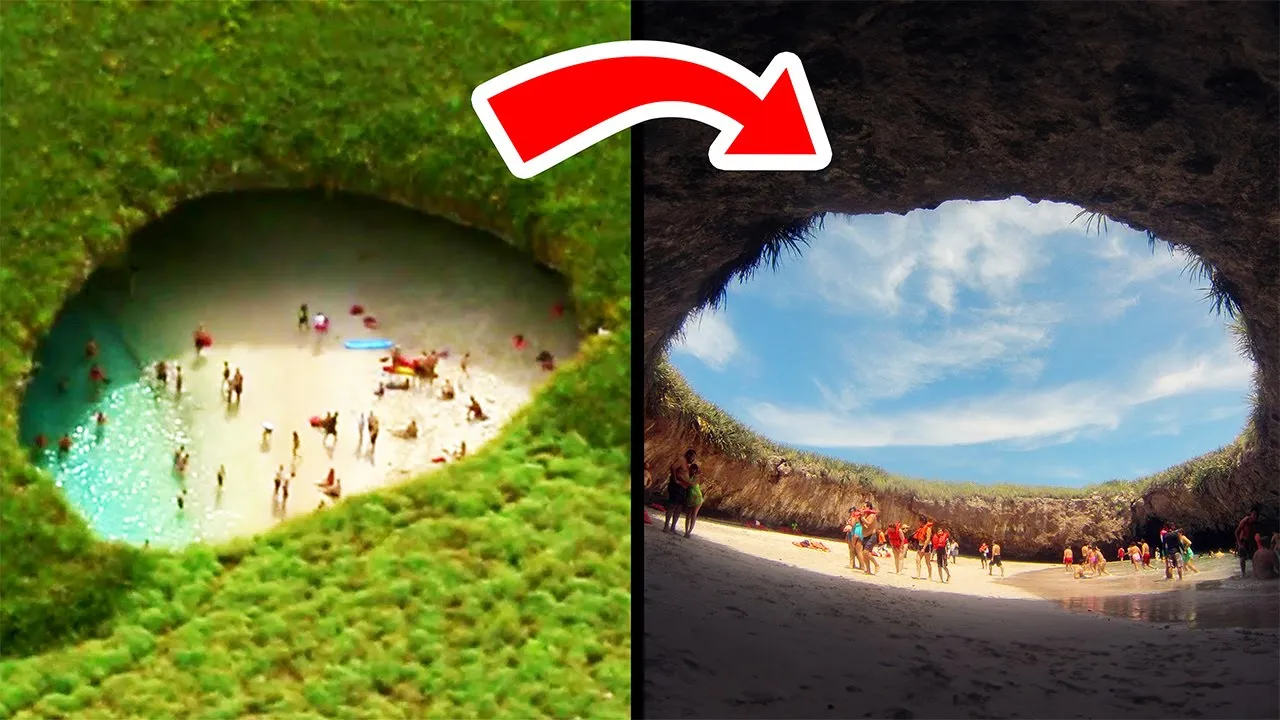
Covert Gove, Marietta Island, off the coast of Mexico, has plenty of beaches, but there's one that's easy to miss because, somehow, this beach isn't actually on the shoreline. Known aptly as the Hidden Beach, it’s located inside a cavern. In fact, this beach is so well concealed, it’s completely invisible from the actual shoreline.
The only way you'd know there's a sandy shore here is from the view from above. Pretty cool sight, right? How do you actually get there, though?
Turns out, swimmers or kayakers can make their way to the Hidden Beach by venturing underneath the rocky shore with around 6 feet of space above water level. After a short swim, the tunnel opens up into this secluded beach oasis, with golden sand, crystal-clear water, and the open roof allowing sunlight to beam onto the beach. But you don't usually see beaches in holes, so how did this place come to be?
Despite the serenity seen today, the Marietta Islands were once a much more hazardous area. It's said that in the early years of the 20th century, the Mexican military used the island as a target for bombing practice. As a result, the humongous hole which has revealed the Hidden Beach formed in the cavern beneath, likely due to an enormous explosion caused by these bombing drills.
Well, that’s got to be the most beautiful bomb site I’ve ever seen! Holy moly, the Marietta Islands aren’t the only place to have a beach in a strange spot. Found on the southern coast of Portugal is Benagil Sea Cave.
Much like the Hidden Beach, this place is only accessible by the sea and also shares that distinctive crater-like hole at the top. So, is everyone just accidentally creating bombed beaches now? Thankfully not!
Instead, over time, softer segments of the limestone coastline eroded away and collapsed due to waves and rainfall, leaving that distinctive natural skylight above the beach. With its awe-inspiring size and dome-like interior, this stretch of shoreline is often compared to a cathedral. After all, it’s very holy!
The constant crashing waves also carved out two arches into the limestone cliffs, creating the only two accessible entrance points, allowing visitors to access the beach by water. As for getting in via the top? Well, anyone dumb enough to take that plunge can expect to be sleeping with the fishes soon after a lethal landing.
Nearly 4,000 miles southwest of Benagil Sea Cave is another section of shoreline that’s a lot more accessible. In fact, if anything, it's a little too accessible. That’s because Maho Beach, found on the Caribbean island of St.
Martin, is right next to the Princess Juliana Airport. In 1942, it got its start as a U. S.
military airstrip. Then, just one year later, the first commercial flight landed here. To this day, planes continue to land at Princess Juliana Airport, zooming less than 100 feet over onlookers at Maho Beach as they descend to land.
Well, you might think a 150-ton chunk of metal zooming overhead while you sunbathe would be nightmare fuel. People actually flock to Maho Beach to plane spot! In fact, it's such a popular activity that daily arrival and departure times are displayed on boards throughout the beach.
But I wouldn't be too keen on booking my flight here if I were you. Back in 2017, a tourist was blown back by the power of these jets and didn’t survive. Yikes!
Safe to say Maho Beach will leave you blown away in more ways than one. You know what else will blow you away? All the videos you'll find on my channel, and while you're checking it out, why not hit those like and subscribe buttons too?
Alright, let’s get back to these bunker beaches! Bitsy Beach. Normally, when you're at the beach, there's one pretty big, glaringly obvious thing you can see—you know, the sea.
But any open ocean lovers watching may want to give Spain’s Playa de Gori a miss, considering you won't be able to see the sea here! In fact, I'd argue you’d see the exact opposite—a wall. But there's still waves.
How the heck does that work? Well, this beach is found 330 feet inland from the Atlantic Ocean, separated from the deep blue by a grassy section of coastline. Turns out, this baffling beach is actually a flooded sinkhole.
Over time, the waves of the Atlantic chiseled away at the coastline, forming underground caves. Eventually, this collapsed in on itself, forming a sinkhole which then became filled with seawater that filtered through caverns in the coastline. As a result, the water remains pretty shallow, reaching around knee height.
But because it’s still connected to the ocean, it still experiences waves. But the beach’s inland location isn’t the only thing that makes it unique. At a mere 130 feet in length, Praia de Guri is considered the shortest beach in the world.
In fact, it’s so small it would take you, say, a boat, less than 4 seconds to run its length! Forget shoreline play—Guri is found on the scorching shoreline in the southwestern tip of Africa. The Namib Desert, which runs through South Africa, Namibia, and Angola, stretches for some 12,200 miles.
Yet, the most mind-boggling feature of this desert is the fact that it borders the Atlantic Ocean. From above, this seemingly endless sea of silica contrasts with the blue crashing waves, creating a. .
. Pictures scene! Yep, that’s one stupendously sized sandy beach.
Along this seemingly endless beach desert, you’ll find a 300-plus mile stretch known as the Skeleton Coast. As you can guess, this place isn’t for the faint-hearted; it’s got its name from the many whale carcasses that are scattered across its shores at the hands of the whaling industry. However, these aren’t the only remains that have cropped up on Skeleton Coast over the centuries.
Nearly 1,000 shipwrecks have littered the sandy shore. So how did this place become a grisly graveyard? Well, in this area, the upwelling of the Atlantic Ocean's cold current clashes with the hot air from the Namib Desert.
As a result, this creates a dense fog that shrouds the area around Skeleton Coast. This fog creates dangerous navigating conditions for ships, with many accidentally running ashore. Yikes!
Doesn’t sound like the kind of beach you want to have a picnic at. Speaking of food, this stretch of coastal desert is also home to a fearsome predator: the African lion. Yep, crazy as it sounds, the Namib is the only place in the world where you’ll find desert-adapted lions.
These carnivores are known to feed on marine species like seals, beach whales, and corant. Yeah, definitely won’t be having my picnic here or those lions might turn me into their picnic! If the Skeleton Coast left you with chills, then how about we heat things up a bit?
And where better to do that than the aptly named Hot Water Beach? As the name suggests, the water on this beach found in northern New Zealand can get pretty spicy. Funnily enough, it’s not the seawater that gets hot, though.
Nope! The fiery fluid is actually found underneath the beach. When the tide's low, it’s possible to dig into the sand, allowing hot water below the surface to escape, forming a beachside jacuzzi.
The source of the heat is ancient volcanic activity that’s left a slab of hot rock deep underground. Thanks to underground fissures, this heats up surrounding water reservoirs, which bubble up to the surface at a steamy 147°F. Around 700,000 people flock to Hot Water Beach every year to experience this steamy silica sauna for themselves.
Safe to say that life really is a beach for anyone lucky enough to spend the day at that special stretch of scorching shoreline. Sandy Sculpture: At first glance, Brav Beach, found on the southern tip of Uruguay, looks like any old sandy beach. That is, until you reach this intriguing site.
From a distance, it looks sort of like five towering tall sandcastles. However, a closer look reveals five giant fingers poking out of the sand. Judging by how small they make that guy look, those fingers have got to be well over 10 ft tall.
But before your mind runs away with thoughts of some giant lurking under the surface, this huge hand is actually the work of Chilean artist Mario Irarrázabal. So why exactly did he decide to craft this cast on an otherwise beautiful beach? Well, Irarrázabal actually intended to make a sculpture of a hand drowning as a warning to swimmers.
Yikes! I mean, that’s one way to do it, but what’s wrong with a simple sign, bro? Either way, any beach sporting a humongous hand rising from the sand gets my vote for uniqueness.
Scrappy Shore: Normally, the beach is the perfect place to unwind and feel at one with nature, but apparently, that’s not a sentiment felt by everybody. Take the residents of Fort Bragg in California. Back in the early 20th century, people here used Glass Beach at Fort Bragg as a dumping ground.
From 1906 to 1967, three dump sites along the shoreline accumulated all kinds of waste—from glass, cans, bottles, and even vehicle parts. The site got so saturated that waste had to be burnt down. Safe to say these tippers weren’t big fans of the seaside.
Thankfully, by the late '60s, much of the waste was removed, but plenty was still left scattered across the Fort Bragg beach. Incredibly, though, this eyesore transformed into a thing of awe over the coming decades. Today, Glass Beach, as the name suggests, is home to beautiful sea glass that’s scattered along the shore.
Over time, the pounding waves weathered down what waste was left, breaking the glass dumped here into small smooth colored pieces that wouldn’t look out of place in a high-end jewelry store. Nowadays, Glass Beach is visited by tens of thousands of tourists each year, each looking to get their hands on that shiny sea glass. Fair to say, Glass Beach really proves that one man’s trash is another man’s treasure.
Sh. . .
yeah! At first glance, this looks like any old shoreline made up of small stones. However, a closer look reveals that everything isn’t as it seems.
You see, this beach, found in Shark Bay in Western Australia, isn’t made up of sand or stone, but trillions of tiny shells. In fact, this 40m beach is brimming so full of shells, it’s believed they go down as deep as 30 ft below the surface. Even more incredibly, they all belong to one species: the Hamlin cockle.
So what makes Shark Bay such a popular place for these mollusks? Well, the waters here have an incredibly high salt concentration, being twice as salty as the rest of the ocean. This is due to the shallow water of Shark Bay, as well as the fact its waters are protected from the open ocean by long-stretching sandbars limiting the water flow.
And it just so happens that Hamlin cockles can thrive in these salty conditions while their predators can’t. So this place has been a Hamlin cockle paradise for thousands of years, allowing the marine mollusks to live, breed, and die, with their shells washing up on shore over and over again. Over and over again, all that makes her one special beach: star-studded shore.
Much like that Hamal and Cocko spot, the beach is in Okinawa Prefecture, off the southern coast of Japan. It looks fairly ordinary, but as you know by now, we don't do ordinary beaches here. So, what's its secret?
Well, to find out, we got to take a closer look at that sand. As you can see under the microscope, this sand is actually made up of star-shaped sand particles. Unlike most places, the sand on the beaches in Okinawa Island isn't made up of rocks and minerals, but the remains of deceased organisms.
What you're looking at is actually the exoskeleton of a tiny organism known as a Baka Gyps. Sper easy for me to say! These critters build intricate shells from calcium carbonate they collect while drifting through the sea.
Then, when they die, their shells remain in the sea until the tide eventually brings this stardust ashore. Five stars for the beaches of Okinawa, am I right? Shadowy sand.
When you think of Hawaiian beaches, you probably conjure up images of idyllic palm trees and the waves crashing onto the golden shore. But there's one beach here that doesn't quite fit that stereotype. Located on the southeastern coast in Hawaii, you'll discover Punalu'u Black Sand Beach.
Yep, as the name suggests, this is a black sand beach. So what gives? Well, Punalu'u sand is made of basalt.
This formed thousands of years ago when a lava flow from one of Hawaii's many volcanoes streamed into the ocean. The rapid cooling of the lava formed basalt, which shattered into tiny fragments, creating this drastically dark beach. But black sand isn't the only unique feature Punalu'u has to offer.
It's also become something of a home for endangered green sea and Hawksbill turtles. As turtles are reptiles, they can't maintain a constant body temperature; instead, their body is influenced by the temperature of their environment. So, black sand offers the perfect place to bask for these rare reptiles—a unique beach with unique inhabitants.
What more could you ask for? Shining bright. Similar to Punalu'u, the beach at Breimer Cender in southern Iceland is covered in jet black sand formed from volcanic lava hitting the ocean before cooling and breaking off into tiny pieces of basalt.
But that's not the only fabulously freaky feature of this beach. You see, this place is known as Diamond Beach, but before you book your flights to Iceland to make a quick fortune, be warned: these aren't the kind of diamonds you'd find on a wedding ring. Nope, they're actually icebergs.
As the temperatures rise, icebergs break off the Breiðamerkurjökull glacier before washing up on shore. Once on land, the big boulders are naturally polished and sculpted by the wind, giving each ice diamond a distinctive shape. To make matters even more impressive, the beach's black sand heavily contrasts with the bright white diamonds, making these ice trunks look especially elegant.
Clearly, any beach near a glacier isn't going to be the place for sunbathing and swimming; the temperatures here rarely reach above 50°F. Even still, those dazzling diamonds are worth the cold conditions on their own. Go green!
As we've already seen, Hawaii is the place to be for any beach enthusiast out there, especially considering less than 20 miles away from Punalu'u is another curiously colored shore: Papakōlea, otherwise known as Green Sand Beach. Is you guessed it, green. You wonder how they came up with that name?
Well, it's not exactly blazing emerald, but this beach does have a distinctive green hue. So how did it come to be? Well, around 50,000 years ago, the Mauna Loa volcano erupted, forming a massive cinder cone that circled around to create a small bay on the south of the island.
The eruption brought tons of minerals to the surface, including a green-colored mineral known as olivine. Much of the cinder cone has now eroded, although the dense chunks of olivine have survived the crashing tides, causing this lawn-like shoreline. Aside from looking funky, olivine is actually a hugely helpful mineral.
When it's weathered by exposure to water, it reacts with harmful carbon dioxide in the air and absorbs it. This effectively removes it from the Earth's atmosphere, which helps to mitigate climate change. As a result, olivine is now being artificially sprayed onto beaches.
So who knows, maybe we'll soon get used to the sight of Papakōlea's exclusive emerald shoreline. Purple rain. Up next on our rainbow tour of shorelines around the world, we've got Pfeiffer Beach.
This place, found on the Californian coast, is famous for having this incredible purple sand. While it looks like some kid's kinetic sand, this stuff is fully natural. The color comes from the cliffs located above the beach.
It's a cliffside made up of manganese garnet rock. After periods of rainfall, the rain washes purple away from the rocks before sliding down onto the sand, creating this stunning scene. But if you ever visit Pfeiffer Beach, don't just stare at the pretty purple sand.
You see, this place is also home to the Keyhole Arch. I know what you're probably thinking: it's a large rock with a hole in it. And while that is the case for most of the year, things take a turn in the winter months.
From November to January, photographers flock to Pfeiffer Beach to get a snap of the sun setting through the arch. Whether it's the idyllic Keyhole Arch or its purple sand, Pfeiffer Beach has to go down as a great sandy spot. Crimson carnage.
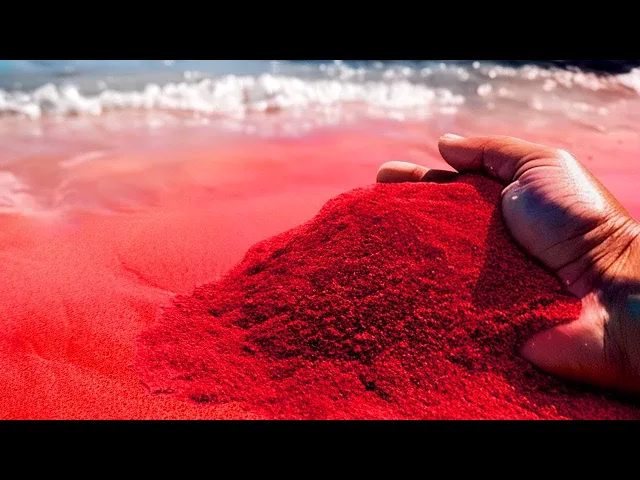
Speaking of flashy waterfronts, let's move on to Christmas Island. And no, before you ask, this isn't where Santa lives. While the world’s full of mesmerizing pink-colored beaches, I don't think this hellish tone is quite so welcoming.
But these beaches aren't always this crimson color. You see, that red hue isn't sand, shells, or stone; it's an animal. Well, millions, to be more accurate.
Even more bizarre, these aren't fossils, exoskeletons, or dead critters; they're live animals. The Christmas Island red crab are the culprits, and every year, between October and November, millions of red crabs all over the island leave their forest home before migrating to the beaches to mate and spawn. Each female crab produces a startling 100,000 eggs, which she safely stores in a brood pouch.
Around a couple of weeks later, the egg-laden crabs leave their burrows and head for the shore. When the high tide starts, the mother crabs move into the sea and release their eggs before returning to the forest. Then, around four weeks later, the juvenile crabs return to the shore to make their own journey into the forest, leaving this radically red scene on the shore.
I'm not sure whether to be amazed or horrified by this baby crab beach; actually, on second thought, horrified—definitely horrified. **Bioluminescent Beaches** While the beaches of Christmas Island are enough to send shivers down your spine, the same can’t be said of this side. Pretty magical, isn’t it?
This is Torrey Pines, off the coast of San Diego, which has become famous—famous for its electric blue waves. This sight isn't magic, though; it's actually down to the work of a microplankton, specifically the species *Lingulodinium polyedra*, which uses bioluminescence to avoid predators. When the algae is disturbed, it reacts with oxygen to produce a bright blue flash.
This sudden burst of light can startle any would-be predators and attract larger animals to eat those predators. Damn, nature, you're smart! So while that bright light spells bad news for any plankton eaters, it's great news for us humans, who can marvel at its beauty.
But San Diego isn’t the only place that's home to these marvelous microplankton. The beaches of the Maldives, in the middle of the Pacific Ocean, are known for arguably an even more mesmerizing display by these little guys. Pretty dreamy, right?
Speaking of bright blue beaches, let's fly to Toyama Bay in Japan. For most of the year, the beach looks beautiful here, but for all its beauty, it doesn’t look too unique, does it? However, between March and June every year, this bay transforms into a shimmering spectacle.
Unlike at Torrey Pines or the Maldives, this isn't the result of algae, though. Instead, Toyama Bay's bright blue waves are the result of firefly squid. By day, they dwell in deep, dark depths over 1,000 feet, but in the evenings from March to June, they ascend to the surface to search for potential mates.
Their glow is the result of an evolutionary phenomenon known as counter-illumination. It's thought this radiance attracts potential mates. Turns out, it attracts plenty of humans too, with people flocking to the beach at Toyama Bay to marvel at the squid's bright blue glow.
Safe to say, despite their color, these beaches certainly won't leave you feeling blue. **Cathedral Coast** Whether it's Notre Dame, St. Paul's, or St.
Patrick's, cities around the world are filled with some stunning cathedrals. Yet there’s one cathedral out there that’s found in a rather more obscure location. Yep, that's right—on the beach!
As Catedrais, which translates to "Beach of the Cathedrals," is a jaw-dropping site found on the northwest coast of Spain. This place gets its name from its natural 90-foot tall arches, which resemble the flying buttresses found in cathedrals. If that wasn't holy enough, it's said during low tide on breezy days, you can hear the wind whistling through the rocks, similar to the organ music that's played in church.
So how did this blessed beach come to exist? Well, over millions of years, natural erosion from blasting winds, as well as crashing waves, carved away the softer stone in the center, leaving behind these enormous arches. During low tide, you can even walk through this coastal cathedral, but keep your prayers short, as the tide can come in alarmingly quickly, washing any dawdlers away!
**Dinosaur Discovery** When you think of a beach, what animals normally come to mind? Crabs, seals, maybe even turtles? Well, one beach on Panida Island in Indonesia is home to a much more menacing animal.
Kelingking Beach, as it's called, is known for its T-Rex. Okay, let me explain—no, this shore isn’t home to an actual dino; it’s not even home to the fossil of one. Instead, it's the coastline that gives this beach its reptilian reputation.
Over time, the limestone cliffs have been eroded by the onrushing waves, somehow forming a perfect outline of a T-Rex. As a result, Kelingking has become something of a hotspot, earning itself the title "the most Instagrammed beach in the world per square foot. " Yep, I'm serious.
In 2021, a total number of 338,000 Instagram pics were taken here, and considering its shoreline is 260 feet long, that makes for 1,300 photos per foot. Man, talk about a popular place to paddle! While it may be a tourist hotspot, the waves on Kelingking's Beach don't take any prisoners.
Even still, safe to say that Kelingking's little quirk has made it into a roarsome tourist attraction. And that just about rounds up some of the most unique beaches around the world. Which spot of shoreline caught your eye the most?
Let me know down in the comments below, and thanks for watching!