Hello everyone! Today we are learning about how bacteria such as E. coli can grow on arabinose by activating the arabinose operon.
So what is arabinose? Arabinose is a type of carbohydrate just like glucose or sucrose. Arabinose is a pentose sugar, meaning it has five carbons, while glucose is a hexose, meaning it has six carbons.
Sucrose is not a monosugar, instead it’s made of one glucose and one fructose unit. These carbohydrates can be used by organisms such as bacteria or animals to obtain energy. However, arabinose is not as commonly present as other more common sugars like sucrose and glucose.
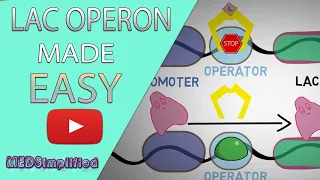
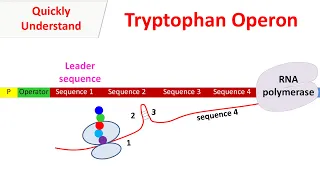
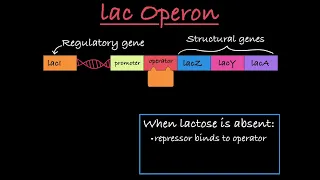
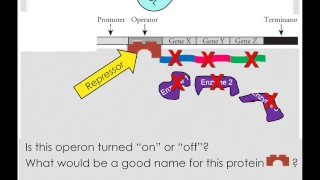
Therefore, smart bacteria have a specialized pathway to metabolize arabinose and this is arabinose operon. But what is an operon? Simply put, an operon is a group of genes that are under the same promoter and thus are transcribed together.
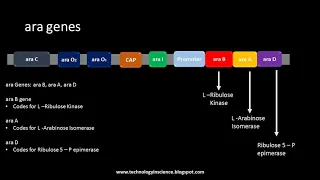
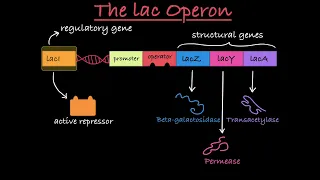
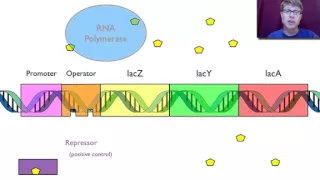
They usually have related functions. For example, there is the lac operon for lactose metabolism and the arabinose operon that will be discussed here. Here is the layout of the arabinose operon.
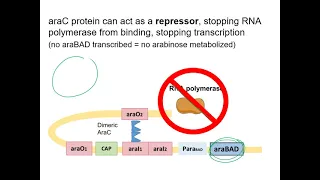
It’s composed of structural genes, control sites and the regulatory gene, araC. The structural genes are araB, araA, and araD. These three genes are essential for arabinose breakdown.
Note that araC and araBAD have different promoters. They are in fact transcribed in the opposite direction. Now let’s take a look at the structure of araC.
The regulatory gene, araC, encodes an arabinose-responsive regulatory protein, the araC protein. araC regulates the araBAD operon in a homodimer form, meaning two araC proteins need to act together to be functional. Each araC monomer has three domains, a DNA binding domain, an arabinose binding domain, and a dimerization domain.
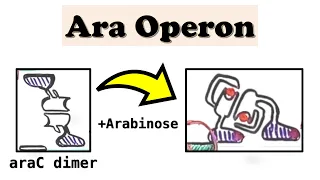
Now let’s see how exactly araC regulates the arabinose operon. When arabinose is absent, an araC dimer binds to araO2 and araI1 sites, leading to the formation of a DNA loop which prevents the RNA polymerase from binding to the arabinose operon promoter, which inhibits the transcription of arabinose operon. When arabinose is present, the araC dimer binds to araI1 and araI2 sites.
No DNA loop forms, the RNA polymerase can then successfully start to transcribe the arabinose operon. Also, the arabinose operon can be further activated via catabolite activator protein (CAP)-mediated recruitment of RNA polymerase, but this can only happen when glucose is absent. Bacteria always prefer glucose over other sugars because glucose is such a cheap energy source.
Bacteria are lazy and don’t want to work hard if they don’t have to. So if araC regulates the expression of the arabinose operon, what regulates the expression of araC? The answer is, arac regulates its own expression!
If the araC level is high, the protein will dimerize and bind to the araO1 site, which inhibits its own expression and prevents more araC from being generated. But do note that araC is expressed at low levels all the time, so it’s ready to activate the arabinose operon whenever arabinose comes in! The arabinose operon has been studied since the 1970’s and has been applied in the biotechnology field to express proteins of interest in a highly regulated manner.
For example, imagine that you want to express your favorite protein in a cell, but too much of it can be toxic. Then you can clone the gene encoding your favorite protein downstream of the arabinose operon promoter. You can then regulate your favorite protein expression in an arabinose-inducible manner, so you can express your protein only when it’s appropriate and don’t need to worry about the toxicity caused by its overproduction.
So that’s a short summary of how the arabinose operon is being regulated. I hope you learned something from it and continue to explore the exciting realm of science! See you later!