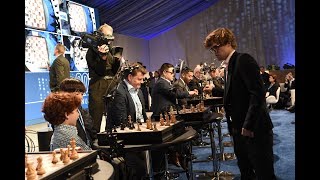
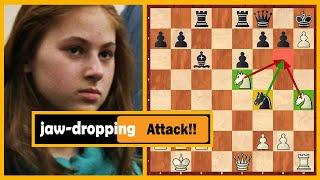
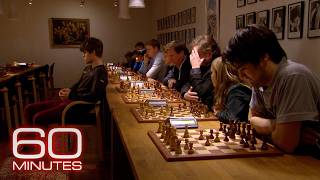
[Music] Susan pogar lives and works in New York City she sees the world in a very unusual way Susan has the brain of a genius perfectly adapted to her single lifelong obsession Susan is the first female chess Grand Master but she wasn't born with her brilliant brain it was created by an extraordinary childhood Susan is the living proof of an amazing theory that any ordinary child can be turned into a genius [Music] [Applause] it's Sunday morning and New York's Greenwich Village is the setting for a [Music] showdown playing white Susan pgar playing Black Paul trong
a former US champion at a supercharged form of chess Blitz each player must play the entire game in just 60 seconds it's a high-speed demonstration of Chess playing genius you're in total control of your own destiny here it's your brain versus the opponent by understanding Susan's brilliant brain we can unlock the potential of our own we can understand how people make life ore decisions faster than a supercomputer or perform miracles of memory in their everyday jobs and how in the battle of the sexes the female brain can outmaneuver the male I really believe that if
you put your mind to it and you really want it you can achieve it Whatever It [Music] Is Susan's brain is an Unstoppable force and her opponent has run out of time the latest in a long line of distinguished victims Susan has competed on equal terms with the greatest names in chess like Gary caspero Anatoli kpov and even the Great great Bobby fiser but Susan's genius is no accident of birth she was once an ordinary 4-year-old whose life was transformed by a unique [Music] education Susan pogar grew up a world away from New York City
in the late 1960s Hungary still languished in the iron grip of the Soviet Union for the ordinary citizens of Budapest daily life was a grim struggle to make ends meet the future Queen of the chessboard was hardly born a princess that's the street I was born in where I used to live for the first 10 years of my my life yeah it the wow the house is still here the closest side that you see was my room and that's where I first learned to play chess and then the second room was where my parents were
sleeping and was kind of a living room it bring brings back a lot of memories if Susan's home was ever so humble her father was a man with a unique Vision a trained psychologist llo pogar had made a deep study of the childhood origins of Genius the archetypal example was Wolf Gang Amadeus Mozart already composing at the age of five he seemed to be the classic case of a child born with special gifts but llo noted that Mozart's father Leopold himself an accomplished musician gave his son early and invaluable schooling in his craft Lazlo decided
that specialized training was more important than natural talent and he had an astonishing plan that would put his theory to the test when zua or Susan was born in April 1969 the pogar family experiment was underway her father had already written a book called bringing up genius and it said that genius was not born but made it reads here a quote which means a genius equals work and fortunate circumstances by Fortunate circumstances llo meant the happy home that he and his wife Clara would provide and the hard work would be guaranteed by schooling Susan himself
my father believed that the potential of the most children is not used optimally he felt that there is not much I would get out of going to school [Music] daily llo planned to train Susan in mathematics but she chose her own future by a happy accident one day unexpectedly in a certain for a new toy I opened a cabinet and the chest set fell out and I asked my mom what is it and uh she said oh this is a chess set although I can't help you much with it because I I don't know how
to play with it but wait until Daddy comes home and he'll teach you with pleasure there was no history of brilliant chess players in the poar family Lazlo himself was strictly an amateur but he was convinced he could train his his daughter to be a genius at anything as long as she was a willing student my father strongly believes that it could have been any other field and the very same methods could have been used first of all it's very important for the child to love the specific field which in our case was chess and
then the rest comes easy easy perhaps if Susan had chosen music or science but devoting her childhood to chess made the Quest for genius much harder for one [Music] reason in the early 1970s chess was totally dominated by men some of the world's best players believed that the female brain just couldn't cope with the game a little girl was about to prove them wrong [Music] these are The Gardens of blenn and Palace in Oxfordshire home to one of the biggest hedge mazes in the world this type of navigation problem is a well-known battleground of the
sexes men never ask for directions they think they're better than women at getting from A to [Music] B Professor Peter McLoud has come to find out whether just sometimes they might be [Music] right there are many stereotypes about the differences between the way that men and women solve problems and although some of these stereotypes may be based on prejudices and biases when you find the same stereotypes appear in all cultures and all over the world you can't help thinking there must be something in them 10 boys and 10 girls are trying to reach the statue
at the center of the maze but the first objective is a wooden bridge that gives an overview of the layout this is where McLoud and his maze run ERS will gather their thoughts how you doing it's really really hard do you recognize any of it well which are the bits where you've been it went r that fast I through the zigzag bit went up here I remember most of the turns that I been through the boys seem to be looking at the big picture they have a strong memory of where they've been and where they
need to go I'm just trying to keep going in that direction or at least they think they did I'm going to go right no not I'm going left oh God why the human brain has two hemispheres left and right most of our thinking happens in the thin outer layer of each called the cortex but in males the cortex is thicker in the right brain which excels at spatial thinking so boys are thought to use a highly spatial strategy they create a mental image of the whole maze to use as a map then they might use
a reference point like the sun to figure out where they are and by rotating their mental Maps they can then decide which way to turn next so the boys have good spatial awareness navigating with a strong sense of where they are in the overall maze okay that's right F but are the girls thinking the same way if you had to draw a map of the maze when you got out do you think you could do it no no what could you remember when you got out do you think um probably the bit with all the
circles and you go from Circle to Circle ah cuz you can remember what those circles look like is that is that the idea yeah the girls are less interested in the big picture they're picking up on specific details I now know where to go now because I once I get out to these Circle bits they're using some distinctive circular Hedges as landmarks like the boys the girls also use their right brains for navigation but in the girls the Corpus colossum which connects the two halves of the brain is better developed so girls also rely on
the left brain which excels at verbal reasoning rather than the whole maze they focus on features that they can describe in words like the circular Hedges the girls navigate by following a list of directions from Landmark to Landmark but with no overall map of the maze it's easy to lose sight of the landmarks and get lost oh this is annoying this particular maze might favor boys because it doesn't have many obvious visual features in it the hedges all look the same the are some shapes but there aren't clear points that you might remember in this
kind of maze scientists consistently find that boys come out ahead by using their mental Maps yes I'm there in mazes with more prominent landmarks it's the girls who would take the honors but today they have to settle for second place found it [Music] in the early 1970s it was taken for granted that chess also required a typically male way of thinking like the maze problem the game seems to depend on a spatial awareness of the board and all the pieces but then Susan pogar came along when she was still just a tiny girl her father
planned to prove that gender differences in the brain were not important I definitely would agree that there are differences in brain and the men and women think differently I'm not disputing that it doesn't mean necessarily that one is worse than the other and that's the beauty of it I think that's the beauty of life that we don't all have to be a certain way to succeed there can be many roads to Rome as they say just a few months after she learned the game llo took Susan to voros meteor the most formidable chess club in
Budapest Susan was about to face male opposition in more ways than [Music] one wow I haven't been here in over 15 years and this is the first place I ever came to a chess club I first came came here late 1973 or very early 1974 and well the place so far looks exactly like it did then I walked in a room it was full of smoke with elder men them thinking that my father is looking for a game and just brought me along but the reality was my father wanted me to have a game to
see how I'll do do against the members of the club the club members thought llo was mad but if they were ready to humor a pretty little girl they weren't ready for what happened [Music] next Susan began the habit of a lifetime beating men at chess I had a whole bunch of guys after losing to me complaining one said oh I didn't sleep well the next one I was sick the third one I had a stomach ache you know it's like was kind of going on in a series and you know I jokingly said that
I've never beaten a healthy man the only man who wasn't shocked was llo pogar he was building Susan's training around a mental skill that didn't depend on either the left or right brain girls could Master it just as easily as boys and before long Susan was literally be eating men with her eyes [Music] closed Susan's about to play a game of chess with a difference okay why don't you be white okay uh E4 E4 C5 night to C3 Susan's friend Ed has the chess board in front of him just like a normal game KN C6
but Susan doesn't need it she's playing the game in her head the only board she needs is in her Mind's Eye F5 now you got to be careful and players like Ed have to see the board to keep track of all 32 Chessmen I'll play G5 but Susan follows all the moves using her fundamental chess ability memory playing without a board helps to train the memory and Susan has been practicing since childhood I'm going to sacrifice my knight now KN G5 you're sacrificing a knight Susan can play up to five games in her head simultaneously
Bishop FES D5 Rook E8 Rook F3 Knight E5 Rook G3 King f8 the queen moving in for the kill e to G4 que h8 check now it's over King E7 check me Susan that's not a nice way to say hello when it comes to chess Susan can perform miracles of memory in fact she's doing something that should be impossible an ongoing task like a game of chess is handled by a mental function known as working memory at the very front of the brain the relevant brain cells or neurons store any necessary information by forming a
network of electrical connections but these connections die away within seconds so working memory is limited it's like a temporary scratch pad that can only store about seven items of information that's why the seven digits of a new phone number are about as much as most people can [Music] remember but just how good is Susan's working memory this is Thompson Street in New York home of the city's sidewalk chess Cafe is and we're about to give Susan a memory test can she memorize all the pieces and porns on this diagram that's 28 items of information to
make things even trickier the diagram has been pasted to the side of a cafe speeding [Music] van Susan only has time time for a single 3 Second Glance but watch [Music] this Susan's working memory is working overtime she's made an exact [Music] copy to explain her Miracle of memory this scientist has come to a very surprising place the D miners at this London restaurant don't know it but their table is under surveillance he's proceeding here in a counterclockwise border psychologist Andis Ericson has spent nearly 30 years studying amazing memories and it doesn't have to be
chess Grand Masters more and more we've been interested in everyday life uh kind of uh expert performance somebody who can do something that is extraordinary he's expecting a bra performance from Spanish waiter vincenti Sano I think I have a good memory I have the the memory of my grandma good afternoon you you ready to order yeah okay have a v of cranberry please um and then I'll take the uh baby squid Roto Roto they're giving drink orders as well as the meal this going to be challenging for him do you have any beer only tiger
okay then can I start off with the noi with Chestnut like Susan Vincent's working memory has to take in a lot of information but he never writes anything down could I start with the sa baby and this is going to be a tall order okay Med Med the and they all have the question is how many orders can he handle in working memory so it's both CR uh Nero Roto and the skate Tiger Beer uh with the noi and the beef bre the Nero Roto the it seems vincenti can remember far more than seven orders
with and medium R wow and the the Naro Roto and the M the lady the glass pinio Nuki and John Dory a couple of bottle of water for the table than you welome 23 orders in all that's impressive like Susan vincenti seems to exceed the normal limits of working memory be but how is he doing it Vincent that was really impressive really want to understand hear how you were doing this now you're coming in do you know who you're going to ask to give you the first order yes it's always the best to to start
for my lap okay so to try to keep an order the first one brunette it has a white Tob and thin jeans the second one blonde blond almost white hair do you have any beer I thought she's not sure about what to drink about what uh to order there it seems that Vincente doesn't remember all 23 orders individually instead he packs the information down to make it manageable using the normal seven items of working memory I associate the person the this and the number it's like all together I don't know how toplay but it's com
all together he forms a strong mental image of each customer and then attaches that customer's orders to the image this seems to be a common technique used by experts in all Fields it's called chunking it is a little like phone numbers one of my best phone numbers was 492 1492 and given that 1492 is when Columbus discovered America you don't have to keep track of the individual digits any longer all the four digits will be retrieved as a single group for memory Susan handles the information on a chessboard in exactly the same way she doesn't
remember all the pieces individually instead she breaks everything down into chunks the menacing formation of White's Queen and Bishops is one chunk the heavily protected black king is another Susan only has to remember five chunks easily manageable in Normal working [Music] memory but without chunking her memory is no better than anyone else's and here's the proof in the chess diagram on the other side of the van the pieces have been placed at random by a non-chess player so this time there are no recognizable chunks now Susan's trying to remember 24 individual pieces and she can't
do it all the pieces are in random position it's just so much harder to remember especially under a very short time but how does Susan identify chess chunks to her their lifelong friends memories that were implanted in her brain during her extraordinary childhood Susan paar's second childhood home was in this Budapest Tower [Music] block we're almost there the Tiny Family apartment was a production factory where Susan's brain was engineered for the game of [Music] chess the current tenants have no idea that a genius formed her earliest memories Within These Walls wow still the same my
phone used to be here but we finally got the phone for the first time we used to keep it there wow and this used to be the living room this is where Susan did some of the hardest work of her life for up to six hours a day I used to have a wall of Chess books here a library of Chess books a collection of four to 5 thousands of different titles and actually I even had a catalog of chess games with selection of 200,000 games manually being cut from various chess magazines and newspapers and
sorted by various openings and various players this massive effort was required throughout Susan's childhood to commit the complex secrets of Chess to memory the number of possible games is vast ly greater than the number of atoms in the universe but chest chunks are the order in the chaos these small but typical formations appear again and again in different games they are the basic words in the language of Chess most 10-year-olds know only 10,000 words at the same age Susan was devoting her childhood to learning a 100,000 chest chunks this process would physically transform her brain
with constant repetition information moves from working memory into long-term memory working memory lasts only seconds until the electrical connections between neurons die away but in long-term memory the repetition of these currents stimulates the neurons to form new and permanent connections the memorized information is now hardwired and can last a lifetime like anyone else Susan's long-term memory is a storehouse of family faces and lifetime experiences but now chest chunks were also indelibly imprinted on her brain [Music] by the early 1980s the pulgar chess Factory had stepped up its output Susan's two younger sisters sofhia and dudas
were next on the genius assembly line and within a few years the family would be ready to take the world of Chess by storm at 15 Susan was already the top ranked female player in the world at at the 1985 New York open she caused a sensation by beating a grandmas For the First Time by 1989 12-year-old Judith had a winning streak of eight competitions in a row at 14 sofhia annihilated four grand Masters for one of the greatest Tournament results of all time just watching them seated at the at chess boards I immediately had
a sense that I had never seen seen with women players uh elsewhere Susan is still a powerful Presence at the board like all the pogar sisters she seems to make a move as easily as taking a breath there seemed to be a line direct from their brain to the end of the finger and the piece moved and that was it but it should be beyond the power of a human brain to pick the best move there are roughly 4 billion possibilities for the next three moves alone that's a calculation only a supercomputer could perform so
how can Susan move at this incredible speed for harston the only explanation is that a human brain is using a very human skill we seem to Heap a lot of Praise on people's calculating ability but take for granted all sorts of mental abilities that are absolutely in intuitive intuition sounds more like magic than science but Haron believes it is a specific skill displayed by experts in all fields and it can be [Music] explained by training William harston is a psychologist and a former United Kingdom chess champion it's not as bad as I feared but today
he's going back to square one as a trainy firefighter Hardon plans to compare his novice skills with those of expert firefighter Lee cork you want to take a quick look at the smoke that's coming out there at the moment I'm going into there you're going into there yeah they're up against a terrifying opponent this is flashover a major killer of firefight Fighters my wife always said I'd go to hell he has no previous experience but he thinks he has a logical plan of attack he aims to control one side of the fire then quickly switch
to the other okay left left's it going now right missed logic isn't working the fire is making moves he can't predict keep's coming back and me backwards what I was doing was trying to apply rules and stopping and thinking I always had to stop and see what the effect of what I was doing was too much water harston's achieved nothing but a cloud of scalding steam going to smoke he's still trying to think his way out of trouble and now he's suffering from paralysis bi analysis oh we've lost our visibility together haven't we Slow Down
slow down for Hardon it's been a harsh lesson in the wrong way to make decisions firefighter cork shows him how it's done him for an expert flame in the overhead smoke is a typical danger sign he reacts instantly by cooling the flames and he doesn't have to think about it when you've done something often enough you don't have to think about how to do it but even more important when you've done it often enough you know you sense what the result of it is going to be and you're ready with the next move intuition turns
out to be a learned skill it means trusting your experience and the ability to recognize and react to familiar patterns and surprising as it may seem chess players rely more heavily on intuition than calculation you don't calc calate from where you are you don't look at a list of possibilities you you sense what's the right move and you don't have to think about how to do it an amateur wastes precious time thinking through his possible moves but a Grandmaster can make the best move without thinking I have to trust my instincts my uh intuition and
it's basically pattern recognition it's each and every position what's my first instinct that what what's the best move it's almost like guessing but it's like uh guessing intelligently kind of basing it on prior games and [Music] experiences Susan guesses her opponent's moves before he makes them the pre laska it feels like she's reading his mind right uh it was amazing like playing uh against like Michael Jordan or some big sports star she definitely has all the pattern recognition down to where she doesn't have I think I have to think a lot more than she does
you know she just she pretty much it's it's it's all instinct it's pattern recognition that separates the best from the rest Susan is so good at it that it's possible her brain has a dedicated pattern processor with modern scanning techniques it might even be possible to identify it but there's a problem the brain is so complex that to find and identify any specific structure is a daunting task but scientists are sometimes given Clues telling them where to look for specific functions and it happens when the brain goes wrong as an assistant editor at the Times
maryan seagert is at the top of British journalism and yet she can't recognize some of the most familiar patterns of all every week I write a column for times two and there's a whole Bank of people who subedit and this sub will come in with one of these which is a proof of the column and I'll say oh thanks very much and and I'll read it through and I'll look for mistakes then I'll take the col the proof back to the subs desk and I'll think who was it who gave it to me I don't
remember Maryanne suffers from prosopagnosia commonly known as face blindness even finding a close colleague can be next to Impossible possible he's sort of tiptoeing around surreptitiously looking at everybody's screen to see if they got my column up on the screen maryan knows she's looking at her face she just doesn't recognize it as someone she knows I wish I knew how people recognized other people because it would make it so much easier for me but it's as hard for me to understand as it would be for a colorblind person to you know if somebody said to
them well can't you see the difference between red and green you know that's red that's green as many as one in 50 people have have some degree of face blindness but Maryanne was unaware of her condition for years because she has learned to identify people in other ways you're right thanks see you later psychologist David Wilkinson wants to know more so what coping strategies do you use oh goodness um I Rely a lot on hair um but that can go horribly wrong when people have a haircut or di or know her exactly um voice right
gate you know the way people stand or walk I think I use uh glasses or any sort of facial hair I find very useful yeah you seem more keen to focus in on local detail on parts of the face and so you're using a different strategy well that's what I used to compensate for the fact that I can't recognize the face so I think right there must be some feature on the face that I can compare to see which is alike I mean I've now worked out you've got you've got a bump here in your
nose so that will help me next time I see you [Music] maybe to test maryanne's strategy we've asked her to take her daughter skating and to look out for any familiar [Music] faces now see I wouldn't have a clue if I were looking at the SE [Music] faces but what maranne doesn't know is that one of these faces belongs to Dr David Wilkinson with whom she's just spent the whole afternoon and with him is Laura a secretary from MaryAnn's office whom she sees every day at a distance Maryanne can't pick up on any useful details
maybe if they go a bit closer it's not mother and daughters is it no Wilkinson tries taking his hat off finally he resorts to a bit of slapstick psychology oh God you're [Music] right I don't believe it who is this this is a guy called Dave who I spent most of the afternoon with this is eie the funny thing is I did say if I saw who's this it's not Nora and even then it was only when your face was right up against mine and I spotted your sort of you know on brain scans of
people like Maryanne have revealed damage to the specific structure that's responsible for face recognition the so-called fusy form face area is at the back of the brain where first processing of information from the eyes takes place in a normal brain it rapidly assesses any new face for its distinctive proportions of eyes nose and mouth then it looks for a match amongst all the familiar faces stored in long-term memory the whole process is lightning first we can recognize people we have met before in approximately 100 milliseconds it's about pattern recognition you can see the analogy with
a chessboard where again one must identify the individual pieces but what's really important when you play is being able to apprehend the the spatial relationships between those pieces every brain has a face processor to help us make sense of the daily Sea of Faces but there are many complex patterns in the world around us does the brain have processes for those few of us see patterns better than Susan pogar so we are going to submit this chess grandmas to a scan to find out exactly what makes her brilliant brain so [Music] unique Grandmaster Susan pogar
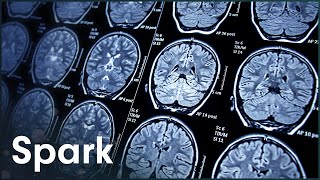
is about to find out how her brain is perfectly adapted for the game of chess she has come to meet Professor Joy hir of Columbia University a leading expert in brain Imaging techniques and one thing these two women can agree on is that Size Doesn't Matter the female brain is quite a bit smaller than the male brain in general and we know that there's no difference in our intelligence right that [Music] one okay hsh intends to scan Susan's brain using MRI or magnetic resonance imaging all right [Music] inside the scanner Susan can see projected images
of some of the world's most famous chess players and so far her brain is responding exactly as expected the fusiform face area her brain's dedicated face processor is powerfully activated [Music] ated but does Susan's brain have another processor that's dedicated to chess pattern she's now looking at diagrams from her own chess games some dating back to her distant childhood in Buddha pest she's been asked to think about each diagram as if it's a game in progress calculating her next [Music] move these are the first scans of a world Champion's brain playing chess but a comparison
with the face recognition scan leads to a remarkable Discovery we're looking at the bottom of the brain four slices and this these two areas this is the fusiform face area Susan is using exactly the same area of her brain for both faces and chess for you we can't discriminate a face area from HS area they are identical astonishingly Susan's brain has hijacked the fusiform face area and adapted it to chess instead of faces it's comparing incoming chess positions with the vast library of games in her long-term memory Susan can recognize a familiar game in just
0.8 seconds almost as fast as the face of an old friend [Music] years of intense childhood training literally molded Susan's brain for the game it's solid evidence for her father's theory that genius can be created I definitely agree with my father that the work part the diligence part is the most important and I think that being trained properly anybody can achieve practically anything at the age of 21 the quality and number of Susan's victories against top opposition earned her the official title of [Music] grandm the first woman among nearly 600 men younger sister Judith quickly
followed suit ranked in the top 15 male players she is now a leading Contender for the world [Music] title and there's one more twist in the pogar family story this Florida holiday Resort is the unlikely setting for the United States championships for school children inspired by the pgar sisters girls now compete on equal terms with boys but Susan's attention is rivited on the T deciding match for the seven-year-olds of the second grade Yash Pasad battles for the title against Susan's son Tommy he's a fighter he's used to playing long games yeah I have my fingers
crossed and um hoping things will end well six-year-old Liam will be next in line Susan stands at a discreet distance getting used to a new kind of tension as a chess [Music] mon I want I a first place he played well until the end and then he messed up a lot he stepped into a one move Checkmate and now I'm the US champion and our national champion with 6 and A2 points is Tom H if they want to be grand Masters Tommy and Liam won't have to look too far for the best possible training but
they to be ready to work hard tomorrow we'll go to Disney and have a lots of fun and uh then after the tournament is over that's when we go into in-depth analysis of the games and where mistakes were made and how to improve on them are these two more Geniuses in the [Music] [Music] making [Music]