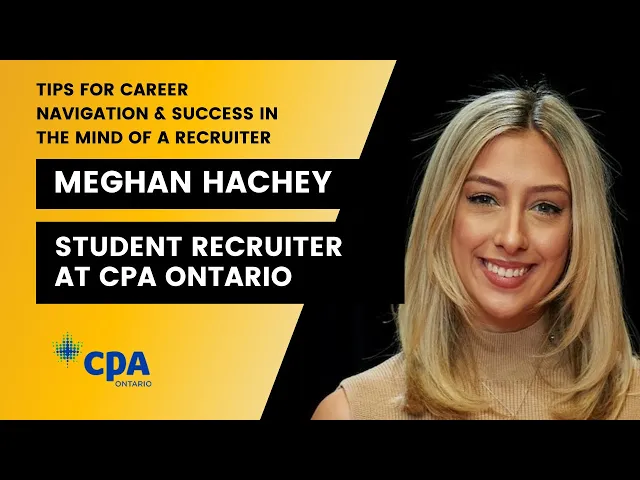
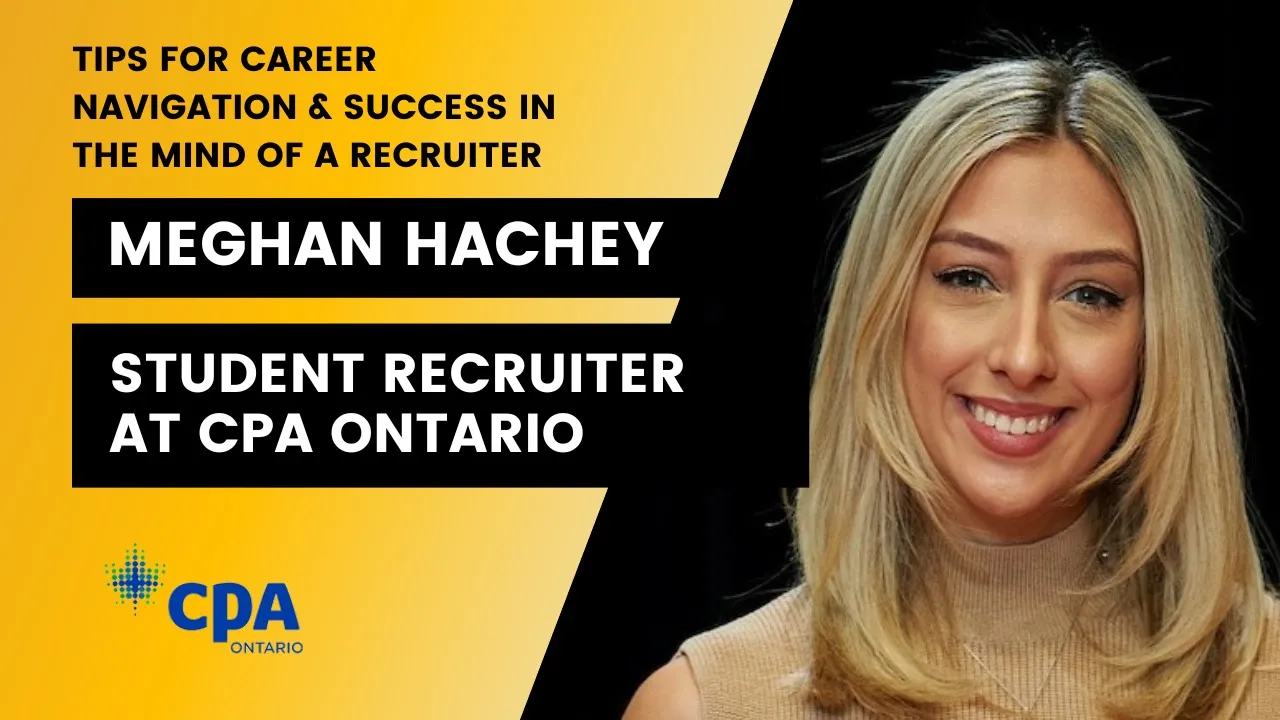
foreign thank you so much for coming onto the cast today it's such an honor to be working with you and also to interview you today now my first question for you Megan we would love to hear about your story and career development let's start from the very beginning so how does your post-secondary experience lead you to where you are today yeah well thank you very much for having me on the podcast I'm very excited to be here I've always been passionate about helping people working with people giving them advice I am kind of the friend
that everybody comes to for advice in my personal life but to go all the way back to my undergrad I actually went to the University of Guelph I initially started in a more science focused program because I actually had the intention of going into medicine when I first started my schooling but after about a year year and a half I decided that science really wasn't for me I wasn't passionate about it the way I thought I was going to be and when I realized that I actually pivoted slightly and I ended up doing a double
major in criminal justice and public policy and then also brain and cognition which is pretty much just Neuroscience I already had that foundation for the first year that I started my undergrad with science all those courses transferred over for my Neuroscience degree so I didn't have to do an extra year even though I switched but when I did that switch I realized there are a lot of things that I'm passionate about like human rights advocation the justice system legal system so I started exploring the idea of being a lawyer at first it seemed to check
off a lot of the boxes of what I wanted in a career but then criminal justice and Neuroscience is what I actually graduated my undergrad with in my last year of my undergrad though I decided I definitely wanted to do more school I just knew there was more I had to learn so I was looking into potentially doing a masters and I told myself I'm going to only apply to one school I only applied to McMaster and I said if I don't get in then I'm not meant to do it but if I do get
in then that's kind of my sign that I should be doing my Master's and about a month later I got an acceptance letter and almost a full ride scholarship so I took that as a sign from the universe saying yep you should be doing your Masters I started my Master's in 2020 and I specialized in public policy so I was doing political science during my Master's I really tried to get involved in the school so I held executive positions on student council I was on the Truth and Reconciliation committee and in general I think my
Master's really helped me refine what I was passionate about and what I wanted to do my major research project was actually about the missing and murdered indigenous women and girls in Canada and how the media portrays them so it was a really interesting and rewarding topic to research doing a master's degree or even any schooling Beyond an undergrad degree it's going to teach you a lot of essential skills that you can use in the workplace so for me my Master's taught me a lot of writing researching and presenting which I actually take into my job
now something I should note though is that both of my graduations both undergrad and Masters were during coven so it was a super super strange time to be entering the job market and starting my career for my entire Master's I didn't set foot on campus once it was definitely a challenge to try and make those connections and stuff like that but it also gave me the flexibility because I was learning remotely for an entire year that I could kind of explore different career options so while I was doing my masters I actually wrote the law
school admissions test and for a lot of that year I was planning on becoming a lawyer and eventually going to law school after that but I sat and I thought about what my life would be like as a lawyer it's a big time commitment and it was just a different lifestyle than I think I wanted I didn't necessarily want to be working 60 plus hours a week for decades of my life I wanted more of a balance so then I was done my Master's I didn't necessarily want to become a lawyer I started exploring different
options of working with people helping them but not necessarily a legal career and I actually ended up applying to different jobs at McMaster because I thought you know education is a fantastic industry to get into so right after my Master's McMaster actually hired me in their admissions Department I was a recruitment officer it was just a contract role for about I think five or six months and then somebody I actually worked with at McMaster used to work here at CPA and she told me that there's an opening at CPA and I applied she actually helped
me get the job here today and yeah so I've been here at CPA since January of 2022. it's fantastic the people I work with are incredible I love my job I love working with people and I get to help students figure out what they're passionate about in their career which is kind of like a full circle moment because I recently went through that kind of figuring out exactly what I want to do so that's kind of how I got to where I am today my previous academic journey I know I gave a lot of details
but yeah and it's so inspirational the whole time I was just like Megan is such a girl boss this is so inspirational so making you talked a little bit about essential skills and this actually leads me to my next question what are some essential skills or characteristics that you'll say are important for a successful recruiter yeah that's definitely a good question there are a lot of skills that I use on a daily basis like communication presenting of course is a big one and for me my oral presentation skills was something that I struggled with my
entire life because I'm naturally actually really shy but throughout my work experience I've been able to develop those presentation skills but I think in general one of the more important skills for my job is being able to help students find their path in life in their career so in order for me to do that I have to be able to effectively communicate and communicate through different means and beyond that being able to relate to people so being personable and putting myself in the shoes of a student when they're in high school kind of figuring out
their life and figuring out who they are and sometimes I even think back to what I would have wanted to hear or the advice that I should have gotten when I was in high school and then once that idea clicked for me that I needed to be personable for these students I was able to kind of be more authentic in the way I communicated overall do my job more effectively so I think communication and being able to be personable is a really important part of my job I actually have a new set of questions for
you this one just came to mind as you were mentioning about how you're shy Megan I can't tell at all and I'm just wondering are you an introvert what'd you say I'm definitely more of an introvert but it truthfully depends on the situation sometimes I can be more introverted and I'm the person who's more observing what's going on in a room but then other times I am more confident in what I have to say and I will be the one talking in the room just depends on the situation and also in a work setting for
me I am more confident in the things that I have to say and I'm also always prepared so yeah and so the reason why I'm asking this question Megan is because I think I am an introvert as well and so communication even though I think it's one of my talent it does drain me at times being an introvert and you're required to communicate all the time and be charismatic and also at the same time being personable and genuine so how do you balance all of this that's a great question I think what you're referring to
is a social battery that's what I call it sometimes like I'll say to my friends like my social battery is running low I gotta go so for me it's kind of setting those boundaries of when I know is enough for me and my social battery is getting low and it doesn't necessarily happen in work because I'm always prepared and go into the day knowing that I'm gonna have to communicate a lot but I think just being self-aware kind of checking in with yourself and knowing if you're kind of extending yourself too much socially checking back
in with yourself to say maybe I need 10 minutes to just unwind with myself that's a great tip I am going to practice that sometime and I'll let you know how it goes sometimes I'll say to people on my team give me 10 minutes give me 10 minutes I need to recharge I'll be right back exactly yeah my next question for you is you talked about achieving so much in the pandemic and given how much the world has changed due to the pandemic landing and job is becoming increasingly more competitive in today's market what are
some interview tips that you would give to people who are actively seeking a job and striving to attain their dream job good question and I want to start by saying the job market is very competitive covid has definitely increased that just because it's really changed the way everybody works and for me transitioning in between school and a career it was hard to find a job graduating in 2020 people weren't even working so to try and enter the job market was the biggest challenge So for anybody who might be upset or they're struggling saying oh there's
a gap on my resume or you can't land this job keep trying because I swear I applied to 50 plus jobs some weeks it just takes one person to take a chance on you and then once you're in the job market you're kind of set but I do have some really good interview tips so the best advice I would have to say is you have to be as prepared as possible do as much research as possible beforehand and I know you've probably heard that a million times before but I have a quick list of tips
that I do to prepare for interviews so first thoroughly go through the job description pick out what the qualifications are the type of person they're looking for the specific details about the role and then from there searching the actual company and the person who is interviewing you so for me for example when I was first being interviewed by CPA I went through their website with a fine-tooth comb and looked at everything you know their values their mission a lot about the CPA designation and then when I actually found out the name of the person that
was interviewing me which is my now boss I did a quick LinkedIn search to see who she was and just some information about her and I think coming into the conversation with that base level of knowledge shows the employer that you're prepared and organized and on top of things and they're going to take you more seriously another useful tip that I have is come prepared with questions to ask so I recently was actually interviewing somebody or was in an interview with somebody and they straight up asked me like what do you like least about your
job they asked me right in front of my boss which was kind of scary to answer but they asked me what do you like least about your job what sort of diversity equity and inclusion initiatives you do so just with those two questions it made me almost look at them differently and think like okay he's prepared he's purposeful in his questions he obviously cares about his career and wants to work for a good company it made him stand out to me just by coming prepared with specific questions to ask me and then I have one
last tip don't be afraid to take notes so I had a boss she was actually the director of admissions at McMaster and she told me that when she sees interviewees people she's interviewing taking notes and writing things down during the interview she loves it because it shows that they're listening they're attentive they're taking it seriously they're organized and beyond that if you're the one taking notes it actually can help you collect your thoughts and then articulate your answers to their questions better so I have implemented that into my own interviews and even in meetings sometimes
because it really shows the person that you're talking to that you're paying attention and you care and in an interview going that extra mile can make them hire you so yeah those are definitely some useful interview tips so now I'm curious Megan how did you actually answer that question what do you like at least about your job so that it was the three of us in the interview my boss the person we're interviewing and then me and I just started laughing because I'm like this is I have to think quick on my feet there's certain
things that you have to be careful how you word it I obviously love my job I wouldn't continue here at CPA and make plans to continue to be here at CPA if I didn't love it I said I'm the type who loves to travel and see new places and do new things and with any sort of corporate job it becomes challenging to pick up and travel whenever you want and that really is the only thing that I dislike about my job even though if I really wanted to I can work remotely so if I wanted
to go to Mexico for two weeks obviously I have to check with my boss but I could work remotely so there isn't really too much that I dislike about my job to be honest so him asking me that question I was like man I gotta think of something quick I think anybody in the corporate world that likes to travel is in the same position as me and I do get great vacation days so I can't really complain I love it following up on my previous question when interview is a time when people showcase themselves and
the skills they hold which leads us to the topic of personal branding what suggestions do you have for individuals to leave an impression that matters through effective personal branding part of creating a personal brand is highlighting the important parts of yourself that you would like portrayed to the world your personal brand is your story that you're sharing to the world about who you are and how you want the world to view you and in terms of the job market your personal brand should sort of be your story where you're showcasing the things things like your
why so why you want the job why you want to be in that industry your journey your goals maybe so in other words your personal brand can be like your origin story that's how I like to think of it should highlight your personality your energy your soft skills like communication problem solving abilities Etc because truthfully what will make you stand out and get hired more than specific experience and hard skills you have are those soft skills so including that in your brand is going to be more important than showcasing oh I worked at X company
for x amount of time it's going to be I develop these skills by doing this so to all the students out there that looking to build their personal brand in order to land a job I really suggest getting involved in things outside of just internships and employment because extracurriculars can really help you develop soft skills and that's what's going to make you marketable in the job market even us at CPA we have a program to develop soft skills for students because we know how important that can be to your personal brand absolutely and I'm a
big fan of the hap program and also the psap program so Megan while we're at it can you actually share a bit more about the hap program yeah so the HOP program the high school ambassador program it's a free program to Ontario High School students they can meet a ton of different CPAs and Industry professionals as well as different students we have workshops on things like financial literacy communication how to build a resume so soft skill building workshops and we also have major events we have a major conference coming up in May that's going to
be in person it's a lot of events and programming specifically for high school students to develop soft skills as well as learn some financial literacy skills because that's a lot of what we do here as well and there's also a program called psap which stands for I think post-secondary ambassador program yes yeah and it's essentially the same as the high school ambassador program just at the post-secondary level and they do a ton of recruitment efforts and different events and pisapa is a fantastic way for students to get involved and even land jobs sometimes so psap
takes a step further to connect post-secondary students with more industry professionals Megan I am wondering you know sometimes personal brands needs to be a bit more fluid and adaptable and the reason why I think this is an important topic to discuss is sometimes I would have potential employees come into an interview very eager to express who they are and sometimes I think it really depends on the room and the personalities that you're interacting with can you share about how to adapt your personal brand while also being genuine I think what you touched on there being
able to read the room is a really important skill to have because in any situation you're going to have to be able to adapt how you communicate and how you present yourself for example how I present myself to let's say external stakeholders of a massive company I'm gonna probably act more professional and more calm than how I would act in a workshop where I'm trying to get students hyped up about the CPA designation or some of our events so being able to Pivot when you know that there's different audiences that you're going to be in
front of is really important and that adaptability of being able to Pivot depending on the audience is going to come when you learn more about yourself so when you're in high school you might not necessarily have that big understanding of who you are and the skills you have the experiences you have your personality but with time you're going to become more in tune with yourself and you're going to be able to adapt in multiple situations Megan we're going to dive into our last question together so in this digital world as an experienced recruiter what do
you think effective communication means to you how do you effectively communicate in this digital world that we're in yeah I've been in this role a year and a month I started January of 2022. it's been a lot of covid working working remotely so everything for me is digital in my job from the time I wake up and I'm communicating with my colleagues on Microsoft teams or the emails I send the presentations for classrooms that I do all of it is digital of course covid has certainly kind of catapulted this digital Revolution because of our Reliance
on it over the last few years but even moving forward that digital communication is our Baseline in the workplace these days so effective communication to me is not only being able to succinctly get my point across to the listener but also being able to spark a conversation in them with the things that I'm communicating because then it shows that my message is not only resonating but they're taking it in and listening to it so my role as a recruiter it's important for me to highlight to the students that the CPA designation is a fantastic career
for the digital age and that accounting is future proof and that there's CPAs that are working in emerging Industries in these more digitized Industries and I think with CPA as well with our events and programs for students we offer skill building workshops like I said before that can help develop effective communication skills and other soft skills like networking personal branding resume and cover letter writing and all of that is focused on more digital communication these days so to answer your question my role as a recruiter in the digital transformation is showing students that they can
have a career in the digital age through accounting but then also my role as a recruiter in terms of how I communicate being able to do it succinctly through a screen in a way that people can resonate and sometimes I have to change my tone or my messaging to help resonate with that audience so how I might communicate with a high school student could be different than how I communicate with another team member or sponsorship or something like that well thank you so much Megan for coming onto the show today I really appreciated listening to
your wisdom and it's always such an honor to work with you thank you very much for having me and I hope to all the students listening if you take anything away from my podcast just know that with time you're gonna figure it out your career is going to come together and it's going to be more fantastic than you could probably even imagine at this age so I hope to see you at some CPA Ontario events and yeah until next time until next time foreign