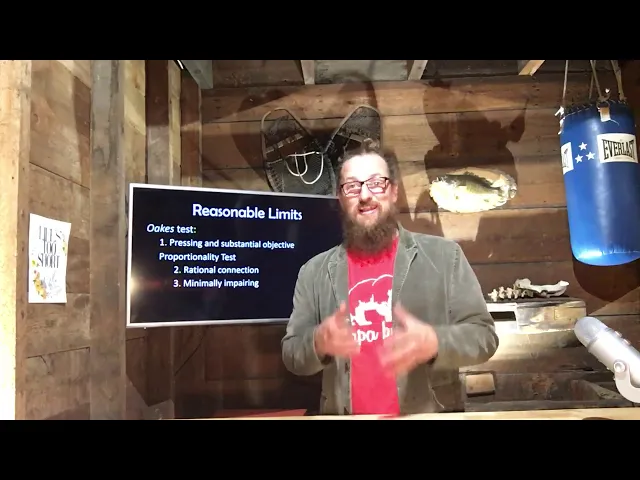
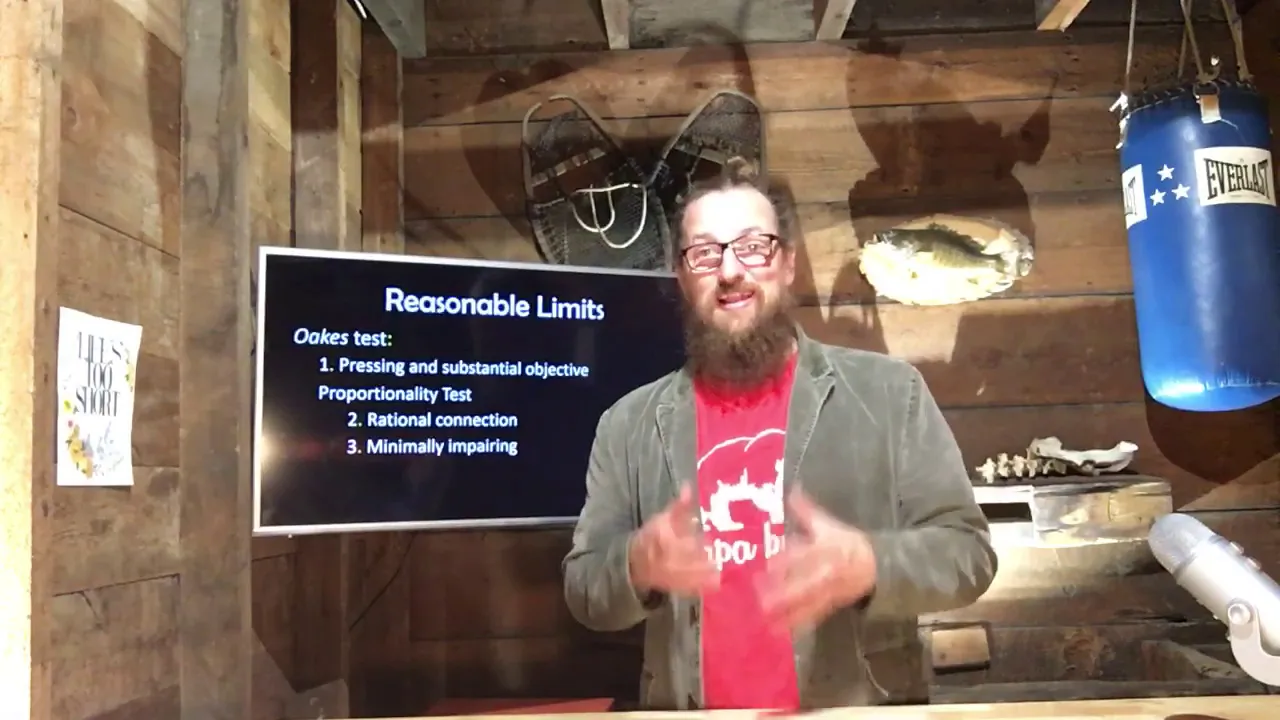
well i blew it i made a big mistake right after this slide so i decided to just stop that video and start here and maybe it'll be spliced maybe it'll be one video i don't know but we're going to pretend that i just stopped talking about this point and now i'm gonna move to the next slide and what happened uh will be would be for me and my ipad alone um so we've just been talking about reasonable limits and the oaks case as setting the framework but there's actually an oaks test there's a four-part test
and this is the test that we use to determine whether or not there has been a reasonable limit placed on a charter right so the first part of the test is to ask whether or not there is a pressing and substantive objective essentially here what we're asking for is is the the point of the law the law that is doing the infringing or the action is doing the infringing is it is it important enough that we recognize as pressing and substantial that the government actually has an issue that it's trying to address and it's not
simply this being done on a whim the next three tests are sometimes lumped together as the proportionality test proportionality analysis but just know there's four tests of the oaks uh the oaks analysis and you'll remember uh them all if you can think of all there's four and name them off you'll be doing you're doing well so the second test asks whether or not there's a rational connection between the pressing and substantial objective and the infringement i.e is there a need to infringe to achieve the objective because sometimes the objective can be very important but there's
not a connection it's not going to actually achieve the results often the rational connection test is assumed and so is the pressing of substantial objective very infrequently will the courts say the government didn't have an important objective it will recognize that it's not the court's prerogative to determine what's important to the the people so well these are tests where a case might find that the infringement uh was not justified that there's a no it wasn't rationally connected or it wasn't oppressing a substantial objective more often than not these are are parts of the oaks test
where there's a relatively easy yes that's going to follow not always it's not the only way to disclose but on occasion you'll find that these are not that complicated of analyses the third test is where a lot of the heavy lifting gets done and i consider this to be the most important part of the oaks test now the textbook may not agree with me on this point but this is the most important part because it actually is where most of case law has had infringements fail the third test asks is the is the infringement minimally
impairing in other words if you recognize there's a pressing and substantial objective that the infringement the law has an objective and the infringement that to achieve that objective is there's a rational connection between them then you ask is this the only way you could do this is there not perhaps another way that is less impairing that could be used to achieve the same objective sometimes the minimum impairment test is called the least drastic means like is this the least drastic way to actually achieve that now really importantly that does not mean it's the absolute possibly
least drastic or the absolute minimally impairing means it has to still achieve the objective so it's the the the means that is the least impairing that still has the outcome that achieves the objective and this is where a lot of times courts say nope the the government could have impaired a right uh in a less drastic way there was it fails the minimum impairment test the final test is an assessment of whether there is a proportionate effect between the benefits of the of the objective and the the the weight or the the impact of the
infringement the proportionate effect test um it's sometimes just glossed over and it's something that probably warns some careful consideration on my own part but more often than not it's the minimally impairing that is the most important it's this one that actually carries like i say the lion's share of the load now this test we're going to have a couple different examples of over the next few uh lessons but i thought i'd give you an example in irwin toy in quebec this case is one of the earliest freedom expression cases that is on the books and
it was a decision that actually is really fun to kind of study because it was initiated by irwin toy against quebec prior to the charter having any force or effects the charter wasn't in play at the beginning of this trial but by the end of it the charter was a relevant consideration and in urban toy there was a challenge against the quebec consumer protection act which essentially banned advertising the children under 13. it's more complex than that there was exceptions or some some guidance but essentially commercial advertising to children under 13 is not permitted in
quebec and irwin toy challenged this law saying it was an infringement on their section 2b rights their section 2b rights being their freedom of expression recall that everyone includes corporations so as a corporation they could claim that the inability to advertise the children was impairing and infringing on their rights now um one of the things that we're not going to get into a lot of discussion here right now about we are going to return to freedom of expression but the this recognition that commercial expression counts as expression and i think that makes sense