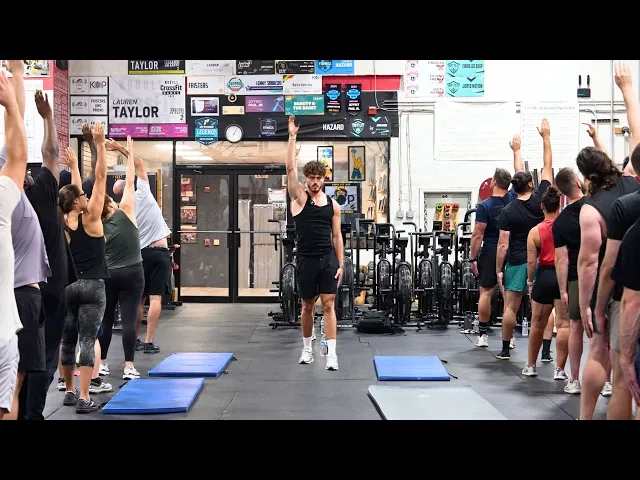
The only rules we have is three. Super important, critical. One, no flare-ups today. Do what's smart for you. Do what's safe for you. Just because I'm directing to do 20 reps on something or you see everybody else is doing it, it doesn't mean that you need to jump out the gym today and do something crazy and then hate me for a week afterwards. It's natural to get some extra energy from the environment and the uh the Enthusiasm of everyone. So, that's real. But just do what's smart for you. If you have any questions or you're
concerned chronic back pain or is in it, raise your hands. That's a good room. It was a slow raise of hands at first. I was like, is this the right work? Wait. Okay. Who here as are sitting on the hard wooden box is in pain to some degree? Okay, that's good. It's good. I'm not too much shifting in the chair yet. I Get it. Okay, cool. Who here has at least surface level idea of what I do or what this is about or has maybe in the program? Anyone in the program? That's cool. Okay, nice.
Just good to know who I'm with. All of it's everyone's welcome. Um, awesome. Now I got that read. We can get started on some of the the simple stuff. So, warm up for me, just start as far from the back as possible. Squeeze the big toe. You can do just the right. It's Like imagine you you're trying to be functional with your upper body. Hit baseball swings or golf swings and you really don't have a good use of your grip. It just messes everything up further. So just a big squeeze, get a little burn. Is
anyone kind of feeling it? Able to get to some work on that? I want to see grimacing faces, though. I want to see a little bit more effort. I see people like kind of It's all right. Put some work in here. >> Good. Okay, that's something. We got We got a sensation. I like that. Another as high as you can. We're gonna go for 30 seconds. As high as you can. Lift. Lift. Lift. Lift. Lift. >> Just the toe. >> Just Yep. All the toes. Yep. Higher. Higher. >> Ankle. Ankle is a big piece of
it or >> Yep. Yep. Ankle. Yeah, definitely. It's ankles. Ankles. Not just the toes. Sorry. Solid. Yep. Keep lifting higher. Higher. Higher. Chase a little burn. Squeeze to the max. Good work. Now, those are the faces I was talking about. Yeah, I'm hearing some job. You can plop it out. Watch your toes. No biggie. Okay, we're going to go to the other side of the ankle. And I really mean this. If picking something up from here is sketchy for you, like don't ask for I will run over, help you out. The point is to not
rule one, don't get hurt. So, We're going to pick up the weight and put it on one thigh, right? And then we're going to do a calf raise. Bent knee leg leaning forward. Keep whatever spinal position feels good for you. Get a little stretch at the bottom. We're just doing one burnout set to failure. Okay, just keep going. Nice and slow on the That's good. Give it the best you got. 10 seconds. >> We went to Mammore. >> There you go. [laughter] Right. >> Nice. Okay. And we're good. Okay. You can gently bring that back
down. Good job, guys. Next, we're going to stand on it. Really simple. Do really firm. Now, and then back up. Watch where your toes are pointed. Could be dead straight or slightly out. And make sure your knee is tracking pretty in line with the toe. Gentle tap. If you Reach out in front, you go deeper. Straight down is pretty easy. We're going for a minute. So, it's plenty slow reps. Nice and slow. >> Um, on the floating leg, yeah, a little bit. Try to keep the the heel on the ground on the standing leg for
sure. Keep that heel flat and go slow. Fight for the stability. >> There you go. Try to start stand real slow. That's perfect. Even if you reset every rep, nice and slow on the tap. [clears throat] >> Yeah, it changes it. Soon as you go forward and you start to do a pistol, it's a little bit less quad and then it's like glute and glute. But if you were to go back, you're like loading it way more. A little slower. A little slower. 5 seconds. And switch. Good work. It's extremely easy. This versus this is
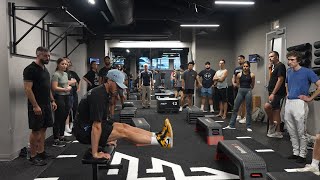
very different. So I don't care how high the Leg is. I just need the the knee locked out. That's what makes this muscle on the quad, the rectus forous work is that it's pulling here and at the knee when the leg's straight. So legs got to be super straight. And then the standing leg needs to be straight as well. If that bends, it's not hard at all. So just keep both legs super strong, super locked out. We'll go together on a count. Do we got a fan in here? We got some air Flow. Five, four,
three, two, one. Really good. One more. Three, two, one. Good job. Anybody feeling sharp stretch in the hamstring? Maybe nerve with the nerves. So, I would do that. And you can kick out low and still make it hard. You just have to squeeze the crap out of the quad. If you're up here with a little bend, it's it's still less potent than here. Let's switch and hit the other one. Got a little Little something going on. Yeah, it's the shortest range. The Reason it's so crampy, it's like as tight as you can squeeze a bicep
right here. That's what this muscles in position there. Ready? Let's hit the other leg. Knee up. Kick out. Five, four, 3, two, one. Good work. Kick out. Five 4 3 2 one. Try to get as tall as you can. Four, three, two, one. Good. Two more. Knee up. Kick out. Five, four, three, two, one. You guys are great with no assistance. One more. Knee up. Kick out. Five, four, 3, two, one. Beautiful. Is applied to a lot of areas in the body that's sensitive and chronically tight. You could just keep trying to open something up.
I know this made you feel tighter. It's crampy now. But if somewhere is really sensitive like hip flexors or outer glute, the squeeze then stretch approach is to take something in a very short contraction, get a pump, get some burn, immediately after go to the opposite and stretch it all out. Whereas if you only stretch on something Over and over and over, but you don't directly train it through, it doesn't have to be this, but some form of a shorter squeeze, the sensitivity stays. You stretch, it gets better, and it goes right back. So, squeeze
and stretch. That's a concept you can remember and apply to pretty much anything. So, what I just showed is what we're going to do. Now on the box or the bench, we should have enough room in the back toes. Doing good. No pain or anything. >> Just clicking on zero. >> Gotcha. Hold from there. Don't hold on to anything. >> Hold the weight. >> 5 seconds. And let's get up and rest. 30 seconds. 30 second rest. >> It's good. >> And then there's a difference of squeezing everything to the max and then making it to
where you start shaking. By The end, you're you're really spazzed out. It's in a stretch, but we want to make that hard. So, another 10 seconds. We're going to do the other leg. So, we're going to go right leg. Slower down together. You control how deep you go before we go. Actually on the back toes, big calf raise. And make sure your toes are turning in, not outwards. Try to be on the outer toes. Rotate it inwards. All right, let's lower down together. 3, Two, one, go. There you go. Yep. Exactly. >> To be on
the >> Yeah. So, it's very easy. People end up like this. >> Yeah. Rotate. Keep it square. Super square. Yep. Intense. Intensifies the stretch. Great job. Go as deep as you feel comfortable. No hands on the knees. No hands on the box unless you need it. >> Back glute. Squeeze the back quad. Great Job. Good. Hold that with strength. Any depth is fine. Great job. Good job, Rob. Nice, guys. >> 5 seconds. You guys are doing awesome. And you're good. Great work. All right, let's go. Right leg up, right knee up, kick out. Five, four,
3, two, one. Lower. Really good. except the leg. Not your torso, not your pelvis, literally nothing. I don't know if I'm Doing it that well, but he was asking of right at the kick out, start to feel a little nerve pain or something in the back. It could just be the stretch, but it could be some compensation of that little round to do it. Something happens that then puts more stress. So, let's be super super firm on it. Five. Four. Squeeze the back glute. Three. Two. One. Last one. Knee up. Kick out. Back quad. Back
glute. Two. One. That's it. Good work. That's All it takes to be sore for a few days. Yeah. Clabby up. Y'all doing great. All right. We're going to stretch it out under load one more time. Rob, what do you feel like is the toughest part for this one? Is it the joint? >> My knee when I did that one and this one just the stability. >> Yeah. >> Not stretching. Not doing that stretch before. >> Do you feel like if stability is out of it? >> Have you bent your knee deep like that in a
while? >> But now >> it's stretched already. Now I'm good. >> Gotcha. like that. Yeah. >> Here, let me do this. Let me move this bench a little bit. So, you get the rubber there. I want you to use two and see how deep you can hold. You can come this way still. You can come from this Way. I just want to see what it feel like on both sides real quick. Now, with those helping, can you go any deeper? Getting the knee to like here. That's good. Now, the back foot, the only thing I
need to do is rotate it. Yeah. Like that's an intense. >> Okay. So, I would say if you can get to like 90% of that for what we're about to do, you're gonna be good. I wouldn't even use weight. I think that's going to stretch you out enough. >> Yeah. Okay. Getting out of it like that. Was that hip? Was that the knee? What was like the uh this hip right here? >> Oh, that hip. Okay. In the front. Yep. We're gonna take a good pause. All the cues I told you about the big calf
raise on the back foot, squeezing the back glute, really tall, but ribs down. >> That's the rep we're going to go through at a steady tempo for 10 reps. Then the last rep, we're going to hold together. Okay, group one. Enter. And then back up. Good work. Two more. Lower down. Three, two, one. Hold. Guys are leaning forward a lot. And then back up. Good. Lower down. >> Three. >> Two. One. Hold. And stay. If you can flex here. Hold. Hold. Hold. >> Right there. You can bring your back foot up more forward to your
B. Yep. Right there. There you go. But don't lean forward. Keep holding. Keep holding. Knee forward if possible. 10 seconds. Great work. Up on the back toes. Three, two, one, and come out of it. Good work. Now, let's let group two go. >> Almost either resting into it or like staying more like I almost feel like >> 90%. Yeah, like 95%. Right. Not resting. >> Pushing against. >> Exactly. Even if you're in the max range, just there's a difference. I could be here and I could be active or Relaxed, but same range. But yeah, keep
it active. All right, guys. Group two. >> Good. Two more. Lower down. Three, two, one. Hold. >> You want to be on the little toes? >> Yep. And back up. Yep. There we go. 5 seconds. Beautiful. Keep that calf raise on the back foot. And come up. Up. Two, one, hold. One, two, back up. Let's lower down. Three, two, one. One, two, back up. You guys are doing great. Lower down. Three, two, one. Hold. Then back up. Nice. Lower down. Three, two, one. Hold. And back up. Couple more. Now lower down. Three, two, one, one.
One, two. Back up. Three more. Lower down. Three, two, one. Back up. You guys doing great. Lower down. Three, two, one. Hold. Back up. Two more. Lower down. Three, two, one. Hold. One, two. Back up. Here's the last one. Slow lower. Three, two, one. 30 second. Hold. Good. Squeeze the back glute, guys. Squeeze the back glute. There you go. Hold right there. Deep breaths. Expand the core cavity. Expand it really good. That's depth. That's great. Good. Don't just rest in the front hip. Still be active. Push up a little bit. Hold yourself. Yep. Did great.
[applause] >> No one joined the class. One more time for you. There we go. They were sleeping. Okay. Hey, no, I just I just did that for the shock value. So, you guys did good with this. This was obviously not a back exercise directly in the way you view it. The soaz attaches the femur to the front of the spine. As soon as you put that leg behind you and pull, it's yanking on the spine a little bit in that direction. That's a tolerance to build. So, that Was really, really good. I could tell some
of you guys have trained this. All those nuance things makes it a huge difference because you could progress through what you see with people going really deep and holding a lot of weight. But even then, if you didn't ever gain the idea of, oh, if I squeeze this back glute, I can get a stretch even up here. And so, the mistakes I made with some of this stuff was just trying to go heavier and lower and look like I'm getting to The split faster and then I tear something. So, if you have the choice of
getting to the 100% stretch without strictness or going somewhere that's like, okay, this is 80% stretch, but the strictness makes it internally more of a tension than down there. I would rather do 80% of the range, but own it and learn how to make easy things hard. Cuz when you got into the back injury loop, you're like, damn, I can't squat. I can't deadlift heavy. I can't lift the Same weights. You feel limited as if you're out of the game. You're actually forced to relearn training from a point of intentionality where can I make myself
sore with light weight, with slower movements. And it's honestly a forced teaching tool from your body. It's like, hey, you ignored a lot of things for long enough. You can't do anything mindless anymore until you fix up your back. So as you get this sort of focus, Doing it in this way may slow you down in the beginning, make you sweat from just 10 reps of light weight. Imagine until you get back to 30 lb dumbbells or 40 lb dumbbells or that kind of intention. It's like a cheat code. So that was the first segment
of the training just to get us warmed up and starting to work on some of the hips. We're going to do some stuff with the upper back now more towards the wall. We got the whole line up all the way Around to the low back. So, we're going to grab on the wall. We're going to have our hands at about eye height. Our feet are going to be at a solid kick to the wall. If we lift our leg up, the sole of our foot's hitting. We're kind of not jamming our toe, right? So, hands
at the eyes. We're going to sink into a stretch. extending our spine at the midback. So, a slight bend in the knees. I'll come through and coach you up. Go into a light stretch. Hold for 3 seconds and then come back up. You gauge how deep and intense you want to go. Arms pretty straight. Let's try to keep straight arms. Yeah, you're good there. Let's do three three seconds on the way down. >> Kind of go at your own own pace here. I'm not counting the reps. All right. Likely want to put the hands up
higher the wall and walk a little closer. Try to bend the knees a little bit, guys. Bend the knees a little bit. Yep, that's totally fine. There you go. That's great. >> Another 10 seconds of practice, then it's going to get legit. >> Good. Okay. So, now I want us to go into the same thing, but instead of going max range, how deep can we stretch? I want you to go about 80 90% of how far you Could go. And then we're going to make it a strength iso hold by pushing your palms into the
wall like you're going to break it. So go into about 80% stretch. And then I want you fighting against the wall as hard as you can. >> You're going to feel it through the lats and the chest and the top of the shoulders. So a little stretch and then push the palms hard into the wall like you're going to break through it. Yep. And hold there 30 seconds. Keep Calm breaths. A lot of you guys are a little bit too far from the wall and too angled down. Move a little bit closer. Hands a little
higher. There you go. We feeling a little bit. We're understanding the assignment. Keep it active. Push in. Push into it. 5 seconds. Three. Two, one. Good. Take a break. What are the questions we got? Because I know who felt low back a little bit for Sure. So, your spine has a lot of movement potential. You could go in here. I saw a lot of people this deep and just start seeing how far can the body crank back. That's fine. It's almost a practice to see, can I move more of the midback by feeling than moving
the pelvis too and getting the low back. That's not necessarily bad, but it's not what we're going for. So, the knee bend helps with that. The hands a little higher. And off of feel, Can I just stretch at the middle of the back? And then that palms in is learning to just get a sort of a can you contract through the shoulders and back in in a tense stretch position in your upper spine. That's something that kind of gets lost in this posture and we only stretch it. We don't build strength at these stretch positions.
So I want to do one more thing with you. Let's put our hands exactly where they were. Get set up again. Let's all yell it out. Let's see the questions. >> So, pressure into the wall and then put my feet really far back to counterbalance that pressure. >> Yeah, I saw you guys were deep like this. So, it's it's not meant to be a horizontal perpendicular force, more down. >> Yeah, a little bit. And then you're almost doing like a pull down into the wall. >> That's a great cue. So the iso hold another thing
that was brought up when I say push the palms into the wall. I think it was wasn't the best cue. People started trying to push this way. It's a down movement on the palm like you're doing a pull down and you're trying to basically get iso holds with the lats and midback this way. So let's try that one more time. Just getting the stretch. All I want you to do, bend the knees, hips back a little bit, arm super Straight, fingertips are on the wall. I want you guys to just barely lift your fingertips off
the wall, but from the midback. So the way you do that, reach up and out. Reach upwards away from the wall. You guys got to move closer to the wall. A lot of you guys bend the hips, lean into it. Good. and make sure your feet aren't feeling any difference in weight distribution. Good. Some of you guys will feel it, some of you guys maybe not yet. We're going to get some practice on it. And then back down. So, you're doing reps. Okay. >> Do 3 second hold off the wall and then back down. Bend
the knees. Hinge at the hips. Let's do three more and then let's grab our box setup. Let's get back on the boxes. Good. Good. Good. >> What's that? >> My legs supposed to be arched or neutral spine. >> More neutral on this. Yeah, on this one. >> All right, guys. Good stuff. Good stuff. I want you to feel another one here. >> Does that same purpose as doing the um >> trap three? >> Dumbbell trap. >> Yeah. Why? And absolutely. It's a very strict only at the shortest part where it's difficult. So, we're gonna try
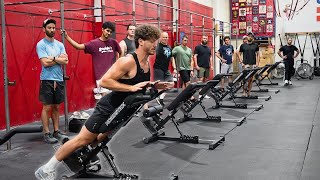
one More time the wall. It's not the easiest thing to coach everyone at once cuz some people have a some people are down here, some people are up here. But overall, we're just trying to teach what does it feel like to contract the lower trap muscles and some of the musculature in the middle spine. And so, we can do the same thing here. I want to teach two things with this the seated. Good morning. Iso hold. It's training the low back. And Then we're going to do a raise from there and try to feel it.
So, we're going to go feet shoulder a little bigger than shoulder width apart, a little wider than a squat. And then a little bit more open than 90°. If you're on a higher box, this will be a little easier. The lower bench is a little tougher. I want you to try to go hands behind the head and be really strict about a flat back almost arching almost into extension like that stretch. We're going to lean forwards very slow only go as deep as you can that you feel no change in your spine position and then
hold there. It's okay if it's even just 4 in. Yep. Retract the shoulder blades. Get a good extension and hold this for about 20 seconds is solid. You're gonna feel some midback. You might feel a low back. I see people going lower than they should in some places. Yep. Low back shouldn't be rounded. Okay. Keep your body where it's at. Drop your hands inside the knees. So from here, pick the chin up a little bit. Super straight arms like you don't have elbows. I want you to do reps raising the hands directly up by the
ears and then back down. Slow. Raise up and slow. Focus on spinal position. Nothing's changing. No cheating. You're trying to stay almost extended. Not just neutral, but extend. Chin up. Keep doing That. 3 second hold at the top. That's good. All right. Good work. Let's go back to the wall. Good job. That's a squeeze you didn't know you need. So, keep in mind how that just felt. We're essentially trying to get in the same position, less of a sitting and stretch with your hips. But when we're doing this, this is just the top position of
that. And the raise is just a very short squeeze. So, you want your arms up by the ears. You shouldn't be down here. Hands are a little higher than before. And hold for three seconds. Reach out. Let's try that one more time. We're going for the same kind of squeeze in the middle of the back. You shouldn't be stretched, so we're not going into that stretch to do this. Try to lean into the wall more. Like Push your butt back. Sit back. Yeah. Have your weight sitting back away from the wall a little bit, but
your hands are leaning on it. Your fingertips only, guys. Fingertips only. Yep. Bend the knees. Hips back. Make sure nothing in your body is moving but your arms. Do you feel your weight going from your heels to toe? It shouldn't. Do you feel your hips moving? It shouldn't. Just the arms. Slow movement. Yeah, that's I'm seeing some really good ones now. It's a killer. How you doing over here, guys? How's it looking, Rob? That's solid. What's tough about your setup is so narrow. It's hard to do it here. >> Yeah, I feel >> kind of
need like a little wider. >> Try. Yeah. Try to go super straight arms. No elbow bend. No elbow bend. Reach up. Yep. No elbow bend. Even Yep. There you go. Slow movement. Slow Movement. Don't just throw the hands off. Like very gentle lift off. Just a centimeter. Yeah, I'm seeing some shake. I'm seeing a squeeze. I'm seeing it. That's it. Really good. This guy's a vet. You You can tell by the the gains. That was a sincere grunt. >> Little trap gain. >> Yeah, little trap. >> Good job, guys. All right, you can pause. >>
Phenomenal. I love it. I love it. >> Good job. >> So, communicate with the back. We're not at the low back directly, but believe if this stuff isn't helping out and doing what it should, it's one spine. And a lot of the muscles, the low back, spinal erectors go all the way up to that area. They're helping out here. So, everything we're about to do with the hip mobility later on is super critical. This is also super helpful. It's just it feels great Afterward. you feel a little taller and you feel opened up. Not the
most fun thing, but something I would keep at least once a week. If it's not body weight and very focused, you can start to add little weights, one, two pounds from this position. Or you could be chest supported on the bench. I post that a lot. Any angle your body is at forward, straight arms, you're going to get that part. So, everyone feeling all right? >> Any questions on that or anything? Yeah. >> Okay. >> Yeah. >> How do you like avoid like overarching your lower back on that? Like >> it's a great question. So,
some of us, I don't know if you're familiar with extension intolerance. If you know, you go like this and that's a pain trigger. It's easy to go too deep, arching back and throwing your spine to do that. That's where it's again to that 80% Range and learn to contract in that rule. Like I was saying there, everything could go deeper, but if you do an easier range and learn what to squeeze. So if you put your hands on there and just go for the relief, ah, stretch into it, you could do that over and over,
you'll get your your back and spine to pop a whole bunch, >> but you could easily overdo it and feel sensitivity. Ease off like 20% and then think, what is the goal to feel here? What is stretching? And once you know a little better, okay, my lats a little bit, maybe some of the chest, the middle of the back. Remember these cues of super straight arms, elbows into the wall, make the stretch loaded, active. So that's why I was teaching you guys to try to palm down on the wall. So you don't have to go
as deep to feel some stretch. So that applies to a lot of stuff and I'll go over it later, but if you've been through the PT route and you Start becoming married to stuff like cobras and you're doing a hundred a day, that might be a relieving thing early on, but it's passive. It takes no spine engagement to do this. You just get a tricep burn like you never had before in PT. But the problem with doing anything hyper repetitive when it's passive is it's just loading onto passive tissue. So bones and ligaments and joints
and you get facet joint irritation. All of a Sudden now you're extension intolerant when it used to be I can't round forward. But you do press ups till cobras till your back is about to break. And a year later now you're like I can't even sit back. That's true with decompression hanging from a bar. That's true with any kind of like weird things we do every day over and over. And my goal is to to tell you like if you feel relief doing any of these drills or band-aids, if you just learn little cues On
how to make it active, now it's a route of building and it's not just this feeling you're chasing. And so this that applies for almost anything you find relief with, whether it's just sitting and doing this stuff and digging into it. We're going to teach you how to strengthen it and squeeze it and then do loaded versions of the stretch. And that applies to the posterior chain, the hamstrings, the low back, the shoulders, all that stuff. So that's a really good Question. Don't want to overarchch into anything. You don't want to feel like I look
good doing it how I should, but it doesn't feel good. So, we're really solid at this point. We are We're flying 345. It's a good group. >> Would you rather like >> Yeah, that I'd rather you instead of just saying like, "Okay, this is good with the weight here. Let me go lower." It's can you just sit on the heel? Can You get deeper and deeper and deeper at this range and get the weight heavier and then very slowly drop down? Eddie, we got someone over here. Ah, and I was forced into things I would
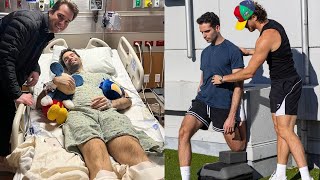
have made fun of myself for doing. And this is one of those of sitting down and hyperventilating, doing breathing, but it was a lifeline when I was going to die. I was going to end it many, many times. And it just like I made a lot of Promises that if I made it out, I would just commit my life to trying to help whatever I'm supposed to help with. I guess it was back pain. This is stuff I didn't think would help as well. So, I appreciate the open-mindedness. This is kind of how it all
unfolded. I enjoy it to this day. So, we're going to get into it. Sorry for trauma dumping, but this is the space for it. So uh at the worst of it really the worst Of I started meditating just sitting still and and trying anything I would think it was pranayyama prana some Tibet kind of eastern philosophy breath work before Wimhof's more popularized version but pretty early on and I did a lot of stuff for like six months that didn't feel like it was working until things started to pick up but I was trying anything fasting.
I was trying a lot of stuff. All right. Very trainable. The Diaphragm, the literal muscle that allows the lungs to expand. It's just a suction for spine support. Every deep inhale you take puts increases the pressure of that intraabdominal cavity. That core cavity is a barrel. There's a ceiling of the diaphragm. There's the floor of the pelvic floor. front of the abs, transverse abdominis, a side wall, and your 360 ceiling floor. And uh that barrel, if you can get Pressure and take deep breaths over time, if you are super sensitive in your spine, level zero
of training, because when you're sensitive, a sneeze can flare you up, which is just a sharp increase in release. You just change the pressure and that hurt you internally. You didn't even have to move. It was from the pressure. So if it can harm you, it can heal you. And this is a good dosage to get that. Outside of the actual breath side, I'm curious, your First time, did you like feel anything from a calming, maybe lightheaded, maybe in a rush? Yeah. >> When you train, it takes discipline like any athlet, you do four rounds,
whatever. And you're trying to stack. the kids getting to sleep right, trying to eat right. This is a really good component to add. Um, there's a reason it feels the way it does now. Like you kind of want to sit up calm and relax. That's life gets Crazy. 2025 life times are weird. It's good to get grounded. So the next section actually spell >> Yeah. W I M H O N really >> main thing I didn't know him then. Now I'm starting to kind of get connected now. It's cool. I met a guy knees over
toes guy who I came and road trip down to live in my car to be mentored by him. Maybe you know some of his stuff. Um That was really huge for me. this guy Cador Xiani who's a French an Algerian dude. He lives in France. He's 51 and he can like he could run up and kick that rope with his foot and he's this tall. So he was the world's best dunker 20 years ago and now he's a longevity freak. And all of his training what he accredits a lot of his longevity to be extremely
flexible, extremely buoyant and resilient in his joints and body is this groundup flow. probably going to go In the middle working a lot of the fascia and they're based off of animal positions supposedly. And so the first one for 5 days, how hard could you flex your tricep for that week? I can't show my tricep because if I wanted to show off my tricep, I go like this. That would require the ability for me to stretch the opposite side of the joint. So, if I Want to be able to stretch this better, I got to
be able to contract this side better. If I want to be able to contract this side, I have to be able to stretch this side. The equivalent of the spine, if you have SI joint issues, really low back by the sacrum or low spine, anything L3 and lower, think about where that is on the pelvis of that joint. That's at the top back of the pelvis. So, the opposite is the bottom front of the pelvis. So, what muscles are Attached in there? deep groin adductor groups, hip flexors, everything through here that shows when we do
any kind of groin stretch of crisscross of hip flexor stuff, that tightness. That's why a buttwink hurts you. The tightness in the groin, if it's not opened up here, you're not able to properly use this stuff. So the better we can open up things deep in this area, the less residual strain and secondary work has to be forced on the spine. A Lot of the spine problems are indirect. Not many people overuse their spine. Rrowers maybe in the sport of, you know, rowboat and they're going thousands of reps. Some people have that problem. Most people
didn't wreck their back by doing too much spine work. it's the other stuff that's forcing it every day to overcome that. So yeah, that concept alone is is worth remembering. The strength, the squeeze then stretch approach I talked about is a core one. If a muscle sensitive and tight, squeeze it then stretch it. That's a core principle that's helped people. The reciprocal inhibition of okay, if this is my problem, what's the opposite side? If I have issues on my outside here, I can't contract this. This doesn't fire. The opposite is the groin, the deep inside.
Can I stretch this? Can I get any range? Can I squeeze it? And that's going to help you then get out. So, you can apply that to a lot of places. This Ground up flow is just easy to do on a daily front. Um, you don't have to go intense and do the weird moves into it like I was showing. But, how's everybody feeling with that? >> Yeah. Feeling a little better. Cool, man. It's pretty off-brand for me. It's not what I post about, but it's just the cool nuance things outside of what obviously we're
going to do today. Back extensions and the hip mobility and the need surgery, you need about a year or Two of building stuff up. They just go to another surgeon and get the opinion that says they can be fixed. So, it's tough even as a doctor. But an interesting thing, he he sees some interesting stuff in surgery. Um, as someone that's just curious, he hears the symptoms. He talks to people that with persistent sciatica and nerve pain, perform a disquectctomy and try to remove maybe some parts of fragments or parts of the disc cuz they
have Persistent symptoms. And he said that he's cut into people through this through the skin, through the fascia, through some of the the surrounding tissue, and he's going to alleviate a nerve that seems to be compressed because all the sis the sciatica and constant nerve pain all the way down the leg that's excruciating from herniation like two years ago. And then when they're in there, the nerve that was compressed by a disc Bulge and it's like this. It's still like that, but the disc is actually absorbed back. It's like, wait. Okay. So, the fascia and
connective tissue and nerve is still compressed as if there's something pinning it, but there's not. It reabsorbed. And that's when it's realizing like, man, it's it's like the muscle memory of injury holds. It's not muscle but the connective tissue memory of injury holds your body gets molded not just posture of our outward how we Sit that's true too but even intrinsically within the structures on the small stuff something gets compressed and and pinned most disc herniations do reabsorb yet symptoms linger a lot of the muscle shut down a lot of the things get just inhibited
the firing gets weird you learn patterns of avoidance and trying to move around that all Well, that speeds up the weird workings of your back to now not just be able to heal on its own. Plus, the Connective tissue stays stuck. And so, his biggest thing is just like I think people have to it's better to make the mistake of moving the nerve and moving the body into irritation than to completely avoid it the first year after a surgery or injury. It's better to accidentally irritate too much and keep gliding or keep gentle stretching or
keep contraction and deal with that problem of a occasional flare up than it is to do nothing and let it almost Cement and become hardened into this dysfunctional position. And that's uh that's a cool thing to hear because when you just the medical industry largely views the whole thing as a mechanical problem that's very A to B to C and you can't really solve it that way. Um even if you get MRIs like a lot of people at the last event said hey I have non-specific back pain. I don't have a herniation but it's really
wrecking my Life. Is there something wrong with me or not? And it's just like it's that's so 101 for me, but I realize it's not the standard understanding of when you look it up online. You're non-specific. You literally can start to think, oh, it's psychossematic. It's like in my head or it's just it's stress. You could have a lot of messed up stuff. It's just what we test on MRIs are bones, disc, and nerve. And by the time something starts breaking down bone Disc nerve that's like endstage dysfunction that means the muscles weren't supporting it
for a long time and then the intra the small parispinal muscles the very supportive ones in the grooves those weren't strong enough for a long time ligaments were probably taking strain and then you get spondi the misalignment or you get spar pars defect fractures in the back you get stress fractures or ddd and the narrowing and it's like by the time you Get those diagnosis that is years after extra strain was already there, but you'll never get an MRI and get diagnosed with a weak multipetus or parispanalis and the tiny things, they just don't measure
it. And so you don't have a lot of circulation in your rotatorous muscle. Like it's just not something we test for. And so I think like zoom way out just getting people to look at their problems differently. It's very complex. No one can know Exactly what it is because it will spread. It's going to be interconnected. There probably is emotional components. There is the whole holistic health component. Um, but you are not your herniation. Your whole life problem isn't just the herniation. It's uh at least a whole body thing if not a whole life thing
to improve. But that was a cool relationship to get with someone inside the medical industry that is eager to have someone I guess the fact I Have a bigger platform to reach more people. He's interested in trying to bridge like so I don't go to the deep end off of just fitness influencer guru cuz that'll take you to selling some weird courses and selling nonsense. Um, but so you know there's no wrong way for us to have the convo this aside from the more current injury. I don't know how much you've dove into learning about
what I teach for people. >> Yeah, >> obviously here we're here today to learn that. But >> do you have any questions or need help with something more specific? >> I just feel like coming into this I'm like back at ground zero basically >> coming out of the spasm. I mean, middle of the night, Tuesday night, I was just sobbing. Like, I didn't know, you know, where I knew I had to do something, but I I didn't I have to kind of take that first leap to commit to it. >> Um, I've been on my
fitness journey for like 3 years now, but I just want to obviously gain more knowledge and more of a better understanding of exactly where to start when you're, you know, in that >> Yeah. >> like bottom place. >> Yeah, I get you. And I mean [snorts] I try to teach people to look at these things from an angle that it's pretty Intuitive. Um like with spasms for example, people normally what I've seen have one of two issues when it they've had building issues in their spine and pain over years. It's either shutdown inhibition. they can't
even they just don't know how to fire it or spasm which really means no firing too much firing and there's a mechanism in the body called gamma motor neurons it's a very specific neuron that controls the Sensitivity of firing there's there's parts of the nerve that say on off but there's parts that are the dial of how intense and when you start going through loops of pain that dial gets weird maybe it's cranked up too high maybe it's cranked down not at all and you have an issue with firing something properly without feeling a crazy
tension that spasms you up and seizes you. And that's why I've coined the term of building evidence of it. Whether it's like a 20 Second iso hold or what we already did here. If you felt any burn, you felt any kind of pump and it didn't go to that point, you just put a little deposit for it to become less on edge over time. And now sometimes people say that's not scientific enough or well that doesn't explain the mechanism. I just after running it through thousands of people like the simple stuff of this feels overwhelmed.
I gave it proof that it doesn't have to be. Circulation and Contraction are two very good things for almost any ailment muscletally and everything does better with that. Now if there's like still tightness after if there's a little bit of s you know symptoms of nerve stuff that's longterm changing all the connected stuff in the body and the imbalances but that spasm and that fear of you could just lock up the first step is like meeting the pain at an appropriate level of okay I'm not going to do nothing I'm going to go directly to
it super gentle and it's um yeah we we had somebody at the event yesterday say they were diagnosed with a kinesisophobia. I was like, what is that? It's fear of movement. I said, I think we all got that at this point. I'm like, okay. Um, and we got to overcome our kinesisophobia. And the only way to do it, you could think about it. We could talk about it. Uh, the best way physical evidence of your body and your Psychology is to actually go feel it. And so, it's a cool place as a community to do
that. you're going to see beads of sweat down their face on the back extension and it's not because of physical exertion. It's because they're like, "Oh god, is it coming? Am I good?" And um I don't know if you've trained it yet or got into the movements at all. But >> working on that fear. >> Good. Well, today's work to it. >> Today is the best day. >> It's the best day. And all you have to do is prove you can do a little bit and then next time be brave enough to do that again.
And what used to take a lot of effort is going to be your new baseline. Just slowly incrementally stack. And even if you have a little dip, like you said the words back at square one, that's almost never really the case. Um because inherently the journey is this. It's like a stock Chart. If you zoom out long enough, the macro is gained, but the the weekly will be like this. And that's okay. Um, but as long as you just you believe and have faith of running away is not an answer and outside in treatments aren't
the answer long term, then you're going to you're going to keep showing up and find a way. Um, I find that like I've had a few convos already through this whole tour already of of people saying, "I followed you for a long time. I was on the edge of having the back issues take over my life. I was trying some of the program, but I didn't commit. And then they get forced to commit because it gets so bad. And I started to realize a lot of the reason people didn't commit isn't just cuz like, oh,
the program's boring or they don't want to stop their lifting. Those could be things for sure, but it's fear of like, what if I truly commit to fixing this And then it doesn't? And it's just like sometimes like when I was dead broke, I hated checking my Chase. I just rather get declined at the cash register. I don't want to I don't want to open it up and see. I just pretend it's not there. And a lot of us are in back debt and we kind of don't want to know just how bad our backs
are. So let's let's try some of it and let's let's put it off till later. So I you heard my story. I was forced to sit down for life Cuz I was ignoring it for a long time. My body gave me signs for a very long time of like, "Oh, that was weird. I'll go 20 pounds lighter on my squats next week, though. Won't be a problem." Um, so I'm sure everyone here relates to a level of stubbornness or a level of out of attunement and lack of communication with our body to where it's like
this is a big hole to climb out of. Um, so it's it's relieving when you realize it Doesn't matter how long it's going to take. It doesn't have to be immediate. I just want to make it inevitable. This is my last time fixing my back. So, let's do it right. Whether it's a year or two, there's no pace too slow. There is definitely a pace too fast. And so, yeah, this is this is a great place to be. And I'm I'm excited to see how you do. And everyone's sure in a similar boat to some
degree. So it's >> you're not alone >> doing like a way for >> like where I'm at right now is like it's been probably 3 years since a real bad flare up >> and I'm kind of at the point where I'm just I'm putting together my own PT program for myself >> and doing like some CrossFit and things like that along with it. I definitely want to add some more offensive uh things in terms right now. I'm kind of just taking stuff from my stupid back Mechanics, which really helped me get out of my acute
phase, like when I'm really bad. >> You need more. >> Um, but now like I'm at a point where like I know I can do more and I'm kind of floundering because I feel my disc kind of coming out a little. I'll hit my PT PT. All right, I'm a little better. And then it's kind of just that rotation and just like, you know, poster turn, use turn, but bullet grip my back a Little bit more. >> 100%. Yeah. And it cost $1,000. That's one thing that I I'm kidding. It's pay what you want. But
you can definitely pick and pull. Um for people that are at a rock bottom, really rough, I'd say stick to it completely. They're like even the ankle. Yeah. Just stick to it completely because having some kind of plan, even if it's not perfect, is something to stick to every day of diligence. I'm going to Show up and have faith to it. If you had to add something, fine. Add something. take one thing out, tweak it, whatever. But where you're at, you need to find like three to four major routes that I'm like, "Okay, today the
back extension, you need to see how you feel today." with our basic tests. If you're doing cleans or you're doing heavy squats, you need some serious goals for your back extension with weight, um, which maybe isn't sudden, you know, for the next 6 Months, but, um, a lot of what we're about to do with the hip stuff and the low back is is directly what I think you should pull from it. But it's all on the program. You can flip through Monday, Wednesday, Friday is some of the stuff we already did. And the back extension,
direct building, Tuesday, Thursday is more mobility and hip stuff. Um, some people need it for the blueprint, some people need more just to pull principles out of it. And I think for sure you Could do that. And we will give you guys a give you like a print out or a uh a text with the links and everything we did. Just a write up. >> Seeing your post like the one thing that you did out of me. >> Yeah. >> Because kind of coming from, you know, again, I'm not not meaning to like plug stupid,
but that methodology is you never put your back in ever, ever, ever. So that's kind of what drew me to your Page is like, wait, this guy's doing something a little different. Yeah, >> that makes sense. But I've never built the courage up enough, right? >> Start to progress to the >> Well, that's really like part of the reason. >> I get it. It's and it's worth learning about. >> I mean, I didn't notice. I've been in the same shoes. Please know I only exist with this niche of a niche and this Approach because the
standard approach did not help me enough. So then I was like, well, I'm studying in school. I'm trying to be a physical therapist and I'm here presenting at conferences yet I'm in the chair shifting and like really getting wrecked. What's going on? And then I looked into the research of the standard back facts and the fundamental back facts that every other movement thing is based off of is faulty. And when you hear about this is The research we base all other knowledge off of for the spine, you're like needs updating. So I don't know if
y'all know the history of that stuff. This is not a personal bash. Let's do McGill. The protocol is pretty smart. Miguel big three. He does apply nuance and a lot of the ideology is very good in those early stages. But just for the sake of pushing low back fear to spinal flexion. Um this is the research that was done in The 90s and early 2000s that has been studed and then regurgitated and repeated and repeated and explained. They took cadaavver spines which means dead animal spines. They were pig spines and without the musculature, without a
living creature, they took a spine and bent it a thousand times. And then they looked at the disc and they go, "The disc is delaminating." Meaning the walls of the disc are starting to crack and the disc the p the Nucleus propuls popping out this the gel. They bent a dead spine a thousand times and said it's bad for the disc. Spinal flexion is bad for you. That is the research. That is it. That is like the main research that then every other physical therapist squat you and all these people that were mentored on them
then make videos about it's it shows when you do repeated spinal flexion there's too much weight that at least that's the research. And when you have Just like intuitive thought you go okay well what about something like the back extension? you shouldn't use your spinal erectors to say you shouldn't round even that they will say the spinal the the back extension puts too much sheer force on the spine and can cause injury if you have somebody who's injured start day one doing reps loaded maybe it is too much but they've never done a multi-year study
of doing holds to hinge reps to gentle assisted reps and that idea of Progressive overload on any tissue they just Like if you take a dead structure and bend it, you could take a knee joint of a of a cow and bend it enough, I'm sure the meniscus will tear. So when I learned that, I was like, what this is, okay, I felt like I discovered a conspiracy. And so my my point is not to attack that or try to be the the truth to that fear, but it's like that's the fundamental reason people get
emotional and fearful about Their back. Don't lift with your back. Be very careful. While it's true, it's riskier in the short term. It's risky in the long term to never do that. Things break down faster. Things never get the proliferation and healing. So, um, your fears around it make sense. Like the main guru, the main expert leading all of it in the spine stuff is the one that did the research and everyone mentored under has just been going with that. and it's time for new Research in new protocols and new ways. So yeah, that's um
something we thought about. We've had people reach out wanting to help us conduct studies of multi-year longitudinal things of what happens to a spine on the iso holes and how are we getting results and some of them are in data science and they're like we could sell it to companies, sell to pharma, nonprofits, get millions. And I'm like something about the people Reaching out. There's a lot of money in research too. And I realized I'm like I like being on the ground sitting in the benches with people eating food and helping individuals versus trying to
fight the narratives of things personally, but it's pretty fascinating when you like dive into the back lore of how this all started. Why is there confusion and who's perpetuating it and what do they sell and what? But anyways, but I just want to help people That I know are coming to the same realizations that I don't think a six injection is going to help me, you know. Um, a little funny story just real quick. I got a phone call. I don't know how this woman got my number. just the old woman. She said, "Hey, I'm
in the program. I'm trying to get logged in." I'm like, "You got my number?" "Okay, what's your name?" "Evelyn." "So sweet to meet you." She's like 65 in the deep south. And [snorts] um said, "Yeah, it's my last chance. I'm really trying to fix it with this. Uh I had 12 cortical steroid injections in my spine." I said, "What?" She said, "Yeah, because my insurance said I needed six injections so I could finally get an ablion." and my my doctor said I need an ablation, but they wouldn't cover the ablation unless I get six injections.
But I got six and then my husband died. So I had to move states and I had to Restart the counter of injections at the new state. So I'm at my 11th injection and I feel like I shouldn't even get the ablation. I'm just like, Evelyn, keep my text me every day. Let's get let's get you out of this. And it's just like, man, she can barely walk. >> Have you ever since >> I haven't um she got logged in. I know that. [laughter] >> She saw her chatting in there with some People, but she
hasn't hit me up, so I assume no news is good news. >> Um but it's like really scary. You guys are all pretty um open-minded, resourceful people because my a big slogan I have is don't trust people on the internet for sure. and you guys are semi doing that. So very adventurous and brave. >> Um but you must have some kind of discernment to think that this is worth it. >> And a lot of people unless by force aren't going to stray from expertise. Like they're going to go where they should go as did we.
And if it doesn't work, they might just go deeper into acceptance of well I'm not supposed to get better. I'm 37. I'm old. Or they start thinking crazy things and it's like I thought that I was 25. It's like this is what happens when you turn 25. Not good. Um so just saying it's pretty scary to hear Stories of like imagine your grandma like she's not going to question what the doctor says. She's going to do what the doctor says. >> Regular training. So if you're >> um and they're training for 10k or you're just
trying to do like something like that. >> Um is it almost like a daily warmup that you incorporate or you just take an entire 1 hour like this whole protocol? Um yeah. >> Yeah. Well, if uh Okay, that was not a good bite. Sorry. >> Just going to pause. Um, it depends how much of your low back is a matter of in your life. Like if your low back is the biggest thing of your life, you should probably prioritize my low back training is my training and I'll sprinkle in the other stuff. If you're kind
of at this place where you're you're you're getting off the cusp, you're seeing bending a Corner and you're like, "Okay, I'm getting back to being athletic and I want to start to merge some of it." You can go less intense and make the intensity a little bit more. So, for example, the flow is normally Monday, Wednesday, Friday. You do some back extension iso holds. You do some of those split squats. Open up the spine that way. You add some kind of lateral force, some kind of load sideways. Stimulate all the angles around the Spine. Uh,
very just one set, very gentle, and then do it again two days later. If you've built up to where you can do two sets, three sets of the back extension, now it's like hitting arms. You can hit it hard on Monday, wait till Thursday, you know, or you could hit it really hard one day a week on your leg day and you could just set very specific goals that you know matter for you. The back extension is a very good one to have or it could be a different Variation, but set a low back specific
goal. Uh look for opportunities and whether it's the hip, a very specific movement of the hip mobility. Try to find out where it's like, wow, I'm bad at that. and make sure at least once to twice a week you keep it in there and progress it. How you do that depends on the person. Some people like cycles and like structured in math. I don't. Some days I wake up and I'm like Enoch and Eddie, we are doing this ballet class Together and we're going to learn how to use our toes that way and then we
go do some back extensions and we just flow more. You know, I like to flow through training and less of the structure. But um it's basically if you're doing better, just include something consistently over time that you're you know matters. Um yeah, it's it's up to you really. You know, >> chain kind of affecting the lower back. Do you find more times it's a deficiency in strength or overtightening and you might need to do some like release therapy >> you know like rather >> right [snorts] well kind of depends what might be triggering it for
example like anterior chain meaning the front of the body and the strength of everything in the front. Um, if you're doing a lot of squatting, but Your knees are really shot or you squat in a very like hinged low bar butt back way, maybe that is part of why you're having so much back strain is because you're doing a low back squat every time. And if your legs and quads are stronger, then you could sit more upright and do a more vertical squat. So maybe like strength things definitely matter to be more well-rounded to not
put so much extra stuff on your back. Um, The soaz is like a very nuanced and I don't know seems like a complicated muscle because people focus on release of it. You get those soaz tools, seen those hook stuff. Never in my life will you see me digging through my intestines to try to get to that muscle. That looks crazy. But [snorts] some people say it it helps them. Um, it's definitely a muscle you can stretch and you can feel, but it's apparently very related to emotion, too. And people Find tension there. It's more related
to how they feel overall. Um, yeah, just on basic trends when I've worked with most people, how I started teaching stuff was like, okay, everyone's hips are tight from sitting. Everyone's back's rounded. It used to just be open your hip flexors, open your spine and extension this way, strengthen the low back. That was like the three-step thing I taught. And that was true for 80% of people. But then I Started meeting people that like had like a different posture. And I was like, "What the heck? They're not shaped like this. They're shaped like that. And
they have a different pelvic tilt and there they have no arch in their back." And I was like, "Okay, that's actually probably not what you exactly need." Um, and so I guess it depends on your trade of life and things, but when in doubt, check both. find out what does it mean to be tight or weak in your interior Chain. That's why I like like Okay, so there's compound movements and then there's isolation training. We're all kind of familiar. It's generally accepted in fitness that isolation training is kind of like broish bodybuilding, not very natural.
And then compound and movementbased training is more intuitive and fluid and using joints together. And that's very true. But when you start having problems and you're kind of trying to understand your Problems better, if all you do is squat, then how many things are involved with the squat? Your ankle, your knee, your hip, your upper back, your spine. So if your hip starts to go off a little bit, your body will find a way to keep squatting for a long time even with the issue. So the compound movements because it involves so much, it can
compensate with so much. So sometimes that's why this approach of we're going to do our arch squeeze and then we're going to do Our toe lift and then this. I don't say you have to isolate train everything forever. But when you're trying to know what's tight or what's weak if you only do a ankle squeeze, you know exactly this at least. And so isolation helps you understand the problem and start to fix it so you can bring it back to compound. So just that kind of approach is helpful. Same with stretching. A lot of stretching
is compound stretching. Chiropractic. What did he say Specifically? >> Oh, yeah. >> I'd say 75% of the time I went to a chiropractor since having an injury. Uh, I ended up either feeling worse when I walked out or feeling worse the day after. Um, the amount of manual adjustments they try to do by twisting your body, you know, you you kind of have to like go into them and give them a whole background, you know, depending on what your situation is. uh just to You know preempt them from doing something with guns to exacerbate issues.
>> But >> yeah, >> that's just my >> So I would say it depends on if they know what they're doing and they can treat you holistically because you could say, "Oh, my neck is stiff here or my back is stiff there." But then they'll only know to do that. Depends on what Their um I guess their business model is. you're in, out, done, done, or am I trying to teach you and show you how you may be doing things incorrectly? I used to go to a chiropractor for a little bit. He was great. He
really knew about me and the work that I did, but and he incorporated a number of modalities >> and I was nervous about certain things. >> Um, but he knew me as a person. And I feel like if you have a practitioner that's a, you know, one size fits all, That's when people start to you're not really a credible practitioner and that's how chiropractors can get a bad rap because that's not everyone but certainly that's the experience that a lot of people have had >> right >> yeah everything changed when I went to a sports
and spine specialist the difference >> I agree I agree with And I've been to a chiropractor where They're just adjusting me, right? And I've been to a chiropractor introducing therapy and I'm a big advocate for that. Like long story short, I'm in the back. I had a knee injury. I was boiling for like three years. PRP injections. All the Eastern medicine stuff never worked. went to a doctor and he started doing additive release therapy and I was like because he wasn't even like doing anywhere near >> said the way you talk and teach these Things
made me realize this they said this following statement I'd be happy is you've taught me to ask why and to understand why why am I trying to fix it in this way why do I have the pain why did that flare up happen why does it feel good and relieving when I do something. What does that mean? That I can now make it a long-term thing cuz I know what it's like to be in year, two years, 3 years, four years of pain of the same thing. And it could have been I Just like rub
my ear a certain way and if I get a relief of pain, I kind of don't care. Well, I'm going to do it every day cuz I just wanted to get there and I'm maybe think, well, if I do it more, it's going to work. Um, and that's okay for a little time, but you got to understand maybe either why does that work or what else is connected or what's the the thing at play. So, when you ask uh the chiropractor thing [snorts] of getting manipulation and adjustments, What is the goal at at the bottom
of it? Can we explain it to ourselves? We don't have to be sciency about it, but just truly getting cracked. You could I think I'm not an expert. Someone could correct me. goal is kind of realignment. You like your hips are off here and cracked and put it back. But it's like what's holding your body in in position is the muscles and connective tissue and those didn't change so it's going to two days later Go back. So it's like what's the goal? If you start viewing it as a well it helps me for two days
feel better. So if I do it three times a week, then what do I live painf free and it just well starts to work less well you know and as we discussed there's a cost to those things if you do cobras every day you do decompressive hangs every day any passive treatment relief tool that didn't make you stronger more resilient more robust more circulatory you can't You don't show better functioning truly if it made you feel better in the short term doing it more is at the cost of something else which is probably your connective
tissue and probably the ligaments and that's how people get new intolerances. And so the same way an injection is like free relief. There's no free lunch in life. There's no free relief and you keep doing it and then you get holes in your tissue or you get instability and you Get even worse uh function. And just like relief movements, if every day you're just like this, cranking it, eventually your body's like, "Okay, that's that's we're not going to let you do that anymore. There's going to be a whole different crank down pain or you have
a different clicking now." And so the chiropractic adjustment just never to me never crossed my mind to try. Not that Cyros equal adjustments. They're they're practitioners that could never Even crack you. But for that I'm like what's the goal? You're going to ring ding me like but like why? What's the Okay, I'm spaced out. It felt good, but like then what? We just know that doesn't make sense, you know? And I think a lot of us know that even surgery the same starting to really get to it. Sometimes you may need something or it's a
lot easier if you just get a certain treatment, but hopefully you know there's still work to be done. There's No short-term fix to long-term problems. So, if it took time to get there, the real recipe can be slowly worked out. Um, but yeah, it's uh takes a long time, but it's it's great to have relief. It gives you hope, but you want confidence at after a certain point when you guys got relief every day. Now, you got to deal with the PTSD fear of it that like sometimes still creeps in. me and Eddie, he also
had serious serious spine issues for years and me as well. And like took A long time to build up the mental fortitude and the ability to feel something cuz I'm human and sat in a plane for seven hours and not be like, uhoh, I'm a fraud. I'm low back ability. And I think I just reharniated it. I was all coming down and it was just a spasm cuz I sat for so long and I'm fine. So yeah, I hope everyone's kind of in that direction of thinking of like it's got to make sense. Like the
long term has to Make sense. Otherwise, it's a band-aid. And band-aids are fine as a band-aid, not to replace your actual body's healing. So trains the glutes and low back from low. Yeah, that machine's there. The reverse hyper, the back extension trains the low back first into the glutes. The back stretches, the back moves, the glutes don't. Where any kind of reverse hyper movement, your hips are locked, so your spine doesn't Move, but the hips do. So, this one's training where the glutes and low back meet up, but more prioritizing very upper glute and very
low back, sacrum area. The thing about that machine, I could kind of show it, but that's a lot of weight on that >> is it it kind of promotes momentum. So, usually it's two legs at a time and you really swing and you get it up there and it comes down, you swing. And that momentum, if you got a segmental problem At L3, L4, how many huge muscles are going to help to just hide that? So, I like things that you can go slow on and hold and control and just know I got it. Like,
that's why I like the iso hold. Two minutes there on the back extension, every single vertebrae has to show it can do it. If you have pain, any point, doesn't matter how strong everything else is, you're going to start to feel it. And the reverse hyper to me, it's just a lot of momentum. But if that's Why I would teach the single leg one on a bench, and you can even put ankle weights just because it's kind of the same area, but you can go slow and get a crazy pump there. But the overall movement
is good. You know, I know people really swear by it and I'm sure you could do it. You know, I think it's great. I'm a newbie. I'm a student for sure. I do a lot of been trying a lot of different things. I've done it for a long time on Like knee tendons. I had patella tendinitis surgery years back was torn. Um, and I was still had issues after the surgery and isos were huge. Obviously, back extension, ISOs I'm a big believer in, but you could do it for everything. I like it. Right now, I
feel like that no one's made a real clear, crisp protocol way to try to make it. So, you just see videos of a guy with a strap going cling cling. And you're like, "Okay, I'm going to all right, I'll try It." And it's like I'm kind of in my focus now. But I'm venturing and trying that for sure. But yeah, it's pretty cool. I think it's potent. So >> some of the stuff we were doing earlier on Instagramology >> what is it >> functional range conditioning is that something >> oh F FRC >> yeah is
that something [snorts] you have a background in >> um I was FMS trained and learned from Exos and Mark Versteagen and certain things like that I'm sure some of that stuff was from their like pales that like pales and rails and they that joints. >> Yeah. >> A lot of relief from that system. Something I found comfortable especially like with that low back pain really Isolate the hips like work on those hip bars as open that space the joint like a lot of stuff already seems similar. kind of the same thing, but just really like
getting control of like the muscle of all the tissues like, you know, adding in some of those isometric contractions rails. >> Yeah, >> I don't know. I've gotten benefit from it. Seems like something that it's body weight. It's fairly you can make it Intense. Start very low. >> Yeah, just something that >> me too, man. And I pulled from a lot of buckets and sometimes forgot what bucket it was pulled from over the years and I've just kept a lot of things that um I forgot I was kind of really popularized by them and started
there. It is huge. The idea for me is balance. I kind of hate the word that gets thrown around sometimes. But in training balance, I think there's a lot of things to try to Uh make sure we're thoughtful of. Um different schools of thought have popularized different things to consider. So for example, you want to balance strength and flexibility. That's a very basic one that became kind of more known. Then there was you want to balance okay structural balance. The idea of don't have your chest be too strong. You don't hit back day and make
sure you're having front to back balance. Okay, left To right balance. That's a structural balance. Now you could even say range of training balance. Make sure you don't only do mid-range, but you're also training full range. whether you also train short range and the iso holds. There's balancing muscle training and then joint dominant training and cars and very controlled articulation for the deep stuff around the joints. Don't just train your quads, but make sure your knees are strong enough to handle the Quads and all these things. It's like you it's not just to be strong
and flexible. It's like you want to be strong at the weakest points. You want to be strong in the muscles. You want to be able to be good with your joints for sure. uh you want to be able to go slow and fast. It's like it's a lot of things to develop a real ready body to be okay. Um and a lot of those schools of like training background I think offer cool Different things for sure. I think CrossFit's kind of cool. They blend a lot of stuff. A lot of times they do it at
the expense of like how they feel though. They just go hard too because it's you got 50 burpees like and it's not going to be fun. But yeah. Yeah, there's a lot of good a lot of good stuff. So, I will say um an important thing is like I'm very anti-expert. I really don't want someone to think that um what I teach here today is Everything that could work for you for sure. I hope you learn something here and a few things that really make you feel something and open your eyes to what to work
on. But you can take stuff elsewhere and keep learning for sure. I hope to be part of the puzzle for you cuz whatever else you find will still be part of the puzzle. Anyone that you meet that trained you or anything if they're this is the blueprint, this is the answer and it's facilitated through me, It's a safe strategy for business, but it's not really like it's probably not that true, you know? So, I just want you guys to be good and hopeful and have faith and healing potential. Realize there's so much more than you
know. So, there's so much more to learn. So there's no need to feel like it's a black hole. Even if you tried a lot of things, it's a lot more stuff and there's a lot more people with stories and weird things you'd never thought to Train and sit on your big toe and then lean sideways tap shoulder to knee. I learned from some some dude in France. Um same with the spine training is pretty novel and new that we're going to do. So it's all fair game to learn on. Trust yourself as the expert and
every person, every professional you work with is just here to make you more equipped to help yourself. No one can no one can heal you. You got to do it. But hopefully people along the way can Really help help you along that. So, does anybody else have uh any I hate physical therapy. [laughter] Thank god I held that in. No, I'm just kidding. you know, uh, as a board certified clinical specialist, like orthopedic clinical specialist, um, I I knew our clinically train like training clinically wise, we had a whole bunch of holes. >> So, like
I absolutely commend you for dispelling all this like uh, principles and you know, you you literally said Principles, right? Like I came here for the principles and I'm like, you know what, these are sound principles. M >> so we had so many holes in our treatment philosophy and you know I work with Dr. Vicara which is like the guy that wrote spinal surgery textbooks >> for six years in this Philadelphia region and I'm like dude people are coming back with the same exact complaints >> after they've gotten surgery that Supposedly was supposed to fix them
in the long run. So >> after six years of that I'm like I started searching I'm like there there's got to be a different way. Yeah. So so right now um we're like holistic functional specialist and um it's basically like it's everything that you talk about. It's it's the neural system. It's how you perceive threat. >> Um tension is not bad in your system. Tension is actually a safety mechanism. So if you want to release it, it it's it's fine. Like um you have to figure out why the hell it's there in the first place.
>> And we found out that like the brain and the spinal cord is priority first. If you don't protect brain and spinal cord, like you basically die, right? >> Prior to is um all the vital organs that are vital to your survival. So, anything that you do in life that doesn't support brain, spinal fluid, and your vital Organs for survival, your body's going to basically put a a lock on the system >> and you like literally figure it out like the breath is is telling you you're not dying. Like, hey, let this let this tension
go. Um so, it's it's helped me fill a lot of holes in just our practice. So, >> you know, like it's been been pretty awesome. So, thank you for putting putting all this stuff together. >> Thanks, man. >> Yeah. It's like, you know, we we we call ourselves a doctrine profession, but 80% of our people have no idea how to fix abled people, >> you know. >> So, we've um used your principles for easily two years now. It's in our protocols. >> It's it's Yeah. We've got people in the last 11 years of practice, we've
only sent three people to surgery. >> Wow. >> So, what's neat is like I don't I don't know what your name was by now. >> Glenn. >> Glenn. >> Clint. >> Glen. >> Glenn. Oh, Glenn. Sorry. Yeah. So, uh, you know, uh, fascial um, what was it? Reactive work or tension. Oh, no. Active release. >> Yeah. And like the use of chiropractors, right? But if they understand the Systems um and they're not just one sizefits-all, then then that's that's the goal. And um speaking of uh balance, achieving balance and these FMS trained uh like in
our shirt uh actually Lynn has has it like the overhead deep squat is is a pinnacle of balance. Like if you can't get into that deep squat position, your fascia is out of tune, out of balance. So, like they're so sound, man. They I've been studying this stuff for like 20 years and they're all there. I'm like, "Holy this is pretty complete." >> Wow. >> And and the fact that you're going to the big toe, I'm like, "Damn, that's like huge." >> Yeah. >> That's so That's so big. And then the low low trap stuff,
like this stuff is solid, man. So solid. So, >> appreciate it. >> I want to commend you that you're helping so many people. >> Help people in our surroundings. [applause] >> Thanks, bro. Thanks, man. Thank you. That's uh that's a rare message that I receive. Someone starts off with I'm a physical therapist, my gut kind of drops cuz normally the next few sentences are not that direction. Um >> we we we basically we tried everything like the McGill method. I I'm FMS Trained, F F F F F F F F F F F F F
F F F F F F F FRC, um functional range release, F F F F F F F F F F F F F F F F F F F F FRR, like hands-on massage work, um like breath work with PA, breath work with, um Brian McKenzie with the Starret Group. Um the breath is life, right? It tells that the body is safe. >> Yeah. Yeah. As soon as you start kicking the spinal cord and you start kicking your spinal nerve, the core, you injure An organ, just basically it's it's wound and the organ can't
function. Like the body wants to shut you down. >> Yeah. >> Yeah. So the breath itself just so much up. >> It's so accessible. You know, if if you're alive, you got some amount of it. You definitely have an entry point. >> And when you're in pain, you you actually forget that you basically stopped breathing. >> Right. Right. >> Yeah. That was a big dive five years ago. So yeah, you got everything, man. >> Thanks, man. Well, it's a beautiful thing that like you don't have to be the smartest guy in your class to stumble
across stuff, following some fearless intuition and being open-minded and just really like being curious and caring enough. And I think that's where the dogma of credentialism or, you know, professional Ego can stop people from wanting to admit, oh, I realize I'm I'm like, I'm lost and I got to keep looking. And it's just like it sounds like the exact wrong thing to do if you're professional. And so for you to come to an event like this and to have any words to say to people and find and to understand that you saying that takes away
nothing to you and physical therapists in the practice is not a disc. It shows actually we're Like this is the page we're trying to help people with. And of course that's why physical therapists have it should be first through professional measures, you know, like I'm not here to replace anything like that. I'm just the person that went through it and I'm curious and the fact that could help offer anything. We're just humans first. You know, we all have bodies and we all should be somewhat experts of our own body. But it's um it's really cool
to hear because Like that's I don't want people to form a negative connotation to any kind of professionals because uh that's just the wrong example of professionals what people are thinking about and you know >> we're all in it together to figure it out >> literally. Yeah. Unfortunately, people are too dogmatic about their system >> for sure. >> And then and then they don't see that they're actually all talking about the Same thing, but they're trying to be like the answer, the Messiah. >> Sounds like religion. Oh boy. Yeah. No, I hear you. I hear
you. >> It's not. >> Yeah, it's not. It's human. It's life. >> Wow. Well, didn't expect that and I really appreciate it. It really helps me to just um I stress out a lot about like damn did I am I framing things in the most true way. Am I being misleading about like am I making it sound this is Too conclusive or this is too effective or I toss and turn it like what if I find out this is actually the worst thing to do for people progressive loading on the spine. What if I find
out? I'm like, when you get a platform, you realize the extrapolation of that like reach is a dangerous thing to send with conviction bad information. And I just, you know, yeah, I I appreciate and I'm glad these relationships form and that these convos happen and it's Equally important to hear from people at different points. >> Yeah. Yeah, really like so for my work I work on healthcare and I actually went to Dr. the car when I originally >> like I don't mind whatever and um look I mean I agree with Brandon like I'm not against
doctors or anything there's a lot of great people out there but I think with some folks like you mentioned car he wrote a lot of text he's like the head of surgery I think you need it you Know sometimes it is catastrophic >> yeah but when he walked in the room like I literally felt like the dog like he just like looked at scan. He didn't really He didn't really We talked for five minutes to the scan, told me like, "Here's the uh millimeters of stenosis. Um, let's get you into surgery like in two days."
Um, and uh gave me questions if I'm just going to go nurse come in and talk to you. I think the best decision I made in That moment was kind of like trust your natural instinct to be like, okay, look, like there's probably some more homework to be done before going into a surgery, even though it's a very minimally invasive surgery. And um I just like looked at them. I was like, I I don't think I want fine, whatever. Um, but I think like it's it's like developing your it's like listening to your intuition, right?
It's like >> yes, doctors know a lot, but you know Your body best and there's a time for everything. So, just I don't know to add on to that. Trust your intuition. >> Yeah, it's real. Wreck fast ball that had no lob to it. Hi, I'm Gwen. >> My name is Gwen and I came with this crew from Dr. Jersey physical therapy. >> So, I just wanted to let you guys know that I just left working bedside in the ICU. I worked through the pandemic. It was freaking awful. I saw a lot. I saw People
suffering. I saw families. I saw a whole mess of things. But I also saw people that really could have taken control of their health. they end up in try to be an expert. I think I know everything. I'm here to learn just like you guys. But I feel like some of the things that Brendan said, trusting your intuition, asking the questions, like those are smart questions and just Because there's one thing that doing or two or three things that everybody knows about doesn't mean that there's no answer for you to find. And I find that
the more that I expose myself to people that are open to these types of ideas and thinking like, oh, well, this can really help with this and how everything's really interrelated. It will change your life. And I started um as a dancer at age seven, went all the way through college. All of that Flexibility was always there. Form was always there. Eventually, I started teaching cardio kickboxing. A couple years ago, I ended up meeting Ken at a holistic health fair and I told him, "All right, I'm going to follow you like like you're going to
I'm going to be a fat tick on your on you cuz I knew that he knew what most other people didn't." And it was just asking those questions and looking beyond. But the most important thing that he said to me That we did today was he literally looked at me and was like, "You're in fight or flight." And I'm thinking to myself, "Well, I'm a mom of twins. I'm working in the ICU. I got a side hustle. I got a full-time job. I'm trying to like I thought that was the way life is supposed to
be, >> which is how I imagine a lot of the people in this room to be with chronic back issues. like, "Oh, this is the way it's going to be and this I've accepted This." >> But Ken somehow got through to my brain and was like, "You need to breathe." >> And then it kind of came this whole spiral of what he was saying. >> I'm just asking, is it rolling? >> Okay. and you are not oxygenating your vital organs. Tell me, you want your right and if you're tight here and you're not able to,
you know, mobilize, what about the Organs that are under your right hip? So, I'm thinking about, oh man, what, you know, just going into all of these body systems and how everything really is interrelated and then thinking back to my patients who, you know, if they're hunched over, I'm sure you've seen in people, they're hunched over and then like the body moving control over the body. That didn't happen yesterday. That happened because of inconsistency and staying on the same path. So Ken got me Into more of thinking about mobility and linking breath because you can't
relax and you can't engage and really utilize the muscles and everything that you should be if you're just in this like chronic crazy state. you like you can't I could probably go into a full split right now, but that's >> but you know, >> pop it out. >> You have to relax. It's like anything like you could go like this and be Stressed out or you can breathe and really move into a stretch. So, I feel like the things that we're doing today, even if it's so small, that is going to give you an idea
of ways to really get everything in your body moving from the ground up. And I just I'm so thankful for people that share what they know from their own experience. So my experience is fix it before you get to the ICU and it's like you're done cuz I can't help you anymore. It's there's too Many things going on and then it starts to compound. >> Yeah, >> that's all. >> Yeah. Thank you, Gwen. Yeah. Wow. short but appreciate hearing about all kind of questions. I consider myself. >> All right. I think I'll make you head
out here before you get started. Yeah, I'll be signing up and see what we Can do about any >> if anybody else has had a similar experience, but when I first started um having really bad back trouble, like when it got to its worst and where like you're on the floor crawling to get to the bathroom when you get out of bed, like really really bad. >> Yeah. >> But as I've kind of learned from just trial and error as well as some of the content that you put out and putting Things into place, I
also find that after, you know, a day off from the gym or just like a bad night's sleep, I wake up and my back's just like, "What the hell are you doing, man? Get this together." So, is there anything in particular that you've experienced through your journey that you've realized is a way to kind of bridge the gap so that you don't wake up and start your day on that really terrible note where it's just Like, "All right, I know this will release in like an hour or once I get to the gym and start
stretching, it'll kind of go away." But have you have you found anything that's kind of allowed you to maintain a more steady state without having those pitfalls? I mean, when you're when you're already on the cusp of a breakdown by any small factor, it's like your foundation isn't great. If just a slight sickness and the the systemic inflammation of something That shouldn't really wreck you that bad causes severe pain in your back, that means you are only this far away anyways. So the overall foundation and like we're talking about the interconnectedness of physical mechanical qualities,
tightness, muscular stuff, fascia, but then also holistic health and like your almost state of nervous system and all of those are opportunities. I really do agree the breath work thing is probably Foundational. You take, I don't know, 20 breaths a minute. You can go hours without food and go, you know, you can go days without food and go a day without water, but the breath is like setting it up every moment. Um, but there's no way to have insurance without building it. You know, like that uh that fear of on the bad days I get
wrecked. Um, that's the real measure of progress is that over time it's not that you don't get flare-ups. It's not that You don't run into pain. It's it's tracking does it last as long or is they short getting shorter? Is the intensity of the symptoms decreasing? uh does the recovery from the flare up, you know, change? It's like measuring pain is a valuable feedback tool. That's that's the point. But to your question, like now my worst days are better than my best days back then. And that's really the goal is not to just be good
on the good days, but it's like even if I do the worst thing ever and get sick and eat five loaves of bread if I wanted or something or I don't know what inflames me, but did everything wrong I could. It doesn't feel nearly as bad as one bad night of sleep used to make my back feel. And so if that's severe relevant imbalances for you and like, wow, you can't lift your hip up like two degrees in a certain way, work on that over time and the strength and tightness related to that. Um, or
if it's just General like low back avoidance and just like you need low back work, you need spinal stimulation to some degree, the direct stuff. Um, find where you're extremely deficient and work on I mean, that's the non-answer, right? That's what we got into all this. So, how to make it through those days or just faith in that real works and um any other question is just trying to cope through it or like find not even Cope, but just find strength through it or it's things along the way that can then help you. So, people
are good at that. People are good at finding in the meantime things that help you as long as they're not at the expense of your long term. People find Advil really helps them, but you pop four a day, there goes your healing potential. Like it doesn't really help with that matrix. So, um, [snorts] yeah, man. Environment is a big word. We've been talking about that just in our lives, me and our friends, and like living in different places has shown how my body feels in different environments from the noise of New York City. I just
feel like I don't know maybe it's trauma from the past of living there and how my life was or maybe it is that ecosystem it's just like harder to feel as healthy there or when I lived like with certain family and it wasn't great in the household environment just I wasn't Healed past it or it was still not great or there was just stuff and trauma of stuff it was harder to feel you know free to grow and change could be a thought environment it could be you know maybe you need a beach son. We
don't all have the luxuries to easily change our life as quick. I understand that. But um control what's controllable and um be honest with yourself. If something's really not working out, a question we get every single time is, "What if I Work in construction every day and my back is just wrecked? I'm on drugs." You're gonna have to stop. There's just what I just can't lie to you. Can I say maybe you can do 10 second holds on your one off day a week and add that micro deposit over 900 years to change your spine?
I could lie to you, but it's like it's either you find the most creative way become a manager in construction or do I don't know what you got to do to change the nature of the work or your Body's going to force you to the answer. And it's just like accepting your true you are here point like your body is here and your life needs to change. Are you going to listen to it to your body when it whispers or are you going to wait till it screams at you and you have no choice but
to listen? Um, sometimes we think like, "But I couldn't. I can't change this about my life." You can, cuz when you have to, you will. It's just you don't want to. And I understand that, but it's it's easy stuff to say, you know, but it's real life. Um, it's real life. talk there with their like sibling or their mom and they got a supporter there and they have no job and they literally are like really concerned with money and they said I I got like six months hopefully of safety net and I really hope I
can fix this or turn the corner on this now. It's like it can wreck your whole life, you know? So yeah, that's um >> what are we doing right now? What's going to help? I was like, the only thing I can think of is my mom's really into holistic health and natural healing solutions. And you know, I was like 3 minutes hot, 45 seconds cold. And you do that three times. And um it's it's a huge pain reliever in the moment until you can obviously get to the point where you can get into the movement
side of it again the next day. But if you're in such an acute state like that, that's Something I found that really helps. >> Cool. I mean, not >> maybe sleep in an extra 30 minutes. >> Just wait in bed till >> Yeah. >> You notice that once you start moving around >> like loosens up. >> I think the blood flow really contributes to that. >> Do you have like a morning and a night routine for mobility? >> Probably should. Have you been doing the program at all? >> Not I haven't like super hard into
it. >> You get them. You get them. You got this one. >> I've been at it for about six months and it's incredible. Honestly, like the cobras, >> triceps burning. Um >> I'm a dentist. I'm an orthodontist. I Don't know if anyone else is dentist. We have some back. >> I've heard about dentists. I guess comments from dentist. It's tough. >> We're like this. We're like this. Kind of been a seated. Good morning all day. Yeah, just committed to the program about six months kind of cut everything else out and you know a flare up
used to wreck my sleep for a month or two and now it's like maybe a day maybe two and that's happened once or twice in the Last few months. So >> that's the answer. >> Just to mirror that, I don't know how many you guys have been actually following the program. I've been in it about a month and a half. I've been following pretty consistently. uh continuing to sprinkle in CrossFit like a just dumbass and continuing to hurt myself. >> You did 50 sit-ups three days ago. >> Yeah. Yeah. Yeah. Stuff like we talked About
earlier, but um you know, I my back injury right now I'm in a period of like escalating the flare ups and the spasms. So, had a back injury, you know, I have 11 years of back injuries on and off. You know, kind of just grumbling my way through them, grinding through them, finding my own routines over time, finding different routines that have worked and provided me relief. But uh earlier this year injured my back deadlifting at like the beginning of the Year. A movement that I love to do. It's really, you know, depressing for me
to not be able to do it right now. But since then, I've just been seeing my my flips go from like once a month or once every other month to once every two weeks. Now it's I'm in a point where it's like once every week, but and I'm still doing things outside that are causing those flare-ups, but I'm pairing it with the program and probably need to take a little bit more of a step back on CrossFit stuff. But >> this week, Monday, completely wrecked my back. I felt it before I left the gym. I
knew I was going to have a problem on Tuesday. Can barely sleep Tuesday, get through the day Tuesday, and I'm just running through the program as it's written out. And I'll even combine like your your Monday, Tuesday, and throw it into one thing and do like the whole thing. Um, spend like an hour and a half doing it. I can walk out of the gym that Next time I do it. And I feel immense relief, immense, you know, just release of tension in my back because that's what it is for me right now. Especially in
the mornings when I'm waking up. It's like that rebuild of tension and I'm like I'm just stuck. I'm like I roll over to my left to get out of bed and like there it is just completely tight. That program has really just helped me get relief and get out of it. And it's like every day if I do it for, you know, Four or five days after my injury or after my reinjury, my spasm, whatever you want to call it, it's like 10% every morning I can feel myself a little bit better, a little bit
further away from that. So the consistency with the program, like I haven't been on it that long. I can already tell like if I were to stick if I plan to and I continue to stick to this, it is something that I really feel like will show returns on it and start to diminish that type of Tension and feeling especially in the morning. Morning is the worst. Every morning you wake up, it's like, oh my goodness, it's like this is the worst way to start my day. >> But uh just following that practice has been
>> hugely helpful for me. So I definitely recommend trying the program if you're currently in low back issues. And >> I don't even know what my low back issue is. I mean, I've probably had a dozen Different over the last 10 years like sometimes spasm spasm be like it's always kind of right side dominant unspecific but it's in a different spot like I'm in this week my low back hurts in a completely different place it hurt last week same general area but it doesn't even seem to matter it's like I do the program release holistically
the whole all of my hips my hip flexures everything um and yeah just immense amount of release from it you know by The end of the week the I could barely stand up on Tuesday Sunday I'm like up I feel 95% back to what I should. Like I feel like I'm ready to go to CrossFit one day and work out myself again. So that's a little bit of what I have to work on for sure. But yeah, >> I you know commend the program a lot. It's just it's massive. >> Thanks, man. And I want
to uh I want to mention about the uh the fresh start to The program. It's kind of counterintuitive, but when you start training your low back, you're at a short-term higher risk of hurting your low back. Because if we use the analogy, if you're in back debt, you have a back budget is basically, you know, it when you're in this deep back loop, like I only got so much back hours for the day. I only have so many minutes sitting or so many minutes standing. That endurance that is lost in that pain-free part of The
day, it starts to ache or whatever. um the problem gets a little I wouldn't say exacerbated by training it but you fatigue it. So if you got 20 back bucks today and you go train it, it's kind of the point of training after leg day. You know you got to be careful going down cuz you might buckle and go down the stairs, right? So it's the same within the deep stuff in the spine and the muscles there. It's like if you go and Train your back to a real fatigue, you got a great spinal stimulus,
but then you're under the sink trying to fidget in something. It's likely that and just intuitively you have less stability or more likelihood just from fatigue to hurt yourself. So even though you're activated and may feel the pump and feel better on those early few months, it gives you the progress and the relief that makes you want to get out there, but it's it's probably even more risky That you did three days of LBA back toback hit CrossFit Thursday with cleans or something dynamic and like intense. Um it's just counterintuitive because you're like, "This is
supposed to help me. I'm feeling better. Why'd I get a flare up? It's like, you know, you're to get out of debt investment. You you put a little bit because it's gonna super in return. It's going to proliferate and come even higher. But that little dip, you got to be mindful. You train it hard On Monday, probably Tuesday, chill. Wednesday, chill. You know, um Thanos, how long you've been in this process? He was in a program before. It's called LBA. is called BBB back breakthrough blueprint really early. He didn't know he was going to get
forced in this. Sorry. December 2023 around Thanksgiving so almost two years and yeah just been doing exclusively um kind of my own you know life gets in the Way so I haven't been as on top of it but even then like took a lot I think anybody wherever you start it's kind of like takes a lot to me especially like that was like my personality you know strong And honestly, like I was prepared to just like sacrifice a lot of the program itself. Like the first month I'm like, "Oh my gosh, I'm leaving the gym
and I don't feel like right?" Like I felt like I squat or dead. I fel like Somebody was just like crunching it and then I left the gym like I feel like I mean it's a process too and got better and push you like it back a bit. So again, you just got to listen to yourself. >> Yeah, at this point through it. >> Good recap. Yeah, man. I'm just like those early days. You're you're closer to the beginning of figuring it out than I am. And people are kind of you a year and a
half ago just remembering the the Hardest commitment, consistency, all these like things of the jump in to do it. It's um it's an interesting thing to hear cuz I'm like, "Aren't you in pain?" And like sometimes people come up and like, "Okay, I'm liking it the program. I just have one question. How do I know like what to keep and what to take out or what should I do to fix this?" And I'm like, "Do the do the program. Like what do you you're not doing it yet?" And It's I know it's not perfect, but
it's better than what's going on for you right now. And it's it's a psychology thing. It's like not wanting to be non-resistant to like, okay, let's let go of gains. >> Yeah. Buying on anything and then you can work with it and tweak it and Right. >> What have you tried everything so far? >> Right. effort like you said a lot of times people Don't like what if I try and fail. >> Yeah. >> What if this is my last chance and I try and it doesn't work out. >> That's what people come in and
get me the last chance thing too much. So you're my last hope. I hope not, please. Because I don't want your lifeline on the stake here if we have a bad day. I want you to say, I'll do it as many times as it takes. And then this is it Still works out. But I it's uh it's tough mentality when someone feels like they don't got much more to try, much more to give. But it's real. Yeah. And I mean um it's the way I'd view it. like you guys helped bring in your group were
explaining um how even something of from the foot and the big toe and something so far and minuscule it's very easy to be like I don't see the relevance I don't see the purpose or the intent it's like it just doesn't The body's connected that's a slogan you can throw around for anything but how and a part of it is too just teaching it a different intention chasing qualitative gains not quantitative gains gains have always been shown in progress of did you increase volume? Did you increase load? Did you increase the weight or the like?
You have to measure the numbers. Whereas what's the measure of the exact same exercise at the exact same level felt kind of good last month But a little achy and a little fearful. And then this month I did the same thing. No improvement on any numbers. It just felt better. That's qualitative gains. That means something. But in a normal sense of lifting, it feels like a lack of progress to do that because progressive overload's normally only m numbers. And so when you get something that's too simple, like I always like the the analogy of developing
an artist's eye, it's like the person who Looks at a hundred art pieces every day might think they know art really well, but if you take one person who looks at the same art piece a 100 days instead of a bunch of photos all the time, they stare at the same thing for 100 days. They start noticing that's magenta blue, that's sky blue, that's a shade of turquoise blue. They see every texture. They get so in touch in tune because they had less and they became more just less is more in so many aspects of
life. And so with movement, I love variation. I love flowing through stuff. I like chasing certain gains for sure. Um but when I was forced to do very little, it was like I finally got the best attunement to my body and I could understand with more isolation type training or more just of a controlled setting. Ah, that's what good feels like. Because what I was doing before was like good enough squats. But now that's actually What good feels like. But if I was worried about the PR, I'm worried about the PR and my elbows up.
I'm not worried about like did my hip groove in good or did I feel the kind of pinch I always felt. And so it's it's counterintuitive to be doing some of this little things and we got more to do today. It'll be fun. But that's kind of the point. Do less and make the easy things hard. you became a more skilled lifter. Now go get back to The complex stuff. You're going to be better. And um and it was getting real preachy, but things to take, things to consider. Um now we're going to go see
what those hips can do. So we're going to move all the boxes back and we're going to get a nice row of lines. I'm like, no. [laughter] >> No. Amen. Agreed. just out of the curiosity of What does that feel like? So, the way we're going to be set up is put left leg in front, right leg behind about shoulder width apart. Keep the toes pointed straight. So, pretty square. Now, I want you to pretend you're in this mini tiny hallway where you can't move your body at all. Your hips can't move. Can't drop this
way. Drop your shoulders. One hand's We all good over there. Right hand's going to go up. Left hand's down. Squeeze your right glute Before you move. So, you push that hip forward. And I want you to slide your arm down the leg and reach up just a little bit and then back down. Yep. It's not about a big movement. Remember, you're in that little hallway. You can't really move your body, but you're going to slide the arm down and reach the other one up. The more of a bigger global movement you do, the less you're
probably stretching, so keep it real tight. Shift in the core and back. You Don't have to go very far. We're going to do 10. So you guys are probably at four or five. Really slide the whole arm down and come back. You don't have to push it. This isn't about training. This is a preliminary feeling. We're seeing what is this like before we do all of what we're going to do. You can look up to the ceiling, kind of rotate, turn, twist a little bit, eyes to the ceiling, and then back down. Let's do one
more. And then we're going to switch. [snorts] I've already had Carter on one side. So now, right leg forward. And so we're going to go down. Squeeze the glute. Right hand down. Left arm up. We're seeing what the tightness symptom is like. Left to right. Slide the right arm down. Reach up. Slight rotate. Turn the head if you'd like. Good. Slide the arm down. Can feel pretty sharp pull. Or dole pull or no problem. You're going to go through 10. Just going to feel something. Try to squeeze that left glute. Pull the lateral tissue at
the spine. Okay, cool. Now we can drop the arms down. A lot of people feel tightness in their day that they try to stretch out and do these little things quick and it'll never go away unless you address some of The obvious contributing factors, some of the like most immediate relevant issues. So, we're going to work a ton of the outer glute. Then, we're going to work some of the the lateral spine muscles and core. So, first with the outer glute, we're going to get on hands, knees facing this way. We got six of these
mats. Probably one per No, you can do two people cuz knees here, feet there. Someone's here. You can see how the math Works if you need a mat. But we're going to be even smarter. I'm a college dropout. You heard. They're doctors, so please. Okay, face me. Hands and knees, please. Okay, so find the easiest place for me to be at. We're going to go super slow. High intension five reps for each. So I'll go through. You guys can't see me, can you? Sorry. I know I go one place and you guys got to move.
So we're going to go clockwise. Try to limit the motion in your torso and core. We're going to go back up around. Then bring the knees together. Try to go pretty slow like this. And no starting or sticking points. So, it should be a steady tempo the whole way. When I say slow, a lot of people will go slow, it's hard, and then slow, it's like it's convenient. Like in life, we could just rush past those hard Parts. So, five by back up and around. Once you do five, you're going to go out the opposite
direction. Back and really slow. Five is all you need. Once you do five there, it's going to be five straight out. abduct just to the side. Don't just lift this leg. Push the ground. Push the knee that's on the ground against the wall, against the ground. You're going to see how much more you open up. There's the last fourth one right here. Whereas where you go from the knee back, keep the knee high the whole time. You're going to rotate to the side and then back behind you. That's one rep. I'm trying my best to
have no movement in my spine. Not going into an arch or rounding. Not shifting my hips. So, it's clockwise five, counterclockwise five, straight to the side, five, then side, back, side, back. I'll be there to remind you guys, okay? Out of it. And work work those reps like that. Stop just short of the click. There you go. It's really good, Thanos. A smooth movement, not start. Stop. The shaking is a good sign. Can we keep the belly button tucked so there's no arching the low back? Pretty semi braced. Very still torso. Just take everything you
got. That's good. The last one. >> Yeah. The last one is bring that knee out to the side. Bring it high to behind you. So, I'm going slip through. So, it's out behind you. Out to the side. Behind. So, it's up the whole time. That knee is high the whole time. >> Then heel to the ceiling. Ready? So here >> you're rotating with the hip extended back the whole time. It's real gnarly, but keep keep that knee bent. >> Yep. >> Mhm. >> No, definitely new one. Yeah, definitely new one. >> Nice, Rob. Think about
pushing the left knee away from the ground like using both glutes. should get higher. Nice. Great. >> That's it. Enoch. Let's switch places. And then whenever you're ready on the Second leg, bend bend that knee a little bit more. Right here. Yep. To the side. There you go. And then back behind. Keep it high. Keep it high. So the knees up. The hips extend the whole time. Yep. All the way up. Got to bring your foot to me. That's that's the knee bend. And then so here side fire hydrant behind you. Fire hydrant kick back.
Super gnarly. Deep burn. Seeing uh skin's getting a little Glistening on some people. We went in dry and now we got a good photo shoot kind of mist on us. Try to keep your head up a little bit. Don't look down towards it. Even if it's a small movement, that's okay. Just nice and controlled. Slow and control will make anything hard more than the range. >> [snorts] >> Nice. >> Beautiful. I keep my toes flexed up towards me. Somebody over here has done a few of these. You can tell. There you go. Great work. He
was cheating. >> He was trying to cheat, wasn't he? >> I'm sure there's a benefit to it, [laughter] >> just not today. >> Yeah, >> this is >> really good. >> You guys did just five on each. >> That last one's brutal. Does anyone have questions? You feel like you're not really hitting the last one, right? doing okay. >> Yeah. >> Yeah. But bring it back again. You want to be more to here. And no movement in the in the body. Yeah. Yeah. Yeah. And pretend your knee can't go below here. So just bring it
back now. Yeah. And then bring it to the side all the way up here. >> Yeah. Exactly. But this got to be opened up more. Not at all. So that's the thing truly you were twisting a lot, right? >> Some of us has have a lot of potential to twist at the lumbar and get some range just by twisting at the spine. I really only want to see how much can you go put a put like a a cup of water on your back. Literally no movement. I don't know if I'm doing it right. It's
hard to tell. I'm trying my best. But to Have no visible action happening in my body, I'm pushing really hard into certain hands at certain times to have no twisting because if I wanted to make it higher, I could do little motions that feel like more range. But we're going for what's happening in the joint. It doesn't really matter where how high the knee gets. Go for the feel and the strictness. Trying not to move my spine, but it could be down here. It could literally Be this. And if you're feeling something, you're good. So,
let's all try two perfect reps of each again. First leg, clockwise, counterclockwise, super slow, perfect reps, still torso. Then hit the other side. >> Nice. Beautiful. Don't rush it. Now, I used to write 10 reps for everything and I like started to realize the way I Was doing it was super fast and I was like, "Okay, let's try slow." And I could barely get five. So, needed to update that program. The last one, someone asked if that's in the program. It is currently not. That was a new discovery. You're on that last one over here.
>> Yeah, it was. >> You want to bring the knee a little higher up to like here. This is This is that starting point there. But I think The foot needs to be a little lower. >> Yeah. >> Yeah. >> And then And then you do >> I wouldn't internally ro You want your knee and foot pretty level. So you don't want to be in there. You want them to be the same height. >> Okay. >> And then you bring it around. >> But the side, they're level height. >> Yeah. Great guys. >> You crank
that uh stand on. >> I guess you guys earned it. I think that's fair. I think that's fair. Take you at the goulage. >> It's pointed straight forward. Try to get that angle. And the back leg, the knee is directly paced by the heel. I'll come back and kind of correct as we go. Yeah, that's good, Rob. That's solid. And now, this is a big one that people miss. You You Need a good box right here. This is something you see a lot. If you're in this position and you try to do what we're about
to do, you're going to feel the wrong muscles. You need to put that hip behind you and extend. Yep. So, push it back. Push it back. I got y'all if it's okay. Not any pain in this. We can bring it back more. A little more. A little more. A little more. Yep. And then open this leg up a little more. Yep. Bend that a little bit. You want more space between those. So maybe shift up a little bit. Your whole body. Yep. And you want to slide this leg back. And then you want to bring
this whole thing out more. Yeah. Perfect box. See? Right. >> Maybe now up a little bit. We only need to get the right setup once and then we're golden for the fun. >> Yeah. Try to open up this back knee to Only 90. Same thing there. Yep. Exactly. Exactly. Almost playing foots these guys. Come on. Don't get too close. >> Here. >> Yeah. Perfect. >> There you go. That's good. Good. Good. Good. Good. Good. Good. You could maybe bend the back leg a little bit more. Somewhere in between. Yeah. I'm a little OCD. There you
go. Get it right. [snorts] We got to get it right now. You're good. Okay, perfect. So, this this is the outer hip drop set. A little bit more in front. Called it a drop set. I guess uh the idea a drop set's normally 40 lbs and 30 than 20. A mechanical drop set is you go from a hard variation to a slightly easier variation to a slightly easier variation. I sometimes do it in upper body. We'll like take 40 lb dumbbell shoulder press till we burn out. Then we'll do incline and then we'll do flat.
So the idea with this deep hip part mechanical drop set is we're going to first do internal rotation where we're just trying to lift the foot as hard as we can off the ground. 30 seconds here. The second one is internal rotation and abduction which is lifting the knee and foot level. This is slightly easier than this for most people, but you're already fatigued. The third one is just kick straight out. You're going to lie down And kick out. You can be on the elbow or on your shoulder. So, I the questions of how do
I make it easier if it's impossible where you facing your body, if this is really hard, you can go to the elbow and turn away from it. If you want it harder, you would sit up and turn towards it. Obviously, the back can twist some. So, I'd rather you stay pretty neutral and just try to get the foot up as high as you can. The second One, the same thing. Really make sure you're in the best position for your spine. If you're really good and feel strong, you could try no hands and see what it
feels like. Elbows fine. It's 30 seconds at each. I'll remind you as we go. All right, let's give it a [sighs] five seconds. We're going to get going. Okay, the first one is just the foot coming up off the ground and lift. Good. There you go. Yeah, you can go all the Way down. I pull the toes up. I dorsif flex. There you go. Fight for it. Fight for it. Don't just lift it off. Go for the cramp. >> Can the knee stay on the ground? >> Can the knee Yeah, just the foot. There you
go. There you go. fight for. Come on. 5 seconds. That's really good. We all have different hip sockets, so don't look at Don't look at some of the crazy ones and feel discouraged. All Right, lift the knee. There we go. Keep it a little back to like here. Yep. Yep. Lift the knee. There you go. As high as you can. Come on. There you go. 5 seconds. You said this was easy. >> Uh, well, sub subjectivity. >> All right. Now, you're leaning over and kicking out straight to the side. >> So, the way you do
this makes a big Difference. You should be in a straight line like you want to get your leg a little bit more in front towards him. And then internally rotate. So, turn your toes down to the ground and lead with the heel to the ceiling. Yep. Make sure you're in a straight line. Got a little straighter. There you go. No, I'm bullying you. There you go. 7 seconds. Kick the leg a little bit more back, Rob. And make sure you're not facing the ceiling. Roll your Hips to be level with me. Facing me. And break.
>> There you go. That's great. >> What's that? >> So, we only have to do that once, right? >> So, we're Yeah. Yeah. Just one time is enough. That's an isometric. If you I had really bad clicking and popping for a long time and I had to just be so careful with what I was doing with the cars stuff. Those little articulation Circles we did. But the isos were great for the burn that I didn't know I could even get. Even the like machines I was doing was popping it. So this was a cool thing
to get some soreness and just good feeling around. And it progresses. I put like a one pound plate and kind of keep going. So let's get in the other position. It's left leg forward now. [snorts] And if the first one's hard, you can really lean away from it and go on the Elbow. Go on the hands. Okay, let's check everyone's position. Try to have toes and knees towards me if possible. Let's try to all be in the same position. Good. Good. Yep. There you go. Okay. And lift back foot up. There you go. >> Toes
up as high as you can. >> We try to be as upright as possible for this. >> No, you can be in any position. I'd rather try to have a neutral spine wherever that that is so you're not side crunching. Yep. Come on. Really fight for it. Make it jump up a little bit. She knows something we don't here. I don't know what she knows, but she does some kind of train. Ah, it's a Philippines. >> There you go, guys. And lift. >> There you go. Get the knee up. Get the Knee up. There you
go. No hands. Whoa. This guy like that. Oh, one day. >> Can you do 30 seconds? >> Absolutely. You want me to do it with you guys? I'll do it right now. Let's go. Okay. I didn't do the first one. That's unfair. Keep it up. 5 seconds. and then kick out. Make sure your body's in a straight line. Think of your front knee and where the back leg is. See, is that still a box? Yep. And then rotate toe down. Gets much tougher there. Good work. Nice. 5 seconds and break. Woo. Love to a loaded
stretch of that exact area. We're going to do a a pigeon strength hold. It's what I've been Calling it. Pigeon stretch. Traditional pigeon. the knee bent, not completely 90 degree, kind of resting here. The way I found out, I don't know if this has been a thing or not, but I started doing it with the back leg off the ground or at least the back knee off the ground. And when you lift, whether on the top of the foot, I like this one more, but you could do the toes. As soon as you're Lifting here,
the load is to the glute. And now you're in a stretch position, but you're holding yourself. The goal is that all your weight is basically on the glute and you're holding for a whole minute here. If you want to make it a little harder, you go hands behind head with a really flat strict back and hold a a slight hinge. You could start here. Many of us will be hands on the ground and just push your knee into the ground just like that Posture we did of that one. You make it hard by fighting the
ground and lifting. So, let's all go right leg forward. Might need to adjust our stagger because we got people behind you now. So, don't want to be smelling feet. Back leg is straight. The front knee is not 90. Again, guys, it's more stacked. You almost want to be like kind of sitting on the heel or close. A little sensitive there. Yeah. If the knee is if you feel pain on the outside of the knee with that that pulling, it's usually better. You could almost start like stacked. The more the knee is contorted and cranked sideways,
the more it's pulling on the outside. So, all right. If we're ready, I'm going to start the time now. Three, two, one, lift. So, back knees off the ground. Back knees off the ground. I like the top of the back foot if you can tolerate that. We'll slide that in there. I would put it in more a little bit. >> Yeah. You think it'd be better there? If it's not, >> you could take it off if it's not. There you go. You could try if you're going to do hands, even be methodical there. Is it
five fingers? Is it three fingers? Is it two? What's your right dose? Assistance isn't just holding. Assistance, how much assistance? If you're going no hands, it's a strict hinge. Lean forward a little bit. Is your knee supposed to be like straight? >> No, slightly in. Slightly in. Yeah, right there. There you go. Back knee off the ground. 5 seconds. There you go. Three, two, one. That's good. Nice tough on the stretch, but uh I really like that loaded stretch work. Strength in the lengthen position. Something to keep. Um, we got one more thing now that
we're going to do standing up. >> Better actually feels like a little looser. >> Um, yeah, >> we're hitting a lot of stuff. So, >> yeah, I'm trying to figure out how to like pull all it in one thing. >> Look at you. >> Can be structured however really fits best with you. But, uh, >> good man. I see all the stuff really in there. A couple things not a couple things you get the nuance because harder to teach like >> like that one you have to lift. You have to have the foot off. I'm
just like I can see people doing it wrong but uh >> Yes. Yes. >> Yeah. We're 5 minutes away from >> Yep. >> Yeah. We're right by the place the tour. >> Hey there. >> Okay. We're going to be in a nice all a natural inclination is like inclination is people will kind of lean against it or lean forward. So just try to be really tall and not shift. We're going to go in a circle together. So we're going to all hold right hand and we're going to go that way and we're going to control
traffic. Please be mindful how you pick up the weight given our situation. I will come pick up your dumbbell if you need help you out. All Right. Someone's got a 50. Okay. All right. Oh, they're moving. Let's open up the circle a little bit. There you go. Try to keep the arm off you at least by the elbow and lower. Nice and steady steps. Heel toe. Nice and tall. Top of the head pulled to the ceiling. You're shooting. [snorts] Keep it going. Almost there. A lot of us leaning forward slightly. Can't realize it. Okay, switch
arms. Turn around. Change positions. We're going this way. Really up tall. We don't realize a lot of us are like this right now. Slightly really up tall. As natural as the walk as you can have. Keep a normal breath. Oh, yeah. Little ATV. >> Stay tall. Stay tall. Think about where Your shoulders are pointed. Are they pointing in front of you or pointing to the ceiling? 10 seconds. Those with lighter weights, make it hard. Bring it outside of you. And good gentle put down. Just oblique. There's no way for the QL's not to be working.
If you're going to go to what we're finally going to test again, the side bend, I wouldn't do it on the back extension machine or a 90 degree and put Your whole weight that way. I wouldn't even grab weight and start going hardcore until you got at least sensibly just back extension reps after many months and allow some some changes and trust to be built because if you're going off the back extension or training side bending that's one side of muscles and one side of tissue with still the same spine. It's like if you were
too sensitive to have both sides and the most help you could have with The muscles doing one side with weight is pretty sketchy in my opinion. So you could just do a hold, you could do walks, side planks are pretty cool still. Iso holds sideways on the machine is cool. That's a good angle of stimulus especially if you know you have more symptoms on one side. So we're going to now you can stand where you're at. Let's go. Left leg forward. Now, let's rotate up with the elbow and slide down the arm. Now, it's warmed
up a little bit. Let's do 10. If you want a more strict stretch, you squeeze the right glute. Make sure you're not leaning forward. It's really natural to lean forward. You almost have to feel like you're leaning back to stay level. Remember, progress doesn't mean you're getting further. It could just be it feels slightly safer. It just feels warmer. It Feels nice. Like that's that's fine. Right arm down. Left hand behind the head. You could squeeze the left glute. Do you have a tighter side? Can you notice any difference? That's great. Good work. Let's do
10. Anyone feel something not fun? Did you Did you feel some you good a little bit? That's okay. This is becoming accustomed getting familiar. It's good to know that that wow. Okay. If I really do enough of Those, that starts to feel something not good. I like to view it just practically as like the first step to solving the problem is really knowing what the triggers are in movement. If something is potent, that means it has the word potent is in potential. And I always remembered if an exercise is potent has a high potent potential
to heal or a high potential to harm. potency. Big strong exercise or medicine, something has a high potency, you got to Get the dosage right. You got to handle it with care, very methodically. And so stuff like this, pulling on the spine really deep, one side at a time. Herniations normally go one way, it's uh can be very telling. So even just iso holds and contracting this stuff is going to help support it more. So you guys did great with this. Just something to feel. Um, yeah, play your own race with this. Definitely don't think
you need to start Doing this all the time. That's why we did body weight. We didn't grab weight. So, all that's really left for us now is the biggest part, the back extension progression. We're going to wheel out all the machines. All we need is the dumbbells back in their place. We're going to get set up. CrossFit gym. We only have GHDs. I've been spamming GHGs as back extensions. >> So, you're not doing holds? >> I've been doing holds, but like max 15 Seconds. Like, they're >> because it's impossible. >> Yeah. It's just like there's
no I've been building a little bit. >> The reason I don't recommend the 90° is cuz like the levels on that are hard >> harder impossible. Like there's no easy level on the 90°. >> Yeah. So, I've just been like I've just mostly been doing reps at like the 20 to 25 range and that's about where I get coke. like it's a it I don't feel like It's overexerting. I just wasn't sure if that's like not advised or if I should find a way to get to a back ex you should find a way to
get to a back spin. I would say um just for the sake that >> at least for me I've never coached someone from square square one like the most sensitive back. I've never started on that cuz you have to have a good baseline to even do it but can you do single leg on that? That's I don't think so. So you miss certain opportunity that Like >> scale isolate >> on this. Bro, Jesus Christ. >> I got to dip a little early question. No problem, bro. >> Did I answer your question? Like, >> yeah, thanks,
man. >> Cuz I mean, I was just like in line when people were asking about the program like cuz I assume everybody here was on it already like, "Oh, no, I'm not really." >> I have no clue. >> Yeah. So, I was just I was kind of giving advice like what I heard people saying in line like, "Do we do all of it?" I'm like, "Do all it. Why not?" Yeah. >> I don't know. Did I do the re endorsement? I hope I did. >> Yeah. >> Okay. Yeah. I was going to say it's not
even about endorsement. It's just about Like honesty of like you you're closer to it than I'm like I'm years out. And when someone's like, "Should I commit you or not?" I'm kind of like, "I don't care. If you want to, fine. If you're not, then I'm not going to convince you." And cuz I forget. >> Yeah. Cuz I don't want to freak people out by saying like I'm 2 years in and I'm still doing it. But like honestly, >> but that's the truth, bro. >> Like I'm I'm doing it because like I I Just enjoy
it. >> I actually enjoy it at this point. Also like you know I was doing the full flow so it's going to be a little slower than like some >> and people can tell you're in shape and like you're not like you know you you're athletic and you're like you don't look restricted >> stuff by doing this program it's an addition of anything you feel more athletic now too like >> course we do cardio right >> now you explained it great no worries thanks bro appreciate it >> yeah good seeing you sir thanks for coming
>> okay >> yes it's going to be on the 45 setting kind of >> are you asking this and this, you know? >> Yeah, I'm pretty anti-endorsement cuz it just like feels weird. But they they're So cool. >> Yeah. Yeah, you're right. It's too much worried about perception. >> True. >> When you say those things, I know exactly. >> Yeah. >> Yeah. >> To you. >> Appreciate it. It helps >> the intention. >> You know what I'm saying? >> Yeah. Exactly. >> Um I more Yeah. to the closer one. Awesome. All right. All right. All
right. Lovely. Lovely. I'll help everything get the final setups, the height adjustments as we go. So, if it's really hard to open, this this little dial has to spin counterclockwise. If it's really hard to to slide open, there's a little dial. That little dial, you got to spin it. That silver one. Counter. Nope. The silver one right here. counterclockwise. >> Oh, okay. >> And it's stuck. >> Yeah, this is the one that >> Oh, >> pulling it up. >> Okay. All righty. That's not as bad as the other one in the middle. >> Cool. >>
My knee does not >> What was that? >> My knee does not love that. >> What's that? >> My whole kneecap moved >> over. I had two ear surgeries. So like it doesn't >> this one doesn't mind being extended like that. This one doesn't have that. So then it rocks my kneecap. >> I understand a little queasy to it. Okay. >> Yeah. >> On the ground for the holes might be okay. >> Take everything slow in the beginning. >> That's actually better cuz now it's not less >> Okay. All right. >> You guys ready? Heights.
And that's solid. What uh I will say about these, we threw them in the back of a van and kind of abused them to make them fit. The van we have is not big enough for this many, so we had to really throw Them in. That's why they're a little janky to adjust heights. But in a normal ideal world, if I'm coaching someone that's extremely sensitive and afraid to even the level one, I tried iso holds and it really wrecked me. There's still more regressions to it. So, for example, where you want the peak force
and how much load you're even going to get changes based on the pad height. If the pad were extremely low, for example, not the right one to try to adjust. The pad were extremely low. It is all hamstrings essentially. It's a Nordic and it's like very little low back. If the pads This is why I test run things. User error. If the pad's extremely high goes higher than that. Goes higher. >> Yeah, that is high to your chest. It's more midback. This is exactly a trap three position. But that's why even this on people if
Someone can't do a hold and they don't have a machine, I get them on a bench at 45° to the chest and just see can they lift their pecs up a little bit. If they're really sensitive to extension, arching a ton back, that's not even the goal. You want to get long and just contract the muscles to get off the bench a little bit. So the high pad is the way I progress people. You can stand out of the machine and stand on the ground and have it at your stomach. And Now you're holding 40%
of your body off the the edge. You go up to here at 50%. The end goal is to be able to do the standard of holds two minutes at a normal height right at the hip crease. You could probably do it on day one, but it's not a guarantee you're going to be walking normal tomorrow and you're going to have a whole lot of pain during anything. So, the the point isn't just To achieve a level. I feel like the levels motivate people, but then they think it's some kind of God sent affirmation. If you
hit the level tomorrow, you must not have pain by tomorrow. The point is you work towards something for long enough with enough rest in between that that let tissue change. It's not really about doing it today. But so what we're going to do is a hold together two legs. If you're Scared, sensitive, new to any of this, have any reason to feel nervous was bump your pad up higher than normal. Have it up to the belly button at least. Take some weight off. And we're going to hold together just one minute. You could have some
hands on just for the mental or for some load assistance. This is the standard way I teach it. Hands behind head makes it even a little tougher. But we're going to do one minute together on a hold. You can Literally hold a tricep hold if you'd like. So there's no height. Does everyone have one or we're going to have two groups? Two groups. All right. No problem. All righty, everyone. Let's 5 seconds. Four 3 two. Let's get into it. Awesome. I'm going to have some cues. Good. I want you to pretend there's a string on
top of your head and it's elongating your body. Get your body as Long as possible. So, it's not the feeling of staying up. It's staying out. Contract the glutes. >> You feel it down here. >> You feel low back. >> Yeah, you might feel it anywhere throughout there. If it's uncomfortable and you think you should feel less, that's a pretty low pad. Okay. >> You know, that makes sense. You're feeling it there. Yeah. >> You want to raise up a little bit? >> Keep going. Yo, >> the midback. >> Want to hold that thing for
me? >> Yeah. >> No, no. >> Keep going. >> Just hold it out. >> Okay. >> Thank you. Three, two, one, rest. Had to adjust. Apologize. So, sometimes we got to go a little higher Than we think. Sometimes we're really focused on arching up versus out. We're trying to keep a pretty normal spine curvature. Whatever our set position is, use the glutes, but not only the glutes. Sometimes it takes a few months of trying this to start feeling low back, glute, hamstring evenly. Sometimes people feel only hamstrings in the beginning. So, somebody had the pad
too low. And what I've noticed to trying it a whole bunch wherever the Pad is, that's pretty much where the most force tends to feel like it's going. So, right on the other side to glutes and low back. If the pad were here, now I'm feeling more to like L1, L2, L2, L3 here. Now it's midback. So, wherever the opposite is at of the pad, if you know you have a sensitive area or an injured area at a very specific segment or you don't want the sacrum getting the most of it, you might want a
higher pad. So, group two, two peeps. Three peeps. [snorts] How you >> on a scale of 1 to 10, how much >> contraction >> contraction >> kind of >> I know it's a subjective thing. >> Yeah. As much that keeps you actively in the right position. So what happens if you're not doing any glutes but you're trying to stay up? It turns into that plank of kids. You know they do planks Like that. >> So you need to squeeze your glutes into the pad to keep the pelvis straight and then use the back attached to
that to be super straight. because there's a difference of no glutes and then you're fighting only lumbar. So, you kind of probably need someone to tell you, oh, you don't look quite straight or let me see. So, I'll try to look at how it looks for you. But >> that's something. >> Yeah, I get it. All right. If we're all ready. So, you want a little lower. Keep going. A little lower. Lower. Lower at the hips. Lower. Let yourself go down right there. And then get long. Squeeze your glutes a little bit. >> Yes, sir.
Yeah. >> So, it's not like lower back right here. I tried it the first time a little higher. >> Is this a good height for >> tight or pain or just like ache or? >> Uh, a little bit of both. >> Okay. >> Yeah. >> Even holding on. >> No, no, no. I'm good. Now, I'm just trying to make sure that the height is correct. >> No, the height looks great on the right side. You felt it? >> Yeah. >> Try to put your right hand behind the head and keep the left hand where it's
At on the pad. That's going to use a little bit more of the left. Maybe if if you feel fine without, you can go back. But the pad looks good. No problem. >> Good job. Really good. Tiny bit higher. Squeeze the glutes. Yep. Glutes into the pad. Glutes into the pad. Glutes into the pad. Yep. A little bit higher over here. A little bit higher. And done. Good work. >> That was a little longer than 60. I'm not going to lie. >> Well, some of them did for the back of your knee. And if you
have hyperextension capabilities or you have a tendency to feel that sensation, higher pads going to help you. I really recommend training the knee in a squeeze often getting strong at hamstring curls. I went a while where I did a lot of heavy single leg with like a bar. And I Started to really build a a problem behind my knee of just the fascia getting yanked on. And it took like 6 months of I had to pause this. So if you're already feeling that here one that shows that's pretty susceptible to that building the strength is
important. If it's just a joint thing and you think you're able to kind of hyperextend I would dig your toes into it and really try to almost semi curl like doing a ham curl from the toes contracting the Calves and hamstrings with it and just hold it muscularly as you go. And maybe don't fully relax. Okay, everybody. Okay. Did everyone go on the hold? >> Saw a head scratch. >> Do you like hips kind of externally rotated? >> Ah, it's interesting. I noticed after doing it for a year and a half the like way back
that my my leg was straight on The left and it was a little bit out on the right. It's probably different glute engagement on one side and then different on the other. And so I I I'm personally okay with legs straight, toes out a little bit. If it gets kind of crazy, it just doesn't seem natural. But who am I to fully say? Um as even would be nice, I feel like. But yeah, as long as it's on the pad on the machine and you don't feel like it's awkward, shouldn't be too much of an
Issue. Um it's hard to know how you look. Sometimes it's good to get a video and get someone to kind of poke and prod and coach cuz the whole goal isn't just to stay up. So, ironically, you'll be here and you're feeling your low back and then I'll tell you like, okay, hip thrust into the pad and then you're here. And the back was working here the same way, but it's the glutes and back working together to try to be pencil straight Long with the ribs down, not flaring, and trying to just hold a longboard
position. Hams are working, my glutes are working, low back. If I do this now, it's a little midback. I may not even be straight as I think. It's hard to tell without seeing it sometimes. So, that is one uh people are eager to skip. I'll tell you for sure. Some people today told me, "Yeah, I've been doing The program a month. I'm doing reps." I'm like, "You don't read instructions, do you? I get it." Um, just so you know, these aren't necessarily levels. They're just different variations. Each one has a different stimulus to some degree.
I think holds are uniquely good even then through range of motion. If you just go do some holds and you just jump straight to RDL's or deadlifts, when you go heavy and you're moving the hips, you could Start to hide those things again. So, I still do holds like twice a month. I just add weight and I do a heavy. So, you can keep progressing it. So, we're going to go now together to hinge reps. So, if you're of load, that one doesn't change. I forgot. If your pad is real high, you want it a
little bit lower. too low. >> And so hinge wrap looks like this. Before we start doing any and kind of setting up, You're only going to go as low as you can that you're keeping a flat back, going to the point of the stretch of the hamstring to where it restricts you and then back. very different from letting go and relaxing to the decompressed rep. Not that one's wrong or right. We're just at the level of the hinge rep. So, it's same thing as hold. Your back ideally is doing the same stuff. Now, you're just
iso holding the back while you hinge at the hips And go down as far as you can while keeping that. If you feel any movement, you went too deep. So, What's that? >> Were you trying to like not feel the movement like your lower back? >> You don't want to Yeah. You don't want to feel any letting go of of the movement of the lower back. The back should be just like the hold, but just now the hips. >> Mhm. Brace. >> I would drop the pad down a little bit. >> Yeah. And definitely use
the handles for the first few or all of them. I would probably do all of them. Use the hands a little bit. Even if you don't use a lot of the weight, actually one more. Yeah. To here is huge. That's a lot more room to mess up. It's a lot more room to master. So, we're going to go down to the same tempo together for the first Three reps. And then I'll let you off the fly on your own. All right. So, I'll get on you. Five seconds. Five. Four. Three. Two. One. Okay, back up.
Good. Remember the hinge. Flat back. Lower down. Five. Four. Three. Go for the hamstring stretch. Two. One. Hold it for a sec. And then back up. Do one more. Just like that. Lower down. Five. Four. 3. Two. One. And then back up. Okay. So, you can do up to 20 reps. 10's A good goal. You can stop here. I would lower this down no more than 20. Try to go nice and slow. >> How many times per week? >> Uh, depends how intense. If you're gonna do one to two real good sets, two to three
times, three times is a lot. But if you're only doing one set, two sets, it's okay. If you treat it more normal, like three to five sets of any level, one to two times a week. Slower, slower, slower, slower. I want you to make it hard. >> Yeah. Slower. Slower. >> Slower. >> On the way up here. >> Yeah. >> And around right here. >> Yeah. >> Is when I feel like extreme tightness. So, it's simply just the left. >> Yeah. It's that contraction. So, that's nerve. I remember we talked about it. Yes. >> What
if you use some help out of it? What if you ease out of it a little bit with your hands? >> So go down using >> go down with your strength. >> Go where you feel it >> and then the limit. >> Okay. And then take some help. So the thing I'll I'll explain to everybody. All right guys, good work. So we had a question about, hey, when I get to the Bottom and I go to contract out of it and really use strength, I feel the zing on the back of my leg. I feel
the the nerve pain start to light up. It's not the biggest concern to feel something. I would be really worried if like in in the way I see it, especially with holds. If you're doing holds and you feel any kind of nerve sensation, that's just contraction squeezing and the nerve is get is feeling it. When you start Doing hinge reps and stretching it, you want to be more careful and not just drop into it. You don't want to stretch an irritated nerve. But air on the side of caution. If you feel good to any range
and then use your hands out of it, that's great. If the iso holes are feeling some flavor of something you don't like, air on the safe side today and see tomorrow if it really meant something or not. Okay? Sometimes it's misleading, But definitely use the handles if you're in that case. How's everyone feeling? Did did both parties go? One, go a little stretch. Come back up. Yep. Start small. Five, four, 3, two, one, and come back up. Good. One more like that. Five, four, 3, two, one. Back up. Now you're on your own pace. You
can stop whenever you got your dose. 10's a good goal. 20 is the max. You're good. Nothing to prove here today. >> Sensitive. No matter what, you're going to feel it. But I would still bring it up higher for sure. Yeah. Another one. >> One more. Okay. Try that. May not get nearly as far. >> Yeah. >> That's okay. >> Awesome. When you guys are ready, you hop up. >> Okay. The full range. Yeah, >> whatever that is for you. So, it starts off similar to the hinge reps. The back can be flat, arms across
the shoulders. The difference is once you reach that range, the hamstrings can't stretch anymore. You let the back start to take the range and the spine opens up vertebrae by vertebrae. So, I spoke a lot about the marriage of band-aids, the like commitment we make to daily practices for relief. I used to Hang from a bar. I do three things. I would hang, decompress, I would do prone press ups, and I would do a side glide. And I thought if I just did it diligently enough for long enough, the symptoms would finally stop. It just
it started to irritate me. So the idea of compression and decompression is like I think overly spoken about without the nuance of what the problem is. You should be able to tolerate the compression on your spine. And the the Answer to that being a problem for you isn't just chronic constant decompression. If you passively decompress, it does not really change the intolerance and conditioning for that to handle it. I like this as a concept. the fact that we get to get inverted and you can feel the disc space, you can feel almost a relaxing thing.
That's why people like it so much. But if you build the strength to go down and come out of It, you're muscularly recompressing and putting your spine back together with strength. So, it's the fact that you slowly go from active to relaxed and then back from relaxed and separated to compressed and strong. I think that's the sort of skill to regain in the spine that matters a lot more than just opening it up for two minutes. However, it's sketchy if you have had disc herniations. It is sketchy if you are currently really fresh to one
Um any serious injury. So, there's no range too little. Even if you go down and just move like bamboo, you bend but don't fold. That's already progress from the flatback. You're sharing the range now. So, we're all gonna get on try whatever we feel safe with. If this is your first time, I would do another set of holds. Truly, I really would. If you've done reps, you can go for it and try really assisted. If you feel safe to go the full range is Elbows to the ground and you would reach down to let it
fully decompress. slightly higher than the hinge. Um, if it's too high, you're going to be pretty blocked. You have to round over it immediately, but >> yeah, you could probably do one higher if you want. You >> think so? >> I I don't know. >> All right, let's do it. Let's go at your Own pace. I'll come through and check out things. >> How's that feeling, Rob? Good. >> It's intense. Try to come all the way up when you can. And even if you use help at the last bit, just feel what it's like to
lock out. Just get the strength part, too. That's good. The knee doing okay? >> Yep. >> Looking solid. Beautiful. She's unwinding. Good. >> Really good. That's awesome. Great work. Nice. Still put together a little bit. You can keep it however you want. You don't have to relax fully. That's solid. >> It's nice to keep like a flat pack going all the way down or kind of like >> you can let it There's a few different ways. You could you could stay more flat And then let it go or you could intentionally round into it as
a practice. >> I guess I'll show that. >> Sometime I lead with the chin and I purposely like cat cow the whole thing >> and I round down and then I would extend and arch up out of it. But it's kind of a very intense way to start. >> I wouldn't fully recommend this. >> Yeah, probably flatter and then let a Little rounding. >> It's up to you though. >> Down and let everything let your spine open and then when you come up, lift it strong as like a >> like comes back together. >> Okay.
>> Yeah. Yeah, it's kind of like a separates and longates and you kind of with the strength put it back together as it bridges back to a board. It's like the back's a board and we get taught That and that's that's a solid way to lift. >> So it's almost like a slinky. >> Yeah. >> And stack them again. >> Yeah, it's a good way. Exactly. >> Yeah, that's important. >> Nice. So yeah, hands behind head kind of keeps you more flat the whole time. Keeps it very muscularly engaged. Arms out in front, shoulders kind
of promotes more of the decompression at the bottom And hanging off. How are you feeling with this? >> That was a big nod. I was like, >> give me more. >> I don't usually do it. >> Okay. >> You coming in with like history of back stuff? >> A lot of >> Yeah. >> You have a bone spur and spondylosis and all. >> Okay. So when you got spondi, >> you got to be really in tune with like what stability feels like for you because if you go in both directions in all directions, but I've
seen people go from that and still get to like pretty good range through things, but they have to be I have I promise from fractures to spondy and it's always like they overcross a little bit and they're like, "Well, that didn't feel quite right. Felt like a shift." But as if you're Intentional and doing a slow movement and you kind of feel it too much, that's very different than going to play baseball or golf or something and just whacked it fast out of a problem in a place. So >> I'm always like, >> I guess
you Yeah. I mean, well, at that point, it's like your new normal, your pain scale doesn't start at zero. It starts at three. So everything you do or maybe five, I don't know. Maybe I'm down To this point. >> I understand. If it's a five, then it's like everything you do, it's not about did it hurt or not hurt. It's about did it stay around five, six, or did it shoot up and and does it last there. And so it's like we were saying earlier, it's not about getting out of pain. Can you do this?
Can you be in the same pain in 3 months, but you can do way more? That's improvement because eventually the Reason for pain will start to go down. Like you know, it's impossible to do certain training and changes in the body don't happen with enough time. So if you can do more then you get more tolerance to just the load and the range and whatever. There's no way it's not more suggestive to like I don't know with bone spur specifically. It sounds like a crazy thing that if there's not space and there's a growth then
there'll never be space but things literally open up Extra things find a way. I've seen people with a fake half kneecap and their knees bulge like that and they're never supposed to fully bend again, but they kept training knee bend and other things opened up extra and now they've got full knee bend and so it's like >> Yeah. >> Yeah. Well, >> you tried it, right? You were doing it. I saw you. I mean, you showed up and did some. Is this the first time doing it? >> Um, yeah, for the most part. Yeah. Okay.
>> I've done holes before, but I don't really usually go down. >> I guess you Okay. Are you feeling encouraged, discouraged, neutral? >> Yeah, neutral. >> It's a safe place to be. >> Yeah, >> I get that. Are you going to keep showing up to try? Okay, >> good. I'm glad I'm glad you're here. >> How you feeling? >> Good. The program I'm at the point where I don't feel like getting to this point like can't just keep going down. >> Yeah. >> Just bust out reps from right here. >> You definitely can. Yeah, you
could do that. Have you done single leg holds? >> Yeah, two minute holds and single leg hold. I'm pretty good at those. >> Good. >> Okay. >> After that, I just >> That's okay. >> These reps, >> there's Yeah, there's nothing wrong with doing holds for 6 months. Like people literally have had to do nine months of hold and then 10th month it's like a breakthrough. >> And it's not just like they might be like you where I'm good until I go here and then month 10 they can go all the way down and all
of a sudden something Is just like ready to go. All that building you're doing >> 30 seconds max. >> Oh, that's great. >> All the building you're doing isn't going to nothing. If you keep doing holds, keep doing holds. It's not like >> you're not still building in that. So, by the time that little thing that's stopping you or whatever specific structure or intolerance, once it's gone, you might be able to go and hit The 30 right away cuz you getting the pump all the time. Got it. >> So, yeah, man. It's two months. You
said >> three months. >> Three months. >> Yeah. Yeah. And the little range is fine, too. It's working hard. >> Yeah, man. Improvement. Improvement. >> All right. Yo, how are we feeling with that? Did that Did that light up any uncertainty? >> Yeah. >> Yeah. >> Yeah. I was just telling these guys like I really uh I noticed like this is a challenge for me. Um so it's definitely something I'm going to have to like work up to. >> Physically or the kinesisophobia? >> I think both. You know, it's like weird. And I was going
to ask you cuz I really feel like I'm compensating by pushing more through one of my quads, you know, through one of my legs than the other One to help stabilize. >> Yeah. >> So, I think just by taking it easier, I'll build up that balance, you know, to >> Yeah. >> Do you experience that at all? Like >> I Yeah, for sure. I mean the imbalance only feeling the left side of your back only feeling left glute to right things guarding like hamstrings kind of holding so you're not really out all that stuff I
mean it's >> I know you kind of incorporated the side um back >> you could for sure >> I just wouldn't want to jump to that to try and help fix the balance >> I don't think it's needed yeah so so here training some of the same stuff more of the other that's pretty intense I would still probably do like the walk Of course, side plank. >> Where do you put your feet when you do that? >> I I go the front foot up to the sky. >> Okay. >> So, opposite to that. >> Opposite
to that. >> Yeah. The bottom leg in front >> and then nice and long. That's how I do it. But that's that's a lot of weight all on one side. >> Yeah. So, but even with that, um, if you have a discrepancy left to right, anything from the glute and low back, a couple hacks I found that really Help. If I want to feel my left side more, obviously single leg kind of prioritizes that and helps. Putting one hand behind the head helps feel the opposite side with the low back. So, even if I'm doing
a two-legged hold, and I used to always just feel my left back crazy tight, crazy sore, crazy fatigued early, I would do it with the left hand up to feel the right back and that would start to help feel more equally for me. Something about the the Sling of fascia. There's this diagonal path with it that changing the hand position helped contract that side of the back. Single leg also really helps with that. That is a step we didn't do today just because I didn't want to give you too much. But after we get to
good tolerance of holds, the single leg brings in the semi-rotation tip aspect that some people that can go 2 minutes no problem here immediately feel some instability that they didn't have Before. And it's some different muscles that have to start firing up more to stop the tip. So if you're feeling imbalances, it's okay. Okay, someone asked earlier, should I even do two-legged back extension if it feels imbalanced? I still think it's better if your right side's here and your left side's here. I still think it's better to bring both them up imbalanced to to train
and get stronger even still imbalanced and then have that workout Over time than to avoid it or not want to get the stronger side too strong or all that. So, it's all part of the game, you know. How long have you been playing around getting involved with this? >> A year. >> Wow. Not the answer I expected. >> To your point, like I think the >> the belief that I might be making the stronger side too strong or continuing to like make that imbalance worse >> has kind of pushed me away from like you Said
doing it even with the imbalance there and allowing it to work out. Yeah. Well, I mean, it's also getting to the root of why is one side doing so much more? You could just say it's stronger, but it it could be realizing like, oh, wow, my left whole front hip is way tighter. That's why I don't get the same lockout ability and lockout strength on that glute or on that low back and maybe there's something else going on elsewhere. Um, Very diligent for a year doing holds >> about once a week. Yeah. >> Okay. Well,
that's consistent. Yeah. >> Yeah. You know, like do you flare up the butt? >> Yeah. >> Just try to avoid >> I think it was like, you know, I was doing the the arm raises. What do you call those? >> Trap three raises. >> Um, you know, jumping up to like Dumbbells while I was doing that was like, you know, I think a little too much fast for uh, you know, where I was. Um, >> yeah. But >> yeah, >> still improvements of some sort. >> I mean, I definitely feel the strength building up. It's
just a matter of like avoiding >> flare up that's going to then >> make me skip a week because, you know, I'm trying to wait for the inflammation to go down. >> Well, at a year in and you keep doing it and you still feel like there's an imbalance, I would still I would look for some clues of maybe something else is holding on. There's some reason for it. The shoulder at the hip. I would be really curious at that. I can't just say like, you know, play the long game further. You've been at it
for a year. There might be some angle that's Not really looked at, you know, but could be something from the glute, be something else. Um, I still don't think it's a bad call. >> In your program, how often do is it every uh scheduled exercise day you incorporate back extensions? >> Oh, you you haven't been doing the program? >> I'm not. Oh, that's why I was I was like, you've been doing the whole thing for a year. >> Oh, that's okay. Well, maybe some I would really double down on maybe some of the other stuff
and the relevant imbalance or tightness or some other, you know, stuff at the hips may really make a breakthrough, >> but it's two to three times a week >> over like obviously, >> yeah, it's made some changes, >> but for about the past year, it's been >> um probably about seven months ago was the last thing added. Yep. >> Yep. But uh what was the question you said before? When is it scheduled? It's scheduled three times a week. >> Okay. >> Yeah. So, okay. >> Anybody else? Any fears come up? >> I have solo convos
with people. I hear the real story and then I'm like, "How are we feeling, God?" Oh, the crickets. Oh, okay. Well, um it's totally cool. >> Just curious how I'm going to feel tomorrow. >> Yeah, me too. Me, too. Let's Let's make that group chat. Let's find out about that. >> How's your uh How's your bossing group? >> I blocked their number. A lot of people were hurt, so I No, I don't know. Um I don't know. I didn't make that group chat yet. We were We've been pretty head cut off running to the next
city, but now we're we're caught up. But we should see. A lot of good DMs so far. No one saying they're hurt, but no official Check-in yet. Um, I was pretty adamant like making sure people didn't do too much. This group was really cool like on a real hang out, get to know each other vibe, which um, not that I'm not showing up to try to help coach, but last time it was like go stop go stop and just different vibe of people or something. But yeah, this is uh, I could try to make it
flashy, could try to make it fun. fun. I mean, there's definitely fun elements of What we can do, but this is the boring basic stuff. This is the potency that for most people has really long enough time frame led to breakthroughs they didn't think were possible. Doesn't mean other stuff doesn't matter. Doesn't mean you could only do this and overcome years of stuff that's happened at your ankle and a surgery here and torniscus there and that takes a whole approach and focus. But I hope you guys are more encouraged than Discouraged. I know it's, you
know, you might be in the thick of it or early on, but the it's not madeup stories that you hear people say and it's not that testimonies exactly explain how your story is going to go. But I really believe in it. I really believe in how you can heal from majority of the stuff that you go through holistically and the exercises that make you the most uncertain should be the most interesting To you and have like a real patient approach towards. So, I appreciate y'all taking this with some steady patience today and being open-minded. We
got one more finisher workout we'll do together. That's really uh it's a leg burnout. It's just to see the fabric of your heart, what cloth you're cut from. Just want to see is it tears? Is it sweat? Are you brave? See what you got. Um but yeah, how's everyone feeling? You Good? >> You all right? >> All righty. Oh, that was Eddie. >> So, he's got energy. All righty. We're going to turn these back extensions around at our own pace. Whatever range you're comfortable with. The more slant you got, the higher the angle. It's going
to help your ankles to get deeper, but it's more on the knees. So, if you want a more balanced squad, You can put just the heels on there. This is pretty intense if you can handle it. We also have these sticks both sides. I would definitely recommend if you're even thinking about it. So, we're going to do four reps together. Hands out in front. counterbalance. Come up down by your side. We're going to do 15 and we're going to go down and we're going to actually lie. We're doing 10. We're going to go down and
we're going to do 20 pulses. Only halfway up all the way down. Then we're going to do 10 20 pulses. So, it's two sets. What's that for? Down two and up. Nice steady squat. down three and up. Down four. Remember rule one is do it smart, do it safe. That's the workshop rule. So you can take pauses. Good. You hop out if you need back up. Two more. Good. One more. Okay. So now when we go all the way down together, we're only going to go halfway up and then lower. That's one. Two. Nice and
slow. Three. Four. Good work. Five. Six. Hands in front the whole time. Seven. Eight. Nine. 10. 11. 12. 13. 14. 15. 16. 17. 18. 19. 20. Stand up. All right. Take 20 second. Breathe. >> 20 second. Breathe. And up. Down. Two. Whatever range is good for you. Hands in front. Three. Down. That's four. Down. Nice. Steady. Five. Six. Seven. Eight. Nine. 10. Here we are. This where the fabric is discovered. All the way down. Steady. Halfway up. One. Two. Three. Take a break if you need. Four. Five. >> Six. 7 8 9 20. Just kidding.
11 12 13 >> 14 15 16 >> 17 18 Everyone with us at the end. 19 At the last one, sit at the bottom. Now sit at the bottom. Stay upright. >> Don't let the pump go anywhere. It's Called metabolic demolition. Metabolic demolition. Hands in front. 15 seconds. It's all good. It's just an experience. It's fleeting. It is just an experience. 15 seconds. Deep breath in it. Just something you're going through. It's not you. This is just an experience. 5 seconds. 3. Two. one. Hope [applause] you >> feel good. >> Yeah, good. So far out.
>> Yeah. >> Rob, how you feeling? >> Worked a lot of different things. >> Yeah. >> And then you uh hope something sparks something, you know. >> Oh, yeah. Yeah. Yeah. Left some more loose. >> Yeah, >> I was tingling when I got here, but [snorts] now >> Oh, really? >> Left leg is gone now, but it was tingling. >> My right hand, but those stretches did it. >> Yeah. How uh how do you find out about the event? Do you follow me on the page or do you see YouTube videos? >> I'm always looking
at different stretches and workouts and dynamic warm-ups and stuff. Yeah, >> starting to get back in, you know, shape. Been what, 2 years since anything >> really. So now, oh man, this seems pretty cool. I used to crossfit and I was >> I was like, "Oh, this back." I was like, "All right, sure. That's even better." Cool. >> Signed up for >> nice. So you had hip, >> you had knee thing you said too. >> This knee is jacked up. >> What I see from going today, it's it's getting range of motion is better. Before
it was like that was it. Now, since I sat on it, the what you call >> Oh, man. That whole flow on the ground. >> It's always Yeah, I couldn't do that. >> Yeah. Well, >> sometimes you don't want to know. Yeah, Exactly. You want to know is it good to force or not? It's glad it's good to solid. >> Yeah. So, >> dope, man. Think I'm going to go ahead and got the whole program, right? >> Yeah, it's online. Pretty much everything we did today. Today, we added some stuff, but uh yeah, you can
sign up for what? You sign up for $2 and try it out, you know, and see It's it's got a cool cool community in There. We got a big group chat and just we doing these events every year and help people just stay focused. Like we we pop in and check in and show the little tidbit like hey put your foot here, make it, you know, contract here, try to give the details, but it's really just what you do over time. You said you were you're in the Marines or something or maybe I'm sorry. Yeah.
So that was a lifestyle of like no matter what you probably on such a diligent thing of Like you said flutter kicks and abs and all this stuff that same diligence, same discipline, just more inclusive of movement probably, you know. So a lot of people have trouble just even sticking to it. I'm sure you won't, you know. >> Oh yeah. >> Yeah. >> Yeah. That's dope. your back every little detail. >> It all counts for real. Including the spine, you know, including the hips. Like you went through some good hip stuff today that exposes it.
So if you do that once a week, it's going to change some stuff. >> What we did today, that like every other day thing >> pretty much. Yeah. Some some of it is what we do Monday, Wednesday, Friday. Some of it is on like a mobility day, Tuesday, Thursday, but for the most part it's four to five days a week and just get >> back see how my body adapt to it. >> Yeah. >> And add some strength training in there. >> Exactly. Once you add some normal strength training, then you might do the stuff
once or twice a week and add an extra set. You know, we only do it every other day cuz like like in PT, you go three times a week cuz it's so gentle. It's like easy stuff. Start this stuff like that. You know that pigeon hold you Did, you could have did three sets of that, you know. >> So, yeah. See it. >> Yeah, man. I think you're on the road. Bye-bye. Good job. >> That's what I really did today. That'll be in. >> Yeah. I'm going to send a text out to y'all and uh
make sure it's a type up and then I'll probably have a video recap of everything just of us going through it and you could rewatch and Just remember what it looked like. >> Yeah, man. >> I'll dig deep into it. I just saw that one post sign up. So I didn't get a chance to actually look through your page. >> No, it's all cool. People find where they find and you know that's I'm just putting seeds out everywhere for whoever needs at whatever point of the journey they're at and you shoot me a message and
say, "Yo, I went to the event. Any Any questions ever, I'll make sure to try to get to it and let you know any direction if anything starts to come like like you hear people, they're a year in, they made progress, but they found a new roadblock." And like that's just the game when you've had a lot of different stuff. So yeah, man. Glad you came. Thank you, bro. Yes, sir. You did good. >> Thanks, man. >> I appreciate it. >> Thanks, bro. Appreciate it, man. Means a lot. >> Means a lot. I hope you
keep growing. >> Thanks, bro. Appreciate you, sir. >> The one that showed up. I appreciate it, man. Yes, sir. Good work. Way to show up. >> Thank you. >> Yes, sir. You did great. You're working. >> Thanks, bro. You sure sir. Thanks. Thanks for coming. >> Keep it up, bro. Stay on it. You're on a Good path. >> Appreciate it, man. >> Yes, sir. Thank you for coming. Good work. Thanks, man. Thanks, bro. >> I really appreciate you, man. Yes, sir. >> Massage the body by trade. >> Cool. >> I hurt my back maybe four
or five years ago. >> I know all the stuff to do. I've tried it on myself. Nothing worked. Try PT Hunter, >> uh, Cairo, soya stuff. I was like, this no one's ever talked about like that. The long game of it. It's like, all right, come for a couple months. You should feel better, and if you don't, >> it's you. But it never occurred to me like incremental steps and just keep building on those successes train my body to kind of feel better over the long term. I just talked to somebody in the Bathroom like
dude I've been on it for a month. I highly recommend dude you had me in a low in the bathroom. >> So you'll definitely uh see me on there. Where are you guys uh from like >> New York and Brooklyn? Yeah. I just moved from New York 3 years ago. >> I was going to try to make that uh what was it? Friday night >> yesterday. >> Yeah. But I was like this is 20 minutes. >> Yeah. And it was packed there. So this Is more personal. Yeah. Yeah. Yeah. Dope, man. Thanks, man. >> Thank
you for the words. It means a lot. Thank you so much. >> Yes, sir. >> Thanks for coming, man. >> Appreciate it. The timing of this was perfect for me. Like just getting into the program month in >> Yeah. Being able to be in person and get these like micro adjustments, cues, just the little things to kind of bring in That form, dude. Super helpful. But the program, >> like I said, only doing a short period of time. I like every single time I do it. I'm like, God, this has been my favorite part of
my day right now is just doing the program. I'm like, this just makes me feel so much better. Like completely like my mood before I get in to the gym, whatever time of day it is going in compared to my mood coming out, I'm like a different person. >> Really appreciate it. Really appreciate the authenticity you guys are bringing. your whole crew. You guys are doing an awesome job. So, >> thank you, bro. Appreciate it. >> Good luck on the rest of your tour. >> Means a lot. Yes, sir. >> Keep it up. >> Thank
you, dude. >> Thank you, man. I appreciate it. >> Exactly what I needed. I feel like I wasn't uh really keeping up with the Program. I was the only bits and pieces. So, it's what I need to like, you know, meet up with people other people are having the same issue kind of. >> Get that motivation. >> Yeah. And see some of the details and like what does it look like? If you keep going, you can do that hold. No hands. You go higher and you're like, "Oh, okay. There's there's levels, you know, it's good
to see it. >> I have like days where I'm yelling 100%. So that's why, you know, those days are easy to like fall off. It's a days really hard. You're like, "All right, it's in the back of my mind, >> right? I got to keep going." >> Proactive, man. Thank you. >> Thank you. Thanks. >> Dope, Eddie, thank you for coming. >> Yeah, I was I was hurting a year ago. I was calling my disability insurance provider. I was I was about to quit my job. So, >> damn. about your video, that clickbait title, the
one you've been >> the one exercise. And at least I told you right away. >> I know. >> Never fall for this again. >> That moment when you're like on the extension and you're like you could start to feel some hope right here, working those muscles. Obviously, that clicked in my brain. That's what I've been missing for sure. So, uh, yeah, It's been great. So, appreciate it. Today was awesome. Thanks, man. >> Good summary kind of. >> Thanks, bro. just want people to experience, you know, real life >> means a lot. The words mean a
lot more than comments, more than reading online. Just to see people and understand what it means to them. It's like a good reminder for us. >> I've been trying to spread the good news to my dentist friends. >> Thanks, man. >> Like I said, a lot of dentists have some back issues. >> Heard it. >> About a third of dentists go out on disability at some point in their life. Wow. A lot of that is in the back. So, >> yeah. >> Trying to spread the message as much as I can. >> Thank you, man.
It means a lot. Be well. Thank you. >> Before you leave, sir, can we get a group photo with everybody that's here? I know we got some stragglers that went out, but we're not going to forget that. >> No problem. >> It saves one to know it. >> All right. What are we doing? 5 seconds. >> Oh, what? On a delay? >> Yeah. This is a This is a post. Whatever. >> Cuz we're going to run away and then run back. >> It's gone. Ready? >> What are we doing? That was terrible. That was terrible.
All right, we jumping. Are we making muscles? It's >> out. >> Dude, you then you move the map back over that. Oh, yeah. I see it now. >> These poor girls. I drove them here and I was like, "Sorry, guys. I'm going off on all the shit." But >> I was fidgeting in with some mats. [laughter] >> No, but like >> I think that's ass. >> Right. No, I think my thing is as a child I was telling them I never felt like I reached my full potential because I'm 45 years old. >> I was
born in 1980. They don't nothing. So I just am a child of immigrant parents just going to Catholic school like I don't know what the hell's going on wandering around because nothing could get my attention. >> But it's it's not that like the one sizefits-all is not going to work for me. >> Yeah. But if you take your personal stories, that's when you'll >> make a difference. >> Yeah. >> You'll see me. >> I understand it. >> You'll see me. >> I'm with you. >> Functional wellness right there. >> I'm with you. >> That's what
I'm trying to build as a nurse cuz I'm done with the bedsides. They me like so hard. >> I know some bedside nurses. >> But now I want to build communities of people and lower the bar like how you did. I just said that like how you did today. >> Lower the bar. lower the bar of people being scared like >> Yeah. Yeah. >> Let's make it fun. We're gonna like, you know, >> some Yes. lower the barrier like make it something that it's more inclusive. >> Yeah. >> And then you start to sprinkle them
with snacks, >> right? >> And then it's small consistent habits. >> Yeah. >> That they can that work with your life, functional wellness. >> So if you're a desk worker, all right, >> you know, we're doing this. You just teach them and then hopefully they make friends. >> You got to tactfully bait them in a little bit with the fun with with the inclusion because it's hard. >> Yeah. Well, that's lead with the lead with the vulnerability a little bit and see what that means to people. It's funny. Every event we do in the first
15 minutes I'm always like >> I think everyone hates me. Okay, that's interesting. We'll see how the end how it goes. >> Stop that. >> Well, I'm not too I'm okay with it, but I'm just like everyone's No, I'm a cancer. >> No, you can't read. >> I'm just kidding. I'm just kidding. >> Are you Libra? >> People didn't like >> No, I'm I'm not nervous. I just reading >> Oh, blood type. I'm just kidding. >> That's funny. [laughter] >> Did you laugh? >> Was born 8 months. >> Yeah. No, but this is it. By
the end of it, it always shows I'm like, oh, people just really don't know what they're walking into a lot of times. And they also have never spoken about it. me into. >> Oh, really? >> I had no idea. >> I literally woke up at 11:00. >> Who brought you here? >> Ken. He sent me this months and months and months ago. I put it on the calendar. >> Ken's a man. >> And then like and I was like, "Are we going? Are we going? Are we going?" Cuz I was supposed to go down to
the shore. I like, "Are we going?" >> She was going to the shore. >> And then he's like, "Yeah." And then I Was like, "Well, could you start a group text?" He was like, "Oh, it's street clothes." I was like, "Okay, street clothes." And then they're talking about the food and then how you're going to work it out. I was like, "Shit, street clothes." >> Right. Right. >> I had to open the actual thing so bad. But thank god I'm here and it happened organically. >> It's so good >> for the best. >> It's so
good. And you're doing like >> you're doing really [clears throat] good. >> Thank you. >> And it's okay. Like I love that you were like I'm not the expert because there's that makes opportunities and learning infinish. Yeah, >> cuz you can't stop. It's not like this is the answer and that's it. >> Yeah. Expert is defined as like the Authoritative leader in a field. The authority. I don't care about Yeah. Exactly. >> And you speak to a certain type of person. >> This is the majority, the people. >> And that's the way it should be.
Not like >> Yeah. >> Not the gatekeepers or the who's going to sign off on the textbook or whatever. Not that those people don't matter, but >> but you're the real people just like me at the bedside. And like sometimes I'd get the doctors saying be like, "Yo, what's up with that guy?" And I'm like, "Hello." >> It's if you spend five more seconds, you'll realize what's up with that guy. >> It's something or whatever. >> It's not just the diagnosis. >> Not a personal paper. Is it more than just >> Yeah. You got to
look beyond that to really make an impact to make change. I don't know. You're >> certain fields are hard to hard to keep care. I've heard a lot from nurses. The longevity in nursing can make you either cold or like you got switches you can turn on and off because the states you got to change adults diapers I hear. >> Oh my god. I'm not even in diapers. >> Hey, I'm sorry. Change your colost. Change your colostomy and stuff. >> Wait until they sit into the chair and it goes boom right on your brand new
shoes. >> The whole bag. >> That's a mistake wearing brand new shoes. That's crazy. >> The whole bag in between my feet for 12 hours in between the shoes >> in the in the sock creases. We will for sure and everything we had. So, yep. >> Awesome. >> Thanks, man. Appreciate it. Yes, sir. >> Appreciate it. >> We will shake your hand as many times I can. >> Thanks, bro. Thanks for coming. I'm glad you could make it. >> Yeah, for sure. Me, too. I made sure of it, you know, like >> all these excuses,
right? And it didn't help. Like, I pulled it on a bend over barbell row. >> Um, and then it got good enough to like, Okay, let's get back over barbell row. What happens? Pulled again. So, I dropped the weight and I'm like, "Okay, >> not not not doing this. I'm not going to be in back pain for this long." >> Well, >> and I'm not painfree. >> That's good. That that means you you're here with the responsibility of learning this stuff to to stop others from getting hurt. You know, you don't have to go to
rock bottom to get better. You Can be here, know it's serious enough, take it upon yourself, and then now you know >> for whenever it comes up and make yourself as equipped as you can to never have the issue. And then, you know, >> have you had any success with that though with people? >> What? >> Like I know my brother's older than me. He's 29 >> and I know he's going to his back's Going to go properly go. And I thought the most recent time was the one and it was right. >> And I
know he's going to get back on squats. He's going to it's just going to happen again, right? And I I'm like I'm just confused cuz like I went through this like I know your whole program, right? >> Once he's left no choice, he will come to you. >> Is that is that what you see with most People that that's how they find you? It's like it's >> everyone here was pushed to the brink of their life falling apart, so they came. >> Yeah, >> people are stubborn. I was stubborn. It took my whole life falling
apart till I was like, "All right, fine. I'll stop doing cleans. I'll stop doing bench press and squats every other day." >> Yeah. Even now, like I'm still the it like I tried squatting. I tried doing Reverse in order. I'm like, "Okay." Woke up the next day, I can't, you know, can't bend my knee again. Like this is great, right? It's been >> We need push to shove, man. >> Bye everybody. >> See y'all. Thank you, man. Thanks for talking to people in the way, sharing that with me. Thank you all. Means a lot. >>
Do it big time. >> Yeah. See you. >> Good luck on your tour. >> Thanks so much. >> Be blessed. See you. And when you can see it's about to happen, man, it's >> just just keep working on it yourself. So you up, too, cuz he did it the first time. Not too bad, right? And I'm like, I thought that time was it. And then like I knew it was going to happen again. And when it did, it's like it's Like weird like I knew this was going to happen. >> Yeah. Nothing. I'm like, oh,
I'm not crazy. But then at the same time, it's your brother and you're just like, you know, I can't squat. And it's just like, you know, >> but you would rather somebody finally go through it bad enough that they're going to change their ways for the better. Cuz what's worse if imagine I'm glad my back got so messed up so fast at 22. Yeah, I had real injuries, but man, imagine it was under that threshold of needing to change my life bad where it was kind of bad, got better, kind of bad, got better for
20 years. That's how you have degeneration everywhere. >> Oh yeah. By the time first time the doctor's like you should get a fusion versus here it was like you have hernated disc you're young you'll get better wasn't true >> but it's like if things go bad enough Fast enough you're forced to take it serious if it's a slow build slow burn 30 years and you can get away without dealing with it >> sometimes that wakeup call is a big disaster it's huge debt so it's >> it's daunting 22 and I can't get out of bed
that that was that was a day >> even for a couple days you go through it and you're like, >> "Oh, this is back pain." All right, I get it. >> I get it now. Good job. Everyone drank some water. Love that. >> Yeah. >> Yeah, man. You get it. You get it. My own father, not closing, but my own father has herniated disc and he won't do anything. I He doesn't think I know what the I'm talking about. >> Yeah. My dad's still trying to buy a new golf driver. >> Yeah. >> Right. like
that's going to solve the >> My dad told me he's like, "Yeah, Brendon, but you you fixed your disc, but some of this stuff, you know, it's about genetics." I'm like, "I'm your son." >> Now, now we're thinking, >> I mean, yeah, half, but like I mean, all right, maybe. Yeah. All right. >> Yeah. >> So, it's You can't convince anybody of anything. Period. >> I'm sure you deal with that, right? That Is I realized a lot on Instagram. I really You're popping on Instagram now. You're almost at a mill >> on Instagram, right? So,
I'm sure you get all these people naysayers in the comments. All these people >> for sure. Yeah, naysayers in the comments. But there I have the problem of like hundreds of people pouring out, please help me in DMs that I can't even keep up with. So, there's there's overwhelming Work to be done in the positive of people who know they need help. Yeah, >> I I don't have any second to pretend to like convince or argue with somebody >> that because the truth is >> people don't even care about the topic as much as they
may seem like. They just don't want me to be confident in helping people. They they're just trying to on me as a person because truthfully, you can feel when someone's like, "Hey, I love this stuff. Don't you ever Consider maybe this?" Like they will not even attack. They'll just throw something. and what do you think about this or maybe help that when they come in to discredit it. You could even try to go back and forth logically. It's an emotional thing. >> It's the one the functional patterns guy does that just attacks everybody on there.
>> It's it's a it's a marketing >> follows his whole philosophy. >> Yeah, bro. It's current. It's current. It's it's politics. It's it's literally the way you just rile up emotions out of people. It's marketing 101. I've studied all the books. I've read them. Not that I apply them, but create an enemy and then now you're the hero against the enemy. >> And if I wanted to, I could frame it as I'm battling Steu McGill and now this is all day. I would blow the up. >> I just don't want that energy though. I like
that this event is full of people that are like, dude, a physical therapist is here talking about how it changes clinic and his practice. And it's like, great. I didn't create this mass divide among practitioners and influencers on in I don't need that. It's just doesn't help the people. What what people need is clear information and stories of healing and that's it. You know, the viral stuff, the people Throwing tomatoes and eating popcorn, a lot of them don't have back injuries. They just like the drama, >> you know. So, >> well, t statistically they will
though. >> Right. Right. >> And from my understanding of now, like understanding it, like how many things originate there, >> it's it's inevitable for anybody who's not >> right. It's inevitable. That's the breaking point of the human body. That's the one that goes, right? >> Y >> and ah right I it's great to see you know Ben Patrick now like trying to create like a school curriculum. >> Yeah. >> Right. Cuz I do think that like oh had I learned to squat when I was six and never lost it. Right. Right. And then that's like
one of the that's when you Get in those you know dark moments where you can't move that well and it's like oh wishable thinking right that doesn't help. Now >> the only thing you can do is be part of that movement right to help. What movement >> like help with that the ATG stuff and what you're doing, right? >> But I know you work hand in hand with them. I watched that. I did. >> I listened to that podcast. It's been a Little while. >> Yeah. A couple years. >> Yeah. And it was 2x speed.
So I'm >> crying. Listen to 2x. >> Yeah, bro. Super net positive. He changed the game in fitness. He revolutionized it at the time it was needed most. You know, take a quirky guy that I was just as unathlet unathletic, but just like that really had no history of success with fitness and it was the un Unexpected hero and it's kind of made the info kick through harder, you know. So, >> where do you guys kind of diverge though? Like, >> do you >> ethics? >> There was an alignment at the end. It doesn't matter.
>> We about to get busy. >> Yeah. [music] Yeah, Heat.