Does the moon exist only when you look at it? Think about that for a second. It's a profound, honestly kind of unsettling question posed by Albert Einstein.
And it literally strikes at the absolute core of the deepest mystery in modern physics. I mean, we all just naturally assume the universe is out there behaving normally whether we're looking at it or not, right? But what if the very act of looking actually changes reality?
Welcome to this explainer. Today, we're diving straight into a massive conceptual rupture sitting right at the heart of science's most rigorously tested theory. We're talking about the measurement problem.
And look, this isn't some fringe idea, and it's definitely not a minor little glitch we're just waiting for better computers to patch up. No, this is a fundamental crack in our understanding of the universe. So, buckle up because reality is about to get really weird.
So, there's this vertigoinducing contrast in physics right now. On the one hand, quantum mechanics is absolutely the most successful theory science has ever produced. Period.
It's the reason we have transistors in our phones, lasers, MRI scanners, and hospitals. Its predictions are literally confirmed to better than one part in a trillion. That is insane accuracy.
But on the other hand, for almost a century, the brilliant minds actually using this theory haven't been able to agree on what happens when we make a simple measurement. The whole theory absolutely requires measurement to work. Yet it stubbornly refuses to tell us what a measurement actually is.
To get why this is so notoriously difficult, we really have to look at what quantum mechanics says about reality before we measure it. The theory describes a quantum system, let's say an electron, using this mathematical object called a wave function, represented by the Greek letter sigh. But here's where it goes off the rails.
Before you measure it, that electron isn't just sitting there in some hidden state waiting to be discovered. It's not just that we are ignorant of its state. No, the electron is literally physically existing in multiple states once.
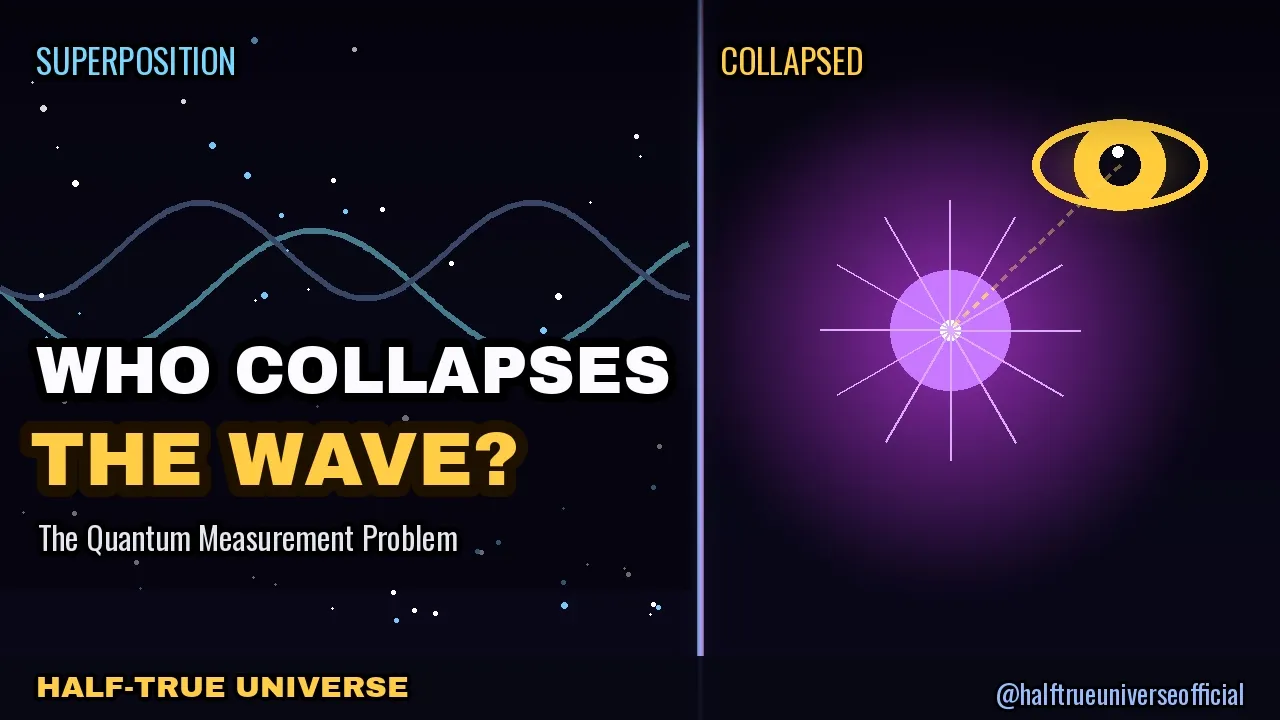
We call this superp position. It's simultaneously spin up and spin down. Both possibilities are completely physically real at the exact same time and they actually interfere with each other.
When you look at the math, it's like quantum mechanics has a split personality. Over on one side, you've got the Schroinger equation. This governs everything that happens between measurements.
And it's beautiful. It's smooth, continuous, totally predictable and deterministic. Crucially, if you just follow this equation, superp positions stay superp positions forever.
But then on the other side, we have what actually happens when we look. We get the born rule. The moment we measure a system, we hear a single abrupt click on our geer counter.
The superp position just instantly collapses into one single definite reality. And here's the massive problem. These two mathematical processes are fundamentally incompatible.
That smooth rolling math cannot naturally produce that sudden violent collapse. So where exactly does that blurry quantum world suddenly snap into the definite classical world we see every day? Back in 1932, physicist John vonomanyman formalized this whole headache into what we call the vonoman chain.
Just walk through the steps of an observation with me. You've got the particle that's quantum. The detector measuring it is made of atoms.
So well that's quantum too. The amplifier quantum. And since you are made of those exact same particles, your eyes are quantum.
Your brain is quantum. You can mathematically apply that smooth Schroinger equation to every single link in this chain. The math itself offers absolutely zero natural cut to stop that indefinitess from spreading endlessly from the tiny particle all the way up into your consciousness.
The cut just has to be shoved in there by hand. And the theory totally blanks on telling us where scaling up the absurdity. Schroinger's box.
Now, I'm sure you've heard of Schrodinger's cat, but it is so important to realize that when Irwin Schroinger proposed this back in 1935, he was not just offering up a fun, quirky little thought experiment. Not at all. He designed it as a brutal takeown to expose how incomplete the theory was.
Imagine his setup. You have a radioactive atom in a superp position of decayed and not decayed. That's hooked up to a physical detector, which control a vial of poison.
And sitting right next to it all is a macroscopic everyday cat. If you apply quantum mechanics universally, the entire box gets entangled. The mathematically inescapable result.
Until you open that box, the cat physically exists in a superimposed state of both alive and dead. Now, the big question isn't whether cats actually do this. Thankfully for the cats, they don't.
The real question is why don't they? If quantum mechanics is supposedly the universal law of nature, the suspects, a century of serious disagreement. Look, physicists and philosophers haven't just been ignoring this giant elephant in the room.
They've spent decades proposing these major interpretations, trying to solve this ultimate crime of reality. But it's wild how fundamentally they disagree with each other. Some insist the wave function absolutely collapses.
Others say no, it doesn't. Some argue the math is physically real. while others say it's literally just in our heads.
Every single one of these frameworks buys you a little clarity in one specific area but charges you a massive conceptual price in another. Let's dig into how this breaks down. Starting with the oldest view.
First up is the Copenhagen interpretation. This is the one most widely taught, historically championed by heavyweights like Neils Boore and Verer Heisenberg. It essentially handles the measurement problem by just drawing a pragmatic curtain right over it.
Copenhagen argues that the wave function just encodes our knowledge, not physical reality itself. So when you measure something, the universe doesn't physically collapse. Your knowledge simply updates.
It works flawlessly as a recipe for doing calculations. But, and it's a huge butt, it completely refuses to tell us where the boundary between the quantum and classical worlds actually is. It basically solves the problem by just declining to ask the question.
Okay. Taking the exact opposite approach, we have the many worlds interpretation proposed by Hugh Ever III in 1957. This view says, hey, this smooth shortinger equation is universally valid.
Period. No collapse ever. Instead, when a measurement happens, the universe simply branches.
That electron is spin up in one reality and spin down in another. And you, the observer, you split into copies experiencing each outcome. So mathematically, Many Worlds is spotless.
You literally don't have to add a single new rule to the physics. But the price, oh, it's just an ontologically extravagant, infinite number of branching realities. It's enough to give all your infinite selves a headache.
Plus, there's this really stubborn lingering issue of explaining why probabilities even exist if literally everything ultimately happens somewhere. Next up on the suspect list is pilot wave theory, worked out by De Brogley and David Bow. Now, this one really appeals to our common sense.
It argues that particles actually do have definite positions all the time. The wave function is this real physical pilot wave that physically guides particles along hidden trajectories. So the randomness we think we see that's really just our own ignorance of their exact starting points.
Sounds great, right? But here is the massive catch. For this to work, the theory requires explicit instantaneous non-locality.
Meaning this guiding wave fills all space and wiggling a particle right here instantly affects the trajectory of a particle on the complete other side of the universe. Then we get to objective collapse models like the GRW model. These theories take a really bold step.
They actually change the fundamental math. They suggest the Schroinger equation has these tiny random built-in modifications that cause spontaneous physical collapses. Now for a single isolated particle, this almost never happens.
But think about a massive number like 10 to the 23rd power. Once you group that many particles together to form a macroscopic object like a detector or a cat, those tiny probabilities add up and the superposition collapses almost instantly. It's a purely physical mechanism.
No conscious observer needed. The only problem so far incredibly precise experiments searching for these tiny deviations from standard quantum mechanics haven't found a thing. Finally, we've got cubism or quantum basianism.
This one totally reframes the entire enterprise. Cubism argues the wave function isn't a description of the objective physical world at all. Nope.
It is strictly a mathematical tool describing a human agent's beliefs about the world. A measurement is just you taking an action and updating your personal expectations using standard basian probability. This is pretty clever because it basically dissolves the physical problem entirely since according to cubism, there was never a physical wave function out there in the first place.
But critics are quick to point out that this leaves us totally in the dark as to why these probability rules work so incredibly perfectly to describe the physical universe. The partial alibi, the role of decoherence. Now, in the 1970s and 80s, physicists made a massive, really gamechanging technical breakthrough called decoherence.
See, real quantum systems are never perfectly in a void. They're constantly bumping into air molecules, heat, light. When a system interacts with its environment, its quantum superposition gets tangled up with millions of surrounding particle in just 10 - 20 seconds.
That is an impossibly tiny time frame. But it is the mechanical reason why you will never ever actually catch a cat in a superp position. But we have to be really careful not to overstate this.
Decoherence is a massive piece of the puzzle for sure, but it is strictly a partial alibi. It perfectly explains why the quantum weirdness is masked from our view, basically hiding the superp position in the environment. But technically, the whole system is still in one giant entangled quantum state.
Decoherence cannot tell us why reality actually picks one definite outcome over another or why a definite outcome happens at all. the deep philosophical mystery of what fundamentally happens at the exact moment of measurement that remains entirely unsolved. And listen, this isn't just people sitting around arguing armchair philosophy anymore.
Modern experiments are really sharpening the problem. Recent tests based on what's called the extended winger's friend scenario actually suggest that if quantum mechanics applies universally, then measurement outcomes might not even be absolute facts that all observers agree on. We've also got these weak measurements now that can probe systems without fully collapsing them.
And maybe most pressingly, the engineers out there actively trying to build quantum computers absolutely need to understand exactly when and how quantum states become classical so they can do error correction. The foundational physics community is literally still debating the very boundaries that tech engineers are trying to build with today. An ultimate open frontier, living honestly with the unknown.
So we reach the end of this explainer with a lingering really provocative thought. What does it actually mean to describe reality at all? The honest truth is that science's most successful, wildly accurate theory rests on a foundation we still do not fully understand.
But I don't see this as a failure of physics. It's a thrilling frontier. It's proof that science is a living, breathing inquiry.
The folks working on this aren't fringe theorists. They're the brilliant minds building the technologies of tomorrow. They're confronting what it truly means for a mathematical equation to be about something real.
This measurement problem has been waiting patiently for nearly a century. And as we leave you thinking about Einstein's moon, remember the universe isn't just going to hand over its secrets and explain itself. Our greatest scientific journey is far, far from over.