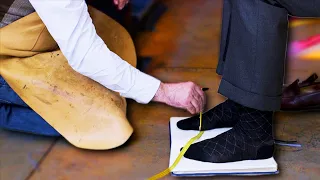
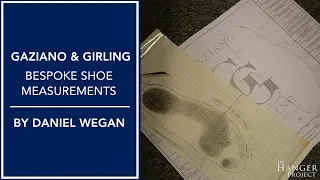
[Music] I'm now going to do the complete process of measuring the foot using the bespoke orthopaedic method in one go okay so David if you would stand on the papers I've got two pieces of paper I'm just gonna do the left foot but if I was doing both feet I want to do them both at once so that what I do here I do here and it's all balanced so I'm going to roll up the trousers so I can make sure that I can see all around the ankle and I check with the client whether
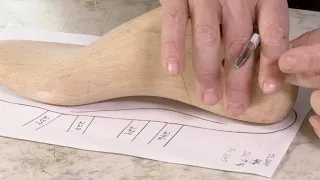
the the hose the socks are the whatever is being worn is the appropriate sock for the Torah book is going to be worn for instance that David was going to have a fell boat he might want to have thick socks on so making sure that there's paper all the way around the foot I'm now going to trace the foot with a pen this pen is seven millimeters wide that's important to make a note I'll just write seven millimeter pen and that's important because the point of the pen is going to be three and a half
or half of seven out from the edge of the foot so I need to know that the pen mark is three and a half millimeters here three and a half millimeters here and three and a half millimeters here larger than the foot okay so I want the heel cup to be one complete sweep so I start on the inside or the medial side and I come around and as I go I make sure the pen is vertical and held firmly against the edge of the foot it's going to do it in one complete move sometimes
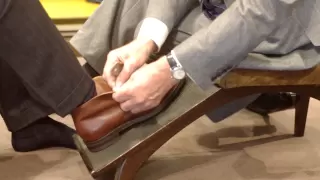
you'll catch the inner ankle bone but that's fine and that's done this is a side stick and if you don't have a side stick you can just push a matchbox up against the end of the toe and Mark where the bottom of the matchbox is but we have this tool and so David is now standing so as I push that in I can see that the standing measure is 262 so I go st for standing - 6 - okay so that's done so now I'm holding David's foot so David if you could sit please so
now that foot hasn't moved on the paper pick up the size stick and now I move in and we have 259 so si4 sitting is 2 5 9 so what's happened there is when David was standing his arch came down and see how my foot gets long and then when he sat the weight came off so his arch came up a bit and so his foot got a bit shorter so those two measures tell us the amount of spring that's still in the arch you know four millimeters difference there's three millimeters difference is very good
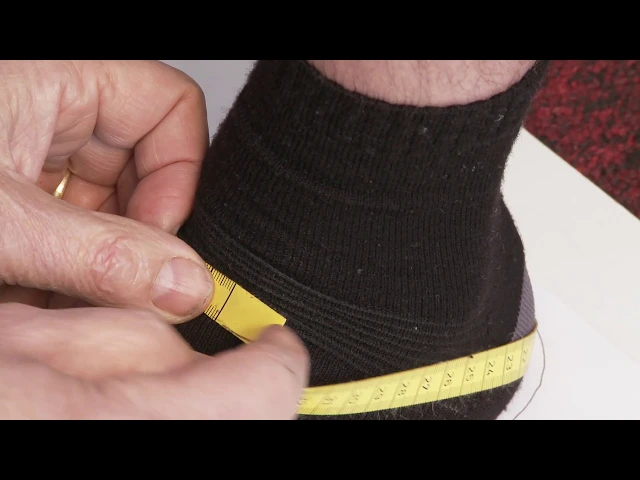
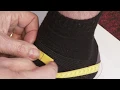
and so no worries there so now we're going to use the tape measure to do the circumference because David's sitting I'm gonna slide under and there's the 5th metatarsal and the first metatarsal of the palpating in there I can actually feel the joint in a way that visually you can't see so it's a very felt process and I can even move the toe move the toe and feel where the metatarsal ends and where the proximal fallon's of the toe begins so it can actually feel exactly where the foot is going to bend and I lay
the tape on and I pull it until it feels right see I could go you know as much as - 6 - but that feels too loose where I could tighten it right down to 2 5 6 but I think that might be a bit tight for David so my feeling is run about two hundred and fifty nine millimeters is the right pressure the measure I write here will be the size of the last the size that last will be the size of the inside of the shoe so what turns off the inside of the
tape becomes the inside of the shoe so I'm actually gauging how much pressure I want to have on that shoe so I'm going to write to 5/9 then you remember the next one was behind the joint so it comes around a bit because now I'm going at a slightly different angle so it's still the fifth metatarsal phalangeal joint the fifth ball joint of the the fifth toe but it's moved around slightly because we've moved around the sphere but in here I'm palpating and feeling that little a doctor a Lucas muscle in there the soft tissue
that's the going on of the foot and we remember we talked about how that's where the as the heel goes through the quarters this is the part where the shoe is held on and where the foot can go into the shoe so I'm feeling that I feel 2 for 9 is right for that so I'm marking behind the joint and marking the fifth toe joint 2 for 9 okay so just feeling along the 5th metatarsal and I can feel the base so behind the base is the perineal notch there's the lump of the base and
I want to come just forward of that and I can feel the muscles of the digiti minimi abductor muscle that pulls the little toe out nice soft part of the foot that I can hold the shoe on with and now my thumb I come up the second metatarsal the first metatarsal there's like a groove in between I come up and suddenly that groove ends and there's the first canal form in the second canal form it's the second canal for my one and I can just feel in there and feel the bone through all the tendons
and tissues and I can feel them the front the anterior lip in very very distinctive so I'm going from there to there so bring the tape from there to there on top of that phone and I'm just measuring that and that's coming out at about feels right at about two four six Lane that flat tracing the tape both sides so from this I'll be able to tell when I'm making the last everything forward of this as metatarsals and will not Bend everything behind these little square bones like Renea forms and navicular cuboid these are where
the flexing and the shock absorption is so the fourth measure that come back and there's the perineal notch underneath there and here's the top of the instep you can see foot sweeps up and suddenly it climbs the shin very very distinct point so in the perineal notch and around the top of the instep and that is 258 so marking that and right 2 5 8 now at some point I haven't done it yet I could have done it earlier but at some point before the foot moves I want to measure the arch so there's two
things I want to do I want to hold the pen at 45 degrees to the base plane to the paper and the reason for that is say I'm measuring there where the pen hits the the paper and draws the line because it's 45 degrees from the edge of the foot to that line is the same as from the edge of the foot up okay because it's 45 degrees and the other thing I want to do is keep the pen at 90 degrees as I come along to there's this the axis of the foot 90 degrees
to the axis and that's because I want the pen mark here to be represented directly by the pen mark inside so a lot of people make the mistake of going like that but if course then the then the they don't know what part of the line is being represented so 45 degrees and parallel to the 90 degrees to the axis and I just come along in one sweep okay so if David if you lift your foot off you can see there's the arch line and so I know at that point the from there to there
is the same as from there to there because it's 45 degrees so I know how high that arch is the same here that from there to there is the same as from there to there so that's a very very useful measure and you can see how the the foot comes under Neath the ball joint the ball joint curves under at that point and then the fifth and sixth measures to finish are around the heel bulb so the same points we found the second contain a form bone top of the instep are the points that we're
going to use for this measure so again I come up find the two metatarsal bones come up where they end there's the second cone air form bone find the anterior lipping very accurately put zero you see the zero there straight on top of that then wrapping around capturing the heel of the bulb and going on top and there I have 361 see where the three six one crosses the zero and so that's the long heel l-h long heel three six one now the top of the instep I can put that there so that whether it's
the instep comes ends climbs up that's where I don't want to go any higher with the lace paddles on the shoe so it's really important to know where that is otherwise you know when you go to take a step the laces dig into the foot so hold it there I come around and this time I've got 300 and 39 so SH short Hill 3 3 9 so now I have 1 2 3 4 5 6 measures to length measures now I just want to demonstrate why that short heel measure is important so if David blisters
foot it's this short heel measure is the pass line for a boot so if you're making a Wellington boot or a zip-up boot or you know your last excited boot this is where the foot just squeezes through and then the heel pops down it's called the choke or the going on or the throat of the boot so that short heel is a very critical measure so if we take the foot off here we have a standing length a sitting length a trace of the foot and we know that that trace is three and a half
millimeters larger than the foot and then we have the joint measure from the first toe joint to the fifth the behind the joint fifth toe joint to behind the joint instep measure going from the Indus forward of the base of the fifth metatarsal so we know that the base of the fifth metatarsal is sitting right in there that's really important to know and that's wrapping around the first connect form and then in the perineal notch is the top of the instep measure and then we have the long heel measure to the canal form and the
short heel measure to the top of the instep so now I know that as they go up into a high heel this gets further and further forward but the bend line is always there I also know that as the shoe gets higher that the crank of the issue that the the foot bends in there and that's where you get pronation and supination and all that occurs I know very very accurately in a way that you couldn't with a scan I can predict every shake that or it will take as it walks as it jumps as
it stands as it sits and as it runs from this simple drawing