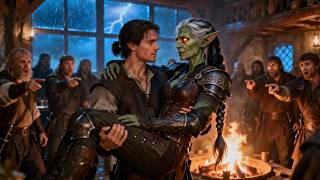
The smell of too many bodies in too little shade hung over Thornfield's market square. Sweat, animal dung, and the sharp copper scent of orc skin baking under a sun that had forgotten what mercy was. 10 girls stood on the wooden platform outside the trade hall, arranged in a line that got less impressive as it went. Borin, the orc trader who'd hauled them from Carth, stood at the platform's edge with a ledger and the voice of a man selling livestock. He'd been doing this run for 12 years. Orc settlements to human frontier towns, girls who wanted
out, and men who wanted help. He'd stopped pretending it was noble around year three. Number one, Tova. Strong back, good teeth, knows livestock. A farmer in a clean shirt stepped forward. She cook, she can learn. Good enough, he signed. Tova climbed down without expression. Number two, Kelchshire. Tall, good hips, can drive a plow team. How tall? A man with gray temples asked. Tall enough to look your horse in the eye. Sold. Another signature. The platform emptied by degrees. Number seven, Issa. Broad build, splits wood like breathing. A farmer's wife tugged her husband forward. We'll take
that one. You sure? The husband whispered. I'm sure my back isn't what it was. Hers is. Three left, then two, then one. Rever sat at the end of the platform with her knees drawn up and her back against the post. She hadn't stood when the others stood. And number 10. Orin's voice lost its rhythm. Rever, she's available. What's wrong with that one? a woman asked from behind a fan. Nothing's wrong with her. She's small for an orc. She meets minimum standards. Minimum standards? The woman laughed. Wonderful selling point. A man near the front spat tobacco.
Heard she's been returned three times. That's not entirely. Three owners, three returns. What is she? Defective. She's not defective. Dangerous. Then another voice. Word is she broke her last owner's jaw. He deserved it, Rever said. Every head turned. It was the first time she'd spoken all day. Her voice was flat. Not angry, not defensive, just a fact delivered from the floor. Borin closed his eyes. Rever, please. He did deserve it. That's not helping. Wasn't trying to help. Was trying to be accurate. The crowd thinned after that. Mothers pulled children toward the bakery stalls. "Show's over,"
someone muttered. Borin began packing his ledger while his assistants dismantled the shade canopy. "Every town," Borin said to no one. "Every single town you do this." Rever didn't answer. The square emptied around her, vendors closing stalls, dogs reclaiming their corners, and she sat in the sun without shade, without water, without anywhere else to be. The platform creaked once in the heat, settling like a thing that had given up. The sound came from the east road. Not hooves, but the slow thud of boots and the dry creek of a pack saddle on a donkey that had
strong opinions about speed. EMTT rounded the corner of the trade hall 40 minutes late, leading a gray donkey loaded with flower sacks. Borin was still on the platform writing figures with the focus of a man calculating losses. You the trader? EMTT asked. Sales over. You're late. Milstang cracked. Had to patch it. Unfortunate had 10. Sold nine. Borin didn't look up. Done for the day. Nine. Emmett scanned the empty platform. His eyes found the post at the far end and the girl sitting against it. What about her? That's the one nobody took. Why not? Borin set
his pen down. You want the short version or the honest one? Same thing, isn't it? Rarely, Borin sighed. Returned three times. Last owner says she broke his jaw. Owner before that says she wouldn't work. Owner before that says she unsettled his chickens. Unsettled his chickens. His word, not mine. How do you unsettle chickens? I looked at them, Rever said from the platform. EMTT turned. She still hadn't stood up, still hadn't moved from her post, but her eyes were open now, tracking him with the flat attention of someone who'd learned to assess threat without showing interest.
You looked at chickens and they got unsettled. Apparently, must be some look. It is. EMTT walked to the platform, stopped in front of her. His shadow fell across her knees. "I've got a mill 5 mi north," he said. "Needs work. I need help." "Congratulations." That was an offer. That was a statement. An offer has a question in it. He paused. Would you be interested in working at my mill? No. No. I've had three owners. None of them asked. You're the first. And the answer is still no. EMTT looked back at Borne. She always like this.
Worse usually. Today she's being charming. He turned back to Rever. What if I'm different from the others? Everyone says that. What if I mean it? Everyone says that too. So there's no right answer. There's no answer at all. That's the point. She finally looked at his face. Not through him. At him. What's wrong with your hands? He glanced down. The tremor was visible even in the shade. Nothing. They shake. I'm aware. Why? Why'd you break that man's jaw? Rever's mouth twitched. Not a smile. The ghost of one. Fair point. EMTT turned to Borin. How much?
Borin named a number. Emit's face stayed flat, but his shoulders dropped. That's more than I have. Then I'm afraid half that, Rever said. Both men turned. Tell him half, she repeated. She looked at Borin now. You've hauled me through five towns. Every day I sit on a platform costs you feed, transport, and the fee for the space. Half price clears your ledger. Full price means you're carting me to town six. You're negotiating your own sale. Borin said someone should. You're bad at it. Borin laughed, short, surprised. Half. Fine. Get off my platform. EMTT counted coins
with shaking hands. Rever watched the tremor, but said nothing. Steady enough to hold a millstone? She asked. Steady enough for what needs doing. When the transaction was done, she stood for the first time in 6 hours. "You got a name?" EMTT asked as they walked toward the donkey. "Rea. Emmett, I didn't ask. I know. The road north smelled of sage and something burning far away, a farmer clearing fields, or just the earth cooking under a sky that had forgotten what clouds were. EMTT walked beside his donkey. Rever walked three paces behind. They'd been moving for
10 minutes when riders appeared. Two men on horses heading into town. Well, well, the heavier rider grinned under his hat. EMTT heard the mail order sale was today. It was. And you actually bought one? He leaned to see Reaver. That one? Problem? No problem. The rider nudged his companion. Lenora leaves him for a banker and he fills the spot with an orc. That's what we call a lateral move. More like a downgrade, the companion said. Or maybe Lenora was the downgrade, the first one counted. They both laughed. The easy kind that comes from knowing someone
else's pain is entertainment. EMTT didn't answer. His neck went red, his hands tightening on the lead rope. The riders passed past, their laughter faded into dust and distance. Rever watched his back, the rigid shoulders, the red neck. Three owners. Not one of them had ever been mocked for having her. This man was absorbing contempt just by walking beside her. She closed the gap by half a step, then another. EMTT didn't look back, but something in his posture eased, barely, like a rope given one extra inch of slack. They didn't speak for the rest of the
walk, but two paces felt different from three. The land around them changed as they moved north, the dry grassland giving way to scrub oak, and then to a shallow valley where the creek ran brown and slow between banks of clay. EMTT's donkey knew the way, turning off the main road onto a track so narrow the sage bushes scraped the flower sacks. The sun was lower now, throwing their shadows long and thin across the dust. Rever counted landmarks without meaning to. A split boulder, a dead pine, a fence post with no fence. old habits from being
moved between owners. You're memorizing the route, Emmett said. Force of habit in case you need to leave. In case of anything. Almost there, Emtt said. Reva didn't answer, but she looked ahead instead of behind, which was its own kind of response. The mill smelled of damp stone and old flower, the kind of smell that gets into walls and never leaves. It sat in a valley where a creek fed a water wheel that turned a shaft that turned a millstone when it worked. The wheel was still now, the creek damned, the whole place holding its breath.
"This is it," Emmett said. Rever looked at the mill. Stone and timber, sagging roof, a water wheel that had forgotten how to turn. "Then the house behind it, small, shuttered, a door hanging off its hinges. Between them, a yard full of tools set down and never retrieved. A chicken coupe stood near the house, three hens pecking at nothing in particular. The creek ran along the eastern edge of the property, and a wooden channel half clogged with leaves directed water toward the wheel. "You live in the mill," she said. "Yes, not the house." "No." "Why?" "The
house is for a different life. The mill's for this one. How long since anyone used the house? Two years. Same two years as the wife. Same two years. She looked at the house again. The shutters were nailed closed from the outside. Not just shut, sealed, like someone had decided the memories inside were better contained than confronted. You nailed the shutters. I did from the outside. That's where I was standing. Inside the mill was what she expected and worse. Stone floor, wooden machinery, flower dust on everything. Cozy, Rever said. It works. EMTT's cot sat in one
corner, a small stove with a pipe through the wall, a shelf with a single plate, a cup, and a jar of something brown. That side's yours, he pointed across the millstone. I'll bring a bed roll. No walls between us. Millstones between us. Four feet of granite. Granite with a crack in it. Still heavier than any wall I could build. He pulled an iron key from his pocket. Mild door. Locks from inside. You hold the key. Rever took it heavy, warm from his pocket. The house, she said. When did she leave? Emmett stopped. Who said anyone
left? The riders on the road said a name. Lenora. Yeah. He set the bed roll down. Two years ago. And you closed the house? I closed the house. Reva didn't push further. She sat in her corner back to the wall, knees up. EMTT went to work on the water channel. The first day passed. Reva sat. You hungry? EMTT asked at noon. Nothing. There's bread, dried meat, beans if you want hot food. Nothing. Suit yourself. He left food near her corner. Bread on a cloth, a cup of water. A strip of dried meat laid across the
bread like an afterthought. She ate when he wasn't looking. Small bites, careful. EMTT pretended not to notice. He was bad at pretending. The second day was the same. Rever sat. EMTT worked the mill, fighting the cracked stone that produced flour more grit than powder. He adjusted the stone three times, cursed it twice. The third time something in the grinding mechanism caught, and a sound came out of the mill like a tooth being pulled from a jaw, metal scraping stone in a pitch that made the donkey outside flatten its ears. Rever tilted her head just slightly,
like a dog hearing a whistle no one else could. "You going to help at some point?" he asked on the second evening. "Nothing. You could at least tell me if you want more blankets." "Nothing." Are you planning to talk again ever? Rever looked at him, threw him, then back at the cracked millstone. Emmett threw his hands up. Fine, sit there. The third day, he stopped asking, just left food, water, firewood. The mill groaned through the afternoon, stone turning badly. Emmett stood over it like a man staring at a wound he couldn't stitch. Flower came out
the color of sand and twice as rough. You sell this? Rever asked. Two words. The most she'd said since the road. EMTT looked up, startled. When I can. Who buys it? Anyone who can't afford Aldrich's prices. Who's the other miller in town? Better stone, better flour, higher prices. He wiped his forehead with a dusty sleeve. I get the customers who can't pay his rates, which is most of them. And if your stone breaks completely. Then Uldrich's the only mill and he charges whatever he wants. Rever looked at the cracked stone. It turned with a wobble,
the crack widening by a hair with every rotation. She tilted her head again, that same slight angle, listening to something below the surface of the sound. Then she went back to her collar. EMTT went back to his stone. On the fourth morning, the smell of wood smoke and warm oil pulled Rever awake before dawn. The mill was dark except for the stove's glow. EMTT's cot was empty. Her boots weren't where she'd left them. They were by the stove. The left one, cracked at the heel, had been stitched shut with heavy thread. The right one, soul
peeling, had been glued and clamped. Beside them, a blanket thicker than the one she had. On top, a bowl of porridge with a dried apricot, still warm. She picked up the left boot. The stitching was uneven, shaking hands, but the thread was strong. She heard EMTT outside shoveling the water channel. You didn't have to do this, she said from the doorway. He didn't look up. They needed fixing. I meant the blanket gets cold and the food. Everybody eats. My last three owners didn't fix my boots. Maybe that's why you broke their jaws. I only broke
one jaw. Right. The other two just got their chickens unsettled. He kept shoveling. You're welcome, by the way. I didn't say thank you. I noticed. She went back inside and put the boots on. They fit the same but felt different, like something that had been given up on and then reconsidered. She ate the porridge. The apricot was sweet enough to ache. The second morning, stove lit before dawn, a cup of grain tea by her bed roll. She drank it without comment. The third morning, a clean cloth by the water basin, another bowl of porridge. EMTT
working outside like leaving gifts was just part of the routine, like feeding chickens or oiling gears, she said from the doorway. Doing what? Being decent. It's suspicious. I'll try to be worse tomorrow. Don't bother. I won't believe it. On the fourth morning, she woke to find her corner changed. Bed roll raised on a platform. Two planks and four blocks lifting her off the cold stone. EMTT. He looked up from the water wheel. She'd said his name. First time with weight behind it. The boots, she said. The platform, the blanket, the food. Why? He wiped grease
on his pants. Why? What? I've been here 4 days. I haven't worked. Haven't spoken, haven't done anything except sit and eat your food. Any of my previous owners would have hit me by now. Emmett leaned against the mill door. Morning light caught the lines in his face. My wife stood in this doorway 2 years ago, he said. Told me I'd never be enough. Not enough money, not enough ambition, not enough of anything. He looked at his shaking hands. She was probably right. That's not an answer. I can fix boots. I can light a stove. I
can build a platform out of scrap wood. He shrugged. That's all I know how to do. Small things. If that's not enough, it's not enough. Rever looked at the boots on her feet. The shaking stitches, the steady care, the millstone, she said. The crack runs northwest to southeast. Left side sits lower than the right by a/4 in. How do you know that? I've been sitting in this mill for 4 days doing nothing except listening to it turn. I can hear where it's wrong. You can hear a quarter inch difference. My ears are the one thing
nobody's ever called defective. She stood. The grinding gear is also catching on the third rotation. There's a burr on the shaft. Metal rubbing where it shouldn't. That's the sound the donkey hates. EMTT stared at her. I've been trying to fix that catch for 2 months. I know. I've been listening to you fail at it for 4 days. You could have said something on day one. I could have, but I wanted to see if you'd hit me before I got around to it. The words landing like a stone in still water. What did you just say?
Emmett asked. I said I wanted to see if you'd hit me. That's what the sitting was. The silence. The four days of nothing. Yes, you were testing me. I was surviving. Testing is what people call it when they're not the ones being tested. EMTT's face changed. Not anger, something closer to grief. I'm not going to hit you, he said. I know that now. How? Because you fixed my boots instead. She walked to the millstone and put her hand flat against it. The stone hummed under her palm, vibrations traveling up through her wrist. She closed her
eyes, listening with her fingertips as much as her ears. But I can't fix it alone. The stone's too heavy for one person. You're offering to help. I'm offering to listen while you lift. What's the difference? Lifting is muscle. Listening is skill. You need both. EMTT looked at her. This orc girl who'd sat in silence for 4 days, cataloging every floor in his mill by sound alone. who'd negotiated her own sale price, who'd broken a man's jaw because he deserved it and wasn't sorry. "Show me," he said. "What do you think about Rever! Is she really
as indifferent as she acts? Or has she been watching EMTT this whole time, deciding if he's worth the risk?" Tell me in the comments. Have you ever tested someone by doing nothing just to see what they do? The morning they went to Thornfield together, the air tasted like copper and chimney ash, the kind of morning where the sky couldn't decide between rain and resentment. EMTT loaded the donkey with three sacks of flour, the best the cracked stone could manage. It's not good flour, he said. I know. I ground it. You listened while I ground it.
Same thing. It's not the same thing. You're right. My part was harder. Emmett looked at her. They'd been working the millstone together for 3 days. Him lifting, her listening. The grind is better, he said. Better isn't good, but it's a start. Uldrich sells fine flour, Emmett said as they walked. White, smooth, the kind women want for cakes. Do people here eat a lot of cake? No. Then what's the problem? The problem is Aldrich tells them they should want cake and they believe him because his flour is white and mine looks like dirt. Your flower makes
better bread. Nobody cares about better bread when someone's selling them the idea of cake. Thornfield was louder than Revered from the platform. Wagons, dogs, a blacksmith hammering somewhere out of sight. The market stalls were half full. Vendors calling prices that nobody seemed to be paying. EMTT stopped the donkey outside a shop with a faded sign. Nell's provisions. Wait here, he said. Why? Because people in there might not be ready for for what? An orc for you specifically. You have a reputation. I've been here one day. News travels, especially the kind people enjoy repeating. Reva climbed
off the donkey. I'm coming in, Rever. I'm coming in. The shop smelled of dried herbs and pickling vinegar. Shelves lined the walls packed with jars and tins and bolts of cloth. Behind the counter stood a woman in her 50s with steel gray hair and the expression of someone who had seen everything and been impressed by very little. EMTT, the woman said, you look less terrible than usual. Now, you look the same. I'll take that as a compliment. Her eyes moved to Rever standing in the doorway. The calculation was quick. Orc, female, young, the one from
the platform sail. And this is the male order girl everyone's been whispering about. Reaver, Emtt said. I can introduce myself, Rever said. Then do it, Rever. She stepped inside. The floorboards creaked under her weight. Orc bones were denser than human, something most people didn't know until they shared a building with one. I work at the mill. Work? Nell's mouth twitched. Heard you sat in a corner for 4 days. I was assessing. Is that what we're calling it? It's what I'm calling it. What other people call it is their business. Nell looked at EMTT. She always
like this. Worse usually. I like her. Nell came around the counter. What do you need? EMTT unloaded the flower sacks. Nell examined the contents, rubbing the grain between her fingers, sniffing it. Better than last month, she said. We fixed the stone alignment. We Nell raised an eyebrow at Rever. I listened. He lifted. Interesting division of labor. Nell weighed the sacks. I'll give you standard rate for two. The third is too coarse. I'll take it at half for animal feed. That's fair, Emmett said. No, it isn't, Rever said. both turned to her. The third sack is
coarse but clean. No grit, no chaff. It's perfect for flatbread, the kind the miners buy on the north road. You sell it to them at full price and call it rustic. They won't know the difference and they won't care. Nell stared at her. Then she laughed. A real one, the kind that came from somewhere deep. Full price for all three, Nell said. And you, she pointed at Rever. Come back next week. I want to talk to you about my inventory. Outside, EMTT loaded Nell's payment, coins, a sack of salt, and a jar of preserved plums.
You just negotiated my flower price up by a third, he said. You were leaving money on the counter. I've been selling Tan to Nell for 2 years, and she's been underpaying you for 2 years. She knows it. She respects you for not noticing. She'll respect you more now that someone did. They walked through the market. A woman pulled her child to the other side of the street. "They're staring," Rever said. "They'll stop eventually." "When?" When something more interesting happens in this town. We might be waiting a while. They passed Uldrich's Mill on the way out.
A larger building stonebuilt with a proper sign and a waterhe twice the size of Emtts. A man stood in the doorway watching them pass. Tall, wellfed, with the posture of someone who had never been uncertain about anything. That's Aldrich? Reaver asked. That's Aldrich. He looks like a man who's never been told no. He hasn't. Not since he became the only real mill in the county. He's not the only mill. He's the only mill that works properly. Reva looked back at Aldrich's building, then at the road ahead, then at the three sacks of coins on the
donkey's back. Not for long, she said. The rain came 2 days later, steady, patient, the kind that settled in and made itself at home. Water dripped through a gap in the mill roof that EMTT had been meaning to patch since spring. It landed in a tin cup he'd placed on the floor, and the plinking sound kept perfect time, like a metronome that had opinions about procrastination. Rever sat at the workt EMTT had built from scrap planks. In front of her, a stack of papers, receipts, IAS, scribbled notes on the backs of flower sacks, EMTT's business
records, if the word records could survive being applied to something this chaotic. EMTT. Yeah, you owe Nell 12 coins from March. I paid Nell. You paid her eight. The receipt says 12. Let me see that. He came over, squinted at the paper, squinted harder. I can't read that. It says 12. How do you know that's Nell's handwriting? Nobody can read Nell's handwriting. I can. The loop on the two is distinctive. Rever pulled another receipt from the pile. You also owe the farrier six coins, the Tanner 3, and someone named Grisk. 14. Who's Grisk? Grain supplier
from Carth. You buy grain from orcs. Orcs grow the best barley in the region. Everyone knows that. Everyone knows that and still won't buy flour ground by an orc's ears. Welcome to Thornfield. They spent the afternoon sorting. Rever organized receipts by date while EMTT watched with the expression of a man seeing his own chaos from the outside. You owe Nell four more coins than you thought, Rever said. And someone named Grisk is owed 14. Grisk is patient. Grisk is owed 14 coins. Patient isn't the same as paid. The numbers told a clear story. A mill
bleeding money from bad tracking. EMTT knew flower. He didn't know arithmetic. You can't read, Rever said. Not a question. I can read some. You can read your name and the word flower. Everything else you guess. I guess well. You guess wrong regularly. She set the organized papers in front of him. You're 31 coins behind where you should be. That's 2 months of grain. EMTT sat heavy in his chair. The rain plunked into the tin cup between them. The Nora used to do the books, he said quietly. Your wife ex-wife almost haven't signed the papers yet.
Why not? Because signing means admitting she's not coming back. She left 2 years ago. I know how long it's been. Rever looked at the stack of papers. Two years of a man drowning in numbers he couldn't read, owing debts he didn't know he had. Running a business by feel instead of fact. I'll do the books, she said. You don't have to. I know. That's why I'm offering. EMTT looked at the organized receipts, the neat columns, the clear totals. Two years of mess sorted in an afternoon by a girl nobody wanted. The last one standing is
the one they need most, Rever said. She was looking at the millstone, the cracked, patched, lopsided stone that still turned, still ground, still made flour that kept people fed. That's what my mother used to say about the old grinding stones in Carth. The pretty ones broke first, the ugly ones lasted. Your mother was a miller. My mother was a lot of things before she died. She didn't say more. EMTT didn't push. The smell of cooling stone and wet iron filled the mill as the fire burned low. Night had settled without announcement. One moment gray, the
next black. Rain still drumed on the roof, the leak still plunked into its cup. Emmett sat on his cot, oiling a leather belt that didn't need oiling. Rever sat cross-legged on her platform, a stub of candle between them, throwing shadows that moved like slow breathing. "Can I ask you something?" EMTT said. "You're going to anyway." "The jaw, the one you broke, what did he do?" Rever was quiet for a long time. The candle flickered. Rain found a new rhythm on the roof. His name was Dawn, she said. Third owner, pig farmer outside a town I
don't remember the name of. Bought me for field work. First week was fine. Second week, he started standing too close. Third week, he came into my room at night. EMTT's hands stopped moving on the belt. I told him to leave. He didn't. I told him again. He laughed. She pulled a thread from her blanket, wound it around her finger. Third time, I didn't tell him anything. I just swung. Broke his jaw. Broke his jaw, cracked two teeth. He went to the trader the next morning and demanded a refund. Her voice was flat. said I was
defective, dangerous, uncontrollable. Borin took me back and added violent tendencies to my file. Nobody asked what Dawn did. Nobody asked. I'm asking now. You already know. You knew before I said it. EMTT set the belt down. His hands were shaking harder than usual. My wife didn't hit me, he said. She did something worse. She explained in detail every way I'd failed her. Every promise I'd broken, every dream I'd ruined by being ordinary. That's not worse than being hit. Depends on where it lands. Fists heal. Words just move in. Your hands, Rever said. They started shaking
after she left. Started the night she walked out. Haven't stopped. The doctors say anything? Doctor in Thornfield said it's nerves. Doctor in Mil Haven said it's guilt. Nell says it's because I drink too much coffee. Which is it? Probably all three. He looked at his hands, turning them over in the candle light. The last one standing is the one they need most. That what your mother said? That's what she said. What happened to the ones that weren't standing? They got thrown away. Ground down to gravel used for roads. That's bleak. That's milling. A silence settled
between them. Not empty. The kind that has furniture in it. Places to sit and rest. EMTT. Yeah. If I stay, I'm not doing it as property. Not as help. Not as replacement for the woman who left. What pen? partner. I do the books. I do the ears. I do the negotiating. You do the stone, the water, the lifting. Equal. Equal. Problem with that? No problem. Just never had equal before. Neither have I. So, we'll both be bad at it. Deal. They didn't shake hands. Didn't need to. The rain said enough, drumming its agreement on the
roof while the millstone sat silent between them, cracked but whole, waiting for morning. The air smelled of dust and horse sweat before the rider appeared. The kind of smell that arrives as a warning. EMTT was adjusting the water channel when the sound of hooves reached the millyard. Single rider moving fast. Nellsboy, a freckled kid of about 12, pulled up hard on a borrowed horse. Mr. EMTT. The boy panted. Nell sent me. Says you should come to town. Why? Someone's at the inn asking about you. A woman. EMTT's hands went still on the shovel. What woman?
Didn't get her name. Nell says she's tall. City clothes came in on the morning coach. The boy shifted in the saddle. Nell says you should come before she finds you first. Rever was in the doorway listening. She didn't need to see Emmett's face to know. Lenora, she said. EMTT didn't answer. He set the shovel down with the careful precision of a man putting something fragile in a place where it wouldn't break. You don't have to go, Rever said. Yeah, I do. Why? Because if I don't go to her, she comes here, and I'd rather meet
a wolf in the open than in my den. He changed his shirt, washed his face, run his fingers through his hair in a way that was probably meant to be grooming, but looked more like a man checking that his head was still attached. "How do I look?" he asked at the door. Like a man about to do something he doesn't want to do. That's accurate. He took the donkey. Rever watched him go from the mill door. Three previous owners had walked away from her. EMTT was walking towards something which was worse. to ward meant he
might not come back the same. He returned at dusk. His face was the color of old paper, and his hands shook so hard the donkey's lead rope rattled against its clip. "Well," Reva asked from the work table. "She'd been organizing grain orders or pretending to "She's back." "I gathered that she wants the mill." Rever set the papers down. The mill says the marriage contract gives her half of all property acquired during the union. Mill was built the year we married. You haven't signed the divorce papers, which means we're still married, which means she has a
legal claim. Does she want to run a mill? She wants to sell it to Aldrich. The name landed between them like a dropped stone. Aldrich, the man with the bigger mill, the whiter flower, the posture of someone who'd never been told no. She's working with him. Rever said looks that way. She sells him the property. He absorbs my customers and she walks away with enough money to go back to the city. And you? I get nothing. Man with a cracked millstone and no mill to put it in. Reva looked at the mill around them. The
stone floor, the patched roof, the platform EMTT had built for her corner. What are you going to do? She asked. I don't know. That's the first honest thing you've said all day. I said other honest things. You said you were fine. You're not fine. No, I'm not. He sat on his cot. She sat on her platform. The millstone stood between them, cracked and dark. There's something else. Emmett said. What? She asked about you. What about me? Asked why there was an orc living in the mill. I said you worked here. She said he stopped. Doesn't
matter what she said. It matters. She said I traded down from what? From her. Rever was quiet for a moment. Then did you did I what? Trade down. Emmett looked at her across the cracked millstone, across the organized papers, across the distance between a man who couldn't read and a woman who could. No, he said, I traded different. Frost coated the millard the morning Lenora came. The cold had teeth. Rever heard the horse before she saw it. City horse shaw for cobblestones, picking its way across frozen ruts like the ground was beneath it. The woman
who dismounted was everything Reaver expected, and nothing she was prepared for. Tall, narrow-waisted, with hair the color of dark honey, pinned in a style that had never seen wind. Her coat was city-made, fine wool, brass buttons, the kind of garment that announced its price without speaking. EMTT was inside the mill grinding. Reva stood in the doorway. You must be the orc, Lenora said. She smiled the way knives smile. All edge, no warmth. You must be the wife. Ex-wife, nearly. Nearly is a big word. So is orc in some contexts. The Norah looked past her into
the mill. Is Emmett here? He's working. Tell him I'm here. Tell him yourself. He can hear you. The grinding sound stopped. EMTT appeared behind Rever. Flower dust in his hair. His jaw set in the way it got when the millstone jammed tight, ready for impact. Lenora. EMTT. You look She searched for the word the same. You don't. Thank you. Wasn't a compliment. The Nora's smile thinned. She looked from EMTT to Reaver and back, reading the space between them the way a banker reads a ledger, assessing value, looking for weakness. I came about the property, she
said. My lawyer says, I know what your lawyer says. Then you know I have a claim. You have a piece of paper. That's not the same thing. Legally, it is. You left, Lenora. Packed a bag, hired a coach, and walked out. Didn't look back, didn't write, didn't send word. Two years of nothing, and now you want the mill. I want what's mine. You wanted the city. You got it. Why come back for a broken mill in a town you called? He glanced at Rever. How did you phrase it? A graveyard with a market. Circumstances change.
Your circumstances, not mine. The Norah's composure cracked, just a fracture quickly sealed. She turned to Rever. How long have you been here? Weeks. And in those weeks, what exactly do you do? I fix what's broken. How charming. The Norah pulled off her gloves one finger at a time. And has he told you about the mill's finances, the debts, the fact that Aldrich's been undercutting his prices for a year? I've seen the books. Then you know this place is dying. I know it was dying. Past tense. The Norah tilted her head. Confidence from an orc. That's
unusual. Competence usually is. The silence between them was sharp enough to cut flower. Emmett stood behind Rever and Rever stood in the doorway and Lenora stood in the yard and nobody moved. I'll be at the inn for 3 days. The Nora said, "Sign the papers and give me my half or I'll have the court do it for you." 3 days. That's generous. That's all I can afford. The city is expensive. She remounted her horse with the practiced ease of someone who had learned to ride for appearances. Think about it, Emmett. Really think. Is this mill
worth fighting for? She rode away. The hoof beatats faded, replaced by the creek and the wind and the sound of the water wheel turning slowly in the current. Reaver turned to EMTT. Is it? Is it what worth fighting for? He looked at the mill, the cracked stone, the leaking roof, the machinery that worked because an orc girl could hear what was wrong with it. I don't know, he said. Ask me again tomorrow. Why tomorrow? Because today I'm too angry to think straight. Fair enough. They went inside. The millstone turned between them. Cracked that standing. If
this story is building something in your chest, that feeling of watching two people figure out they're stronger together than the world expected, then this channel is your kind of place. We tell stories about the ones who got thrown away and the ones who caught them. Hit subscribe. We'll be here when you come back. The sound that woke Emmett wasn't a sound at all. It was the absence of one. The mill was silent. No breathing from the other side of the stone. No shift of weight on the wooden platform. Rever, he said before his eyes were
fully open. He sat up. The stove was cold. Rever's corner was empty. Blanket folded. Boots gone. Rever. Nothing. Just the creek outside and the donkey shifting in its leanto. He checked the yard, the house, the road. Rever, the water channel, the leanto, the ridge path. Where are you? He asked the empty yard. The donkey looked at him with the patient sympathy of an animal that had seen humans lose things before. She was gone. EMTT stood in the mill doorway, holding the key she'd left behind. It was still warm, not from her, from the stone. She'd
been gone long enough for her warmth to leave. "Four days you sat there," he said to nobody. "Four days I fixed your boots and lit your stove, and you leave without a word." The donkey looked at him from the leanto. It had no advice. He went back inside. The organized papers sat on the workt, receipts sorted, calculations in her handwriting. two weeks of her work laid out in rows that made sense for the first time in two years. "Damn it," he said to the empty mill. He tried to start the grinding, released the watergate, let
the wheel turn. The stone moved heavy, uneven, the crack wobbling the rotation. Without Rever's ear, the grind was off within three rotations. Higher on the left, he muttered, adjusting. Too much metal scraped metal. Back just a little. Too little. The wobble returned. She made it look easy, he said to the stone. The stone didn't answer. Flower came out thick as sand. He sat on the floor back against the stone. His hands shook worse than they had in weeks. The morning passed. Noon came. The flower in the hopper was useless. grit that no baker would touch,
no customer would buy. You can't do this alone, he told himself. The mill didn't argue. He stood and walked to Reaver's corner. The platform was bare pine. Two planks and four blocks he'd cut at midnight. He'd measured twice, built it in the dark so she wouldn't see. Small things, he said to the empty platform. That's all I had. And you left anyway. He sat down on her platform. The wood smelled like pine and the faintest trace of orc skin, warm copper, like coins held too long. He hadn't noticed the smell before. He noticed now because
it was going away. The way you only hear silence after the music stops on the workt. Her calculations sat in neat columns. He ran his finger down the page. Numbers he couldn't read. In handwriting, he'd learned to recognize the way you recognize a walk from a distance. Every number had a reason, he muttered. Every page was you staying. A knock at the mill door. Nails boy again, breathless. Mr. Emmett, the lady at the inn says she's waiting for an answer. Tell her I'm thinking. She said you'd say that. She said to tell you thinking time
is over. Cracked stone. The empty corner. The key. EMTT looked at the cracked stone. The empty corner. The key on the ledge. Tell Lenora I'm coming. The walk to Thornfield took an hour. He didn't take the donkey. He needed the walk. Needed the time. Needed his legs to do what his brain couldn't. He thought about the cracked millstone. About how Rever had listened to its pain like it was alive. He thought about Lenora 2 years ago. You'll never be enough. and about Rever sitting in her corner for 4 days testing whether he'd prove those words
true. He'd passed the test. She'd left anyway. At the inn, Lenora was waiting in the front room. City dress, city posture, city smile. The papers were on the table between them. Divorce documents, property transfer, signatures needed in three places. You came to your senses, she said. I came to sign. The Norah's smile widened. She slid the papers across the table. EMTT picked up the pen, his hand shook. He steadied it with his other hand and signed. "Not the property transfer, the divorce." "The mill stays mine," he said. "You get nothing." The Norah's smile froze. "That's
not what we agreed. We didn't agree to anything. You demanded. I'm refusing. My lawyer, your lawyer, can read the marriage contract same as Rever did." Emit set the pen down. There's a clause, page four, third paragraph. Property acquired through pre-existing trade license isn't marital property. I had my milling license 3 years before we married. The mill was built on that license. You can't read. I can't, but she could. The Norah went pale. The orc. Her name is Rever, and she read every document in that mill, including our marriage contract. This won't hold. It'll hold long
enough. He stood. Sign the divorce, Lenora. Take your city life. Leave the mill alone. And if I don't, then we go to court. And a judge reads that clause. And Aldrich finds out his investment isn't worth the paper it's written on. Lenora stared at him, the silence stretched. Then she signed one sharp stroke like cutting a rope. You've changed, she said. No, I just stopped believing you were right about me. He walked out. The divorce was final. And somewhere on the road north, an orc girl was walking away from the only place that had ever
fixed her boots. The road north smelled like cold dust and the particular emptiness of autumn. Everything dying, but not yet dead. EMTT walked fast, faster than he'd walked in years. his shaking hands swinging at his sides. He didn't know which direction she'd gone. North seemed likely, back toward Carth. But Rever wasn't the type to go back. She'd broken a man's jaw rather than go back. He passed the split boulder, the dead pine, the fence post with no fence, the one he'd tied the donkey to last week, while Rever stood in the doorway, deciding whether staying
was worth the risk. She'd memorized these landmarks on their first walk. He'd watched her eyes move across the landscape. cataloging every turn like someone drawing a map of retreat. He just hadn't expected her to use it. The trail forked where the creek split around a mossy boulder. Left went to the main road and thornfield. Right went up toward the ridge. Harder terrain, fewer people, the kind of path someone takes when they don't want to be found. He went right. The sun was dropping when he found her. Not on the main road, on the ridge trail,
sitting on a flat rock with her back to the valley. She was looking at nothing. The same nothing she'd studied from her corner in the mill. You left the key, he said. She didn't turn. Didn't need it anymore. Didn't need it or didn't want it. Both. He sat on a rock across from her. Close enough to talk far enough to leave. Lenora came to the mill. Rever said, "Before you woke up." What? Early. Before dawn, she came to look at the property. I heard her horse. Rever pulled at a thread on her blanket. She looked
at the mill, looked at me, said, "You're still here? I assumed you'd have moved on by now. Girls like you always do. Girls like you. Throwaway girls. The ones nobody picks. The ones who sit on platforms while people decide they're not worth the trouble." Her jaw tightened. She was right. I always move on. That's what I do. That's what every owner taught me. Leave before they make you. I didn't make you leave. No, she did by being right about me. She's not right about you. She's right that I run. EMTT leaned forward. Rever, I signed
the divorce, not the property transfer. The mill is mine. She looked at him for the first time. How you the marriage contract, page four, pre-existing trade license. You remembered that you read it to me two weeks ago. I remember everything you've read to me. He held out his hands, shaking as always. I can't read. I can't do numbers. I can't hear the difference between a good grind and a bad one, but I can remember. That's not enough. It was enough to keep the mill. The mill is stone and gears. The mill is where you fixed
my books. Where you heard the quarter in drop. Where you sat for 4 days testing me. His voice dropped. The mill is where I fixed your boots. Rever looked at the boots on her feet. The stitching that shook. The care that didn't. I gave Lenora the divorce. EMTT said, "Signed it at the inn an hour ago. She's gone. Uldrich's deal is dead. The mill stays. Why are you telling me this? Because I walked an hour to find you, and I'd like you to know it wasn't for nothing. You walked. Donkey was too slow. You walked
an hour on a washedout trail to find an orc girl who left without saying goodbye. I walked an hour to find my partner. The goodbye part is up to you. The wind shifted. The valley below them was turning gold in the late light. The creek catching sun like a vein of something precious. The mill was down there somewhere, small, damaged, half a day from falling apart. I can't promise I won't leave again, Rever said. Didn't ask you to. I can't promise I'll be easy to live with. You've been impossible to live with. That's not new
information. I broke a man's jaw, EMTT. He deserved it. You said so yourself. He stood. Come back to the mill. Not because I need you. Because the millstone needs someone who can hear it. That's a terrible reason. It's the only honest one. You could learn to hear it yourself. I could, but it would take years. And the stone doesn't have years. He looked at her. Neither do I. Rever sat on her rock. The wind moved her hair across her face. She didn't brush it away. The last one standing, she said quietly. Is the one they
need most, he finished. She stood, brushed dust from her legs, looked down the trail toward the valley, then back at EMTT. If I come back, I'm doing the books. You're already doing the books and the pricing. Nell already likes you better than me, and I'm not sleeping on the floor anymore. I want the platform raised another inch, 2 in, one and a half. Deal. They walked back down the trail together. The sun set behind them, throwing their shadows long and merged across the dust. The donkey was where EMTT had left it, tied to the fence
post with no fence, chewing grass like the world made perfect sense. At the mill, Rever stopped in the doorway. The cracked millstone sat dark and still. Her corner was empty. The key was where she'd left it, centered on the stone. She picked it up, put it in her pocket. EMTT. Yeah. For the record, I didn't leave because of Lenora. Then why? Because staying scared me more than leaving. Does it still? She looked at the cracked stone at the organized papers. Yes, she said, "But I'm tired of running from things that scare me." She walked inside.
EMTT followed. The mill door closed. The key turned in the lock from the inside. This time by choice. The creek ran cold and steady. The wheel turned and somewhere in the dark mill, a cracked stone began to grind again, uneven, but steady, doing the work it was made for. If this story hit you somewhere real, if you know what it feels like to be the last one standing and to discover that's exactly where you needed to be, hit that like button. Think of it as flour from a cracked stone. Not perfect, not pretty, but enough
to make bread.