For a while, I thought it was just me. I thought I was just getting older and becoming one of those people who thinks that everything was better before and that the world is getting worse and worse. But then I learned that there's a word for what I'd be noticing.
Slop. Slop is lowquality, forgettable stuff. It just about does the job, but nothing more.
And once you start seeing it, you realize it's everywhere. The buildings going up around you, all glass and gray, designed for the short term with the most maximum profit-seeking motives possible. The endless stream of content you forget 5 minutes later.
The food that's technically fine but tastes like nothing. Just a bowl of grub during your lunch break. The slow degradation of all the products and services you used to love.
Everything has been optimized for profit and convenience. And yet it just has no sole beauty or substance. It makes the entire world around you feel meaningless because we're living in a world of slop and nobody really wants this.
In fact, we all hate it. But what we don't realize is that we're actually helping to create it. Every click, every scroll, every time we choose easy over meaningful, we all play into a part the sloppification of everything.
And every single day, this process is getting exponentially worse. So, where is this actually going to take us in the future? Because it's pretty clear if you look over the whole year of 2025, slop has become one of the defining words of this era.
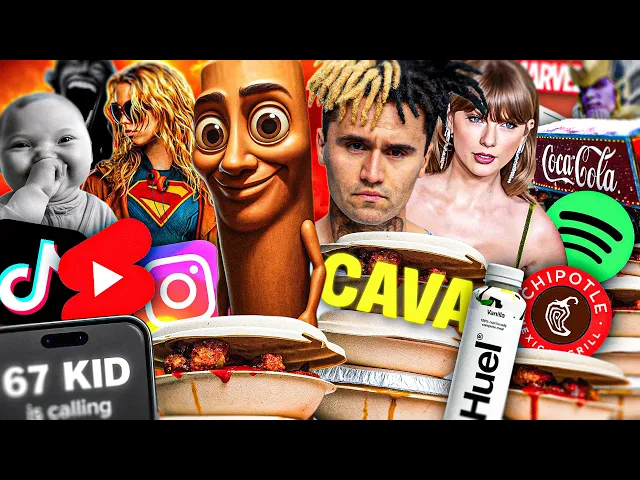
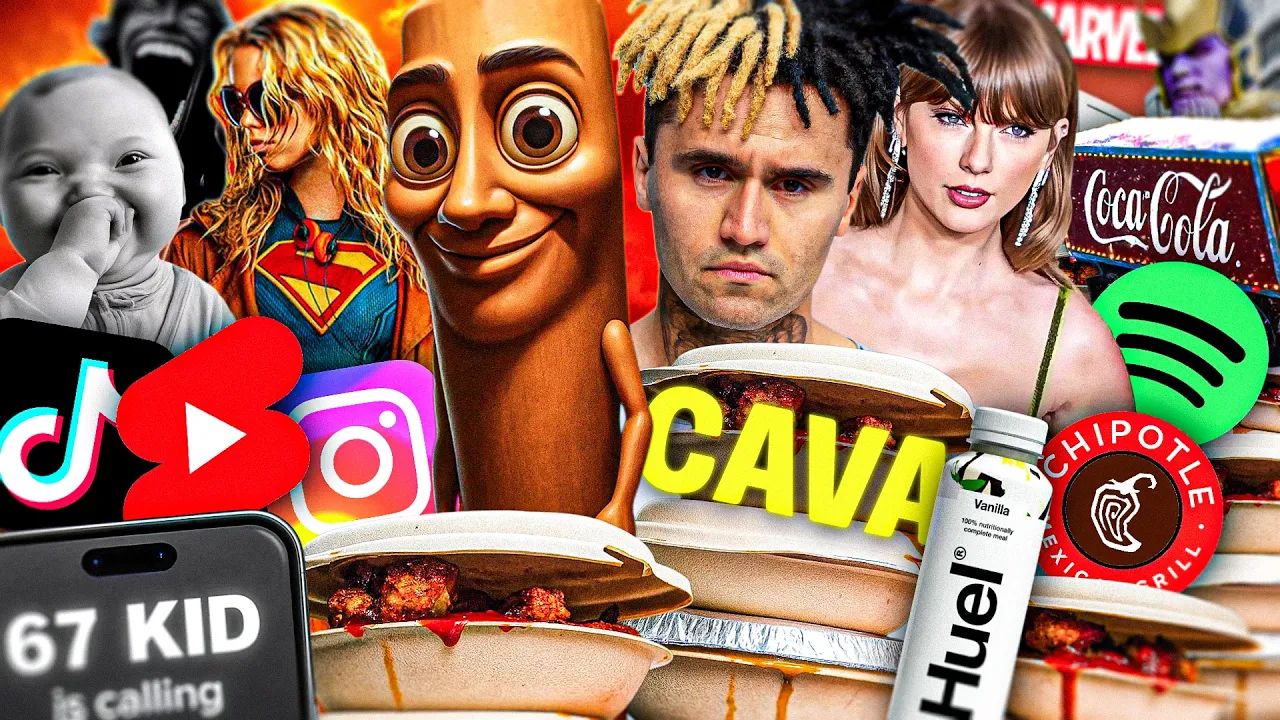
When most people hear it, they just think of one thing. All the AI generated garbage of people like Charlie Kirk or a baby laughing flooding the internet or even just the basic boring videos with generic writing, fake images and videos, spam churned out by bots. But slop is actually way more pervasive than that.
It's not just AI content. It's absolutely everywhere. And we're becoming so desensitized to this already that we're not even noticing this anymore.
As we've become conditioned to just accept everything around us turning to slop. And once you start seeing this, you won't be able to stop in your own life. Just take a mundane feature of everyday life that you might not expect to have been sloppied.
Imagine just a lampost. In cities like London, Paris, and Vienna, lamposts built hundreds of years ago were expected to be beautiful, ornate, and detailed. They didn't have to be, but people valued quality and beauty as well as function, so they were.
Now look at modern street furniture. All mass-produced, identical, purely functional slop. This is a microcosm of the sloppification of our lives.
Or [snorts] look at what we're eating. Hu meal replacements, bland protein bowls designed to just be consumed as quickly as humanly possible. Now, there's nothing inherently wrong with this stuff.
It can be healthy. I eat it sometimes, but it is literal slob. It assumes that all that matters about food is the calories and nutrients you extract.
Never the actual experience of eating itself or what that even means. It's convenience above everything. And then there's cultural slop, endless sequels and remakes, music produced by algorithms, mind-numbing Tik Tok videos designed solely to keep you watching, or it'll just be another Marvel movie.
Classic slop. It's never groundbreaking and it's just good enough to make money. but nothing more.
And AI is just only accelerating this process exponentially. Here and in a thousand other places, we see the same pattern. Convenient, palatable, adequate, but soulless and superficial.
This is the world of slop. Now, I don't want to sound overly judgmental. In a way, slop is a symptom of all the progress we've made.
It's the natural endpoint of the consumer capitalist system we've built that's become incredibly good at giving us exactly what we want. But that mixed with the internet takes the production of slop to the next level, giving slop a whole new meaning. In the early days, the internet felt different.
There were no gatekeepers, no corporations controlling what you saw. It was, as hard as this might be to believe, just people connecting and sharing with one another. I remember it.
It was homemade videos, obscure forum posts, cat videos, and Charlie bit my finger. Most of it was poor quality. But it wasn't slop.
It wasn't bot farms just trying to make money. It was seemingly people just sharing what mattered to them. But the logic of optimization took over fast.
Platforms needed to make money. And because we'd got used to everything being free, the only option was ads. Today, almost half of what we see on social media is from advertisers, not accounts we follow.
And that's not to mention all the soft advertising secretly being pedled by influencers, always with some ulterior motive or sometimes just straight up in your face. Like when Netflix, a paid streaming service, introduced them after promising they never would. I mean, I was literally at the dentist yesterday and even the screen showing landscapes while your teeth are being worked on, now has ad breaks.
When you walk around places like Florida and you want to look at the beautiful sea, you'll see ads on boats. Yes, literally trying to look out to nature and you'll see more ads. There is quite literally no escape.
And that's not to say advertising is bad, but it's the way in which anything and everything in life has been monetized. Platforms don't care if content is creative or meaningful. They just want it engaging enough to always keep you watching.
Whether it's the next Charlie Kirk meme or just an AI perfect 10 out of 10. And it's the perfect formula. We consume formal layer content.
Our attention span shorten. We lose the capacity for anything complex. So, we create more formulaic content.
Then the sloppy watch makes us into people who can only make slop. And the cycle continues exponentially speeding up. But there's something else that makes digital content not just lowquality, but uniform.
Creators now have perfect knowledge of what works. Think about it. 30 years ago, if you made a film, you got vague feedback, ticket sales, reviews.
You didn't always know which scenes worked when the VHS came out, you knew how many people bought it, but not if they watched it. It was the same with music. Artists didn't know which songs people skipped.
Today, we know everything. And that's great on the surface. You watching this right now, I'll know exactly how long you've been watching for.
We'll know which thumbnails get clicks, where listeners skip. creators can see precisely what the algorithm rewards and predictably they all started making the exact same thing. Mr Beast is a perfect example of this.
As he's a business genius, he wanted to track every single metric which is why almost every video is identical. It's the same insane rapid pacing, the same insane thumbnails, rapid cuts every 3 seconds, and it works terrifically, so everyone copies it. All the top YouTubers are trying to mimic him.
platforms reward songs that hook instantly so artists make simple hookable music where you don't even have to say real words. The beat just has to happen in the exact way that triggers a primal mechanism in your brain. One study found pitch and rhythm complexity in pop songs has decreased by 30%.
As they continue to dumb it down to hypnotize you more and more. The machine is functioning perfectly. We're getting exactly what we engage with.
So why does it feel like homogeneous slop? Because we don't really want it. Human beings have conflicting desires.
Just because a platform hijacked my nervous system doesn't mean I actually wanted to watch that content. I mean, does anyone want to spend all day consciously on formulaic videos? Probably not.
But it felt comfortable in the moment. So, what's going on here? Why does optimization produce the opposite of what we want?
This is Goodart's law. When a measure becomes a target, it stops being a good measure. Engagement metrics were meant to show what's popular.
But high engagement doesn't mean content is good. It just means it's optimized for engagement. When creators optimize directly for the metrics, they're not necessarily making better content.
They're just gaming the system. And this pattern, optimizing for the wrong thing, goes back further than you might think. Mass production did the same thing centuries ago.
Henry Ford's assembly line turned production into repetition. The focus shifted from craft [music] to volume, quality to efficiency, and you see the transformation everywhere. Handcarved Victorian furniture became flatpacked IKEA.
Intricate watches became stamped products, all identical. Goods became disposable, just good enough to work, but not last. Always with planned obsolescence in mind.
Sometimes this was deliberate. The light bulb industry formed a cartel to limit bulb lifespan. The same thing with the iPhones today.
But mostly it's just the logic of mass production. Cheaper materials, faster assembly, nothing lasting. And here's where the cycle begins.
Cheap disposable goods trained us to expect less. We stopped valuing craftsmanship. The more slop we consumed, the more our standards degraded.
Slop in, slop out. And so by the 70s and 80s, the machine learned it didn't need better products. It needed better marketing.
Nike now just wasn't selling trainers. It was selling identity. Apple wasn't selling computers.
It was selling who you could become. quality became secondary as long as it made you feel the right way. But we're not done yet.
Everything we've built, the efficiency, the optimization, the perfect metrics, it's all been accelerating massively, compounding, and now it's reached its logical conclusion. And we see this in 2025, marking a new AI era. Up until now, at least, humans were still in the loop.
Someone somewhere had to sit down and create something, even if it were just following a formula. But AI removes even that. So now the machine produces the slop itself.
Generative AI can pump out articles, images, videos, and music faster than anyone could ever consume it. Before we were drowning in slop. Now the world is just flooded by it on a daily basis, and it's only getting more and more crazy each day.
We live in this absurd world where it's algorithms all the way down to the bottom. AI algorithms produce content designed to be as engaging as possible so that other algorithms will pick it up and show it to all of us. There's literally no human in the loop anymore.
We can think of this as the perfection of the slot machine. And all this slop sounds like a meme, something annoying, but ultimately harmless. But that's actually wrong.
A world of slop isn't just ugly or lowquality. Over time, this will change the trajectory of our literal civilization. They say you are what you eat, and the more slop we consume, the more we're becoming slop ourselves.
In a reverse situation to what we saw in the Renaissance, where ordained art and culture uplifted the entire civilization. It produced a renaissance in almost every field. But for us, it's actually the opposite.
And we can see this by what it's doing to our brains, our culture, and our capacity for meaning. And the effects compared to the Renaissance are so measurable, visible, and happening right now that it's truly disturbing. One of the most striking findings from anthropology in the last century is that humans today have much smaller jaws and more crooked teeth than our ancient ancestors.
This is because our modern diets are much softer than the diets humans ate for thousands of years. We don't chew enough, so our jaws and teeth don't develop properly. We need braces and procedures to correct what should have developed naturally.
Basically, our diets are too sloppy in a literal sense. And it's just the perfect metaphor for what slop is doing to our brains. If we don't use and strengthen our cognitive capabilities, they atrophy.
All the slop we watch and listen to go straight down without us needing to chew metaphorically. It's easy on our brains. But that ease comes at a cost.
As our society is becoming functionally illiterate, reading used to be one of our most common pastimes, now it's extremely rare. In the US, reading for pleasure has fallen by 40% in just the last 20 years. Yes, that's literally since 2005.
In the UK, more than a third of adults say they've just given up reading completely for life. One study found a shocking and dispiriting drop in childhood reading, now at the lowest levels on record. The average American adult now reads at the level of a seventh or eighth grader.
And we've mentioned similar things on the channel so many times about how America is becoming idiocracy. But it's not just in America. It's everywhere.
And it's not like people aren't taught how to read. People are obviously reading all the time. Social media posts, photo captions, Tik Tok subtitles, text messages.
But it's always scattered and insubstantial. It's just slob. And it's nothing like reading a book.
Proper reading engages our brains in ways other content doesn't. to boost memory, attention, focus, reasoning, and depth. One study found that students who read more actually had physically larger brains in areas connected to learning and abstract thinking.
Back in 2008, a precient article in the Atlantic predicted exactly this decline. It argued we are not only what we read, we are how we read. When we read online, we become mere decoders of information.
Our ability to interpret text, to make the rich mental connections that form when we read deeply, that remains largely disengaged. Reading and writing are the foundation of civilization and we're losing it. This is the first time in human history this has happened because how are you supposed to read when slop destroys your attention span?
It's just the new normal now that Tik Tok and reals have conditioned us to consume content in 60-second chunks. For almost everyone, this is just how we consume media and news at this point. It's why we literally can't watch a full film without checking our phones every 2 minutes or needing crazy CGI to constantly engage us with colorful effects.
There's no chance of even sitting through a lecture anymore for students and there's no way that anyone's going to do their homework without Chachi PT at this point, which is why there's evidence that our IQ scores are dropping with this. For generations, IQ scores rose consistently. It was an observation known as the Flynn effect.
But in the last couple of decades, this has reversed. For the first time, people in developed countries are scoring worse than their parents. And it isn't just consuming slop that's killing our brains.
Producing it is too. Throughout history, technology has always replaced certain skills. GPS means nobody can read maps anymore.
Calculators mean we never even add up numbers in our own heads. [music] Even writing thousands of years ago destroyed our memory in a way as we didn't have to remember as much information. But AI has just put the accelerator on with this.
[music] As GPS and calculators are narrow tools, AI is general. Writing, analysis, creativity, problem solving, it covers all cognitive processes. As AI isn't replacing a skill, it's replacing thinking itself.
As well as being a useful skill, writing is also arguably one of the best ways to train your mind. Many of history's most influential writers said some version of, "I don't write to communicate what I think. I write to work out what I think in the first place.
When we use Chad GBT or whatever it is to produce AI slob, we don't get the cognitive benefits that come from actually writing. We don't even remember what we've written. It's why students who use AI to write essays barely remember any of the material.
It's why 2025 seems to be the first year our brains just are left idling, slowly [music] decaying. Even if our output is technically better, you just don't really learn anything that sticks. [snorts] You don't achieve as much.
You don't have a sense of accomplishment. And we're already seeing the [music] cost after just a year. In the UK, one in five people from age 8 to 25 has a probable mental health disorder.
And about a third of young people aed 17 to 24 have selfharmed or attempted self harm. For so long, happiness was described as U-shaped over a lifetime. Happy as a young person, tough and middle-aged, comfortable in retirement.
But now in western society this is just completely inverted because as a society we are teetering on the edge of a doom spiral where every single thing in our life takes us away from base reality and serves us slop. Slop in slop outs. We consume it, we become it, we produce it.
The cycle accelerates. And this isn't just about bad movies or boring music or just some dumb YouTube video. Culture is how we make sense of the world.
How we process what it means to even be a human. When culture degrades, we lose our ability to understand ourselves. To create something truly groundbreaking, you need defocus, patience, the willingness to wrestle with difficult ideas and push through setbacks.
It's why millions and millions of people every single year flock to Italy and Greece trying to see the remains of a forgotten great civilization, whether it be the Greeks, the Renaissance period, so that we can feel some sense of connectedness, to replace our culture that has just gone downhill since, as nothing feels new anymore. We've seen it all before. We're just going around in circles trying to experience the past.
I mean, honestly, just stop for a moment and think about the last time you experienced something genuinely new. A story that actually surprised you. An idea that challenged you.
Art that made you see the world differently. For most people, it's genuinely been years. And you probably can't even remember it.
I mean, it's almost a cliche now to point out Hollywood's addiction to sequels and remakes. We've done it plenty of times, but the scale is staggering. I mean, in just 2024, all 10 of the top grossing films worldwide were franchise entries.
Not a single original film in the top 10. Until 2000, it was about 25%. Since 2010, it's been around 50%.
In recent years, basically 100%. Even supposedly new things rely on nostalgia. Stranger Things mining the 80s, endless reboots and revival.
I like to think of remakes and sequels like photo copies. With each new copy, the quality degrades. You get further from the original.
Quality can only decline. It's like we can't think of any new ideas anymore. Like, there's some invisible barrier that's just stopping us from this.
And sure, most of these films were fine. There's nothing inherently wrong with a sequel, but they're just slot. Just good enough to get made and make money, but nothing more.
Fashion trends cycle faster than ever, but they're always revival. 2000s, '90s, 80s. architecture.
The same bow house copy and paste apartment blocks in every city, especially in the US. Almost every city just looks identical. Endless strip malls of Chipotle, Starbuckses, and McDonald's.
Video games, endless sequels, franchises, remasters. Maybe you just put on a show that you've already seen because choosing something new just feels like too much work at this point. I mean, I feel this myself.
My brain is becoming so fried from slop that even the possibility of something challenging is now starting to feel more exhausting than it would have. Distracted, fragmented minds can't produce anything genuinely novel. There's no deep culture without deep thinking.
And the terrifying part is that we might lose the ability to even recognize quality when we see it. If something brilliant and original came along, we wouldn't know what to do with it. We'd be stuck forever in a world of slob, unable to escape even if we wanted to.
But the worst part isn't what slo does to our brains or our culture. It's what it does to our souls collectively. We're like consuming slop because it's easy.
We're like producing because it's easy. But here's the thing. Ease isn't the same as good.
People don't find meaning in comfort. They find it in challenge, in struggle. You don't get a degree just to have a piece of paper.
You do it to become someone who knows something. You don't build something for the end product alone. You do it for the satisfaction, the growth, the proof that you can.
Slop strips that all the way. Relationships are meaningful because they're difficult. They require effort to compromise vulnerability.
But I'm starting to genuinely believe that virtual boyfriends and girlfriends will actually become ubiquitous in the coming years. And there we'll see the sloppification of relationships away from dating platforms into literal AI bots. A simulated partner with all the friction removed.
It'll feel good momentarily, maybe briefly scratch the itch of loneliness to connect with someone, but ultimately it will just hollow you out. You'll always feel like something true is missing. We need friction to grow.
I'm sure you've experienced this. I definitely have. Using AI to get work done, being productive but feeling completely empty at the end of it, like you haven't really achieved anything, or spending hours scrolling Tik Tok, feeling fine in the moment, but completely hollow afterwards.
Stop is like a drug. It makes the mundane bearable for a brief moment. It makes an otherwise boring life just feel interesting, but it does nothing for you long-term.
It just keeps you numb, looking for more. Engineered to keep you stimulated and engaged, but never actually satisfy you. Even on YouTube, we can just see how the top creators are changing.
From people like PewDiePie, where it was genuinely authentic, to the slot we have today. And we all know it's bad, but we just can't stop. Doom scrolling through Tik Tok at 2:00 a.
m. Looking at random garbage on X, watching YouTube videos you don't even care about for 3 hours, refreshing feeds compulsively, even though you know nothing new has happened, waiting for the next text message. And on some level, our bodies and brains are conscious of this.
We all know something is deeply wrong. But knowing doesn't stop the cycle. We're seeking this because we're so exhausted.
We're exhausted because we've been overstimulated for years now. And it's only getting worse. And what terrifies me is that we're raising an entire generation in this environment.
Kids who've never known anything else. And for future generations, for the rest of humanity, this will just be base reality. This is just how life will be for everyone.
Their brains will be shaped by slop from the moment they can hold a tablet. So what's going to happen when a whole generation grows up mentally malnourished? When defocused, patients, the ability to sit with boredom, all of that becomes so foreign and difficult and not even necessary anymore.
We're literally running an experiment on human development and we have no idea what the outcome will be here. The machine will keep on perfecting itself. Everything around you will become more and more basic, and there's horrifyingly no way out.
As you slowly watch your entire life become slop itself.