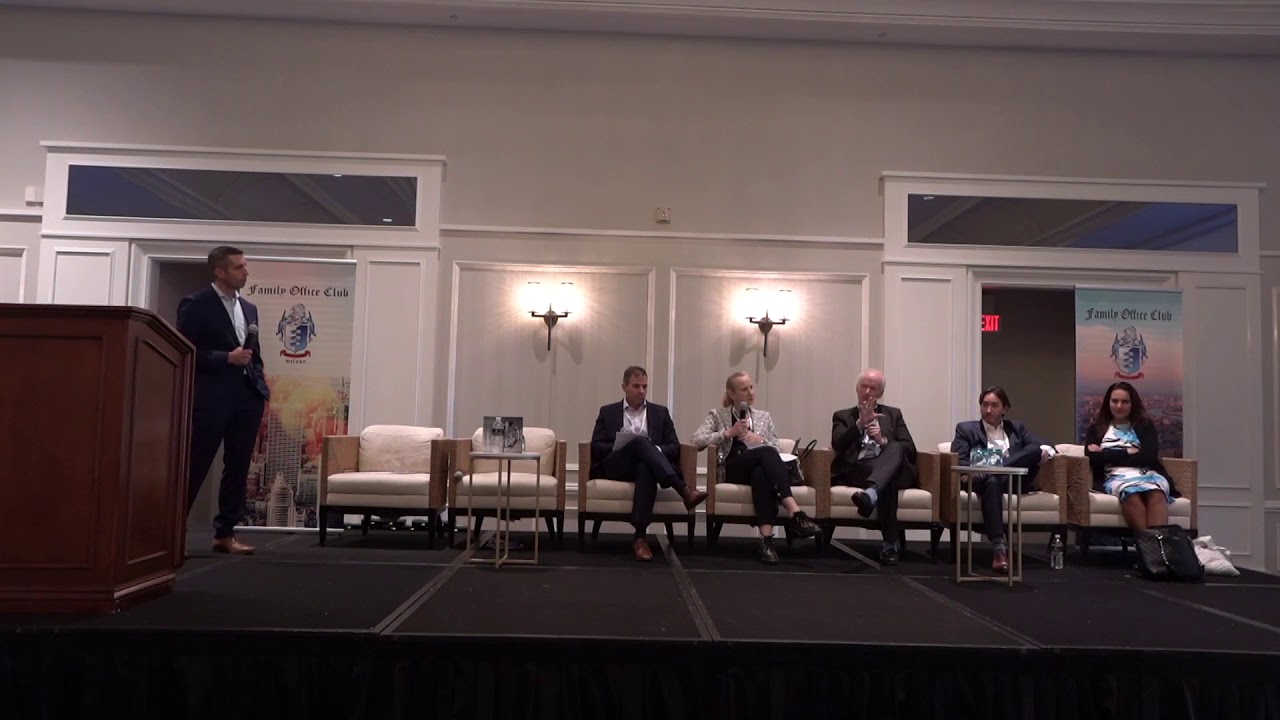
Well, thank you so much for joining us. I know all of you have flown over from elsewhere. So welcome to Hong Kong.
It's not usually this rainy. And I know we've got about half an hour in three panelists, so I'm just going to jump into it because everything between everything standing between the audience and lunch. I think the first question on my end is, you know, China has been a real engine of growth for ultras.
You know, this is a key target market for private banks. And, you know, it's been a bit slower these days with the IPO engine sort of slowing down, with growth slowing down. So what are the key engines of growth for the new ultras?
Rajesh, if you could start. So thank you for the for for calling us. It's a it's a great panel.
It's been a great session so far. Indeed. China has been huge.
It's been massive For most wealth managers. It's the single largest market and I dare say it will continue to be the single largest market. The size is just absolutely huge.
You have two and a half million dollar millionaires. You have 55,000 ultra high net worth clients. It's a factor of 2 to 5 compared to the next and the one after that.
So it's absolutely huge for us and I think for the rest of the industry will continue to be huge as well. Growth has slightly slowed down, but it doesn't mean the industry is not growing, whereas in terms of where the growth we see is Japan and India. India, you've seen three years of excellent growth.
And when you think about how ultra high net, what wealth has created, IPO is this one growth in earnings and dividend payouts is the other. And third, growth in asset valuation, typically equities and real estate is the third one. So in terms of percentage growth, I would say India and Japan way above, but in terms of just absolute magnitude, still a few years to catch up with China.
Okay. So it's still India and Japan case. I know you based in Japan, so I wondered what your opinion was.
I think similar to what Rajesh had said, beyond looking at India and China in terms of the size of the markets, I think Japan at the moment is really growing. The local markets have been very successful, both on the liquid side and the liquid side. That's created quite a lot of demand for IPOs and businesses being bought by private equity or larger businesses.
I think all that wealth created is definitely leading to the third largest ultra high market to grow. So we also see a lot of growth onshore on the Japan side and we see a lot of demand from those families for international wealth management services. So beyond just looking at domestic wealth management services, obviously we've been on shore for four decades, so quite a long time.
And we think Japan is a very interesting market. We signed an alliance with the Mizuho Group to tap their onshore knowhow and mix it up with our international expertise, and we think that will be a very good source of growth for us in the region. And Ali, I just wondered what your view is.
You know, you obviously you're traveling a lot. You're not based in one low, you based in one place, but you're travelling all the time. So where do you see the biggest growth right now?
I think the emerging market across Latin America is growing so fast with the ultra high net towards Asia has been the discussion of everybody, everybody like the China story, the Hong Kong story. Singapore is becoming a big winner. India you can have discounted and also what's happening in the Middle East creating more opportunity for newcomers.
There is stability in the region from a political point of view. That is, the new world has been creating, leading by Saudi Arabia with all the revolution. What do we see in Saudi Arabia domestically?
There is a lot of wealth will be created. We see more Latin America, India and Asia has been always there. And I think the Middle East is a new hub, a new market to focus that.
Okay, that's interesting. Yeah, definitely. A lot of Middle East, some you know, it's a growing region, a lot of attention on Middle East.
And talking about Middle East, I just wanted to talk a bit about geopolitics in general. You know, it's you know, clearly we've seen a lot of China-U. S.
tensions. Positions have hardened this year and elections here in the US. You know, geopolitics always sort of ranks quite high among concerns among the ultra wealthy.
So if you come from, you know, the founding family, Lombard family, I wanted to get a sense from you on what sort of concerns Ultras have around geopolitics and also how this sort of managing that risk. Thank you for the question. That is, I think it's one of the most hot topics of the moment.
And geopolitics are definitely a big concern for for ultras, not just in Asia but across the world. I think the conflict in Europe, the conflict in the Middle East and the superpower tensions are definitely leading to clients being concerned. That concern is leading clients to look for the safest and strongest financial centers, but also the safest and strongest financial institutions.
As you just mentioned, we've been doing wealth management for eight generations as a as a as a business. This experience is obviously something. And this stability and discontinuities obviously is something that clients are increasingly looking for at the moment.
And this is obviously a call that we are answering. So where do you see the safe is? You mentioned that you want to go to the safest financial centers, cities, banks.
You know, where where do you see that? At the moment, we're seeing from Asia the most demand from Switzerland for Switzerland, Singapore, and as Ali was mentioning, to the UAE. Okay, So those are the regions that people like the ultra view are safe as offshore financial centres.
Okay. And in terms of banks, do you have a view on the safest banks? I think people are looking for the banks that are not listed, especially after the recent tensions in the banking market.
They're looking for unlisted banks. They're looking for very high capital ratios, the highest rating for credit ratings, and in some cases they're looking for pure play players to diversify their pool of banks. Okay.
And Ali, I just wondered, what's your view in terms of, you know, how you obviously talk to ultras all the time. You know, so what is how are they sort of hedging themselves? Look, they look at it differently, like volatility, great opportunity.
The regional and the Middle East have the stability which is attract more money to it. We see the boom in Dubai, we see the boom in Abu Dhabi from family offers, either as an American is an Asian, it's not I it's even European family moving down there. I think the lack of Virgin Europe having to deal with in the Middle East focus, look, we want to grow the business.
This is a priority for us. We don't want to take a side of any war or anything in the world. We have a domestic priority.
We want to focus on it. And this is make it a big difference to attract foreign money to the region, number one. And number two, I think big family offices also moving down there for the regulatory reason.
What Dubai, what and Abu Dhabi has been done recently and the political stability in the Gulf state. Okay. So basically a lot of stability in the Middle East, Honduras.
Okay. Dennis, maybe if I may just add to that, we have an annual survey being very close to our family of US clients. We have a survey called the Family Barometer.
And for the first time last year, the single biggest factor for families from an investment standpoint was geographical asset diversification. And the single biggest factor for the non-investment aspect was making sure that my wealth structure is in good shape. And some of the drivers behind that was the very conscious sort of knowledge of the fact that geopolitics is changing at a rapid pace.
And what that means for these families. So it's certainly a very important topic for families at this point. Okay.
I'd like to talk a bit more about, you know, competition for this ultra keen, ultra competitive. So and we have various hubs, you know, competing for this money, whether it's Hong Kong here or Singapore or Dubai or London or the US. Like, where where do you think the money is going?
Like, who's winning at the moment, which actually could address that. So, actually, you know, we speak about this. But if you go back, financial centers have learned from each other, competed in a healthy manner for forever, whether it was asset management, whether it was capital markets, whether it is listings on exchanges, whether it's hedge fund assets being domiciled.
So this is not new, in my opinion. Every financial center will have its own value proposition, will have its strengths that it will play to and eventually. It's not a binary game for families.
They will choose not just one, but potentially two or three that best fit the triangle of themselves and their families. And there's a lot of next generation wealth looking, next generation actually looking to re domicile themselves because of education or whatever reasons say. I think it has a great role to play and we are seeing that.
That's the great point of Access China. There is no substitute if you want to access China. All the connect schemes, including the Wealth Management Connect, are great ways to access China.
So Hong Kong is playing to its strengths of a 3040 year history. We have relationship managers who have done just wealth bank a wealth management for 35 years. We have wealth planners in Hong Kong who've just done wealth planning for 30 years and that kind of deep.
Just like to pave. We seem to have some tech problems. I just want to get your opinion on in terms of, you know, where the money flow is going.
I think in terms of offshore wealth hubs, Switzerland, Hong Kong and Singapore remain the three largest hubs. If you look at the latest data from the Boston Consulting Group. But in terms of growth, and I think that's where it's interesting.
The UAE, as any was mentioning, is doing really, really well. And we're seeing Singapore and Hong Kong growth continue. And I think Switzerland will remain quite stable, but quite lower in terms of growth growth sectors going forward.
So I think, as I just was saying, Hong Kong will remain a very important hub in terms of its connection with China. And I think China being the biggest market in the region, it will continue to do well from from that perspective in terms of growth going forward. The Boston Consulting Group definitely thinks that UAE, Hong Kong and Singapore will be the three fastest growing hubs for offshore wealth management.
And I mean, the government has been making a lot of effort to bring back family offices. Do you see interest on that end? Definitely.
I think in the region, family offices are mostly choosing Hong Kong and Singapore as their hubs moving away from the region. They're choosing most of the UAE and Switzerland as their hubs. So I definitely think that trend will continue and those four hubs will continue to strengthen.
Ali, what's your view on this? I think. 111a place has been.
It's Miami. To be honest with you. It's attracted a lot of Latin American money today.
If we look at Hong Kong, which is attracting all that China money, Miami did a fantastic job in the last four or five years. I think attracting Latin America money, even a couple of people moving from New York, San Francisco to Miami, one to I think Hong Kong will come back like it's still the glamour. It's so beautiful.
It is buzzing. It's you feel the wealth in the city, which is amazing, which is super nice. You enjoy it being here.
I've been coming here often pre-COVID. I like the city and I think one day we'll have an office here because you have walls. You have more than a thousand billionaire in China, only you have a lot of talent here, which is very difficult to find it.
Also anywhere in the world, regulatory framework is as good today. Okay. I think sooner or later you'll see Hong Kong will stand back and it will come back again.
So you're planning to have an office here? Hopefully. Okay.
When when do you plan to open this? The minute we find the talent. So the minute we find the talent, lots of talent in Hong Kong.
Lots of talent in this room as well, you know, And also the family offices. What's your view? Is Hong Kong has been ruling out the red carpet.
Do you see a lot more the ultras trying to open up family offices? I think what we see from our point of view, which is my level learning what's happened in China, in Hong Kong, is I call it 40,000 feet is there is a lot of money coming from China domestic to Hong Kong. Okay.
It's the language is understanding the legal framework, understand the local politics. It's good to attract foreign money is not going to be easy at this stage like a middle Eastern to open an office in Hong Kong. Why not?
Wait, wait. I think one it is time zone. Okay?
This is one thing. Second, it is still is. I know, like everybody talking to that Asia's want to invest in the Middle East.
But we did not see we see two G, but we don't see principles of principle yet because of their lack of relationship. And this market has not been developed. Plus what Switzerland have been doing with the US, been doing what London have been doing for the last two or three decades, attracting all these people.
I think sooner or later we will see people coming back here. Okay. And Rajesh, give me thoughts on the family office front.
You know, you're based in Singapore. There's been a lot of family offices there. Do you see momentum in Hong Kong?
There's tremendous momentum in Hong Kong. Just generally, Hong Kong is as a location for us. It's the third largest location globally.
We have over 500 people here and we only do private banking. So we are focused private banking business. So we have 500 people.
Last year we moved into over 100,000 square feet premises and to take your place. And that's a reflection of the fact that we strongly believe in Hong Kong and it's even doing well. Both of our locations have had net new money this year.
As for the last few years, so they're both doing well and the recent announcements made since last year around the city as around the seven or eight factors that go into make makes it even more interesting in addition to the DNA that I mentioned. So it is a very, very competitive location for family offices. You mentioned that both locations, Hong Kong and Singapore, are doing very well at the moment.
So like Singapore has had some issues recently in relation to money laundering. Do you see like the momentum shifting in terms of where the pendulum swings? I don't think so.
I mean, there were those incidents, but it's like cybersecurity or any of those elements, no matter how much you do in Singapore, in the Southeast Asian context, has seemed to be a sterling location in terms of some of those measures in place to make sure it doesn't happen and yet it can happen. So that's just a reminder that we all, as a as a financial ecosystem, need to keep working hard to learning from these experiences and keep making things better. I don't think the pendulum is swinging.
Every location is dealing on its own strength. Singapore has great access to Southeast Asia. There's a big India corridor in terms of connectivity.
It has focused a lot on a more formal approach toward family offices, and those are its strengths. I'm sure I'll even talk about Dubai, which has its huge strengths in terms of access to the Middle East and also playing into the India corridor. And as I mentioned, the Hong Kong strengths have been 30 years of of a DNA, great capital markets, exclusive access almost to the to the to the Chinese capital markets massive amount of access to by far the largest wealth pool.
So they will all play to their strengths. Okay. Well, we've heard from the panellists about family offices, but I'd like to hear from the audience.
So if you could go to our pool, if you could get that up and running. So, yeah, the poll question is what's the best location for family office? Oh, we have A, Dubai.
B, Geneva. C, Hong Kong. The New York and E, Singapore.
So there's a QR code for you to scan. Yeah. In the meantime.
So be good to find out which family office location everybody's looking for. Well, just for the moment, everybody's voting at the moment. If we could look at also maybe investments and where people are putting their money.
Rajesh, I'm wondering what where do Ultras put most of the money? So as you can imagine, you know, ultrahigh net worth is between 30 to 60% of most wealth managers asset base. So that's a very big pool of assets and it's not all doing the same things.
I would say there are 3 to 4 major trends or themes which are playing out on different timescales. The most urgent thing is around the impact of interest rates on what investors are doing in their portfolios. So first there was a trend from sort of like current accounts to deposits.
There was a massive sort of deposit war and now that money is slowly but surely being deployed into fixed income of all sorts from like the mid-term bond equivalents all the way to structured credit in different phases. That's like the most immediate trend on investments then. And the the flip side is what do you do with the liability side of the coin?
Because your dollar loans have become very, very expensive. So people have reduced the liabilities in dollars and there is some diversification in terms of liabilities from lower interest rate currencies, perhaps the Swiss franc, perhaps even scenic to kind of diversify your financing pool on the liability side. The next thing which is going on, which is a much more on the longer timescale and that's what makes me super excited both about wealth management but also about our role is there's a massive amount of institutionalisation in the way families are approaching the business of investing.
The purpose behind it, a proper strategic asset allocation. Ten years back when I would ask a family, What is your IPS? You're an investment policy statement.
I would get a lot of blank stares and now that conversation is real. People are looking for outsourced CIO services. People are engaging with custom private markets.
So a lot of the stuff that we have depth in has has now agency has no traction. So that's maybe at a much more kind of longer scale. And the intermediate one is US primacy.
There's a lot of diversification that has taken place from home buyers to the US. Led by tech, led by the general access to the market. So those would be, from my perspective, the three things that I would say.
And what's your thoughts on. Well, because for the money, I think we're just made some very good points. But to add to those points, we do a study every year of about 4 to 500 family offices and high net worth individuals.
And from the study we did last year, the two biggest trending investing that came out were really around sustainable investing and around private assets. I think there is growing demand and growing interests in both of these areas. Zooming into private assets, there's about two thirds of the clients that we polled who are interested to invest in private assets, but only about one third were actually invested in them.
So we think there's a lot of demand that's coming from private assets and a lot of education that needs to be done around private assets and including them in their portfolios. And what about art? I know we've sort of chatted about that earlier.
Like what about Yeah, I think rare collectibles, alternative assets, goals on these kind of asset classes remain interesting to family offices. And all the family offices we speak to have those assets in their portfolios. I think this trend will continue, definitely.
And any particular artists that ultra, you know, gravitate to. I think in the rare collectibles space, clients are quite interested in watches, wine, art in general. I think this trend will definitely continue.
More recently, because of the geopolitical tensions, gold is also more and more and more discussions with clients. And Ali, I think they covered everything. I thought you said something about cigars earlier.
Yeah, I was. I was making a joke. I said one of the best performing assets we sell, one of our decline portfolio for the last five years was this cigar collection, to be honest with you.
Okay, I think we've got the results in. So can we have that up in there? So the results of the poll, basically, surprise, surprise, Hong Kong is top at 48% and Nick's is Singapore with 28% and Geneva with 12% and Dubai with 8% and New York with 4%.
Clearly, no home buyers. No home buyers. It wasn't very so.
And also, I think I just wanted to check in with you, Rajesh. Earlier you talked about, you know, alternatives, I think, and just generally how the wealthy are sort of putting money into alternatives. Do you think the challenges around selling like illiquid structures to ultra wealthy individuals?
So there's a lot going on in the alternative space, I think I think you mentioned a bit, even when it comes to private markets, there's private equity, there's private credit, there's infrastructure there, real estate, professionally mandatory listed even when it comes to private equity. That is the way you go it alone, which is you try to be on the cap table of a company buying your own unlisted investment. You do it through funds, you co-invest, you do to fund the funds and so on and so forth.
One very interesting dynamic I have seen is when you would talk to family offices, the sort of in between size family offices, not the nouveau, but not the biggest. There was always this fascination for being on the cap table. I don't want to go through a commingled fund.
I want to be on the cap table. And what this recent shakeout has illustrated, that even if you have three or four people in the family office looking at direct investments, it's not enough because the distribution of outcomes is so skewed. The kind of due diligence that needs to go in is so skewed.
So we are seeing a return of the commingle structure back for the sort of in between size family offices, whereas the really large ones, the one with seven, eight and 12 investment professionals who come from a lot of the private equity due diligence background, they continue to want to participate directly in investments. Fund raising for private markets. Illiquid has been much harder this year.
There is also a fear that 60% of private markets tend to be buyouts and hence with an increased interest rate environment. Does the L in the LBO still work? Because now the cost of the financing, the transaction is that much higher.
So it has been a tad harder, which has beautifully then been supplied by these in the semi liquids that the asset management industry has created, which is drying and creating quarterly liquidity or monthly liquidity from some of these illiquid strategies. So there's a massive interplay of factors going on, primarily driven by the increase, increase interest rates, but also the need to diversify. Yeah, I'd like to go into some of the lighter questions.
I don't think these questions were very hard, but the first question is what is the best investment you've made? Money or otherwise. I'd like Ali to answer that question.
Money was the best investment which could be there for everybody. We invested in a business aviation called Vista Jet, and we made like a decent return for our clients. We benefit out of Covid use.
I think it was this was one of our first investment. We did second investing in myself and the team where we are today. I can be proud of my team Once we invested the time and energy within 40 years.
We operate in seven countries, six countries. Seven. New York.
Miami. Geneva. Dubai.
Singapore. Monaco. We've been growing more than from 0 to 5 billion in the last four years with COVID, with tours, with 60 professional.
And this will never happen without investing a lot of time and energy in working with the team in a global global. Okay. And pave, I think looking with hindsight, as Amy was saying earlier from UBS, I think alternatives have done really well.
Technology is going really well. Going forward, we're most excited about sustainable investing. I think sustainable investing and sustainability in general will be one of the biggest drivers of returns going forward.
I think it's a 5 trillion a year opportunity in terms of investments and many investors and family offices are more and more interested in this area and looking for science based approach on how to invest in that space. Okay. And what about Patek Philippe watches?
What's your view on that? Definitely. I think rare collectibles in the alternative space will remain an attractive niche.
It's a very niche asset class, but I think it will remain attractive for clients. It's not Rajesh personally or. Yeah, personally.
Yes. Well, I started my educational career being an electrical engineer and here I am on the stage with you talking about ultra high net worth clients. So I am with the consensus panelists before us that investing in myself has been frankly the biggest personal success of investments.
When I was doing my engineering, I realized I should become I got interested in business. When I was doing business, I got interested in investments. When I did investments, I got interested in alternative investments.
So that for me personally, but in terms of financial investments, two things in terms of just percentage, it was my small Bitcoin holdings in my Metamask wallet that played out well, but it didn't make me rich. That thing that actually helped to retire soon? No, actually is very small.
It was just an experimental purchase impulse purchase. But the thing when I moved to Singapore from India and this was the year 2004, I started putting money in what was then a recently launched iShares ETF called the S&P Core ETF, and that became like my retirement account. Whenever I had some spare cash, I put that my original investment is now five X.
So in terms of risk adjusted returns, that's been the most fantastic. So sometimes the simple things work. Okay.
And the next question is, you know, Ali, what's your advice for young people on how to build wealth? I think focus, discipline, allocate your time for what you like and what you love. That's it.
That's very simple. Discipline, discipline, discipline. Focus, focus, focus.
And look at your time for something you love. Okay, MPF, I think adding to it, Ali just said the time I think is probably one of the most important factors. What do I mean by time compounding?
And so I think the younger generations need to start investing as early as possible, not wait for to be in their forties or in their fifties, but really start investing in their twenties. The diversification compounding in time are your best friends. That's true.
That's something they never teach you at school. Definitely. I have two teenage daughters and I tell them what I what I said before.
It's human capital, before financial capital. So once you have the human capital, then then you have to worry about the financial capital. The other thing that's still too young for this, but I strongly believe that markets are generally fairly priced 80 to 90% of the times.
So the 10 to 20% of the times you're taking a contrarian view, you better know why you're taking that contrarian view and you better back it up and only then it'll pay out. And then the rest I agree with. But fear about about compounding, diversification, etc.
. A lot of people talk about this. It's really hard to practice.
It's like waking up at 5 a. m. and going to the gym late.
Like Bonnie mentioned, it's hard. You get easily seduced by different things. You believe you know better than the market, and that usually doesn't happen.
So it's it's important to test your assumptions and question everything. Okay. I think it would take a maybe a question from the audience.
One question is, what is the panel's view on family office appetite for crypto type assets, you know, and the change from traditional assets. Okay. We always tell our clients that if you invest, if you invest in art, wine, all this collectible art watches, jewelry is as an asset class.
You should put two, one, 2%. And it could if you never done this type of assets. Okay.
And it was not part of your asset or part of your portfolio. You should not touch on this because too volatile is a long term. It is.
You allocate one 2% of the whole portfolio is not going to change your life. Okay. I think similar to what Ali was saying, I think many of our clients are interested in that space.
We are not involved in that space directly, but we do see clients invest a small part of their assets in that space. We have, as just Bear been quite involved in the space because we know that clients will do it one way or the other. So we felt that it's important to get engaged.
So for the last four years or so, been tracking the space. We have been writing research reports for the last two, three years. It's very hard with that volatility to have a view on target prices and things like that.
But we have been engaged in the space. We also have an investment in Saba, which is the first of two crypto banks in the world. So we've been engaged in the space.
What we see happening is originally the hype was driven more by speculation and a little bit trying to make a quick buck or for these extremely negative views about the collapse of the financial system and how this is all about. You know, the traditional financial system is just all a big scam. So that has been replaced by a lot more institutional grade sort of research into the topic.
And when we talk to our families offices these days, there is a big risk that the way the US dollar was used almost as a like the financialization of the financial and the weaponization of the financial system with sanctions and things like that from the perspective of family offices is one reason, whether it's physical gold or whether it's the digital version of that, which is Bitcoin in particular. I'm not talking about the other current digital virtual assets, but specifically Bitcoin, which has somewhat similar analogue. Those characteristics are becoming more and more maybe two, three, 5% kind of allocations for family offices.
Okay. So I think we need to wrap up quite soon. We do have one question maybe Ali can take.
What's the impact of minus the stability of the recent regional conflicts and the recent financial challenges in Saudi Arabia? I started with Saudi Arabia, then go to the conflict. I sincerely Arabia.
We see in the media they want to borrow a lot. But it's a country Still, debt to GDP is one of the lowest in the G20. The country did not invest in infrastructure for the last 5070 years.
The development recently led by His Excellency Abbas, to develop the country to try to be one of the top ten cities in the world need this massive investment. He can't do it. They been doing it.
And compared to them, which is mark to market debt to GDP, still they are the lowest with the G20. I think there's a lot of form about the way they're spending the new project. But people was laughing at Dubai 20 years ago when they did the banks.
The most expensive real estate has been sold in the Middle East was in the Palms. This is fact. And on the other question, the stability in the Middle East.
I think you have to split the Middle East to do. You have the Gulf state, which is Kuwait, Qatar, UAE, Saudi Arabia and Bahrain and the rest of the Middle East, which is Iran, the loved ones, Syria, Jordan, Palestine, and all the way to Israel and up to Turkey. The GCC stick has been holding the stake from the middle, not taking side.
They try to do their best, would be in Qatar and Saudi Arabia, even the UAE. And the conflict on the ground, I think there is a big effort but cannot be done by all the Middle Eastern side. Our European colleagues have to move.
Our American colleagues have to move to make it a lot more stable. Okay. I think that wraps up our panel.
Thank you very much.