Have you ever stopped to think that, without realizing it, we might be making serious mistakes during Holy Mass? Mass is the Sacrifice of Christ made present. It is the most sacred moment in Catholic life.
Yet, many faithful behave as if they were at any other event and don't know how to act at certain moments of the Eucharistic celebration. Today we're going to talk about 39 common mistakes that need to be avoided urgently. Let's begin.
Mistake number 1: Not preparing spiritually. Going to Mass without praying beforehand, without recollection, is like visiting a king without even thinking about what you're going to say. Dedicate some time before Mass to prayer, acts of faith, hope, and charity.
Meditate on the mystery you will participate in, and make small acts of contrition for venial sins. 2. Not practicing basic personal hygiene.
Just as we carefully prepare for important events, we should prepare even more to encounter Christ himself at Holy Mass. Taking care of basic personal hygiene, such as showering, brushing your teeth, and wearing clean clothes, is a sign of zeal and reverence before God. 3.
Wearing inappropriate clothing. Short dresses, low-cut tops, team t-shirts, prints and flashy colors, caps, beanies, flip-flops. .
. All of this offends the sense of reverence. Drss appropriately with humility, simplicity, and respect.
Error number 4: Not respecting the Eucharistic fast. The Code of Canon Law teaches that those who are going to receive communion should abstain from consuming any food or drink for at least one hour, except for water or medicine. This fast prepares us spiritually and physically to receive the Blessed Sacrament.
5. Not bringing offerings or intentions. One of the four purposes of Mass includes making our requests.
Before going, be clear in your mind about what you wish to present before God. It could be a request for conversion, an intention for a deceased person, the healing of a sick person, or gratitude for some grace. If you wish, you can write down these intentions to help you remember.
In the Mass, there is a specific moment to present these personal intentions: during the Collect Prayer, which occurs immediately after the Gloria (or after the Kyrie, when there is no Gloria). The priest says "Let us pray" and there is a brief silence: it is there that, inwardly, you can place your intentions before God. There are other opportune moments, such as the Offertory, while the priest prepares the offerings.
Place your intentions with faith and with your heart united to the sacrifice that will be offered. Regarding material offerings: the Church does not impose a fixed amount like the Jewish tithe, but teaches that every faithful person has a duty to contribute to the material needs of the Church. This help should be spontaneous, according to your possibilities, and may include not only money, but also food, clothing, or voluntary service.
In the Mass, the appropriate moment for the material offering is the Offertory, when we present to God the gifts that He Himself has given us. 6. Arriving late or leaving early.
According to the Catechism of the Catholic Church, the faithful must "hear the entire Mass" on Sundays and holy days of obligation, which presupposes participating in the celebration from beginning to end. Mass begins with the Opening Hymn and the entrance procession, and ends with the final blessing. If you arrive late to Mass unintentionally due to traffic, an accident, illness, or any other real unforeseen event, there is no moral guilt.
In these cases, enter the Church discreetly, and preferably sit in the back pews. But if you did not make an effort to arrive on time due to laziness or lack of planning, there is moral guilt and you must seek to repair this before God—for example, by attending another Mass at another time, if possible. However, if this lateness caused you to miss the last Sunday Mass of the day, you should, repentant and with the intention of not repeating this mistake, seek the Sacrament of Confession before receiving communion at the next Mass.
7. Entering the church without making a reverence. The church is not just anyone's house: it is the house of the Lord.
Upon entering, the first gesture of reverence is to make the Sign of the Cross. If the tabernacle is visible, genuflect with your right knee toward it. If the tabernacle is in a side chapel, and you know where it is, genuflect in that direction.
If the tabernacle is not visible, make a bow. Deeply bowing towards the altar. And if, upon entering the Church, the Blessed Sacrament is exposed in the monstrance, the genuflection should be double, with both knees.
Genuflecting before the tabernacle or monstrance should not only be done upon entering the Church, but whenever you pass in front of them. Gestures such as the sign of the cross are a custom that allows us to confess Christ crucified with our own bodies. Genuflecting before the Blessed Sacrament is a liturgical norm of adoration of the Real Presence of Jesus in the Tabernacle.
Error number 8: Not making a reverence or bowing at the necessary moments. Whenever passing before the altar, make a deep reverence, bending your torso forward from the waist, at about 45 degrees, because the altar represents Christ himself and is where Christ's sacrifice is made present in the Mass. During the Creed, at the words of the Incarnation of the Word, all the faithful should make a deep reverence.
In the Apostles' Creed, this occurs when it says: "was conceived by the power of the Holy Spirit, born of the Virgin Mary. " In the Nicene-Constantinopolitan Creed, the gesture is made when it says: "and was incarnate by the Holy Spirit, in the womb of the Virgin Mary, and became man. " However, on the solemnities of Christmas and the Annunciation, instead of a profound bow, the faithful should kneel at these words.
And whenever you pass before an image of Our Lady, Jesus, or the saints, it is customary to bow, that is, to incline your head, as a sign of respect and devotion. 9. Do not turn off or silence your cell phone.
Before entering the Church, put your cell phone on silent mode or turn it off completely. 10. Bring toys for children.
Mass is not a place for distraction. Children need to be patiently educated to understand that Mass is a sacred moment. Set an example with your posture, teach them to respond simply, and explain, according to their age, that we are there before Jesus.
It can be very effective to sit closer to the altar so that they can see better and participate more attentively. 11. Not properly caring for children.
Helping a child behave well at Mass is part of faith education. Allowing them to run or play in church disrupts the prayers of others and does not help them understand the value of the sacred. If necessary, leave briefly and return when they are calmer.
Mistake number 12: Looking around. Looking to the sides, observing people, or being distracted by details breaks inner recollection. Keep your eyes fixed on the altar or close them if that helps you concentrate.
13. Relaxed or sloppy body posture. Body posture should express your inner self.
When we stand, we demonstrate readiness for prayer; sitting during the Liturgy of the Word should favor recollection, with the body relaxed, so that "our hearing and understanding may be unimpeded. " Sit respectfully, keep your spine straight, and avoid gestures such as crossing your legs or sprawling in the pew. 14.
Talking inside the church. Talking inside the church disturbs those who wish to pray. Keep silent before, during, and after Mass, out of respect for God and your brothers and sisters.
Regardless of the moment, whether or not there is Mass, the church is not a place for conversation. If it is necessary to say something, speak in a low voice or go outside the church. 15.
Being distracted by the liturgical booklet. Use the booklet as support, not as a distraction. Many people spend the entire Mass with their heads down, reading mechanically, and miss what is happening at the altar.
Read carefully, but keep your focus on the celebration: on the priest's words, gestures, and prayer. The booklet is a resource, not the center of the Mass. Mistake number 16: Photographing or filming Mass without permission.
The liturgy is not a show to be recorded. Even on special days, such as holidays, solemnities, or important celebrations, avoid filming or photographing on your own. If necessary, do so with permission and complete discretion, without distracting others.
17. Failing to respond to the proper parts of the people. The General Instruction of the Roman Missal states that the faithful form one Body when “hearing the word of God, or joining in prayers and song.
” Therefore, the Mass requires “full, conscious participation and "Active" – especially with the responses. 18. Attending Mass only outwardly.
Being at Mass only physically, with your mind elsewhere, is like being absent. Be truly present: body present, mind attentive, heart turned towards God. 19.
Saying "Amen" at the end of the Our Father. When we pray the "Our Father," saying "Amen" means that we are ending the prayer. However, in Holy Mass, after praying the entire prayer, we should not end it, because it is not yet finished.
After the Our Father, the priest continues the prayer with a prayer called "embolism," where he says: "Deliver us from all evil, O Father, and grant us your peace today. " " Aided by your mercy, may we always be free from sin and protected from all dangers, while we await the blessed hope and coming of our Savior, Jesus Christ. " Then, the assembly concludes by responding with the doxology: "Yours is the kingdom, the power, and the glory forever.
" Therefore, it is this response of the assembly that acts as the solemn conclusion of the Our Father in the Mass. Error number 20: Praying the Our Father holding hands. Holding hands during the Our Father is not part of the rite of the Mass and originates from Protestant traditions.
In the Catholic liturgy, true communion takes place in the Eucharist. Although the Church does not explicitly prohibit this gesture in any document, it also does not prescribe it. The liturgy prioritizes common gestures that express the unity of the whole Church, and not just affection between those sitting next to each other in the pews.
21. Clapping during Mass. The Mass is not a show.
The Mass is the renewal of Christ's Sacrifice on the Cross. And, before the Lord's Cross, the natural attitude of the soul is not It is not applause, but also silence, contrition, and adoration. As Saint John XXIII taught, not even the Pope should be applauded inside the Church.
Accompanying the hymns with clapping is also inappropriate. To understand the reason, it is necessary to first understand what liturgical chant is and recognize that its purpose in the Holy Mass is to glorify God and sanctify the faithful. Liturgical chant should highlight the Word of God and encourage meditation and prayer—and while we do this, we do not clap.
22. Incorrectly pronouncing the Trinitarian formula. Many say incorrectly: “in the name of the Father, in the name of the Son, in the name of the Holy Spirit.
. . ”—as if they were three separate names.
The correct form is: “In the name of the Father, and of the Son, and of the Holy Spirit. ” It is a single invocation, because God is one in Three Persons. 23.
Making the Sign of the Cross incorrectly during the Gospel Proclamation. This gesture is made by all the faithful when the priest or deacon says: "Proclamation of the Gospel of Our Lord Jesus Christ according to Matthew," for example. Using the thumb of the right hand, trace three small crosses: one on the forehead (to welcome the Gospel into the mind), one on the lips (to proclaim it with the mouth), and another on the chest (to keep it in the heart).
Do this silently, without saying anything. It is not necessary to finish with the complete Sign of the Cross after this gesture. Error number 24: Praying prayers proper to the priest.
It is not for the faithful to repeat words and prayers that are proper to the Priest, as many do, saying along with the priest: "Through Christ, with Christ, and in Christ. . .
". 25. Kneeling or standing at the wrong time during the Consecration.
In the Roman Rite, according to the Missal of Paul VI, the general rule is that the faithful kneel at the moment of the epiclesis, When the priest extends his hands over the offerings and invokes the Holy Spirit, saying: “Sanctify, therefore, these offerings, pouring out your Spirit upon them…”, everyone kneels. Kneeling continues during: the Consecration, when the priest says: “Take this, all of you, and eat of it: this is my Body…” and “Take this, all of you, and drink from it: this is the chalice of my Blood…”, and during the acclamation “Mystery of Faith! ”.
After the assembly responds to this acclamation “Mystery of Faith! ”, everyone rises and remains standing until Communion. However, the General Instruction of the Roman Missal also provides for the custom, considered praiseworthy, of remaining kneeling from the end of the “Holy, Holy, Holy” until the “Great Amen” that concludes the Eucharistic Prayer, as well as kneeling during the “Lamb of God,” before Communion.
Therefore, the standard is to kneel from the epiclesis until after the… The acclamation is “Mystery of Faith! ”. Kneeling during the Consecration is a liturgical gesture.
Adoration is reserved for the Blessed Sacrament, in which the Church prostrates itself in humility before the majesty of Christ truly present. 26. Do not kneel during the Consecration.
Those who can kneel should do so. The General Instruction of the Roman Missal establishes that the faithful should kneel during the consecration, except for reasons of health, limited space, a large number of people present, or other justifiable reasons. Those who cannot kneel should make a profound bow while the priest genuflects after the consecration.
27. Eating, drinking, or chewing gum during Mass. Eating, drinking, or chewing gum during Mass is a grave disrespect.
It demonstrates a lack of faith, irreverence, and scandal to the other faithful. Even water should be avoided during Mass, and only consumed if there is a real need, such as for health reasons or dehydration caused by intense heat—and always discreetly, without noise. Error number 28: Leaving one's place to give the sign of peace.
The gesture of peace should be discreet, made with the person next to you. Do not leave your place, do not cross aisles, and do not cause a commotion. It should only be done if it is appropriate and as indicated by the priest.
If the priest says nothing and goes directly to the Lamb of God, remain recollected. 29. Receiving Communion without knowing what you are doing.
Many will receive Communion without knowing that they are before the Body of Christ. Formation is essential to understand the greatness of this Sacrament and to receive Communion with faith, reverence, and awareness. 30.
Receiving Communion in mortal sin. Receiving Communion in mortal sin is a very serious sacrilege. Anyone in a state of mortal sin should seek the sacrament of Confession before receiving Communion.
31. Receiving Communion irreverently. Receive Communion with profound respect.
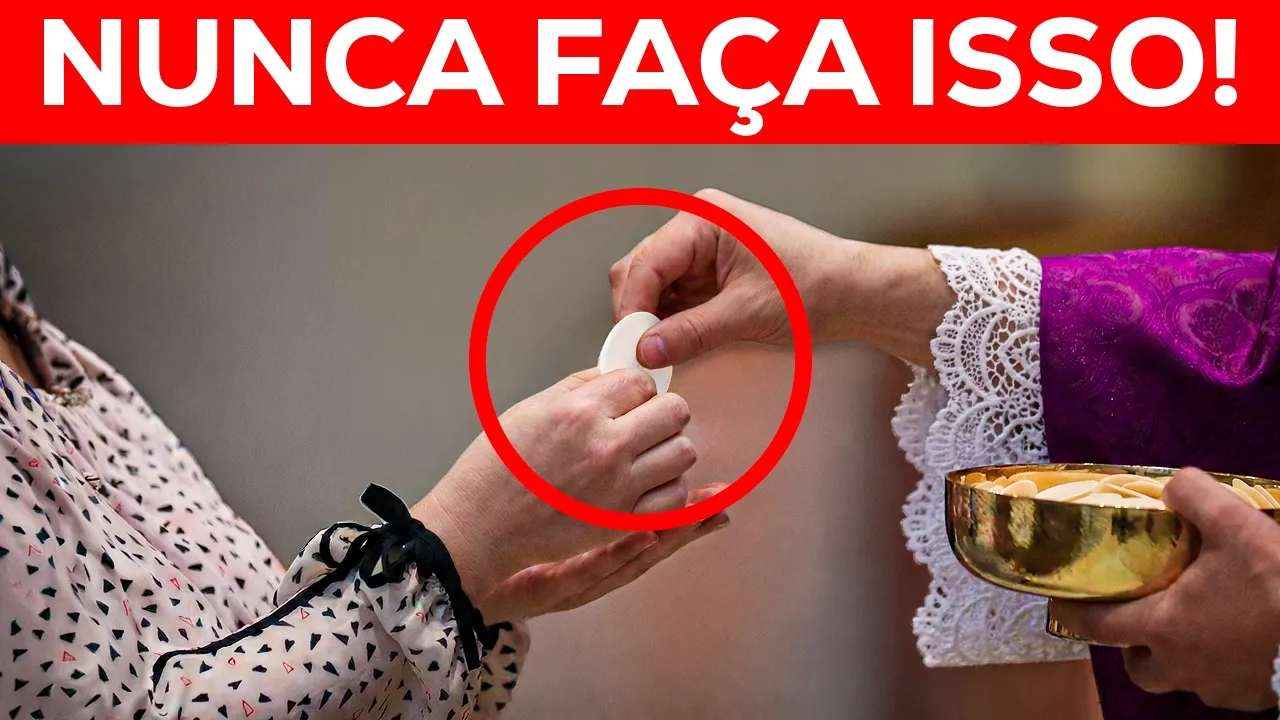
If possible, receive the Eucharist kneeling and on the tongue, a form that expresses greater reverence. However, know that the choice is always yours and, regardless of the form, the minister cannot deny communion. If you receive Communion in your hand, before receiving the Eucharist, while the person in front of you receives Communion, bow in adoration of the Body of Christ.
Error number 32: Not checking if any fragments of the Host remain. If you choose to receive Communion in your hand, examine your palms and fingers with extreme care, so that no fragment falls or gets lost in your clothing. Christ is totally and entirely present in every part of the species and in every fragment of the Eucharist, however small, as taught by the Council of Trent.
33. Not consuming the consecrated Host immediately. If you decide to receive the Blessed Sacrament in your hand, consume it immediately, in front of the priest or minister.
Never walk away with the Blessed Body of Our Lord Jesus Christ. 34. Avoiding extraordinary ministers of Communion.
The validity of the Sacrament does not depend on the person who distributes it, provided they have been duly prepared and authorized by the Church. Christ is present in the Eucharist, regardless of whether He is given by a priest or an extraordinary minister. 35.
Talking after receiving Communion. After receiving Communion, avoid conversations and distractions. This is a moment of inner reflection, thanksgiving, and silent intimacy with God, present within you.
Speak to Him in your heart, give thanks, adore Him, and unite yourself spiritually to the sacrifice you have just participated in. If you don't know what to do, prepare some prayers beforehand to read at this time. They can greatly help you to pray and meditate with the Eucharistic Jesus.
The Pocket Rosary app has some, such as "Soul of Christ" and "Prayer of Saint Thomas for after Communion. " You can download Pocket Rosary for free on your cell phone and have access to these and other prayers for your daily life. Mistake number 36: Not bowing to receive the final blessing.
The final blessing is a true missionary sending, a grace that concludes the Mass. Bow your head as a sign of humility and willingness to live what you have received. 37.
Leaving before the end of Mass. Mass only ends liturgically when the deacon proclaims: "Go in peace, and may the Lord be with you," and the assembly responds: "Thanks be to God. " This is the true end of the celebration.
Leaving before this is like leaving the table without thanking the Lord. Except for real necessity, remain until the end. 38.
Not giving thanks after Mass. As soon as we receive the Body and Blood of Christ, we are called to “give thanks to the Lord for the gifts received. ” The Church recommends that we live this thanksgiving immediately after Communion and also at the end of Mass.
Pope Pius XII reminds us that “one is not free from the obligation of thanksgiving ” at the end of Mass, because what has been received must be welcomed in union with the Divine Master. Error number 39: Forgetting to live what was celebrated. Mass does not end when leaving the church.
The very term Mass derives from the Latin mittere – “to send” – indicating that the liturgy sends us into the world with a mission. As the Catechism teaches, it “concludes with the sending (missio) of the faithful, so that they may fulfill God’s will in daily life. ” The Eucharist gives us the grace to live what we celebrate: with attitudes of faith, charity, and evangelization.
Saint John Paul II reminds us that “what is done in the Eucharist does not end at the church door. ” Therefore, the Mass extends throughout the days; it is a mission to be lived. It is important to emphasize that this guide aims to help you participate better in Holy Mass, as the Church preserves it through its documents and guidelines.
Just as there are the Commandments of God's Law to help us live the divine Will better, the Church also helps us live the liturgy better, drawing from it the source that nourishes our soul. If this video helped you, please share it so that it reaches more people. Subscribe to the channel, activate the bell, and if you can, become a member to support our apostolate.
Thank you very much for watching and until next time.