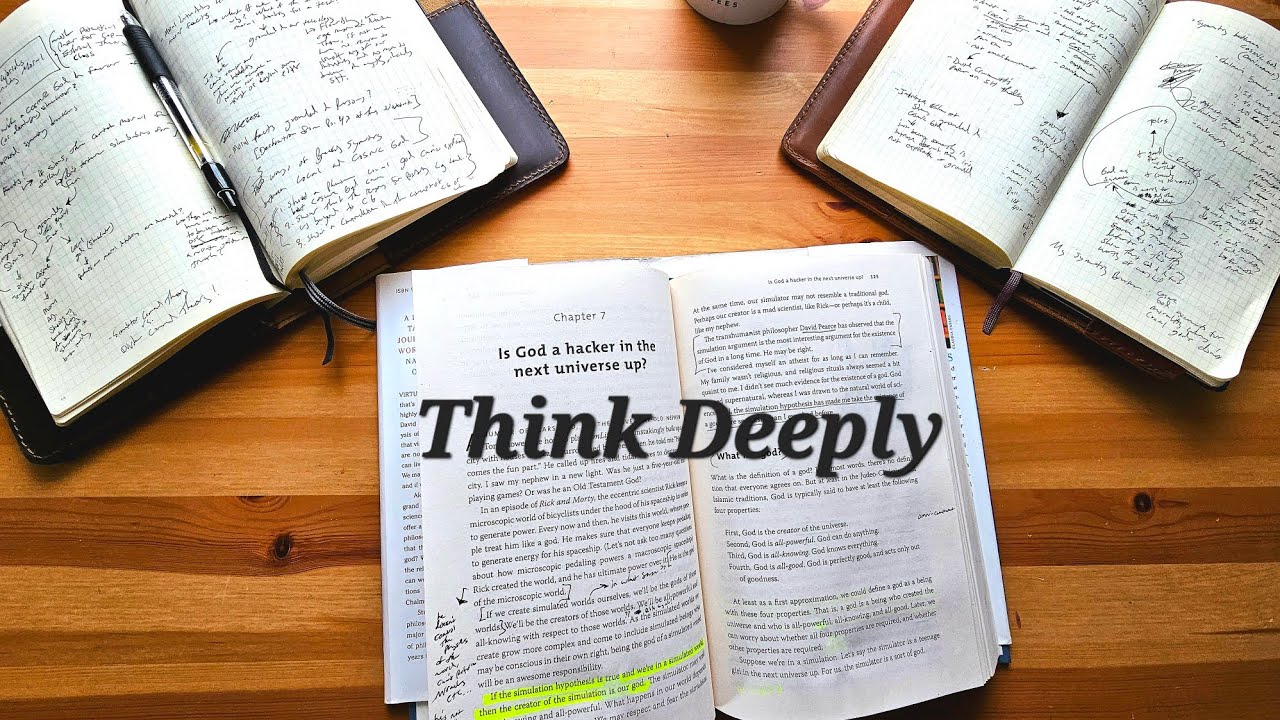
my journaling and marginalia practice has allowed me to converse with the greatest Minds in history when life has descended into chaos it is my reciting and relishing of great literature and it is the writing in the margins of my favorite books and putting ink to paper that has provided me with a life-saving light my journal has been my comfort and my constant companion and today I would like to walk you through how I Journal how I do marginalia my philosophy behind it and a recommended approach for you to try out now let's talk practicalities and
let's talk marginalia because a good journaling practice begins with marginalia in much the same way that a good morning routine Begins the night before there's lots of talk about morning routines it's a very sexy thing to talk about but I think even evening routines are more important our day begins in a powerful way the night before and our journaling begins in the margins of our books now if you've never stained the pages of your books if you've never put ink to paper then the prospect of marginalia can be rather daunting I remember the first time
I started doing marginalia it felt as though I was doing something wrong something naughty like I was blaspheming against the writer but indeed one mindset that helped me overcome this was the idea that writing in the margins underlining things circling things writing my own notes is the highest compliment you can pay to that writer and indeed if you put yourself in the writer's shoes which reader would you feel more grateful for more thankful for more flattered by the reader who keeps the book pristine doesn't dog-ear it doesn't crack the spine doesn't write in it and
then pops it back on the Shelf hardly ruffled or the reader who covers it in their ink that's a high compliment because that person is saying that you have put together something that is worth working over worth taking seriously worth committing to memory worth wrestling with that's a high compliment now the fact of the matter is when it comes to my favorite books I have multiple copies I have show copies and I have work copies if the book is my favorite book then of course I'm going to want to check out new editions Illustrated editions
editions with new introductions rare additions but you also want to have an old paperback that you can beat up and use to put your thoughts in the margins this is my work copy for Moby Dick I have several beautiful copies of Moby Dick I have an old Every Man's Library Edition that I wouldn't dream of marking my library of America editions are very very beautiful you can see I have a Lauren Eisley behind me I wouldn't dream of marking the page in this book in particular having said that however I do have a library of
America edition of Emerson's essays and that is one of my most beaten up dog-eared and stained books I picked that one up secondhand it didn't have its dust jacket it was nude and so I thought why not and now it is like a little piece of me it's an externalization of my soul and I really do cherish the work copies even more than the show copies the show copies are nice they're fun to Rifle through they're fun to show off to people but it's the work copies that mean a lot to me and if somebody
got their hands on my work copies they would have their hands on my soul my soul at a moment in time a little piece of me now I understand the prospect of marking your books might feel a little bit daunting a good way to get over that however is to begin small begin with a short story and do what Michelle de montane did montane who was a very very good reader a deep reader as you might expect from the father of the personal essay montane would reach the end of a work and he would date
it right at the end he'd put the date and he would write a synopsis of sorts one or two sentences maybe three where he would try to summarize not only what the book was about but how he felt about it as well this is a really good way to get started with marginalia pick a short story treat yourself to an old battered maybe even secondhand copy of a book of short stories get a Wordsworth paperbacks Classics Edition and read through your short story date it at the end and do a synopsis that's how you get
started the next stage to marginalia is simply underlining things circling things and you might wonder what do I underline what's important enough well the answer is anything that resonates with you for any reason yeah the fun with imaginative literature and the reason why I have always found it so rewarding is how subject active it is yes there are objective markers of aesthetic accomplishment and even with something like symbolism we can say well by virtue of the symbolism appearing at this part in the book or because it's introduced with this character then it has to mean
this despite there being objectivity in great art I love the subjectivity because it is a mirror it is reflective and Carl Jung told us that the only one who can interpret a dream is the dreamer he told his students to dispense with their dream dictionaries once they learn everything there was to know about symbolism it was time to throw all of that out it's about what it means to you and when it comes to marginalia it's all about what resonates with you right now for any reason but what are some reasons why I might underline
something or Circle something musicality I might just love the phrasing the way it sounds poignance or if I find something that's profound if I think whoa I want to sit with that I want to return to that very often my underlinings are a note to my future self to spend more time disproportionately with that quote maybe even learn it paraphrase it and sometimes I will see recurring themes and I will jot in the margins the other Pages where I've noticed a similar theme this is an extraordinary way to bring some Unity to an expansive work
like Moby Dick like War and Peace and so looking through my marginalia for Moby Dick as you may know Moby Dick begins with some etymology it begins with some extracts Melville gave us a procession of quotations about whales later in the book he would give us a procession of biological encyclopedia entries around Wales and marine life but you can see in my jottings in the margin I'm posing questions this is something that I like to do I like to pose questions because imaginelia is something we return to and we will will answer those questions when
we journal in more depth and if we pose that question we do not need an answer but our unconscious will start to work on and answer as rilka taught us learn to love the questions you can see I'm asking There's A procession of different etymologies for the word whale and I have taken it that because Moby Dick is a quest narrative all of this can be a stand-in for what we are going through in our lives our personal Heroes journey and so I have asked myself well what is your whale and I am prompting myself
here in the margins to uncover the etymology of my quest my whale because our ancestors have gifted us wisdom it's embedded in the words we use every day and we can go on an etymological excavation we can look up where the words we use without thinking come from and so we can get to better know our subject matter by understanding how those who went before us thought where do the words come from because all words are sign they're all symbol they're all figurative to some degree they all represent something so where did this sign come
from that's a really interesting thing to think about and you can see here I've asked another question when we get to the extracts Moby Dick begins with an extract from Genesis and God created great whales and then we get to job Leviathan make us a path to shine after him then Jonah and we go through and we see the Psalms we see Milton we see Shakespeare of course and I have simply asked myself well what is the effect of flipping through these yeah because a lot of readers will skip the extracts they want to go
straight to loomings chapter one call me Ishmael let's get into the story but Melville put these extracts here and an overwhelming amount of them to create the effect of the Leviathan looming on the horizon and so that Insight arise is from a simple question what's the effect here and I encourage you to embrace difficulty and pivot into the pain if you come to a part of a book that you wish to dismiss You may wish to actually slow down and start asking questions why has the writer created this effect why are they doing this how
does this tie in to their message and you can see that there's some self-talk going on in my copy of Moby Dick when we get to chapter or one and I'm telling myself to think back to the last significant Journey that I took a metaphorical Journey yeah a moment of self-development and growth I'm prompting myself to think back to that and to analyze the commonalities between my story and ishmael's story and we're always telling ourselves stories yeah about who we are what the world is what our purpose is and so it's interesting when we're trying
to unravel these stories what we're actually doing is thinking through our own Own Story our own self-talk and of course there's more frivolous marginalia here not everything has to be profound and indeed insights come from frivolity you should remove the inner editor the sensor they are not your friends when you are playing they're there to clean things up once you have already experimented and pulled your ideas forth so out of frivolity comes Insight but here I've just marked in the margin poetry because I love the opening whenever I find myself growing Grim about the mouth
whenever it is a damp drizzly November in my soul whenever I find myself involuntarily pausing before coffin warehouses then I account it high time to get to see as soon as I can you can see I'm also trying to do some cross pollination yeah I'm trying to bring other writers into the conversation so you're reading Melville for example but who naturally joins that conversation you are the mediator yeah so here I've brought in Coleridge that's Samuel Taylor Coleridge and indeed on the next page you can see I've brought in Marcus Aurelius you can see that
I've brought in Freud because I've made a note ego superego id that's Freud I've brought in Shakespeare I've written all the world's a stage that's a reference to Jacques and as you like it all the world's a stage and all the men and women merely players and one man in his time plays many parts elsewhere I've brought in Wallace Stevens I've also started scribbling scriptural references in the margins because Melville like many great writers is very elusive there are plenty of biblical Illusions throughout Moby Dick so I've just put here Luke 16 19 and of
course you can see I'm underlining rather liberally so that's marginalia and we can talk more in depth about margin Alia if you're interested but our next stage in our journaling practice is re-reading they're all linked marginalia is linked to rereading rereading is linked to journaling you want to use your marginalia as a scaffold or a direction a map to direct your re-reading good reading is re-reading our first reading is certainly not our last reading unless the work is not very good what does it say about a work if you simply want to steam through it
and then put it back on the shelf and say done the great works are those Works where we are never finished we will never say I've read that book we will say I'm reading it or I'm rereading it yeah reading is something that we are always doing even if we do not have the book in front of us and our journaling our marginalia is a mnemonic that helps us remember and commit things to memory and so when we're out in the world we're walking around we're talking to other people we're dealing with problems we are
reading as well and this is what I mean when I say live the great books so if you're reading really cognitively challenging non-fiction you want to spend a lot of time over everything one of the most rewarding readings I've ever done in my life was when I took Aristotle's ethics to a cafe in Vienna I was living in Vienna at the time I took it to a cafe in the morning every day for weeks and weeks and weeks and I spent a couple of hours there and I nursed some double espressos and I wrestled with
every word and labored over every single page and I broke that book down until I possessed it and that kind of reading is work but it's also the kind of work that is love made visible to paraphrase Khalil Gibran I would do that and then I would go on a little walk around the grounds of Schoenberg Palace and I would digest everything that I had just read it was a very very rewarding thing to do and there's no way I would have been afforded the self growth that came during that year if I had attempted
to speed read through Aristotle you do not speed read Aristotle you read very very slowly and you think everything through but with imaginative literature you're first reading you might want to immerse yourself yeah and your marginalia might just be very very light yeah it could just look like a little star in the margin underlining here a circling there but essentially you want to see everything Flex those imaginative Powers because imagination is connected to empathy and morality and so when we're reading imaginative literature we want to see everything hear everything smell the smells interact with the
characters befriend them they are your friends and they are real people and so you're just jotting in the margins but then the re-reading happens set yourself a milestone yeah say to yourself you're going to read X number of pages it could be 10 pages and I'm a huge proponent for minimal effective dose I love having a one-page prescription every day day because it doesn't matter how tired you are if that book is on your bedside you can reach for it and it's an easy win if all you have to do is read one page and
that one page typically will turn into multiple 10 20. but once you've hit your Milestone maybe you're reading for half an hour you want to bake your rereading in by virtue of your marginalia when you finish up for the day or you're about to put your book down go back over what you've just read and pay attention more close care and attention to the passages that you have marked and the more sleep cycles we introduce the more powerful our rereading becomes just so you have a page allotment for the week of 50 60 70 Pages
whatever it might be five chapters we want to be just outside our comfort zones yeah not too difficult we don't want to set goals that are unachievable but every day when you read on just so you're reading 10 pages a day reread everything that's come before for and if you do that by the time you get to the end of the week there are some sections that you have really reread you know them so well and rereading in this fashion does not look like a to B it might just look like skimming it might just
look like refreshing your memory it might look like flipping the pages for 10 20 30 seconds it might look like lingering on your favorite bit and just having a little think why did I like that you do that every single day until you come to the end of the week where you have scheduled in ahead of time some journaling you need to schedule these things when I begin my week I schedule two things before everything else I schedule my reading and I schedule my physical activity and the body and mind are intertwined I'll very often
go on a walk and deliberately think about what I have read recently and therefore make these writers my walking Companions and so if you are creating really powerful habits your scaffolding really healthy habits on to one another you're taking advantage of that blood flow that oxygen you're stepping away from the digital for a moment I love the digital world when it is used appropriately when we curate our digital world with Illuminating podcasts and lectures and documentaries great films and music but it can also be a degenerative realm as well and sometimes we need to engage
with the analog paper and pen and the real analog our soul in the world and so all of this re-reading is kind of like a spaced repetition technique those of you who have learned a language likely know what an SRS is that's a spaced repetition system like Anki where you put in your vocabulary or you put in the grammar that you want to drill and learn and you do a drill every day every other day but you will be prompted at the appropriate time to revise things just before they leave your memory so it's not
exactly the same but it does still serve as a powerful mnemonic as that adage of Drillers being Killers yeah and we have that idea I think maybe Bruce Lee said something to the effect of I do not fear the man who knows a thousand kicks I fear the man who knows one kick but has drilled it a thousand times the same sentiment is true when it comes to the great book so we want to reread and focus in on those passages that really resonated with us and another reason why rereading is beneficial is because it
plugs into that idea of reflecting your change we are always changing we're always in flux and the world is always changing it's unhealthy to not change there is no such thing as stasis but there is such a thing as entropy and degeneration if we do not keep changing we degrade we Decay but change is also painful and it can be a challenge at times to change and we change by adopting new habits and discarding with old habits that do not serve us and so as you're reading these books you're collecting things that will Aid you
as you forge valiantly forward on the hero's journey that is your life you're collecting themes you're befriending characters you're collecting pithy maxims and phrases that you can utilize as mantras in times of need you're collecting words and ideas and all of this becomes more robust your understanding of all of these things deepens with every rereading because you are bringing the changes that have taken place in the world and have taken place in you back to these books and that's why it's so extraordinary to read Shakespeare as a teenager yeah we read Shakespeare in school and
school does not do a very good job at teaching Shakespeare and many of us leave school thinking wow I am never reading him again but the thing is we can't understand Macbeth or King Lear we can't understand any of that at such a young age but we still want that initial reading by virtue of being able to mark the growth later down the line years later we come to Macbeth thank King Lear and we think wow I get it I get it now that's rereading so how do I Journal let's talk about my Approach the
tools of the trade are very simple they're straightforward they're easy to obtain they look like a set of Muji pens I love these little pens I first came across these in a convenience store when I was living in Tokyo and I found that these are brilliant pens for marginalia and journaling and it looks like a bullet journal with graph paper dotted paper from the like term 1917 range which looks like this now every Journal like every book and every person is different and unique and I have different journals for different purposes and that's something that
I would encourage you to do too this one here is my Sonics Journal I've actually had many sonnets journals during my time every few years I like to go through the sonnets of William Shakespeare in sequence and treat them as raw shark tests and just treat them as an opportunity for a little bit of reflection a little bit of me time a little bit of therapy I'll put the date at the top of the page I'll put the Sonic number and I've done marginalia in the margins for the sonnet in question and I just Riff
on the different themes this one here doesn't have the date in the margins but it is quite old and I know that this is from a while ago because my handwriting is actually somewhat legible it's quite neat it seems as though the older I get the more illegible my handwriting becomes and you can see I've started by just making a list of the parts of that first sonnet that leap out to me I don't immediately need to know why I just need to get the ones that do leap out of me down on paper and
then we'll see what comes of it we just get into the habit of writing you just need to get the ink flowing it's like with exercise you want to get the blood flowing you want to feel the ink coming out of your pen just get used to writing indeed before I sit down to make a video or do a lecture or a podcast I start talking for a little bit before I turn on the camera or the microphone I just get into the habit of talking and so you can see I'm made a list of
words and then I have asked myself a question I've basically said which of these parts of the sonnet most leaps out at me I find this to be a very good orienting question because the one contains the many and the many contains the one I love that Buddhist tenet it's such a great guiding principle rather than get bogged down and try to talk about absolutely everything try to be selective yeah you want to curate your life be selective Force selectivity upon yourself pick the one thing that resonates most with you that's also a powerful mnemonic
because whilst you're thinking about that one thing everything else falls into place you start to understand the work as a whole in this case it's a sonnet and I'm not doing anything particularly special here I've just written out a quote the edist thy lights flame with self-substantial fuel and like a child doing a homework assignment I've just written I think I like this because and I just start meditating I'm the page what I really love to do with my journaling is to pick one quote for the session now I will journal every Sunday or every
other Sunday and I'll typically do that for 15 or 20 minutes and I'll begin by rifling through what I've read that week and I will a light upon one thing that resonates the most with me and so if you've been rereading and constantly returning you'll find that the thing that resonates most with you might change it might deepen by virtue of the lived experience you've had over the course of the week or the last few weeks or the last month pick one thing and for 15 minutes you will write around that thing so you're right
on the page and then you'll think on paper and You Begin Thinking by asking questions and the questions can be quite simply why does this strike me or you can take key words if the writer is talking about war we'll just try to Define things yeah what is war war is dot dot dot yeah you can make a list what is love well there's different kinds of love you go through the love that you've experienced in your life you try to qualify it you try to understand it get inside it so step one a light
upon resonance with a quote that means something to you it could be kings are the slaves of History that's from tolstoys War and Peace we're aligning upon resonance it could be every life is many days day after day we walk through ourselves meeting robbers ghosts Giants old men young men wives widows Brothers in love but always meeting ourselves that's James Joyce from Joyce's Ulysses so that's step one a light upon resonance step two is to write the quote Out Feel the ink coming out of your pen ground yourself in the present moment and play pretend
you are James Joyce you are Leo Tolstoy Helen vendler one of my favorite exegetes when it comes to Shakespeare and Keats and Emily Dickinson in order to become an authority on these poets she told herself that she needed to commit the works to memory and she did this by writing the works out by hand and she questioned every single word why did the poet use this word and not a proliferation of other potential words and she found that this was a powerful way to commit the Poetry to memory and to understand what the poet was
feeling and trying to convey when they wrote it so that's what we're doing find the quote write it out and step three pose questions to yourself and then just continue asking questions bring in other writers bring in insights from your day-to-day life bring in autobiographical meditations and musings and be like a jazz musician riffing on a theme great literature is simply riffing on a handful of themes we don't read these great books because they're necessarily always teaching us something new part of the joy is seeing how different writers convey the same message and again when
you're writing remove the editor yeah this is not for other people so be a silly and frivolous make mistakes get it wrong question yourself in the act and simply write and write without a filter you are explicating the quotes free association style and keep that idea from rilka in mind learn to love the questions what you're doing with your journaling is you're taking the scenic route through great literature and through your life it's not about the destination it's a cliche but it's true we always look back with fond memories on the journey so relish the
journey and every book is an opportunity for a New Journey and you can take many Journeys so you don't just want one Journal you want to have several and there's such joy in flipping back through your Journal a couple of months on and reading what you wrote about The Taming of the Shrew reading what you wrote about Titus andronicus and when you're engaging with these great books you're ultimately always engaging with yourself it doesn't matter if what you're reading is not about your actual life it is if you are a gardener then reading told story
even though what he's writing isn't ostensibly about gardening we'll teach you something about your profession and your vocation if you are a scientist if you are a fighter if you are a doctor a teacher a mother a father a husband a wife a mechanic a carpenter whatever your life looks like you're always learning something about it through these great books even if the topic isn't ostensibly about your vocation and your situation and that's why it's good to put the date in the margins because we do not get these insights and impressions in isolation your life
is the fertile soil necessary to explicate them so let's talk action steps and philosophy and how to practically apply it the first thing you want to do right now is to schedule some journaling time for yourself if you do not have a journal then that's stage one get yourself a journal carve out some dedicated time look ahead look at your calendar and fit it in I find that if we do not schedule things then they do not happen and keep in mind the aristotlean idea of us being what we repeatedly do habit creation can take
a little while so it might be uncomfortable at first we might be really really excited and then we might abandon it in about a month it takes about two months roughly maybe a little bit more maybe a little bit less for some people but around two months to firmly establish a habit and so you want to be consistent because you will get to a point where it will feel strange if you're not journaling at a certain time it will feel strange if you're not doing marginalia the best way I have found to establish a new
positive habit is to scaffold it onto pre-existing habits if you have your coffee in the morning have your journal and pen or the big read you're trying to breach near where you store your beans where your cafeteria sits where your coffee or or tea making apparatus lives and that'll be a reminder to reinforce that habit another mindset is to treat this seriously it's work work of course as we've said Is Love made visible Khalil Gibran said that but it's work and we designate meaning we designate what is Meaningful and so what would your journaling look
like if it were a meaningful activity if it had a very strong knock-on effect for the world around you because it does it can it most certainly can many people might find themselves understandably from time to time questioning whether there is any meaning at all in the world well we designate it and if we can designate it then there is a sense of meaning we are the masters of Our Fate we are the captains of our soul it's a quote Invictus and so if your journaling is working it's meaningful then it might look like you
carving out specific time on a specific day and sitting in a specified location sitting at a table with a pen in your hand sitting with good posture and attentive and the Fantastic thing about creating new habits isn't just because of what the Habit can give us or what it can lead to in and of itself but very often we need to swap out bad habits if we're doing one thing we can't be doing another and so whilst we're journaling whilst we're thinking about the great themes of The Human Condition what are we not doing well
we're not Doom scrolling through social media we're not feeling riled up and struck with anxiety struck with fear and depression thanks to the news Cycles we're not arguing with people what I love to do when I Journal is I put my phone on airplane mode and I like to go for a little walk claim a little bit of Stillness and then sit down and treat it as a little bit of self-care and there's always something to look forward to because there are multiple journals and if there are multiple journals waiting on your shelf to be
filled in then there are multiple conversations I have a short story Journal I have a Shakespeare Journal I have journals dedicated to specific poets like Shelley and Keats I have topic specific journals journals on Gothic literature journals on tragedy yeah tragic drama generally and each of these journals contains something of my soul and so that's how I personally approach my marginalia my rereading and my journaling practice let us know what is the first thing you're going to journal on what are you going to dedicate your journal to what are you going to start writing about
what great books are you reading right now what great writers do you intend to enter a conversation with thank you so much for watching today and I hope you have a lovely day happy reading and happy journaling everybody bye for now






![Become an Expert in (Almost) Any Subject Using Commonplace Books [Philosopher Explains]](https://img.youtube.com/vi/LTbjlUe7vMk/maxresdefault.jpg)