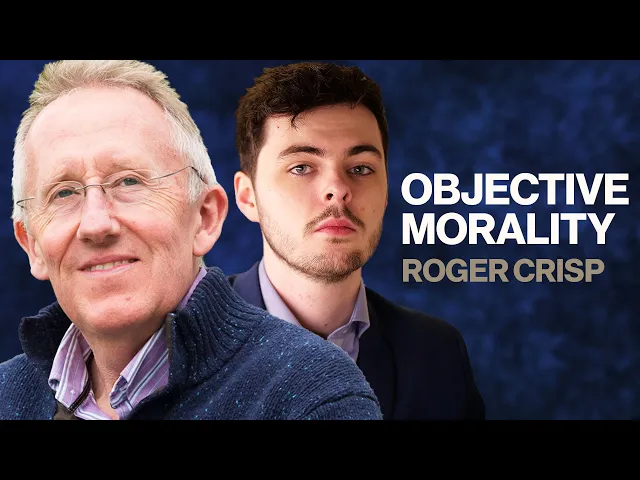
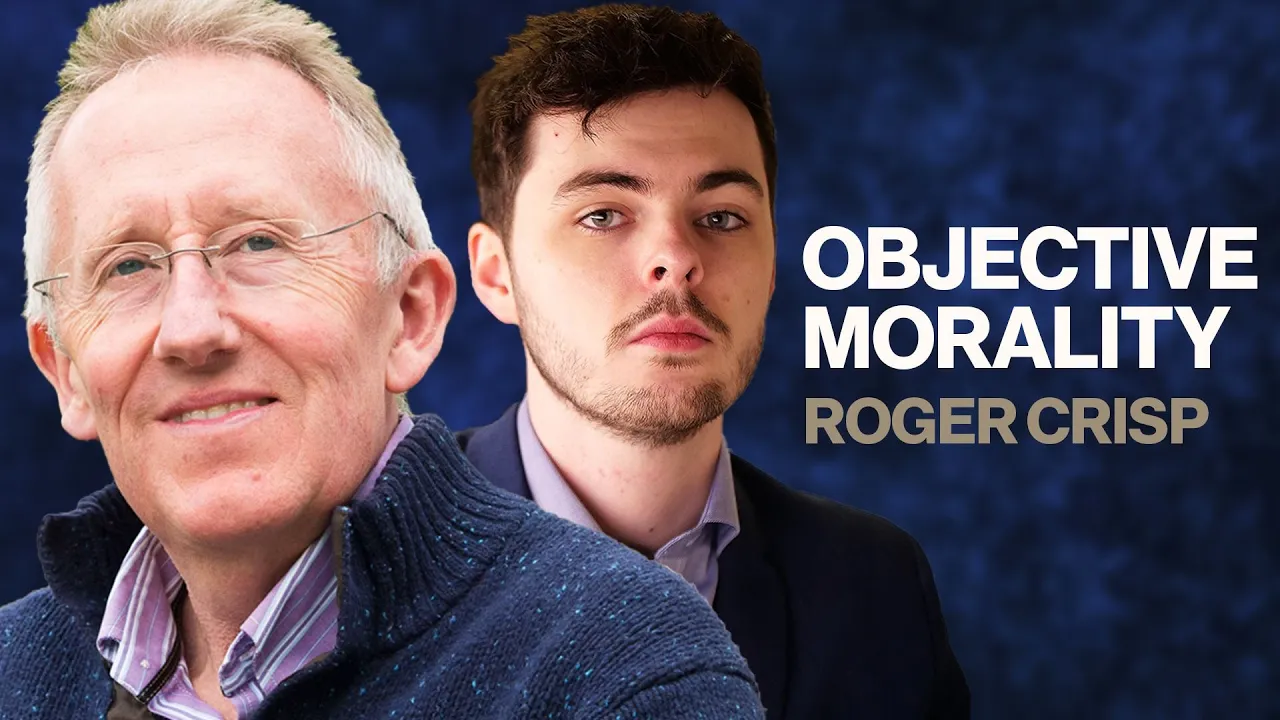
well hello and welcome to the Oxford Socratic society's official YouTube channel my name is Alex o Conor co-founder and former president of sock sock and today we have the Good Fortune to be joined by Professor Roger crisp who is here to address us on the topic of objective morality and we thought we'd sit down for a moment and talk a little bit about morality for people who couldn't make the event in person uh the motion tonight is whether there is such a thing as objective morality what does it mean for ethics to be objective and
why is that important well I think it's one of those uh words that one has to Define um without implying that somebody who uses the word in a different way is using it wrongly and I think tonight what I mean bym morali is being objective is that the claims within it about how we should act um are truth AP they could be true or or false um and that they're made true if they are true or false if they're false by the facts you might then say well okay what are facts and of course we
could go on all night about facts if you wanted but I hope that would be enough to give you a rough idea yeah I know a lot of people will if you are somebody who thinks that ethics is a real thing but a subjective thing uh based on interest or or preference or something like this that they might still think that moral claims are truth apt it's just that they can be subjectively true or false would you say that that's a misguided view of what subjective ethics would be uh I think there are people who've
done this and they have views of Truth which would be more minimal than mine um so you're quite right that you you can you can you you can play with the notion of Truth so that a subjective VI could allow for truth but I think I'm I'm really thinking of Truth in the way that most people think about it I'm imagining somebody who thinks that well ethics is just essentially a euphemism for for preference you know when I say that murder is wrong it means something like I don't like murder and so it's true for
me that murder is wrong and the thing that makes it true is the fact that psychologically speaking I don't like murder um but because that fact is a fact about my brain even though it seems to be a fact that makes something true true for Me Maybe in the way that it can be true for me that you know it's it's not raining outside but it's true for somebody in I don't know somewhere else in the country or somewhere else in the world that it is it's it's true that it's not ring for me but
it seems somehow dependent on the subject it seems to me that a definition of ethics that says it's objective if it's truth apt and it's made True by facts might be counted by a subjectivist with with reference to that kind of Truth and falsity about the state of a person's mind you know yeah um so I mean if if we take the view that you called subjective According to which um the statement X is wrong means I don't like x uh that's an objective view according to me so that would be a a a kind
of objective ethics uh yeah be a very odd view so what are some examples of things that are not objective ethical theories that would you say that it would have to be something that's that has no truth apess like ethical emotivism or something like that or is is it that anything that any system of Ethics in which you can describe propositions as true and false is going to be objective in your in your understanding yeah so emotivism is is is a good example I think many so-called subjectivist views have the Spectre of emotivism behind them
so if we understand emotivism as the view that when somebody says some that X is wrong they're essentially saying boo to X down with X they're expressing an emotion as you say that's not truth AP that will clearly count in the sense I'm using as a subjectivist view but you because it's philosophy people mean all sorts of things by objectivism and subjectivism and and uh I think the the other kinds of views that you were talking about According to which for example uh morality rests on our preferences in some way or our desires and is
in that sense contingent um those people could come up with a minimalist uh account of Truth uh allowing them to to talk about moral judgments as true or false without as it were translating them into uh propositions not to do with morality certainly a sense in which some forms of utilitarianism which is one of the first objective ethical theories that people will come across uh can be said to be dependent upon brain States uh if you've got a a form of utilitarianism that says that we should be maximizing pleasure and the reason for that is
because people desire pleasure then the fact that makes this ethical truth is something about somebody's preference which is essentially their preference for pleasure might be a sort of tautological preference but maybe the subjectivist who thinks that something being based on a brain State makes it subjective we'd have to call utilitarianism subjective for that reason I'm not sure um but I wonder what you think of the claim that's often made and I think there's often an implicit assumption that it will be discussed when people talk about their being or they not being objective ethics that objective
ethics is only possible with some kind of moral Authority that looks like some kind of God or Creator or author of the moral truth what do you make of that claim and why do you think it's such a popular one um well I mean the the that claim I think um was first discussed in philosophy as far as we concerned by Plato in his dialogue with youth which is thought to be one of his earlier dialogues uh and that that dialogue is about the nature of piety uh and they get to a point which is
often called The euth ofo Dilemma where youfo this uh interlocutor of Socrates uh is asked to say whether he thinks that things are Pious because the Gods like them or do the Gods like them because they're Pious so that's a sort of decision we're having to make here why do people feel the need for Authority well it could be because they're inclined to think that we we need the Gods in in our account of piety or rightness and wrongness or whatever it is because otherwise there wouldn't be any moral truths or moral facts they somehow
have to be made True by God or whoever it is by by the individual with authority but I think people who are uh skeptical um about theism for example or theists who have a a more robust conception of morality will say no you know these things stand on their own uh if if things are Pious the gods May well like them because they're Pious but they're not Pious because the Gods like them in that sense I I think a struggle that people will have in saying that there is an objective truth and as you've defined
it this means moral statements that are truth AP and the thing that determines their truth value are the facts generally speaking speaking when we're talking about facts we're talking about descriptive facts facts about the way things are facts about the universe and famously it's impossible on uh many people in many people's opinion I should say because some people surely deny it that you can derive ought from ises that you can get moral statements that are made True by non-moral statements So when you say that there might be a conception of objective ethics which is and
these propositions are made True by the facts are those facts necessarily prescriptive facts or can moral claims be made True by descriptive non-moral facts um well no they they can't but uh I don't think this is a problem for the realists because they'll say you're uh you're rigging the game by uh not allowing there to be moral facts to start with so it could be that you can only draw a moral conclusion from a set of premises including a moral claim uh but there's nothing to stop the realist saying that moral claim is made True
by a moral fact to be clear realist here for our listeners is a moral realist which is someone who believes that morality is objective yeah um for such a person who says okay well yes you can only describe prescriptive that is you know moral uh ought statements from other moral ought statements you require some some kind or some set perhaps of fundamental prescriptive fact in the way that descriptive epistemology probably requires some fundamental descriptive fact that the Universe exists that our sense data is accurate something something like this do you think there is a fundamental
moral prescription that we can boil objective ethics down to is it a set of prescriptions or can we not know what these prescriptions would actually be uh well I'm inclined to think that there there is a set I mean it may include only one principle I don't know um because uh it seems to me that certain normative or moral um propositions are very hard to deny if we use normative in a broad sense so for example it seems to me that um it's true that severe suffering is bad for me that seems like an evaluative
fact it seems to me that at least other things being equal I have a reason to avoid severe suffering that's a a normative fact about reasons that I have to act so I I suspect that the truth about um value and about reasons will consist in the correct set of such propositions and I'd be very surprised if the two I mentioned weren't in there one I I certainly would say that any attempts to objectify ethics without God at least tend to start with something like at least human suffering being bad in some respect even if
just for that one person you said that to be an objective moral statement it must be made True by the facts and so when we talk about the fundamental moral prescriptions at the basis of our ethical epistemology you could ask well if we have this fundamental principle you know human suffering is bad or my suffering is bad for me something more modest like that for that to be objectively true at least on the definition that you were working on earlier that itself would have to be something that's made True by the facts or would you
say that those are some forms of objective moral truths that are immune from being made True by other facts about the universe what what's the fact that's being what's the proposition that's being made True or whatever the fundamental ethical prescription would be so whatever it breaks down to if you keep asking well what makes p true see what you mean you get to a point where you either have to say that you have a necessarily true moral statement which seems good tricky to to justify to make it necessarily true no because I think it would
be true in all possible worlds that any sentient individual has a reason to avoid suffering so it is a necessary truth but reason there when you say any sentient being has a reason cuz you could put it in the conditional because somebody might say well how can it be true in all possible worlds that human suffering is bad when there are possible worlds where there are no humans but we'll say it's true in all possible worlds that if there are sentient creatures like that's the claim then you said they have reasons to avoid harm are
those reasons more like the way that somebody might have reason to put money in a bank account that is that translates to something like it is within their self-interest or is it reason as in the moral sense of Jus a justification for acting because I could say you have reason to put money in the bank account but I wouldn't say that's a prescriptive ought that binds you morally speaking it just means something like well this is in your self-interest in the same sense seems very obvious as obvious to me as it does seemingly to you
that any sensient creature has reason to avoid harm but that seems to me just to translators that that being that being self-interest is served by avoiding harm rather than it being justified in prescribing a sense of having to avoid this harm you know well I think I mean I was talking about reasons uh and I'm inclined to think that if we can answer the questions we want answered in terms of reasons uh then we don't need to go on to ask whether some of them are binding or not that seems to me an unnecessary question
if of course we can weigh reasons against against one another and decide what we have strongest reason to do you're quite right that I started with what's with self-interest what some people call Prudence uh that's just because it seems to me even clearer that I have a reason to avoid pain uh than that I have a reason to take steps to avoid your feeling pain though in fact I do would believe both that's the difficult jump to make though in so many cases uh it's where I think utilitarians in particular have the the most work
to do in saying from an intuitive injunction that I myself should avoid my own suffering it just seems self-evidently bad if there's such a thing as Badness must consist in that kind of experience but to then say it's bad generally for suffering to occur or it's bad for me for your suffering to occur such that I have a prescription to minimize your suffering as well as mine that universalization of the avoidance of suffering principle seems to be a bit of a hurdling block how might some get over that yeah good point um I mean what
I I certainly wasn't trying to do was to prove any kind of moral principle utilitarian or other uh principle from some kind of egoistic premise um I wasn't trying to do that I'm not saying you couldn't do it with some extra premises and obviously people like Mill and cidc and people have have attempted to do that um I was really doing it uh just purely because um I think it seems more persuasive because many people are egoists still not in philosophy but outside philosophy they are so if one is engaged with in a discussion about
reasons and objectivity one might as well start with egoistic reasons so to be clear then if we're going to have objective ethics and objective ethics means that the propositions are made True by the facts then you have this chain of P being made True by R are being made True by Q for any system of objective ethics do we have to terminate in some necessary moral truth um yes and you think maybe we we can't quite put a finger on what that is at the moment no not at the moment we can't does that make
it impossible to have any moral knowledge if the justification if the chain of justification eventually terminates in somewhere a bit mysterious and dark that we can't access yeah personally I think it does about most questions um but that's again why I chose the examples I did because I think in in in the ordinary sense of knowledge I know that suffering is bad for me and yeah I yeah I would I would claim to know that I have a reason to take steps to um decrease your suffering or remove it is that knowledge on par with
descriptive knowledge is it on par with your knowledge that the external World exists with your knowledge that the Earth orbits the Sun is it a different kind of knowledge do you believe it as strong yeah that sounds like um knowledge gained through the senses or empirical knowledge uh whereas I think this uh knowledge I'm talking about is knowledge gained through what philosophers call intuition so it comes when you grasp what suffering is when you grasp what reasons are I mean it seems almost tological to say that suffering is just that which a sentient creature has
an interest in avoiding it's what suffering might be I think they're PA it defines suffering as that which is not wanted when experienced or something like this yeah I would disagree with him about that I I think it's a kind of sensation right so maybe that's a form of sense dator it's the sensation of the suffering sensation of the moral feeling that's at the B is yeah but the the Judgment that it's bad is not that's intuition well fantastic um thanks and uh before we shut off I wanted to ask if people are interested in
in discussing or learning about this further do you have any resources that you could Point them to like a particular book about objectivity and ethics or anything like this that they should start with well to be honest I would recommend Henry Cedric's uh methods of Ethics which like many other people I think is the best book on ethics ever written um so dip into that but also read some Plato uh read some hum read some Mill read some burnard Williams there's a lot of very good stuff to read yeah well we'll make sure that everything
relevant is linked in the description down below uh but with that thanks for sitting down with us and thank you everybody for watching