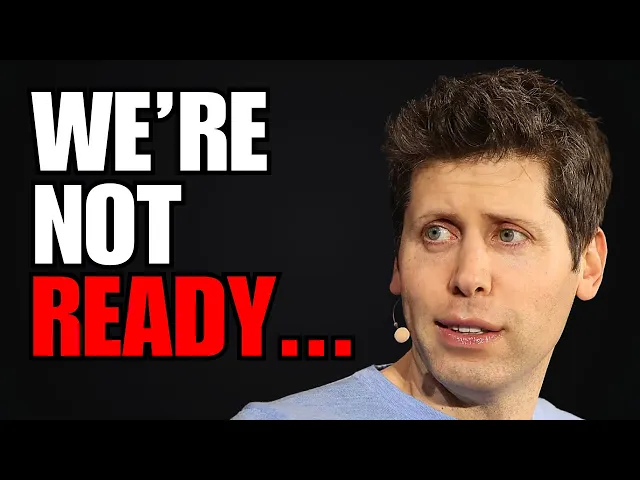
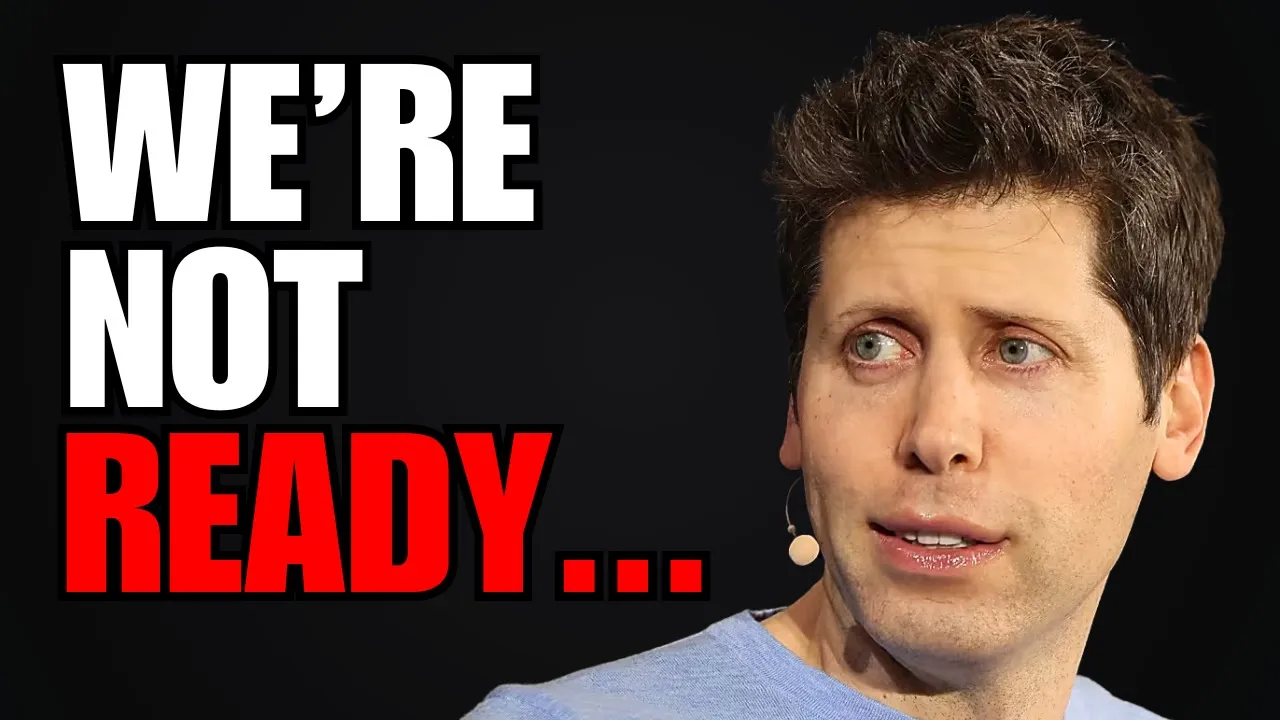
And then 27 I I would guess is the year where like that all moves from the sort of intellectual realm to the physical world and robots go from a curiosity to like a serious economic creator of value. So Sam Alman recently sat down for an interview where he talked a lot about the future of AI and where all of this might be headed. In this video, we'll be breaking down the three big takeaways from this conversation.
First, why he thinks startups have a serious edge in the AI era. Then, the endgame for personalized and customized AI. And lastly, Sam's timeline.
What he sees coming in 2025, 2026, and 2027. Let's get into it. All right.
So, in this first clip, Sam Ultiman talks about a pattern he's noticed with every major tech shift and how it's playing out again with AI. Apparently, the next few years are going to be filled with denial right before the quote last minute scrabble begins. Check this out.
Um, what do you think the larger companies are getting wrong about transforming their organizations to be more AI native in terms of both using the tooling as well as producing products? It's been, you know, it's smaller companies are clearly just beating the crap out of out of larger ones when it comes to innovation here. I I think this basically happens every major tech revolution.
Um there's nothing to me surprising about it. The thing that they're getting wrong is the same thing they always get wrong, which is like people get incredibly stuck in their ways. Organizations get incredibly stuck in their ways.
If things are changing a lot every quarter or two and you have like an information security council that meets once a year to decide what applications you're going to allow and what it means to like put data into a system like it it's just it's so painful to watch what happens here. But like you know this is this is creative destruction. This is why startups win.
This is like how the industry moves forward. Um I am I'd say I feel like disappointed but not surprised at the rate that big companies are willing to do this. Um they will my kind of prediction would be that there's another like couple of years of fighting pretending like this isn't going to reshape everything and then there's like a capitulation and a last minute scramble and it's sort of too late and in general startups just sort of like blow past people doing it the old way.
Um, I mean this happens to people too like watching watching like a you know someone who started maybe you like talk to an average 20-year-old and watch how they use chat GBT and then you go talk to like an average 35-year-old and how they they use it or some other service and like the difference is unbelievable. It reminds me of like, you know, when the smartphone came out and like every kid was able to use it super well and older people just like took like three years to figure out how to do basic stuff and then of course people integrate. But but the the sort of like generational divide on AI tools right now is crazy and I think companies are just another symptom of that.
So I think this is a really important point and one that not many people are talking about. As he said, every big tech revolution tends to follow the same playbook. First, the younger generation and startups jump in early.
Then, once the momentum's too big to ignore, the older generations and the bigger corporations finally get on board. That's when things hit a sort of tipping point and change goes from gradual to explosive. Now, here's the crazy part, though.
We're still a few years away from that tipping point with AI. So, if you're watching this video right now, you're already way ahead of the curve. Even though a ton of people know about AI and are using AI models, it still hasn't been integrated into our economy and daily life the way say the internet or smartphones have.
Now, of course, it's hard to fully compare AI to past tech shifts because this isn't just a new tool or platform. It's something that could reshape how we think, work, and even what it means to be human. Which brings us to the next big idea Sam touched on the long-term goal of customized personalized AI.
Take a look. I mean, in some sense, I think the like platonic ideal state is uh a very tiny reasoning model with a trillion tokens of context that you put your whole life into. The model never retrains.
The weights never customize, but that thing can like reason across your whole context and do it efficiently. and every conversation you've ever had in your life, every book you've ever read, every email you've ever read, um every everything you've ever looked at is in there, plus connected all your data from other sources. And you know, your life just keeps appending to the context and your company just does the same thing for all your company's data.
Um we can't get there today. Uh but but I I think of kind of like anything else as a a compromise off that platonic ideal and that is how I would eventually I hope we do customization. So yeah, this part honestly feels straight out of a black mirror episode.
Sam Ultim is telling us straight up the ultimate goal for personalized AI is to give everyone a model trained on basically their entire life. your conversations, preferences, behavior, routines, all of it constantly being fed into a model that can reason across your entire personal history. Now, obviously, for something like this to actually work, we need a device that's recording everything, whether that's AR glasses, a phone, or something else.
It has to be on all the time. The possibilities with this are kind of insane. Imagine a personal genius level assistant that knows everything about you, what you're doing, what you've done, and what you should be doing, and helps you with it all in real time.
But now, on the flip side, this is also kind of terrifying. I mean, what happens when your AI knows things about you that you forgot? Or worse, what if someone else gets access to your model?
What if it predicts your choices before you even make them or subtly nudges you without you even realizing? I mean, this is why it really does feel like a Black Mirror episode. So, let me ask you guys, if you had an AI trained on your entire life, what's the first thing you'd use it for?
And also, what do you think people will actually use it for? Now, finally, in this last clip, Ultims out his timeline for the next 3 years in AI, and it's kind of insane how fast he sees things moving. Check this out.
I mean in some sense the value will continue to come from really three things like building out more infrastructure, smarter models and building the kind of scaffolding to integrate this stuff into society and if you push on those I think the rest will sort itself out. Um at a higher level of detail I kind of think 2025 will be a year of sort of agents doing work. Coding in particular I would expect to be a dominant category.
I think there'll be a few others too. Um, next year is a year where I would expect more like uh sort of AI discovering new stuff and maybe we have AIs make some very large scientific discoveries or assist humans in doing that. And you know, I'm I am kind of a believer that most of the sort of real sustainable economic growth in human history comes from once you've like kind of spread out and colonized the earth, most of it comes from just better scientific knowledge and and then implementing that for the world.
And then 27 I I would guess is the year where like that all moves from the sort of intellectual realm to the physical world and robots go from a curiosity to like a serious economic creator of value. But that was like an off the top of my head kind of guess right now. So just to break that down quickly, 2025 is the year of AI agents, models that can actually take actions in the real world.
2026 is when he expects AI to start discovering new things, pushing into science, research, maybe even creativity in ways we haven't seen before. And 2027, that's when he thinks robots go from being just a concept to a realworld economic driver. So, what do you think?
Are we actually on track for this? And which stage of AI are you most excited for? Personally, I think once AI starts discovering new things, especially in science, that's when we'll start to see massive tangible real world impact.
But if you've been following this channel for a while, you already know how bullish I am on humanoid robots. Once that starts to scale, I don't think there's any turning back. The way we think about work and who does it is going to completely change.
And once that happens, society itself will have to change, too. I mean, if humans can no longer trade labor for money, then what happens? Anyway, I'll leave you with that.
A question that's easy to ask but extremely tough to answer. Thank you for watching and as always, if you want to stay uptodate on future AI news just like this, make sure to hit that subscribe button.