hi let's talk a little bit about Gail rubin's text the traffic in women in this piece Ruben notes that the nature and origins of women's oppression is a very interesting topic since knowing the root causes of Oppression can lead us to some kind of insight on how we can work to eliminate oppression however e ruin suggests finding the specific origins of Oppression is virtually impossible since so much time in history has passed so rather than search for the origins of Oppression as such that is where and when precisely did gender oppression begin in order to
find the cause of it Ruben wants to offer an explanation of the problem of gender oppression and this can also give us Insight on how we might mitigate gender oppression in our current Society Ruben's thesis is pretty simple even if her argument is somewhat complex Ruben's thesis here is that sex and gender are a product of social relations sex and gender then are not innate qualities of human beings but their social constructions in the sense that they're based on conventional means of human relations Ruben Begins for discussion from a socialist feminist perspective socialist feminism was
pretty popular in the 70s and 80s and there are still Marxist feminists to a large degree Marxist feminism is not currently the primary or majority approach to feminism or is not the primary feminist method or methodology but a Marxist approach starts from the position of a historical materialism historical materialism is an analysis of how social relations have material effects in our society and this is precisely the kind of approach that Gil Rubin is taking here so she discusses for example how gold is only counted as money as currency in a society that has specific specific
social relations that is gold is simply a raw material uh it's something that exists in the world and it only becomes currency it only becomes money a means of paying for things a means of capital in a specific social relation where it's counted as such uh and in the same way women only become prostitutes or Housewives or victims of rape within a society that practices certain kinds of social relations that is we're in a society where if we are talking about a group of people known as prostitutes we are very likely referring to women and
not men we're very like likely referring to women and not people who hold bachelor's degrees for example so historical materialism is an approach that shows the ways in which the practices and activities and traditions in our society have material effects they change the way things are and the way things are are a result of the way in which we relate to each other socially so the the certain kinds of systems and structures that are put in place will cause material conditions to come about so the question that Ruben really wants us to think about is
what are the social relations through which women's material conditions just are conditions of Oppression that is how is it the case that merely by being born female you're at a greater risk of being sexually harassed or a greater risk of being raped at a much smaller risk of becoming president or a CEO what are the social relations through which being a man or a woman shape the conditions of your life and in particular particular for women how is it the case that the condition that the material conditions for women are that of gender oppression in
multiple forms so she digs into this from a Marxist perspective she talks a little bit about Marx a little bit about angles and a little bit about Levy Strauss in order to analyze social relations to try to make clear to the reader that specific social relations do change the material conditions for women in particular ways and that we have to be able to raise our consciousnesses or have knowledge about be aware about the ways in which those social relations shape our lives and shape our material conditions so Allah Levy Strauss and Freud females are the
raw material for a social apparatus that produces women so women are a product of social relations we take female bodied beings and produce women and we'll see this line of thought again when we read bis's introduction to The Second Sex we'll also question whether or not this is the case when we read an FAO Sterling's text which shows that there's not clearly two biological Sexes so Ruben explains how the sex gender system is a set of Arrangements through which and by which a given Society transforms biological sex into products of humanity So based on the
genitals that you have that will determine a whole host of things about how you relate to the world and to other people and to what kind of world it is that we live in Marx's theory of course was this very complex explanatory resource to do class analysis uh an analysis about wage labor and the division of labor between the capitalists and the proletariat in Marxism has been applied to questions of gender questions of gender inequality questions of gender oppression by Marxist feminists and some of these Marxist feminists have tried to locate oppression of women in
a critique of capitalism that is by discussing the exploitation of Labor the division of labor and reproductive labor some feminists have argued that capitalism is the cause or the origin of gender oppression but this is a problematic line of argument because the oppression of women existed far prior to the existence of capitalism as an economic system the oppression of women has existed in in all kinds of different economic systems including feudalism uh we can look back to philosophical texts written in the 300s BC by Aristotle and Plato and we can identify the ways in which
gender oppression was at play in their society women were seen as barely just barely one notch above slaves of course Aristotle and many of the dead white male philosophers uh discuss women as being non rational irrational beings man is rational a a reasoning intelligent knowing being and women are embodied irrational hysterical this has been the narrative throughout the last the last several Millennia about the distinction between men and women so obviously this precedes capitalism as a as a system which has only been in place for a couple of hundred years so the accounts from Marxist
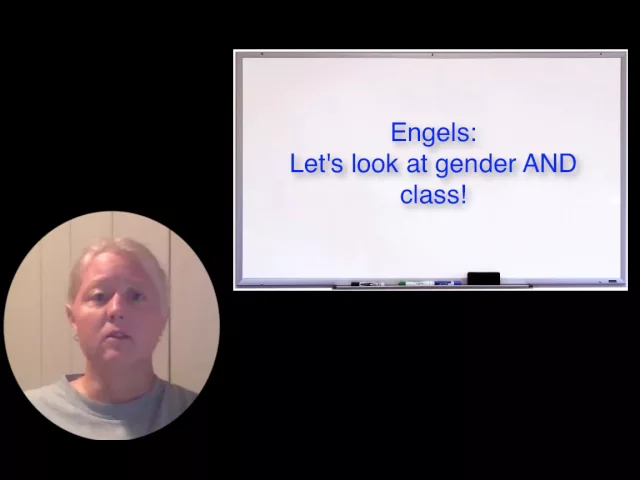
feminists might help to explain the ways in which women's usefulness within capitalism has been exploitative but they do not explain the origins or causes of gender oppression so Ruben then moves on to angles who was a contemporary of Marx's in fact they did a lot of writing together but but Engles actually digs a little bit deep deeper uh and acknowledges gender as a separate issue as an issue separate from class analysis so for angles relationships of sex and gender are distinct from relationships of production and reproduction so social organization social relationships the structure of a
society is determined both by an economic system modes of production divisions of labor and by family structures modes of re production so every society has some form of economic activity and that economic activity provides the means of acquiring food and other goods and basic necessities whether it's whether that system is capitalist or not similarly every society has some form of sex gender system provide the means of a family structure however these means are conventional they vary from Society to society geographically they vary culturally across time it changes economic structures as well as gender structures are
AR somewhat arbitrary they're conventional they're not innate they're not natural there's no one sex gender system there's no one economic system uh these systems are conventional they're socially constructed they're socially produced and reproduced Ruben also wants to make sure that we understand that the sex gender system then is a neutral term it doesn't refer to any one kind of sex gender system for example that there are males and females and masculine bodied beings are males and femin uh feminine bodied beings are females that may be one sex gender system but it's certainly not the only
one so the sex gender system is a neutral or abstract term that could refer to any particular kind of sex gender system in the same way that economy is a general or abstract term that can refer to particular economies or particular economic structures such as capitalism so the particular means and material effects of the economy or of the family depend upon contingent social relations it they are conventional they change over time they change from society to society the family in the sex gender system of a given Society is completely conventional certainly it's not innate it's
a product of social relations and this is the focus of Ruben's text to interrogate social relations in order to better understand how sex and gender are product of social relations and how the sex gender system has been structured in such a way that the material conditions of women are material conditions of Oppression so she starts then by looking at the kinship structure since the sex gender system is a product of kinship of our the way that we arrange family she will look at kinship and the social relations of kinship structures in order to gain some
insight on how it is that we might mitigate change eliminate gender oppression in our society looking at this particular convention which is a social relation kinship is not some uh biological class or category it's actually a social relation because the people who we are related to we are related to because of social conventions that say who can marry whom who can love whom who can bear children with whom so kinship is a social relation which varies among cultures it's different in different cultures who you can marry who you're allowed to marry who you're not allowed
to marry this varies by culture uh and so we can gain some insight into seeing the ways in which these relations produce gender oppression in our society the kinship system is a social way of organizing a society it's as fundamental as the language of a given Society our knowledge is based on language what we know and what we can do depends upon the language that we have and language is conventional it varies from culture to culture and in the same way kinship systems are conventional they from culture to culture and kinship systems are a way
of organizing a society different societies are differently organized in terms of kinship structure so it's a system of categories and statuses that often contradict genetic relationships and it determines to whom one can be married which varies by culture both geographically and temporally so in looking at the kinship structure Reuben identifies a couple of different practices that she thinks can give us a little bit of insight into the oppression of women she talks about giftgiving and the incest taboo Ruben argues that gift giving is pretty Universal it's it's a practice that is in place in most
societies historically and geographically so it's somewhat Universal although this specific customs of gift giving who gives a gift for what reason to whom what kind of gift is it these things vary somewhat from culture to culture because it's a conventional practice but the significance of gift giving has been fairly Universal in that gift giving promotes trust between the giver and receiver of a gift it promotes solidarity among the givers and receivers of gifts and it promotes Mutual Aid bonds of friendship so gifts were in the past and remain threads of social discourse ways of relating
to others to create bonds of friendship to create trust this Remains the case today according to Levy Strauss marriage is the most basic form of gift exchange and it's a form of gift exchange in which women have become the most precious gifts so marriage originated as a way to give a very important gift from one man to another man women were given as gifts from one family one man to another man to create a bond between those those men and those families and these bonds of friendship these bonds of solidarity provided social and economic power
to men but of course not to women and this is still evident in today's marriages in our society there are remnants of this if you ever wondered why it is a father gives away his daughter and that's part of a wedding ceremony this is residue from the practice of gift giving the reason that marriage even started to be a thing was because men gave women away as gifts and we still see this in contemporary marriage ceremonies we may not know why it happens we may not know why it's so important to ask our fathers to
give us away but this still acts as a symbolic gesture of women as being men's property and being given from one man to another of of course it's not it's not the same now as it was previously but we can certainly see the remnants of that practice still having a hold on on this social practice as it exists today I mean why don't mothers give daughters away why don't mothers and fathers give daughters away isn't it odd that that it would be a father's right to give away his daughter but not a mother's that does
tell us something about about gender roles as they still exist in our society although the practice has changed somewhat it still shows a difference uh in gender and in and how that reflects Social Power in addition to giftgiving Reuben talks about the incest taboo most people think that there's an incest taboo that you should not have sex with or marry a close relative like a brother or a sister or father or mother or first cousin because there's a risk of genetic deformities this is what most people believe that's why we have an incest taboo but
in fact as Ruben pretty convincingly argues um that can't really be the reason for an incest taboo because although in our society the rules are you do not marry your mother or father or brother or sister or first cousin or uncle in some societies there is an incest taboo but that means that you must marry a first cousin or you're supposed to marry an uncle uh so again this is a conventional practice which varies from culture to culture the incest taboo is not in place to prevent genetic deformities rather the incest taboo ensures that exchanges
occur between men typically between certain nuclear families these exchanges produce benefits Social Power for men as the givers of gifts men are exchange Partners so women are the objects being exchanged they don't set the terms of the exchange and this still holds true on many levels today even though it may not be as obvious as it was in the past or it is in other cultures that practice things like arranged marriages or marriages to certain relatives for Reuben the traffic in women women being gifts to other gifts of men to other men as a product
of our kinship structure as a product of our social organization as a product of the social organization of relations among men in our society this traffic in women places the oppression of Women Within social systems rather than in biology so it's not that women simply are inferior beings that their brains are smaller or they are weaker or they're not as rational that is not the cause of gender oppression the causes of gender oppression can be found in Social relations such as kinship structures in Social practices such as giftgiving where women are the objects in Social
practices such as incest tabos that require women to be the property of particular men so we have to look at Social systems in order to mitigate gender oppression the exchange of women is a fundamental aspect of kinship structures it is through kinship as a system of social relations that sex and gender are organized and produced and in this social organization of the family men have full rights but as gifts women do not have full rights social relations then are organized in such a way that men exchange status they exchange wealth access lineage rights even people
in order to benefit from these relations while women Remain the objects of these relations and you might say well but we don't practice gift giving like that it's not as if one man sells his daughter to another man and that's how marriage works today but I would urge you to reconsider the prevalence of women as gifts or Commodities in our society and we will think about this a little more with respect to sex trafficking as such as it currently is practiced today in our country and around the world it's a huge huge Market in which
women are exchanged by men to other men for the benefit of men