London in the 1800s had become the largest city the world had ever seen. By midentury, its population exceeded 2 and a half million people, making it not [music] only the capital of Britain, but the center of a global empire that stretched across continents. In this video, I use modern AI tools to bring historic paintings and engravings to life, allowing us to move through scenes as they might have appeared nearly two centuries [music] ago.
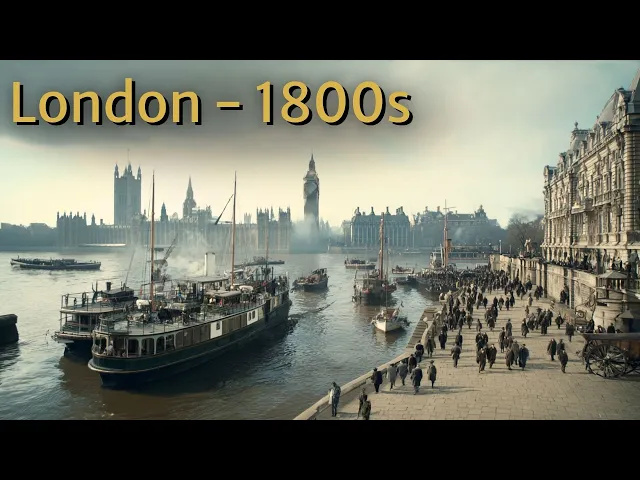
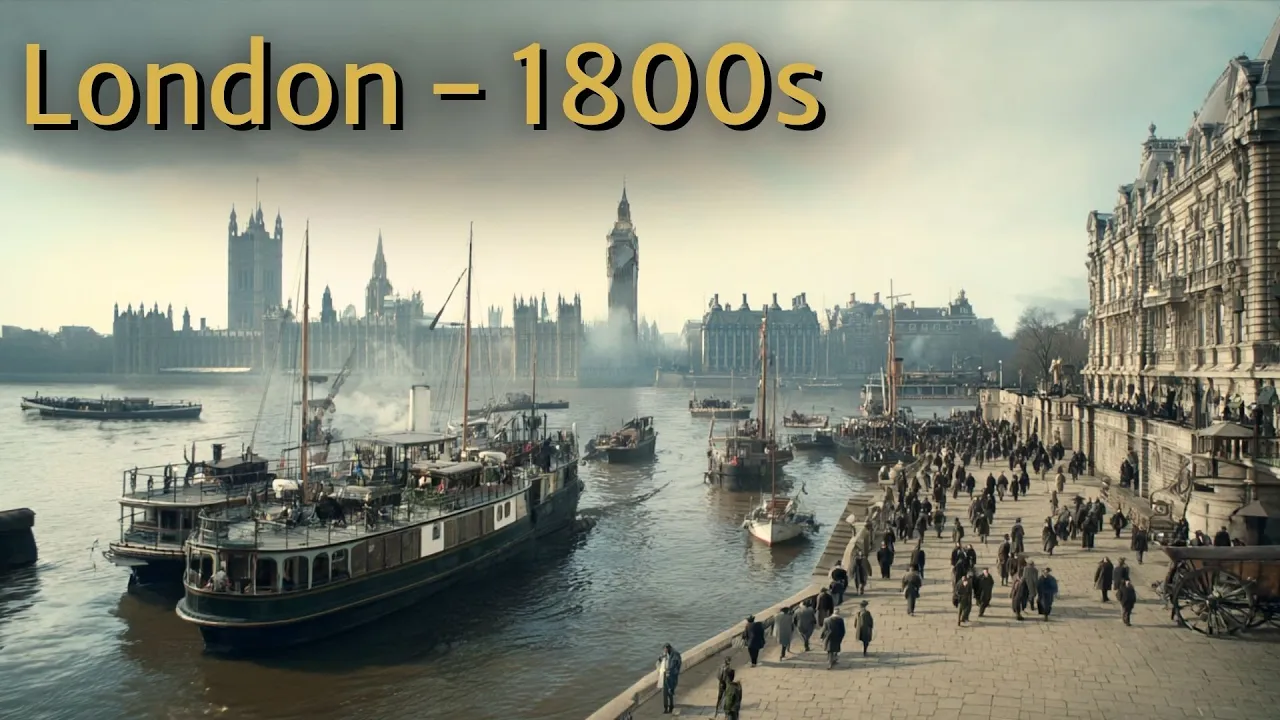
This is the river tempames in the mid 1800s and it was far more than a waterway. It was London's primary artery, the force that powered the city's rise and connected it to the rest [music] of the world. The river carried everything.
Coal from the north to fuel factories and homes, timber for construction, grain to feed a growing population, [music] manufactured goods heading outward to markets across the empire. The tempames was constantly in motion, crowded with barges, [music] steam ships, sailing vessels, and smaller craft weaving between them. Smoke rose from chimneys along both banks.
Warehouses lined the water's edge. Their walls blackened by soot. Cranes lifted cargo from ships onto docks where laborers worked in shifts that stretched from dawn into [music] darkness.
Without the temps, London could not have sustained its scale. The river was not just geography. It [music] was infrastructure, economy, and identity.
This shows the port of London and the vast dock [music] systems that expanded rapidly throughout the 1800s. By midentury, London's docks were among the busiest in [music] the world, handling goods from every corner of the British Empire and beyond. Ships arrived [music] carrying tea from India, sugar from the Caribbean, cotton from America, spices from the East Indies, and timber from Scandinavia.
They departed loaded with [music] textiles, machinery, coal, and manufactured goods produced in [music] Britain's industrial cities. The docks themselves were enormous. The West India [music] docks, the London docks, the East India docks.
Each one a self-contained world of warehouses, basins, and warves. Thousands of men worked here as steodors, [music] porters, and sailors. The work was hard, dangerous, and often poorly paid.
But it was constant. Standing at the water's edge, you would have seen forests of masts stretching [music] into the distance, heard the shouts of dock workers, the creek of rigging, the splash of cargo being unloaded. This was where London's wealth was made tangible, where global trade became physical [music] reality.
Away from the river, London's streets told a different story. The city had grown explosively and its infrastructure struggled to keep pace. This view shows a typical workingclass neighborhood in the mid 1800s.
Streets were narrow, often unpaved, and crowded with carts, horses, and people. Tenement buildings rose several stories high, packed tightly together with little space between them. Families lived [music] in single rooms.
Multiple households shared courtyards and water pumps. Smoke hung in the air constantly. Coal fires heated homes and powered factories.
And the resulting [music] pollution turned the sky gray. Even on clear days, the smell was inescapable. Coal smoke mixed with sewage, rotting waste, and the odor of industry.
Disease spread easily in these conditions. Cholera outbreaks were common, particularly in areas with poor sanitation. Overcrowding made privacy impossible and turned everyday life into a constant negotiation [music] for space.
Yet people adapted. Street vendors sold food and goods. Children played in alleyways.
Neighbors formed tight communities [music] out of necessity. This was not the London of grand buildings and royal processions. But it was where most Londoners actually lived.
By the 1800s, London had begun to transform after dark. Gaslighting introduced earlier in the century spread throughout the city, turning night into something [music] navigable for the first time in history. Fog was a constant presence in Victorian London, thickened by cold smoke into [music] what residents called Pa supers.
Dense, choking fogs that could reduce visibility to a few feet. Gas lamps changed how the city functioned. Shops stayed open later.
Theaters and music halls drew crowds well into the evening. Police patrols became more effective. But the night also brought danger.
Poorly lit side streets remain treacherous and crime flourished in the shadows between lamps. Walking through London at night in the 1800s would have felt both modern and unsettling. A city pushing into the future while still shaped by older, darker rhythms.
This is Westminster and the [music] West End, the seat of political power and the center of London's ruling class. The contrast with the industrial neighborhoods could not have been sharper. Here stood the Houses of Parliament, rebuilt in the mid 1800s after a fire destroyed the old palace.
The new Gothic Revival design with its iconic clock tower became a symbol of British authority and imperial ambition. Inside, laws were debated and passed that shaped not only Britain, but colonies across the globe. Nearby, Palm Mall and the surrounding streets housed gentleman's clubs, grand town houses, and government offices.
Carriages moved smoothly along wide, well-maintained roads. The air was cleaner. The buildings were taller, more ornate, built from stone rather than brick.
This was where wealth and power concentrated. Members of parliament, aristocrats, military officers, and senior civil servants lived and worked within walking distance of one another. The machinery of empire operated from these streets, far removed from the docks and slums that made that empire possible.
The separation was not accidental. London in the 1800s was a city divided by class and geography. And those divisions were visible in every street, every building, every neighborhood.
Movement defined Victorian London. The city was constantly in motion, and its transport system struggled to keep up with demand. This view shows a crowded street filled with horsedrawn omnibuses, carts, private carriages, and pedestrians all competing for space.
Traffic congestion was severe, particularly on major routes and bridges. Crossing the tempames could take an hour during peak times. Horsedrawn omnibuses became the primary form of public transport, carrying workers, shoppers, and travelers across the city.
They were slow, uncomfortable, and often overcrowded. But they were affordable and ran frequently. Later in the century, the introduction of underground railways began to ease some of the pressure.
But for most of the 1800s, London's streets remained chaotic. The sheer volume of people and goods moving through the city every day created a kind of organized chaos that visitors found both impressive and overwhelming. This shows the East End, one of London's poorest districts, [music] where overcrowding, poverty, and poor sanitation defined daily life for tens of thousands of people.
Families lived in cramped, poorly ventilated rooms. Work was irregular and low paid. Children often worked alongside adults in factories, workshops, or on the streets as vendors and errand runners.
Access to clean water was limited, and disease was a constant threat. These conditions were not hidden. Reformers, journalists, and social investigators documented them extensively.
And by midentury, pressure was building for change. Public health reforms, housing improvements, and labor protections began to emerge. Though progress was slow and uneven.
The East End was not separate from the rest of London. It was connected by labor, by trade, by proximity. The wealth visible in Westminster and the West End depended on the work done here in streets that most of the city's elite never visited.
Standing here looking back at these images, it's striking how much of modern London was forged in the 1800s. [music] The infrastructure, the inequalities, the global connections, all of it took shape during this period. These paintings and engravings [music] offer us a window into a city that no longer exists, but whose influence is still felt today.
If there's another city, another era, or another moment in history you'd like to see brought back to life, let me know in the comments. I'd love to continue [music] exploring the past with you. Thank you for watching.