Wow, check out the appearance of all these hotels in complete abandonment. What is the purpose of these properties? This is a side of Las Vegas that is not usually showcased in tourist guides.
[Music] The forgotten side of Las Vegas. We find ourselves in the iconic city of Las Vegas, Nevada. Today, we are going to show you the grand hotels, impressive casinos, and shows for which this city is globally renowned.
However, today we will see the opposite. In this video, we will venture into the part of the city that is increasingly abandoned and forgotten. It's intriguing that just two streets away from where I'm standing is the most touristy area of Fremont Street in the heart of downtown Las Vegas.
As we walk a street or two further, w e'll begin to witness complete abandonment. It's fascinating to see how, over time, this part of the city has fallen into obscurity and is gradually declining. The old signs even take on a somewhat eerie appearance.
Many of the former casinos, strip clubs, tables, motels – it's truly a surreal side of Las Vegas that isn't often shown. So, let's go. As we walk, you'll see how the scenes change dramatically.
The abandoned and somewhat forgotten part of Las Vegas is waiting for us. Let's dive in! [Music] It's really crazy how, after just one block of walking, everything starts getting eerily lonely.
You begin to see many more people sleeping on the street. It must be a tough life because the heat here is incredibly intense, and all these huge empty lots don't help, as it's pure concrete reflecting the sun. Yes, the vibe changes.
It's challenging to walk one or two blocks. This is no longer a touristy area, and you'll see how it continues to evolve. Right from here, the abandoned casinos begin.
While some are still in operation, most of these establishments have nowadays transformed into event spaces. For example, this very old casino at the Western Hotel now advertises that you can host dinners, office parties, whatever. Well, yes, trying to make some monetary use out of this entire area.
Because all these streets we are traversing saw their peak in tourism around the 1950s and 1960s. To understand this, we need to briefly consider the history of Las Vegas, a city founded in the early 1900s. It was around 1906, I believe, that the first casino was established, gaining notoriety for selling alcohol during the prohibition era and hosting not entirely legal bets.
In the 1940s, Las Vegas experienced a significant boom, with hotels, restaurants, and casinos sprouting everywhere. This downtown area, in the heart of the old city, as I mentioned earlier, witnessed a massive tourism boom from the 1950s to the 1970s. Nowadays, from what I've gathered in conversations with locals —by the way, very friendly and talkative— they manage all these establishments we are documenting, abandoned for over 20 years.
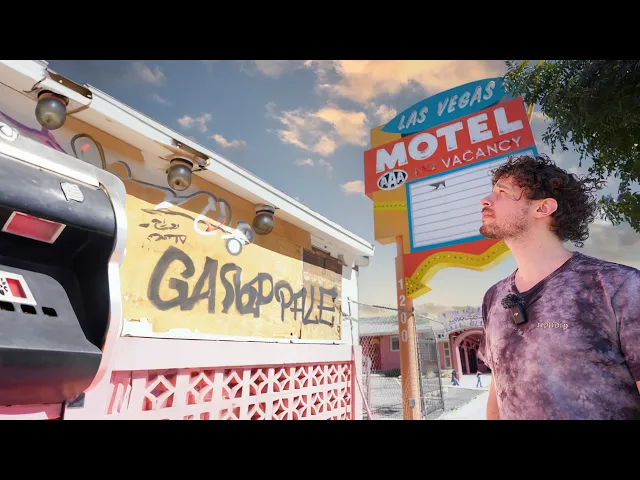
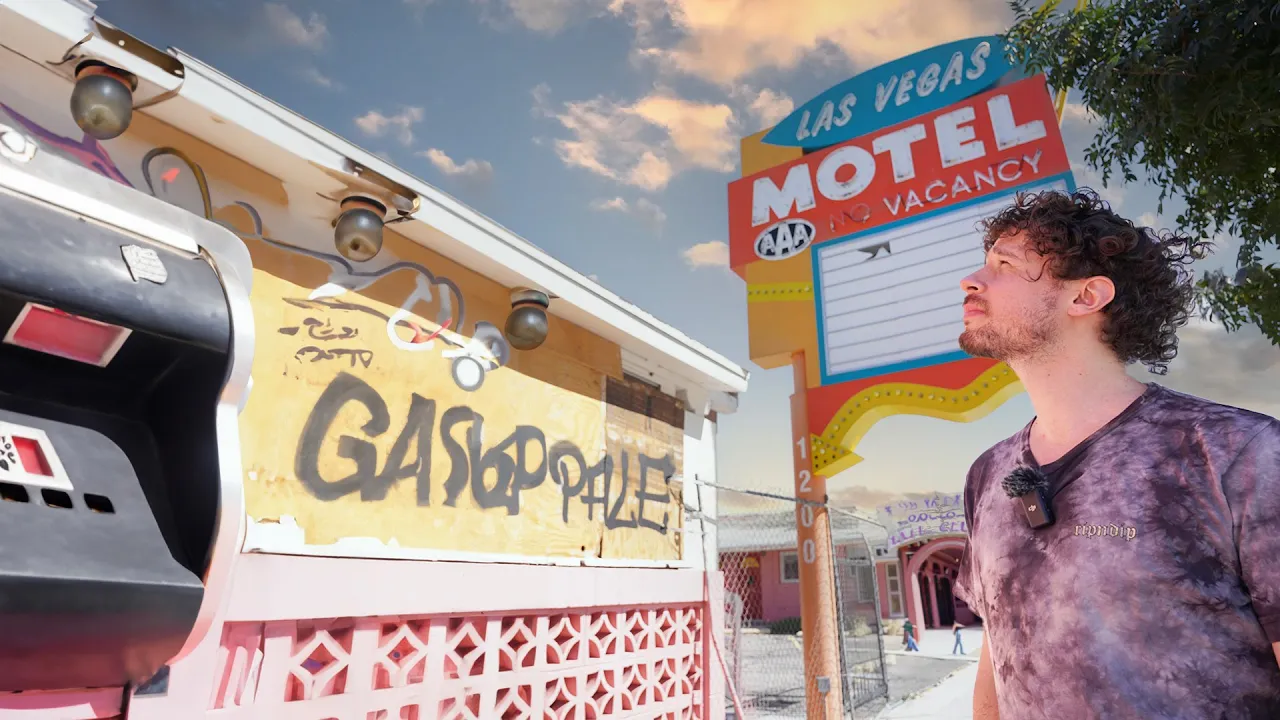
I can perfectly imagine a family arriving in an old car, parking at this motel, requesting a room for a night or two to rest from a long road trip. Today, it's a closed site, windows boarded up, broken glass, covered in graffiti. A truly massive property, really huge, in complete abandonment.
And just like that motel, all the ones on this avenue are the same. Every hotel on Fremont is abandoned. It's noticeable that in several of these establishments, the vegetation is cared for, indicating that perhaps a gardener or several come periodically to maintain the properties, suggesting a possible future plan for these lands.
However, this motel tells a completely different story; it's very neglected, from the vegetation to the fences, all securely closed with thick chains, windows covered. I imagine it's to prevent animals or people from occupying these properties. This old grocery store is a glimpse of how, at one point, everything in Las Vegas was all about casinos.
They offer video poker 24/7, slot machines—betting machines in a grocery store, even accepting food vouchers as payment. Indeed, from its beginnings, Las Vegas was popular for gambling, but it experienced a significant influx of people moving here in the 1930s when it was easier to get a divorce in Las Vegas than anywhere else in the United States. They enacted a law stating that if you lived six weeks in Las Vegas, you could legally and easily get a divorce.
This also sparked the boom of globally famous chapels where I believe it's easier to get married than anywhere else on the planet. Just as many weddings occur, there are also a great number of divorces. This, coupled with gambling and alcohol, which was illegal at the time, brought in a significant influx of people, leading to a substantial increase in the population.
[Music] And to understand how this area ended up in the state it is today, now mostly a local habitation where, as I've been told by people we've met, locals come at night for drugs and accessible prostitution— outside the inflated tourist zones— I was explaining. Yes, all of this declined when The Strip started to emerge. The Strip in Las Vegas is the hot zone currently, with massive hotels, casinos— everything you've seen in tourist guides is there.
In the 1940s, when a significant part of Las Vegas was operated by the Mafia, one top mobster decided to invest $6 million dollars, in building one of the most iconic hotels to date, the Flamingo. Pay attention: the total investment back then was $6 million. In its first year of operation, the casino-hotel generated over 4 million dollars, undoubtedly becoming a goldmine for the mobsters.
Everyone shifted their investments away from here to pour their money into that venture. Tourists increasingly demanded more impressive hotels with larger capacities. Oh, a curious fact from that era, around the 1940s-50s, is that casinos used to display one million dollars in cash at their entrance doors.
It was to assure people that if they won, there was enough cash to pay them. They'd say, 'Look, we have a million dollars right here, it can be all yours today. ' As the decades passed, The Strip continued to grow, and it wasn't until the 1990s that the boom of mega-resorts and mega-hotels occurred, a boom that persists to this day.
Yes, in present-day Las Vegas, if your hotel isn't a massive spectacle with shows, casinos, water slides, and roller coasters, it honestly won't grab the attention of tourists. Around the mid-90s, these motels began to evacuate, one after another, following the trend. In 2023, it's now an entirely forgotten area, uncertain about what the future holds.
However, I want to clarify that this entire area isn't a barren wasteland with no thriving businesses at all. Many people make their living in this region. You see tattoo shops, wedding chapels, supermarkets, the occasional bar, and operating motels.
Clearly, it's not a zone in its tourist heyday, in its economic boom, but it's also not entirely 100% dead. The motel behind me is an example of how many of these establishments are turning into successful businesses. Locals see an opportunity in all this abandonment to create attractions with a vintage, cool appeal, drawing in the hipster and alternative crowd.
Yes, this place, the Pergusons motel, is now a little square with shops and restaurants. I believe that's eventually what will happen to this area— giving it a second life. Hey, and if you reach a certain point in the neighborhood and go deep enough, it does start feeling a bit dicey.
You begin to see many more people experiencing homelessness. We just encountered a girl shouting loudly— Clearly, there's a lot of drug abuse in this area, evident in the appearance of the streets and the number of people you see lying down. It's not that it feels extremely dangerous, but it does start to feel suspicious.
This sign here caught my attention. It's an apartment building that rents furnished units. It says, 'We check history, making it a safer place to live.
' I've noticed that many of the old motels are turning into something like this— furnished apartment buildings that rent rooms at a reasonable price, almost like an affordable loft style. And yes, if we're seeing all these things in broad daylight, the night must bring an entirely different vibe. [Music] Well, there you have it, a bit of the non-touristy area of Las Vegas, showing how any corner in the world that was once fruitful and attractive can fade into complete oblivion, emphasizing that nothing should be taken for granted.
Would you like to add any information? I'll be reading your comments down below. Thank you for joining me, and see you as always, you know, in a few days with a new video.
Goodbye.