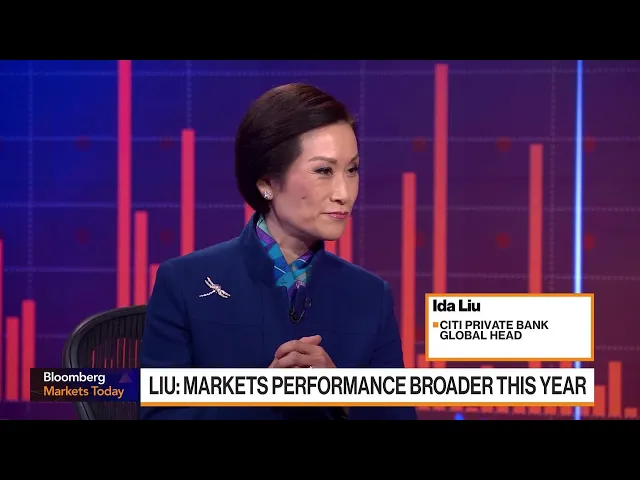
Really nice to speak to you. Wonderful. Thanks for being here.
And I know that you travel and you talk to clients a lot, and so you can give us a really interesting take on what people are thinking about and talking about at this point. So on your travels recently, if you were to think about what's the biggest concern for investors, what would you what would you suggest? I mean, inflation, i.
e. not a concern, but maybe a huge opportunity. Geopolitics may be a concern.
Where does the conversation focus? Well, given the fact that we are an extraordinarily global business, I've been meeting with investors around the world and there's a few themes that keep recurring amongst the investors that we work with. The first one is what's going to happen with the US election and all the other elections that are happening around the world, but from a political perspective as well.
The second is on geopolitics. How are we going to navigate the ever risky and changing dynamics around geopolitical tensions around the world and the focus there is on US-China relations, frankly. And the third piece is, as you mentioned, on A.
I. . So how do I invest in A.
I. ? How do I take advantage of the upcoming growth in A.
I. ? But also, what does it mean for my company and how do I position my company and my businesses around the world?
So I know we'll dive into a few of those themes. If I think about the geopolitics and the bifurcation of the world, the battle that many investors will cite between the US and China. Do the high net worth individuals that you meet, do they feel the need to pick?
Do they feel the need to expose themselves to two different systems? How are they navigating that tension? We're helping them navigate it because as US-China relations are becoming more and more bifurcated, as you said, both countries are turning more and more nationalistic.
They're turning inward. But what this means is that the supply chain demands around the world are shifting dramatically. And that means that for investors that are very globally minded, some new opportunities in different regions.
So, for example, in China, a lot of flows are now going down to Singapore and countries in Southeast Asia, like Thailand, Malaysia, Vietnam, Japan, even India, for example. And in the U. S.
, a lot more is focused on Mexico and Latin America, given the near shoring of the region. So what's important for investors to consider is geographic diversification. Some interesting opportunities in emerging markets given the changing supply chain dynamics between the U.
S. and China. Either you're laying out a world which is undergoing some quite significant change.
Yet I look at financial markets, it's just up, up and away. All the investors you talk to, are you comfortable with where markets are right now? Do they feel comfortable with the pricing that they see on their screens in front of them every day?
Well, it's interesting because last year's 24% market rally was driven by seven tech names. This year, 11%, roughly year to date performance in the markets is much more broad. So we're seeing a much more broadening of the performance.
And as you know, the Nasdaq just hit an all time high yesterday. So still the enormous upside potential in the tech names as well. But they feel comfortable with that.
So you've got credit spreads super tight. You have got Bitcoin running again. Commodities are on a tattoo.
They comfortable with this kind of ever upwards narrative that they see in front of them because you have this on one hand and but you've just laid out a whole load of kind of quite significant risks that the markets seem to not be kind of paying attention to. And there seems to be a disconnect at the moment in the world between all of the risks that we seem to be facing and this kind of very, very effervescent market that we see in front of us. So therefore, it's more important than ever to construct very thoughtful, globally diversified portfolios for clients, just given some of the risks that we're navigating on behalf of our clients.
So on the one hand, we have been leaning into locking higher rates for longer, right? Extending duration on fixed income as one way to sort of hedge out some of the other challenges. But on the other hand, we've been leaning into equities more so than ever because we see that there's an opportunity, particularly in small and mid-cap companies and also in industries like health care, like tech, digital A.
I. that we were just talking about and in clean energy and some of the parallel industries as well. For A.
I. , for example, like semiconductors that are the brains behind the growth in AI as well as energy and clean energy that are going to be needed to fuel the ongoing growth in the air phenomenon and some of the other tech phenomenons as well. So some really interesting pockets of longer term opportunities, both by industry segment, small and mid-cap emerging market economies around the world that you've got to consider into those portfolios and building a really well-rounded portfolio.
And the last piece I would say is investors in the ultra high net worth space also have a significant allocation to alternatives. Private equity, hedge funds, roughly a third of our clients portfolios are allocated there. I'm so glad you brought that up.
One of the tailwinds, or at least one of the bull cases for this market in the stock market, the bond market is that there's so much money that isn't. They allocated yet to the public market. Do you agree with that, that there's still money sitting on the sidelines that are being waiting to be deployed?
Yes, there is still a fair amount of cash that's been sitting on the sidelines and or treasuries that have been waiting for opportunities. And what we've been seeing over the last couple of years is, again, a rotation into alternative assets, looking at private equity, hedge fund opportunities, direct investing opportunities, because investors are willing to pay that illiquidity premium for some of the potential higher digit, double digit returns. And also in markets like this where there is disconnect and there was some dislocation.
Private equity and hedge fund managers can really take advantage of some of those opportunities as well. Well, private equity really, I think, grew and ballooned even more so than usual in 2022 when the public markets and the carnage, they were kind of escaping it almost to find that alternative investment. But in an environment where we're seeing hedging to the downside be extremely cheap, short squeezes show up in the market.
What is the incentive to be in private equity right now? The incentive is that private equity as a whole can achieve a much higher return overall than what you typically see in fixed income and obviously even sometimes on the equity side as well. So just having that complement a different type of return profile greatly enhances overall investment performance.
I don't really get to have you with us to talk about markets, but also to talk about the business of running, you know, private banking and the city operation there. And this is an area that Jane Fraser has obviously been trying to grow the long term plan around the wealth business. And what does that look like right now?
Is this a business that's finally on the path to to gaining ground against the competition? Oh, absolutely. I mean, we are the most global private bank in the world.
We operate in 52 different cities in 20 countries around the world, and we are one of the core five businesses that Citi is focused on. We're very interconnected with the other businesses. The top clients of the private bank are also top clients of Citi.
We work with our clients and their families on the wealth management side, but we also advise their companies on advisory work to with our investment bank, commercial bank services and markets colleagues as well. So leveraging the entire entirety of our platform on behalf of our clients. You told us a couple of times about the sort of huge geographical footprint that you have.
Where within those geographies do you see the most excitement right now? You must pop around the world the whole time. Asia, the Middle East, Europe, America, in terms of where you're seeing the most traction right now, in terms of where you're seeing the biggest buzz, the biggest opportunity, where is it?
Well, there is a global phenomenon that's happening right now. We are in the midst of the largest wealth transfer in history to next gen and millennials. So 85 trillion of dollars are going to pass to next gen and millennial clients over the next decade.
Not to mention that women are playing a very critical role. They control a third of the world's wealth today, and that number is going to about a half in the next five years. So our focus here on the next gen millennial and women clients in a full family approach that we're taking, the private bank is going to be significant and very important.
So we're leaning into that and we've made some great traction with the next gen millennial and female clients. Where are you seeing that happening? What are you building out?
Where is the biggest opportunity? Is it in Hong Kong? Is it in Dubai?
Doha, Riyadh? Is it in Europe? Where is it?
So it's a global phenomenon. But for us, the areas of focus, I mean, obviously is home country, which is the United States in the Americas, but also in Latin America, it's Mexico. And Brazil are two largest markets in Latin America.
Here in this region. Obviously, we've been in London for a very long time. It's a big hub for us, a big area of focus and a big area of growth as well as the Middle East.
And then as we move into Asia, we continue to be very focused on Hong Kong, Singapore and Southeast Asia opportunities there, too. We've been on the ground for 120 years there, deep, deep relationships, lots of upside still in that region. How are you accomplishing that going on 60 seconds here or so?
Jane Frazier has talked about rightsizing the workforce in terms of your internal kind of headcount, your internal strategy. How are you tackling that? And also externally, who are you partnering with?
So Jane has been very bold in what we're doing at Citi, where simplifying the firm, we're focused on five core businesses, we're improving the client experience by reducing bureaucracy in the business. We're now able to execute in a much faster, seamless, quicker way on behalf of our clients. I know that the feedback from our clients globally has been very positive, very strong to the changes that have been being made, and we're very excited about unlocking the full power of Citi on behalf of our clients in their companies.