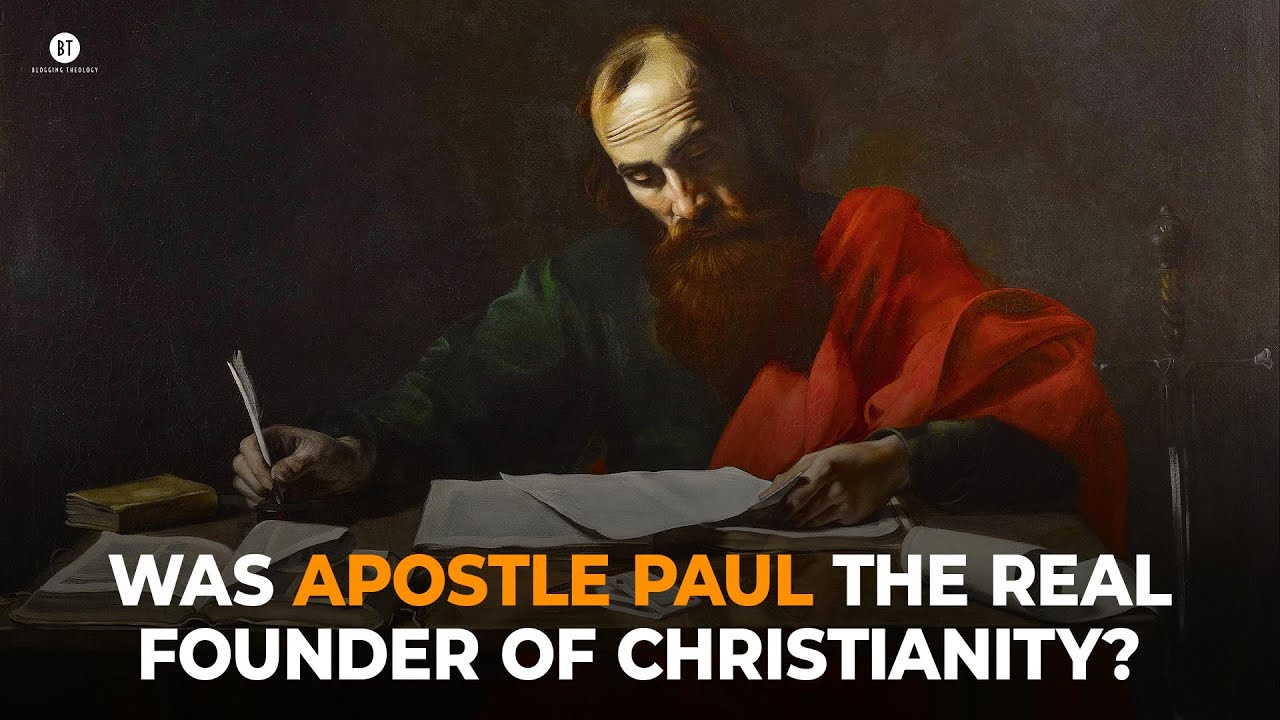
if you enjoy these programs please like And subscribe there was no human being in history that was more responsible for the Jewish rejection of Christianity than the author of Matthew but Paul gets away with it because his audiences are non-jews and as non-jews they would have no chance at sniffing this stuff out well hello everyone welcome to another video F podcast today I'm joined by bra to a singer and today we're going be discussing Paul the Apostle the Theology of Paul and when we get a little bit about the gospels does Paul and the gospels
um believe in essentially the same thing which they do appear to but there are differences the gospels add more details about Jesus and Paul does and obviously that we're going to be discussing the in Greater context about Paul deviating from the Torah so welcome back to the show toia well thank you thank you Jacob thank you for having me on yeah thank you for coming on so toia when you look at Paul's Epistles um does it seem to you that he he does uh he goes off rails from the Torah obviously he's preaching anti- circumcision
and Paul's in like Galatians for example he's getting into an argument about circumcision he gets into an argument of keus who apparently Peter and Peter gets up from a table because some Gentiles come over to the table and he's like oh they're not circumcised and Paul's getting furious like why are you getting up from the table just because they're not circumcised and Paul's acting like that circumcision is not required throughout his letters even though it is could you talk about that Galatians 1 and two the event you're describing occurs in Antioch in Galatians 2:11 Paul
is seeking to in these first two chapters of a second most important letter to convey to the readers in this case their churches in Asia Minor modern day Turkey why his Revelation is above everyone else's why he should be trusted and others shouldn't why why what he has is not from Jerusalem but directly from Jesus Christ and he's quick to point out Peter's hypocrisy where Peter behaves one way in front of Gentiles and another way in front of Jews from the Jerusalem Church there's something so crazy striking about this because Peter was really following Paul's
advice like why does this bother Paul so much the reason to bothered him because this is what Paul did and and it's not an interpretation literally in another letter First Corinthians maybe his third most important epistle he literally instructs his followers to behave like him to the Jew I become as a Jew that I may gain the Jews to those and listen to these words 1 Corinthians 9:20 to those who are under law I become as one who's under the law although I'm not really under the law so there Paul gives it away only in
a pass he says I'm I don't have to keep the Commandments he he can become anything to anyone that he may gain some for Christ chapter 9:22 of 1 Corinthians so what's very striking is what bothers Paul the most is people behaving like him so Paul wants to do away with the Commandments and it's just a caveat for the viewers when we talk about Paul's talking about Commandments he is antinomian which means he opposes ritual Commandments like circumcision that Paul's going to talk about a lot it explodes in the last two chapters of Galatians Galatians
5 and 6 I mean five he says the most outrageous things about circumcision which exactly completely conflict with the Torah and there is something I know the viewers are thinking and I have to address it and the viewers are thinking well the book of Galatians is written to Gentiles Paul is largely uh speaking to non-jews and he says so he's a minister for non-jews well people may think well non-jews are not really required to get circumcised anyway right so maybe Paul is just following the dictum that non-jews don't have to keep those Commandments but that's
not at all what Paul has in mind Paul's view is that the Commandments were never obligatory they were only a shadow and the essence is Christ and the reason why Commandments were given all together why did God ever give Commandments it was just to show you that you're a sinner it was only a a Taskmaster to get you to look in the mirror and and realize that you're a sinner it had no intrinsic value and we don't know who wrote the book of Hebrews but Hebrews follows Paul not in style it's obviously a different writer
but and not in fashion it's a different he has a different temperament than Paul but the logically Hebrews Echoes this in chapter 8 101 that the law was always a shadow it does has no substance and the essence is only Christ so Paul completely opposed law and Paul really favored Paul he really liked himself and one other point if I may Paul didn't get along with people he got along he didn't get along with the Jerusalem Church he didn't get along with Peter he didn't get along with Barnabas had should surprise people barnabus introduced him
to Jerusalem Church he didn't wouldn't travel with John Mark his cousin so that was the nature of Paul he didn't get along with people he wanted to show his viewers his readers his own Primacy Philippians 3 he was a Pharisee of Pharisees and that's why he's pointing out um Peter's shortcomings in the second chapter of Galatians you think it's just Paul doing this himself or do you think he has had uh he's working other people that were already trying to do something like this before he started it we have a problem we have no literature
that is older than Paul that's the oldest surviving Christian literature so however that said the ideas found in Paul were well well known in the Greco Roman world the idea of ritual cannibalism somehow eating from the body and drinking from the blood was an idea well known in the Pagan world and when Paul introduces that in 1 Corinthians 11 Paul is fusing together ideas that are completely strange to Judaism with with a quote incidentally Paul going to what you mentioned the outset really never tells us anything about what Jesus did during his lifetime nothing there's
nothing where there's no place in Paul's letters as he tells us anything about Jesus's life his ministry his sayings aside from this there really is there's nothing at all we don't even have a a passion narrative in Paul I means all you have is Jesus was crucified and resurrected and appeared to people but there's no there's no there's no John chap 18- 20 in the letters of Paul we have nothing nothing so Paul is fusing together the Greco Roman ideas that preceded him I'll give you another example in that in the GRE or Roman world
had a respect for Judaism Judaism was not just a lcit a legal religion in the Empire it was a it was a Fai Ed religion the that world admired Judaism for its Antiquity that Alexander the Great had a relationship with the Jews with shim at sadic Simon but they found some ideas of judis to be completely outrageous one of them is the physical resurrection of the dead cisero in his sixth volume of the Republic talks about this and thinks the idea of physical Resurrection was outrageous when Socrates is about to drink the hemlock and he
was set to die he talked how happy he is going to be without this wretched body in the Greco Roman world the notion that the there would be a physical Resurrection to the body that died was outrageous they couldn't understand why the Jews believe in something so outrageous so Paul is taking that idea that was all over that's real dualism dualism meaning that the spiritual world and the physical world are totally separate and the physical world is damaged this world is the Satan is the Lord of this world and in afterlife very much did but
I didn't think you're coming back to this and we see that in what was mentioned earlier in 1 Corinthians 15 where there's there's no physical resurrection of the dead it's a spiritual body that's resurrected something entirely different than what dies Paul uses the analogy of a seed that is planted what comes out of it is totally new and the seed dies I'm not interested in the whether what he's saying is accurate or not but in Paul's view um the resurrected Christ is something very very different it was this is why there were Christians that argued
like um like Calvin and Luther disagreed over things like did the resurrected Jesus have intestines I'm not kidding this wasn't this came up as an issue um so that's why there's no empty tomb in Paul's letters why not so this is a little deep but but in Paul's view the empty tomb whether the tomb was empty not was completely irrelevant Jesus rose and his body could have been in the Tomb decaying because the resurrected body had nothing to do with the physical body follow so that's that's the reason why Paul doesn't make a deal about
the empty tomb the gospels make a huge deal about this but the gospels were written 20 30 40 years after Paul and they're going to develop this so it's one of the interesting things that although Paul know no doubt is the most important convert to Christianity he is the he is the framer of Orthodoxy or we'll call Proto Orthodoxy what the on one area the church Rejects and that is the notion that it's not a physical resurrection and we see this push back in Matthew in Luke it's very strong math in Luke 24 where Jesus
is eating burnt fish and asking his his followers you know does a Spirit you know eat and drink as I am with you why is that in Luke well it's in Luke because that's a push back Paul loses on that area and other the view of the Jewish view that the resurrection is a physical Resurrection does win and we have Thomas uh touching the physical body of Jesus to see that in fact he was resurrected Downing Thomas so that's all a pmic so that's one area that Paul loses that's why there's no empty tomb there's
no empty tomb in Paul because Paul doesn't need an empty tomb he Jesus resurrects that has nothing to do with what's in the Tomb because what resurrects is a spiritual it's a body but it's a spiritual body so that's the one area where Paul uh Paul's idea is not adopted by the pr Orthodox what you're saying is that the gospels are writing a pmic against Paul by making Jesus more clearly a physical Resurrection while Paul is more spiritual it's not more Paul is spiritual it's a spiritual body he's arguing this this is not like an
inference 1 Corinthians 15 is very easy to read it starts with a fake verse I'm I don't mean to U mock him but it really is as a Jew it's like incredibly offensive that Paul says that Jesus rose from the dead on the third day according to the scripture and those words are picked up in Luke 24:44 through 46 that's a copy of Paul a Paul explains and after claiming that Jesus appeared to all these people and so on uh Paul makes it a he's arguing this what is he arguing it for because it's a
pmic it's a pmic against a physical Resurrection where do you think Paul got got this idea from to turn Jesus into something that um that somewhat resembles a GRE Roman deity and uh turn them into a uh an anti- for a Messianic figure basically in the essence your question has contains the answer that Paul was seeking to fuse together the ideas that were well known in the Greco Roman world and ideas in a framework of Judaism it was really so simple Paul he has big problems on his hands he a problems like why don't the
Jews believe this like why don't the Jews believe this like why is this the Jews it's their Bible they can read it in its original language they were in the land of Israel they would have they met Jesus like they weren't impressed apparently Paul has to explain that problem that's a big problem it's a big problem in the Christian Bible why don't the Jews believe everyone knows the Jews are fairly clever like the Jews like why didn't they so Paul has to explain this whole thing was a grand mystery and no one could understand it
and he makes that point in Ephesians uh 3:3 in 2 Corinthians excuse me 1 Corinthians chapter 278 this is a grand mystery no one knew about it he's got all that to explain and this is the mystery religion when you we hear the term mystery religions what does that mean that is so that's such a gnosticism the idea that there's a secret that no one has access to it's the occult something that's hidden that's all it means but if you have the special knowledge the nosis that hidden secret knowledge then you can unlock the mystery
and then you can have salvation this is the way the Greco Roman World thought that they were Grand mystery salvation and one other thing the ancient world was a puzzling place to live in Jacob I'm not going to ask you this question if modern medicine did not exist would you be alive today I don't know the answer to that question but it's possible that you would would not it's possible both you and I would be dead right now right that's not a stretch in the ancient world people just died and people didn't know why it
was everything was puzzling it didn't make any sense at all people died of infections that we know nothing about people had mental illness that no one understood and they thought they can cast out demons but that was really an attempt to deal with people who was psychotic and neuro it had all kind that existed at the time so the world was just a mysterious Place unlike the celestrial world when you looked at the skies and you saw the stars and the the moon and the sun always in its proper place following a a predictive course
the physical world was just was broken and therefore people sought out the answer to Mysteries that were completely inexplicable they didn't know what an earthquake was they didn't know a tectonic shift of tectonic they didn't know any of that so Paul works right in there and he says these words literally that's why the word mystery just search for the word mystery in the Bible it's all over Paul mystery mystery my it's very hard to find that word in tanak and if you do find it it doesn't mean that way the way Paul does there's no
such thing as there's a mystery to Salvation and like somebody has that's ridiculous because that means everyone's going to go to hell what are you talking about so this is the grand this is the motherload of mystery religion and this is this is the the even though most Scholars um insist that Christian gnosticism emerged in the 2 Century but it didn't it didn't emerge out of it didn't come out of nowhere out of a vacuum rather it was an idea that there was dualism and Paul and you need a special knowledge to escape the mysteries
of this world and that's why that Paul says the craziest thing in First Corinthians 278 he says look I'll tell you the truth he says you better listen to my Revelation and if the rulers of the epoch had only known what I'm telling you they would have never crucified the Lord Of Glory wow he's saying they would have never killed Jesus if they would have known his mystery and that's why Jews are so puzzled like of course we don't believe in this because it's not in tanak that's why and that's why Paul has to come
up with this stuff of explaining why don't the Jews believe in he has all kinds of solutions he has Romans 91011 he's got First Corinthians 2 he's got it all over here first Thessalonians 24-6 the Jews just lousy people he says pretty bad things about Jews and you pick whichever whatever flavor you want that's why the Jews that this is a big issue in the New Testament why if this so obvious why don't the Jews believe it just like today like people who I don't know people say the Earth is flat right people as them
but why do all the scientists say it's not that's a big issue you've got to explain why the people who should know want nothing to do with these teachings and my closing question do you think that Paul is also trying to misrepresent um the Jewish god through Jesus Paul really twisted Tanakh very deliberately he really was a malevolent figure in history because he took texts in the Hebrew Bible that have nothing to do with Paul says they mean when Hosea chapter 2 is speaking about those who are not my people will be called My People
Hosea is talking about the 10 lost tribes that's the context Paul completely mischaracterizes that in Romans chapter 9 changes it completely to say it's referring to Gentiles that's that's it's just a complete lie I I'm using very strong words but what am I going to say I mean you go to jail if you do this if you're an attorney in the United States and you play with a contract like this you you get to sparred and go to jail I mean that's that's what happened this is that's what Paul did this is very very well
thought out when Isaiah in chap 59 verse 60 explicitly states that once the Jew the children of J once Jacob repents the Messiah can come and to will come forth a redeemer to those in Jacob who repent Paul can't let that sit you can let that sit why why CU it's completely inconsistent with Romans 3 it's completely inconsistent with Romans 6 Paul held that nobody could repent adequately to save himself Paul changed it in Romans 11:26 I beg you the viewer please don't take my word for it just open up two browsers if you you're
watching this on a computer open up two Bibles and just compare Isaiah 59:20 with Romans 11: 26 just put him side by side okay Isaiah says that the that the Jacob is going to repent and the Redeemer will come because jaob repend Paul violently rips it apart because that can't sit the Redeemer died for your sins in Paul's View and you can't adequately save yourself if if what I'm saying doesn't seems seems odd to you then you've never been a Christian this is standard Sunday morning so Paul changes it that the Redeemer will turn the
hearts of Jacob he changes it he changes kabook who talks about the person of faith will wait for the Redemption although it terries and Paul completely misappropriates that everywhere in Galatians and Romans they say that it's through faith that you're saved has nothing here's the point this is not a mistake this is not like some this is a false Shuffle this is Shuffling from the bottom of the deck this is marking the back of cards you go to jail for that if you try that in the poker game Las Vegas this that's what Paul is
doing Paul there's nothing kosher here nothing clean so no Paul is is is is a person who had no problem altering the Jewish scriptures and the gospels that would follow we don't know who wrote the gospels we don't know who they are and then don't don't the gospels don't claim to be written by somebody wrote them and they copied from each other but they will do the same thing Matthew's most famous One caveat on this which is this interesting thing so Matthew does what Paul does they both quote extensively from the Hebrew Bible both are
misquoting and here's the strange thing that I think will help you the viewer understand what's Happening Here Paul is writing for whom who is who's his intended audience non-jews and Paul's the success story of Christianity why because his non-jewish viewers excuse me his non-jewish readers they don't they can't read Hebrew Bible so Paul gets away with it Matthew's writing for who we don't know who wrote it we don't know we don't know where it was written you can guess but no we don't know but we do know one thing whoever wrote Matthew was thinking about
a Jewish audience that's what he had in mind Matthew this is the this is the twist it is possible to advance to state that there was no human being in history that was more responsible for the Jewish rejection of Christianity than the author of Matthew because Matthew's intended audience was was Jews Matthew altered the Jewish scriptures and Jews were able to sniff that out in a second and therefore Jews wanted nothing to do with it pul in contrast uses the same technique much earlier than than Matthew but Paul gets away with it because his audiences
are non-jews and as non-jews they would have no chance at sniffing this stuff out and that's the that's the major twist in the world of Canon and Christian canon in particular so no Paul was a bad faith actor if you enjoy these programs please like And subscribe I don't I share my love [Music] [Applause] [Music] [Music] foree ah