ARGENTINA 1985 Where did he go? Sir. .
. Can't you see me searching? -We found Maradona, sir.
-What! Finally you slipped up. -Where did you find him?
-In Egypt, sir. -Amir Tawfik pulled it off. -It's way stranger than this though.
-Maradona quit football. -What! He sings folk music now, and became very popular.
-What are you saying? -Here, sir. .
. if you don't believe me see for yourself. That's Diego Armando Maradona, that I've been looking for for years.
See? he sings folk now. I won't leave you, Maradona.
. . I won't.
Sir. . .
we found Maradona in Egypt. What! .
. . wait, why am I surprised?
We already know, there he is. I did it first. and I did it best.
-That's not Maradona, sir. -What! That's the real Maradona.
How are there two of him? Then who's that? Hello my dear viewers, welcome to a new episode of ElDaheeh.
In 1972, a song was released on a vinyl record, starts with a ballad sung by a nice voice "Oh you beautiful thing. . .
" "spare me, my longing is too strong. . .
" Normal lyrics, nothing abnormal. But then suddenly that nice voice starts singing weird lyrics, "El-Saah El-Daah Emboo, Edy El-Wad L Aboo. .
. (Good, Bad, Water. Give the kid to his father) "Ya Einy El-Wad Byaayat El Wad Aatshan Es'ooh" (Oh the Kid is crying, he's thirsty water him) People heard this song, and everything went crazy.
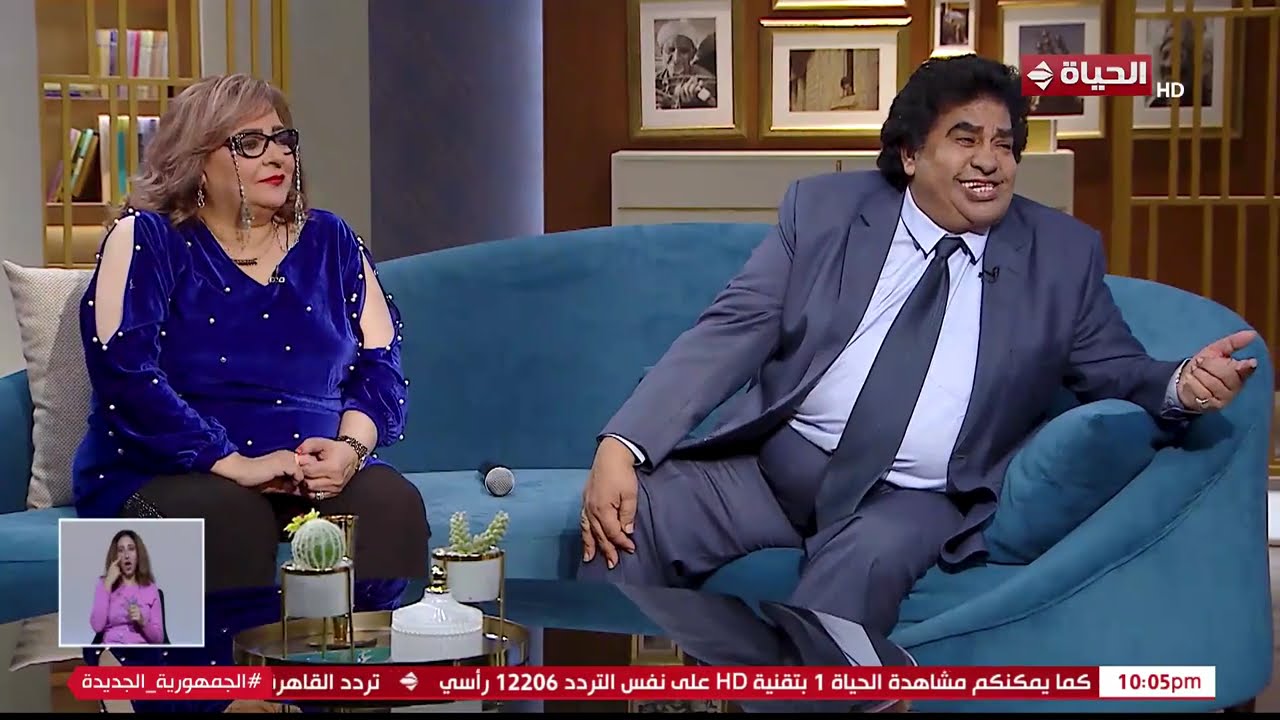
The record was a major hit, and it was sold like crazy in one day. This wasn't just the birth of Ahmed Adaweyah as an artist, and not just turning into a phenomenon as a folk master like those before him; Shafiq Galal, Mohamed El-Ezabi, Mohamed Rushdy, Abdu Al-Askandrany, and Khedra Mohamed Khedr, or the ones after him like Hassan El-Asmar Abdelbaset Hamoda, Hakeem, Mahmoud El Leithy, and Ahmed Sheiba, but no, Adaweyah can be considered as the most important folk singer. All respect to Hamo Bika.
Adaweyah changed folk music's nature and status in the music industry, to the point that makes us define folk music as what's before Adaweyah and after him, pre-Adaweyah and post-Adaweyah. It somehow rebels on the standards of Arabic music, going from "Al Atlal", and "Wasafoly Al-Sabr" to "El-Saah El-Daah Emboo" and "Single or Double", and "Allah's people that are higher". Adaweyah started from the bottom.
In the mid fourties of 20th century, Ahmed Morsy El-Adawy was born, a. k. a Adaweyah, for a cattle-trading father in Menya, in a family of 14 siblings, he was the 13th.
His father definitely wasn't giving him all attention because of that. But he noticed Adaweyah's love for singing, specially music he hears on coffeeshops and ballads. In an interview with Ayman El-Hakim published in Radio&Television Mag.
in 2005 where Adaweyah said he snuck out of his home and school to attend weddings, listen to the music and see the singers. His family tried hard to stop him from singing, whether by hitting him or kicking him out or keeping things away or even by shaming him that he'll be working with dancers, but the boy that's surrounded by art, ballads, and singing from a young age, was already too deeply in love with it. And in Cairo, he found his love, and went to Mohamed Ali St.
, the maker of stars, where its coffeeshops like El-Tegara had the most famous musicians, artists, and singers as customers. Adaweyah saw them as his tutors, and wished to be like them one day, like Mohamed Roshdy, El-Ezaby, and Shafiq Galal. When his family cut him off emotionally and financially, to stop him from singing, he worked as a coffeeshop busboy in Mohamed Ali St.
to earn his living, and then as a carrier for the band's instruments. This was according to the story of the Violinist Abdo Dagher, the violin master who played a huge part in tutoring Adaweyah. He got a small promotion to a "Mazhargy", who is a chorus member of the dancer's band.
He got another small promotion to a Daf (drum) player. He tried seizing any singing opportunity here or there, a local wedding, a party in a side alley, or even on a rooftop. He got another promotion and started singing in nightclubs.
His salary started increasing gradually, from 40 piasters to half a pound to a pound, and it was conditioned that he sang till sunrise to get the full pound. Until he landed a major opportunity in 1972, in the singer Sherifa Fadel's anniversary party with her husband. He then sang in front of established singers and journalists, he stood there, that brown slim guy, that no one knew, and owned the night with his voice.
Among the attendees was the owner of Arizona nightclub in El-Haram, who signed with him a singing contract, and that's when Adaweya's life changed into being the jackpot of El-Haram nightclubs. But he still wasn't a famous star yet, until the second coincidence happened. An opportunity with the then-start-up production company, Sout El Hob, that was founded by Atef Montaser when he was 22 years old.
A start-up, Abo Hmeed. Montaser tells Omar Taher in his book "Egypt's Craftsmen", that while being bored from working in the family-owned contracting company. .
. He's so an AUCian. he met the huge poet, Mamoun el Shenawy, who suggested they start a record label company.
The young man managed with difficulty to borrow money from his parents and start it. It started its productions with the new voice at the time, Hany Shaker not just that, they also produced for megastars like Shadia, but the company faced hinders, and the small capital it started with is running out. Mamoun El Shenawy, as a consultant for the company, suggested that they produce a record with a folk ballad, maybe the audience would like it and it would blow up.
Because Shenawy at that time was the first to notice that the public taste changed. One day, Montaser and Shenawy together go to Andalus nightclub, that by chance had masters of folk singers singing like Shafiq Galal. They both went and heard Adaweyah singing a ballad, "Oh Life, knock it off" Adaweyah's voice caught Mamoun El Shenawy's attention, so he went up to him, gave him his card, and asked him to stop by his office the next day.
The agreement was to produce a collection of Adaweyah's folk ballads. Montaser said that he left him in the office and when he came back he found Adaweyah drumming on the table and singing "El Saah El Daah Emboo" So he decided that it was the one, and they were to disregard the ballads idea for having another idea, to record that song. There are other versions of the ElSaah ElDaah Emboo origin story who thought it would be a hit, Montaser or Mamoun El Shenawy?
But there's even a discussion going on to this day on who wrote it, was it Al Rayes Beraa Khalel Mohamed Khalel? or Adaweyah himself? There's also another discussion on who composed it, El Sheikh Taha or Abdo Dagher or Farouk Salama.
Because as we know, failure is an orphan but success has many fathers. They all wanted to take part. And the kid is crying, I feel bad for the kid.
But surprisingly, Adaweyah wasn't the first to sing El Saah El Daah Emboo, but it was sung in parties since the fifties as a song in baby showers. Mahmoud Shokoko also sang it in one of his monologues, but it only became a hit with Adaweyah's voice. Like the track "Qamarun", that only became a hit with Mostafa Atef's voice.
Atef Montaser said that everyone who heard the song as it was being recorded, which consists of a weird mix that feels like a genetic breakthrough, a ballad and a monologue, said they were crazy and predicted its failure. Montaser produced 1000 copies of the record and gave 5 of them to a record shop under the building for free. Just to stir in and people know there's something new to the music industry.
Tiktok wasn't a thing yet. Anyway, around 12 pm, as he was looking out the company's window he saw that the road was closed and there was a crowd at the shop. He thought it was a fight.
So he went down, found that the song was playing and people were gathered listening to this weird song. Around 10pm, the thousand copies ran out. When El Saah El Daah Emboo was released, Adaweyah was in Libya not Egypt.
When he came back, he was surprised that it was a hit. Like the influencers saying they uploaded the post and slept, then woke up with thousand of views and likes. Never started from here, It started back then.
We woke up to being stars. Let me tell you, that when Adaweyah recorded this song he took 15 pounds. He asked Atef Montaser a huge raise, -How much, Abo Hmeed?
-He asked for 10 pounds. But Adaweyah doesn't get paid in tens anymore, he knew all about money after. He transformed from a young singer with an audience in El-Haram St, into the most wanted singer in Egypt.
Parties, weddings, and film producers, and also casino owners. The wedding that Adaweya doesn't sing in isn't a wedding. To make a complete wedding; Katb Ketab, gateau, and Ahmed Adaweyah.
Any movie that Adaweya sang in, its revenues doubled regardless of its rating. He also became the most asked for by the intellectuals. They wanted his head apparently.
In the seventies, Omar Battishah hosted his guest Naguib Mahfouz, in his famous show at the time "A Witness on the age" Seems like there was a subscribed version called Shahid (watch) VIP in the afternoon. Anyway, this man asked Naguib Mahfouz about his favorite singers. Mahfouz said he liked to listen to the man that you guys are boycotting in the broadcast here.
Who, Abo Hmeed, Sherif Mounir? What got him in here, my friend, it's Ahmed Adweyah. Abo Hmeed, it's as if Naguib Mahfouz, this culture and literature giant.
. . -was listening to ElSaah ElDaah Emboo?
-Yes, my friend. It's known that Naguib Mahfouz wasn't just in love with Umm Kulthum's music, we could actually label him as her Ultras. When Omar Battishah commented on his stand, Mahfouz replied that Adaweyah's songs were music to his ears, where he saw in them a translation for the age's chaos in beautiful singing.
That's the Nobel prize winner talking! These songs' success didn't come out of thin air, and even if we don't fully like the singing but is liked by millions, it's still singing. He asked the host if singing was supposed to be likable to only the both of them.
We know see this as normal, it's okay for Naguib Mahfouz to like Adaweyah, but we're talking about the seventies, when Adaweyah came into light, Radio&Television boycotted his songs. Naguib Mahfouz's opinion was a very advanced and surprising opinion at the time. Now, some people when they listen to Adaweya they admire it and say 'Oh man, we're missing Adaweyah.
. . the days of beautiful folk singing.
. . that reflects the society's culture.
. . unlike the current flamboyance, vulgarity, randomness, regression, and corruption of public taste, and the rest of the criticizm menu that's being used against singers these days, specially those of Mahrganat and rap, that I like them personally, I listen to them.
Just like Naguib Mahfouz's support for Adaweyah, I, as someone who will get Nobel prize of peace, or PES, whichever came first, I declare my support, like Naguib. . .
Mahfouz not the other one, to the Mahrganat and rap singers, and that I love their songs, and I like the Gibberish songs, the singer is great, this lost boy Flex has a future. . .
lost. The irony that this criticizm menu was all said to Adaweyah, nothing more or less, or maybe more. Adaweyah rose among legends, that formed the public taste and defined the form of music, what can be sung and what can't.
We're talking about real legends, Umm Kulthum, Abdelwahab, and Abd El-Halim Hafez. It was also a time when Egypt was in shock after 1967 war, and was changing from a socialist system to the openness of economy, which made serious and major economic changes in Egypt. Young artists started looking for a new music language, whether in the forms of western music or through combining them to form western bands with eastern music, such a molotov cocktail.
That was through musical bands that had musicians and players like Hany Shenouda, Omar Khorshid, Ezzat Abou Aouf, Ammar Al Sherei, and Omar Khairat. They were all criticized when they started their career. Imagine Omar Khairat being criticized, you can't attend his concerts without a suit.
Anyway, all of them -just like me- were attacked in their beginnings. You know my friend, ironically I wasn't attacked when I first appeared, I was attacked afterwards. Everyone when hearing "ElDaheeh" said 'wow it's so cool!
' but then went down to 'it's bad' , 'it's really bad' , 'it's awful'. You can still say that Adaweyah had the bigger piece of the attack cake. It was the intellectuals favorite sport.
"An Intellectual" "Adaweya" One of these intellectuals would wake up, and think, 'don't like the economic openness? attack Adaweya' There's ugliness, crowd, randomness, and pollution in Cairo? 'where do I find a symbol for all that, who do I attack?
' 'Adaweyah is around' You carried a lot, Adaweyah. In Mohamed Khan's movie, "Kharaga wa lam ya'ud" (Gone and Never Came Back) in 1984 that's considered one of the best Egyptian movies ever, when Khan used to express Cairo's chaos juxtaposing to the beauty of countryside, he made Yahya El-Fakhrany when he decided to return to Cairo to shout out "I'm coming, Adaweyah! " Being sick and tired of their lives made the attack on Adaweyah harsher.
To the point where the writer Salah Eissa called him The Baleful Nightingale, although the only thing that everyone agreed on was Adaweyah's beautiful voice! And that happened a lot. Most of the intellectuals took a stand from him, to the point where Abd El-Qader Hatem, a former minister of culture, formed a committee to stand up against the Adaweyah phenomenon, maybe there was Adaweyah-19 and Adaweyah-20, and Anti-Adaweyah.
. . I mean his music was contagious after all.
Maybe these cultured people didn't realize the thing that Naguib Mahfouz understood, which he stated in his interview with Omar Battisha. Mahfouz always said that he enjoyed great people's singing, such as Umm Kulthum, Abdel Wahab, and Abdel Halim. But, after they disappeared, he didn't like artists who depend on Eastern orchestra, and still try to copy these big artists.
And that he likes listening to the new music not just Adaweyah. Mahfouz pin points the main problem. The age we're living in is a new one, and it needs music that goes with it.
In the 18th century, a definition was made for folk music for the first time by the German philosopher Johann Herder. That man defined it as a composed lyric poem, of an unknown source from the public from older times. And that these songs were passed down.
And generally, the idea of folk music is that it represents music of the folk, and spreads throughout simple, lower, and less-educated classes. Like you, Abo Hmeed? And the critic Ibrahim Zaki Khurshid distinguished it in his book "Folk Music, and Musical Theatre", from traditional music that sparked inside king's palaces that only aimed to praise kings and entertain them and their company.
That was music for them, and the other is for the folk. He saw that folk music was the subconscious inner voice that expresses people's pain,or happiness. It even used different types of musical instruments than the organized palace, and high society music.
Folk music leaned more towards transparency and improvising, It was passed down from one generation to another by memory. And in the 20s of the 20th century, there were songs that people called corny playing in coffee houses and local pubs, there were also musicians like Sayed Darwish, Zakariyya Ahmad, and Dawood Hosni, who tried to combine between classical and folk music. The song "Fun and jokes are better after dinner" for Monirah El-Mahdiyyah that starts with "you should stay on Tuesday.
" You might ask "Why Tuesday, Abo Hmeed? " Because he was enchanted by two girls on twos-day. That song was composed by Mohamed El Qasabgi The same El Qasabgi that composed "Lover's sympathy" and "My heart is my guide"?
No, no. It's surely not him, Abo Hmeed. What do you mean "stay on Tuesday"?
That's outrageous. There's no way that the sensitive Ahmed Rateb, who amazed us with his performance in Umm Kulthumm series would do that. But, why go this far?
Umm kulthum herself has a song that starts with "I'm lust, and naughtiness is my belief. " Keep going, queen! Wait a minute, Abo Hmeed.
I came to see her from Tanta. If you're so fun, queen, why do you act the opposite? The writer Sayed Mahmoud says in a famous study by him in Al-Ahram that since July 1952, Egyptian songs were going down two parallel paths.
The first path is formal with a suit and a side part haircut, and the other is all about coffee shops, pubs, and weddings. Just like that El-Nazer movie scene. The other type was always bolder in representing social problems, and more sensitive to colloquial changes in people's lives.
And it also can sing about acceptable things during celebrations. Just like "You should stay on Tuesday. " Visit on Thursday, and we'll go to a cafe.
It's so easy. Come any day, and I'll find a rhyme. So, there was no opposition between paths.
We could find Mohammed Abdel Wahab himself composing for Shokoko, who sang "My night is long unlike hers. " The monologue they wrote says: "you who cut the heart with broken glass. " Generally, the musical scene until the 40s was able to comprehend different types of music, and renew itself by containing different instruments and musical compositions.
When the 23rd of July revolution happened, it sided with lower classes of workers. So, naturally taking care of folk music is the top priority for the revolution. And we find singers mostly from countryside backgrounds, who present themselves in traditional local outfits, like khadra Mohammed khedr, and Mohammed Taha.
And a famous folk singer shines even if he's wearing a suit like Mohammed Roshdi. -Who's Mohammed Roshdi, Abo Hmeed? -My millennial friend.
Gen Z! He's the one who says It was an ad for Mobinil company once. Where do you think mobile operators get it from?
From heritage. Simply put, Adaweyah didn't show up out of thin air, he's a product of a big heritage of music and folk songs, country ballads in specific that he had memorized from Anwar El Askary, and Abdo El Askandarany, who cared a lot about wisdom, and moral lessons. But Adaweyah managed to improve the country ballad into a new one, that got the power back through words, that came from the local people, especially craftsmen.
What, Abo Hmeed? There's also the dynamic music that he used to make using a group of the most skillful musicians of that time. Adaweyah's band included musicians that hold status with Abdou Dagher, and trumpet player Samy ElBably, and the Accordion player Hassan Abu El Seoud.
He gave them space to play and freestyle. The Lebanese music critic, Fady Alabdallah noticed that this free space wasn't allowed in the famous bands, that played with Umm Kulthum, Nagat, and Warda. But instead, the player was given a prepared and agreed on piece to perform, just a solo, like Mohamed El Qasabgi's solos with Umm Kulthum.
Fady saw that the ballads that Adaweya made is his most prominent achievement, as they reformed the art of ballads. An art that has bigger spaces of playing music, showing it, and word playing. It was a new form of a ballad that had role switching between singer and instruments.
We have to jump back on track with the song, "Get well soon, Hasan's mother", where we ask an important question, Hasan? who's Hasan? Hasan, my friend, is Hasan Abo Etman.
A songwriter and the most important poetry reciter, who wrote most of the most important and beautiful Adaweyah songs. By understanding him and his nature, we'll understand the songs. Hasan Abo Etman is a famous poetry reciter and talented songwriter born in El Mahalla El Kubra.
He started his life working in a spinning and weaving company, then a calligrapher, then a barber. Jack of all trades. However, his career didn't start with Adaweyah.
It started with Mohamed Roshdy He continued to write songs for him for 10 years. Most of the songs were successful and famous till this day. Such as, Arabawy that I find has very beautiful lyrics.
"Eyes that can't be any more beautiful, like a nest of squabs. Just one look and the sun shies away from her eyes. " The lyrics stay suitable to be played on TV, or on the radio if they ever want to play folk music.
"The sun shies away from her eyes" is eloquent and beautiful, but it didn't come from their heart. Meaning, Adaweyah and Etman's hearts, and it could also be an unoriginal expression. Abo Etman is your average guy, the barber and worker.
So, if he wrote something, he won't write about the shy sun from his lovers eyes. He'll instead describe her as pineapple and fruita. "Fruita", my friend-who pretends to be higher in class, and pretends to be classy- No, go back to your roots!
Look who's talking. "Fruita", my friend, means fruit in English. Also, when his lover starts talking, he describes her words with vitamins, which is healthy and nutritious for him for the next day's shift.
Or, when he wants to express his love for her, he makes a promise and says: "Swear by your sugary heart, I'll fry you shrimp a lot. " Or, in the song "You're an Anesthetic" composed by Baligh Hamdi, Etman will flirt with his lover and say "So little of you around, with eyes so far to be found. Your eyes are cameras for movies, and I, in acting, have expertise.
" Oh Yeah That is a creative expression, not "the sun shies away. " That's why we can say that Abo Etman will be more free when he works with Adaweyah. And the first song he writes for him that will break records is "Get well soon, Hasan's mother".
Great, Abo Hmeed. Now we know Hasan is Hasan Abo Etman. Hasan in the flesh, but who is his mother?
Did he mean to write about his mother? According to the story told by his children, when Abo Etman wrote the song, he meant his bigger mother. and even my mother.
-What, Abo Hmeed? -Egypt, my friend. Probably when they criticized the poets a lot back then about all that sweet clingy talk, they said that they wrote it for Egypt.
So, they just wrote sweet talk to Egypt. Then, Egypt was recovering from the 1967 war. So, he compared Egypt to Hasan's mother.
He wishes for her well-being, and blames what happened to her on envy. And when he describes her after the Naksa day, he says "Confused, so confused, thinking made her dazed" And when he wants her to stand back up, he says "What is this, Hasan's mother? Stop and be ashamed.
No incense or ritual will help this. Wake up and be wise. " And after the 1973, he combines it all together.
He says "Who does he think we are? Don't we terrify? We're masters of the game.
If the door knocks we know came. " Maybe they have a camera, Abo Hmeed. All that might seem for us as knowledgeable high-class people, who look down upon all this, that it's all silly.
However, If you think about it, you might find some fluency that comes from people's heart, like Abo Etman and Adaweyah. And it aligns with the vocabulary used by the public, and the workers class in their daily lives. We don't have to listen to this and say "Wow!
That's so beautiful. " Because what makes it special is not that it's beautiful, or complicated, but that it's real and authentic. It expresses those people's feelings and thoughts.
Those people who can describe defeat as confusion, and victory and confidence as being masters of the game. That's why these songs didn't only succeed, but I think, most importantly, they still live on to this day. Not just that, when Adawaya in 1977 went to film an ad for his new album "Bent El Sultan", the TV said no.
What? then how did he gain popularity in a time with no TikTok? The answer is the magical invention back than called the cassette player In his book "Media of the Masses: Cassette Culture in Modern Egypt" published by Stanford University, see even Stanford University writes about Adaweyah, which is a very established university, the researcher Andrew Simon says that the cassette in a time with no internet, or music streaming platforms made popularity easy for Adaweyah, and other people like Mohamed Mounir, who sang unusual songs at the time.
That quick rise in popularity was due to cheap production fees, ease of access to cassette tapes, and ease of producing multiple copies of a song. So, you can listen to whatever you want, whenever you want. When a song gets denied like "Karakashangy slayed his sheep.
How beautiful is it's meat broth of sheep! " Adaweyah resorts to recording it overseas. -Where, Abo Hmeed?
-Greece. And within days, the song was all over the Egyptian streets. And probably for the first time ever when Adaweyah was able to defy censorship over his appearance on TV, was through an ad for a folk product, like the Khedr El-Attar store ad that was composed by Farouq Salama.
It's outstanding composition got Abdel Wahab's attention. After that, when he releases his first tape called "Get well soon, Hasan's mother", he'll sell, according to some sources, 1 million copies. Surely, this number may not be very accurate.
However, it shows how successful Adaweyah is and his rise to stardom. During the free market economy, when many Egyptians traveled to other Arab countries, the cassette player was the first thing they bought when they came back to Egypt. Cinemas, as well, played an important role in his popularity, because his appearance and his music guarantee the movie's success.
Walter Armbrust noted in his book "Mass Culture and Modernism in Egypt" that a song like "What a crowded life", "A never ending carnival", wasn't just a song, it turned into a local idiom. It's used in situations when we feel the crowded busy effect of Cairo on our lives. Hany Shenouda writes about it in his journal saying that when he first heard the lyrics, he knew it wasn't just for entertainment.
He found messages in it, and notices lines like "I wish to find him and say his words don't reach me. " He saw that these lyrics talk about noise pollution due to noises and sounds. Shenouda says that Adaweyah himself feared taking risks.
As Hany Shenouda is known to compose songs similar to Western songs. Adaweyah showed the lyrics written for him by Hasan Abo Etman, the most important partner in his career, to many composers. However, in Adaweyah's words, he couldn't get Hany Shenouda's compostion out of his head.
It was the first time, my friend, that a bass guitar and drums are played in a folk song. And of course, it made massive sales when it was released. Shenouda says that the impact the song had was more than just of a cassette tape.
Taxi drivers would turn the volume up in their car stereos. "What a crowded life! " Hany shenouda wasn't the only composer for Adaweyah.
There were other big composers like Baligh Hamdi, Kamal Al Taweel, and Sayed Mekawy. Salah jahin and Mamoun El Shenawy himself wrote songs for him. El Shenawy who wrote for Umm Kulthum.
Abdel Wahab valued his voice, and found that it was the most beautiful folk voice he has ever heard. Abdel Halim Hafez, at a Hilton hotel party, sang "El Saah El Daah Emboo" with Adaweyah. Adaweyah, despite the attacks against him, reaches great success.
Nothing stopped him, except an accident that put him in a coma for a long time. When he came back in 1989, he had lost a lot of his energy. However, in a big celebration for his birthday, attended mostly by very important artists in Egypt, Adaweyah gets, for the first time, a huge acknowledgment for his art and impact.
Artists as big as Adel Imam and Sanaa Gamil. We even see singers nowadays how much they appreciate him, and aspire to sing with him. They want make a duet with him.
Just like Ramy Ayach, and Cairokee. Adaweyah lived a very long journey with up and downs, however, his talent and his songs were always up. Despite a lot of studies that analyzed Adaweyah as a phenomenon, and studied his songs and their impact, nothing will ever express his experience more than his own words, where he says "I'm a king, and that's my game.
I can sing and jump between melodies (maqam). From the Rast maqam to Nahawand and Hijaz. I play the Sikah maqam, then the Bayati and Saba.
" That's being a king. It's about melodies. He says "I got this far after a tiring life, and I started from the lowest bottom.
Singing in festivals and local events taught me. My talent and hard life gave me what's equal to a doctorate in music. A lot of musicians have high degrees in music, but they can't be kings.
They look for a guy like me, and try to learn. That's the story. I'm my own story.
" And that's my episode. There are previous ones, new ones, and there are sources below, and subscriptions for the YouTube channel. And tell us what's your favorite song for Adaweyah, but, please when you write favorite songs, do it without singing, ok?
Only sing if you have a good voice. God bless Egypt. God bless Egypt!
Really, my friend, history combines together here, you find Abdel Halim combined with Umm Kulthum, Adaweyah, and El Qasabgi making a cocktail. God bless Egypt.