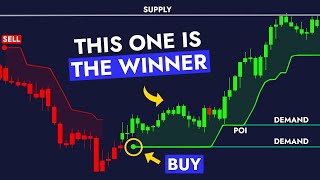
Most traders think of swing trading as this vague no man's land. Too slow for day traders, too fast for long-term investors. But that's just surface level thinking.
Swing trading is its own game with its own rhythm, psychology, and edge. It's not about sniping every tick or clinging to a trade for months. It's about identifying key moments where the market shifts from one value zone to the next and positioning yourself to ride that wave.
The real magic, it happens overnight. Literally holding through the close changes everything. How you analyze, how you plan, how you manage risk.
And once you understand that, you stop guessing and start trading with intention. So what is swing trading really? Strip away the jargon.
And here's the essence. Swing traders play for moves that take time, several sessions, not just a single day. Unlike day traders who close everything before the bell, swing traders intentionally hold positions overnight, embracing both the opportunity and the risk of after hours price gaps.
Why? Because the market doesn't always move in one breath. Some setups need time to unfold.
By stepping back from the tickby tick noise, you give strong trades room to work without chaining yourself to a screen all day. That phrase you hear, letting the trade work, this is what it means. Trusting your thesis beyond the intraday chop.
It's a trade-off. More freedom, more upside, but you carry your risk into the next day. And that's the real game.
Let's make this real. Picture a stock trending higher on the daily chart after strong earnings. Then it pulls back right into a zone that used to be resistance 3 weeks ago, but now it's acting as support.
Classic price action. Old resistance becomes new support. A day trader might try to catch a quick bounce and exit before the closing bell, but a swing trader, they zoom out.
They're thinking bigger. The thesis is this pullback isn't a reversal. It's just a breather before the next leg higher.
So, the plan is clear. Enter near support after buyers step in. Place your stop just below the structure that breaks the idea and set your target where sellers last showed up.
Maybe even beyond if momentum kicks in. You're not chasing green candles. You're sinking with a bigger picture.
Entry on the pullback, structure for protection, and time as your silent partner. Let's talk structure because in swing trading that's everything and it's exactly why Lux Algo's price action concepts toolkit is such a powerful fit. The price action concepts doesn't just guess where the market's going.
It maps the market structure in real time, showing you when we're continuing a trend or hinting at a reversal. No lag, no clutter. It marks breaks of structure, change of character signals, even equal highs and lows that often act like price magnets.
In other words, it gives you the story of the market at a glance. Are we pushing into new highs with strength, or are we signaling that momentum is fading and a turn might be coming. With this toolkit, you stop reacting and start reading the market like a map.
But here's where the price action concepts toolkit takes swing trading to the next level. It doesn't just tell you when a level broke. It separates the market's movement into two distinct layers of structure.
So you can think like a swing trader by default. The first layer is internal structure. These are the smaller, more frequent advances and pullbacks that unfold inside a larger move.
Internal labels will print often as price grinds, pauses, and shakes out participants, which makes them fantastic for timing, but noisy if you mistake them for a change in the bigger story. The second layer is swing structure. These are the dominant legs.
the major higher highs and higher lows in an uptrend or lower lows and lower highs in a downtrend that define the actual path of the market. In the Lux Algo ecosystem, swing structure is intentionally made more visually prominent so you immediately see the primary trend while internal structure provides the finer grain triggers inside it. When you learn to read both together, your entries become precise without losing the bigger context that keeps you on the right side of the move.
So swing trading isn't about fortunetelling. It's about flow. It's recognizing when the market has both the fuel and the runway to move from point A to point B and building a position that rides that wave without getting thrown off mid-flight.
When you understand swing structure and build a consistent routine, the chaos quiets. Fewer decisions, clearer risk, and the rare satisfaction of watching a multi-day move unfold exactly as you plan. Want to trade this way?
Load up Lux Algo's price action concepts toolkit. Set the swing layer to map the backbone of the trend. Use the internal structure to time your entries.
Then start replaying charts. The visual clarity will accelerate your learning and the customization. [snorts] It evolves with you.
You can try the Luxalgo price action concepts algo for 30 days at luxalgo. com. Give it a spin and see if it fits your trading style.
And if you want daily insights in real time updates, follow us on X.