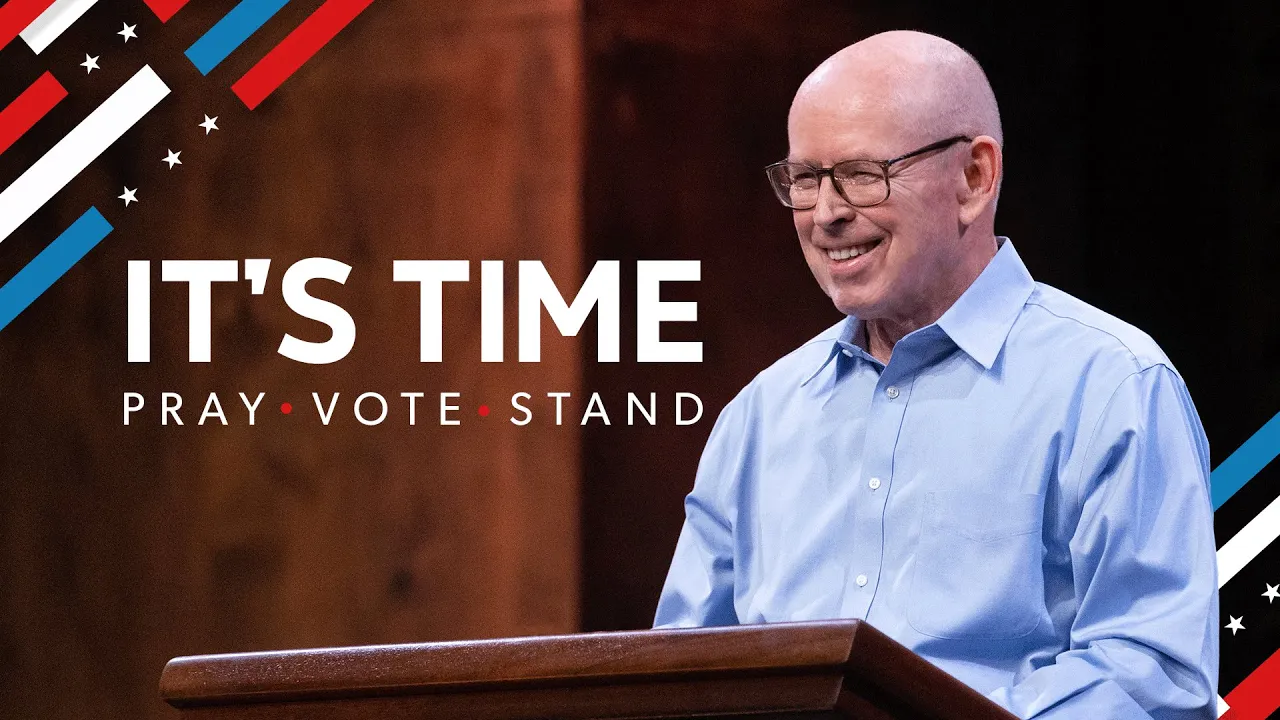
Church, we told you, uh, a long time ago that we had a treat tonight, and I am honored, uh, to introduce this man who has made a major impact in my life and in the lives of tens of thousands, if not more, of Christians. You may have read his books or you’ve heard his books quoted, not having any idea that it was coming from the mind and the heart of probably today’s America’s most cherished theologian, Dr Professor Wayne Grudem. He is Research Professor of Theology and Biblical Studies at Phoenix Seminary in Arizona.
He’s a graduate with multiple doctorate degrees from Harvard University, Westminster Seminary in Philadelphia, and the University of Cambridge. He has served in many roles in strengthening the church and theological societies. He has been a key contributor and editor of the English Standard Version Bible, the ESV, which is an awesome, awesome work.
Uh, he has authored over 20 books, and he continues his ministry. I got to tell you, uh, I’m going to give you a couple of his books. One of them I’m just going to really highlight tonight.
First of all, his "Systematic Theology" is second to none. Right? You’ve got to get his "Systematic Theology.
" He’s written the book "The Gift of Prophecy in the New Testament," and today he’s written books regarding business for the glory of God. Here’s my favorite because it’s only about that thick and in small print. It is a research book—an absolute research book.
I have it on my desk at all times because of its exhaustive ability from a biblical perspective to address the issues, and it’s "Politics According to the Bible. " It is amazing! He has written the book "Poverty of Nations: A Sustainable Solution.
" He’s got the answer on how to bring poor nations up out of poverty, and it comes right out of the Word of God! You guys, he’s a hero of mine. I love the man!
Every chance you get, listen to Professor Wayne Grudem, buy his books, but give a warm Calvary welcome tonight to Dr Wayne Grudem. That's next. Oh, thank you for that welcome, Jack!
I love your church so far. I’m going to do something a bit different tonight. I’m not going to take a single Bible verse or a paragraph from the Bible and talk about it.
I’m going to talk about my relationship with a friend, and this friend is anti-Trump. The question is, how do I relate to and interact with this long-time good friend who’s mad at me about my support for Donald Trump? I do that well because Pastor Jack asked me to [applause], but also because I hope it’ll be a help to you in knowing how to interact with friends who are on a different side in the political arena today.
So this friend, I’m going to call him Zachary—that’s not his real name; I’m hiding his identity—but Zachary wrote me a long email. It took me by surprise. He said, “I’m frustrated with you, and I’m angry at times.
I don’t want to be angry because we’ve been friends for a long time, but I can’t understand why you can support such an immoral man with such a poor character. It’s hurting your reputation that you’ve built as a long-time professor of theology. It’s hurting the evangelical name, evangelical, hurting the proclamation of the gospel.
" And it hit me hard, and I really pondered it for a few days before I answered because those are serious concerns, and I didn’t want to ignore them. I’m going to watch the time here, and I have 14 objections that he raised. In about 28 minutes, I’m going to try to do this, and then we have some time for Q&A.
The first thing I said was, “Thank you! Thank you for writing! Thank you for putting this in words!
Thank you for bringing it! I didn’t know he was mad at me, thank you, and thank you for the thoughtfulness of your comments because they really were. They were serious; they were thoughtful; they were not trivial.
” Number one, he said, “I’m not going to talk about policies; I’m only going to talk about Trump’s character. I’m not going to talk about policies. ” My response was, “If you don’t talk about policies, you don’t talk about the whole reason that I support President Trump.
That’s not fair to—" well, I didn’t say it’s not fair; it’s not meeting the other person’s concerns to say you’re not going to talk about policies; you’re only going to talk about character. Now, I’m going to talk about character—that is important, but policies are also very important. Next thing he said, “I don’t think there’s anything that Trump could do to make you stop supporting him.
” And I said, “Yes! If he started favoring pro-abortion policies, if he started abandoning Israel to stand on its own, if he started raising taxes and putting more government regulations on people, if he started appointing judges to the Supreme Court and lower courts who were making up laws on their own accord without following the Constitution and the laws, if he was doing one thing after another like that, yes! I’d stop supporting you.
” I said, “You have to realize now 56 years ago, I read a book. I was old enough to read at that time. I read a book by Phyllis Schlafly, a lawyer, called 'A Choice Not an Echo.
' In it, she persuaded me that it’s important to believe in and support conservative political policies: low taxes, low regulation, small government, an emphasis on individual freedom, a strong military—one after another. I thought, 'Yes, this is right,’ and I think it accorded with my sense of what the Bible. .
. " was saying, and so that, uh, influenced me. And then in, um, 1964, I became president of the Young Republicans Club at Memorial High School in Eau Claire, Wisconsin.
There was an added benefit to this, which I’ll just put as a side: there was this cute girl who was really fun; her name was Margaret White. This year, we celebrated our 50th—51st—wedding anniversary. So, anybody out there, I recommend Young Republicans.
In 1968, I was a junior in college, and I volunteered—well, Jack mentioned I went to Harvard. There was actually a Young Republicans Club at Harvard. I don’t know if there’s any more, but there was.
I volunteered to help and held a sign supporting—a sign supporting Richard Nixon in the election season because I thought his policies were better for the nation than Hubert Humphrey’s. In 1980, I was teaching at Bethel College in St. Paul, Minnesota, and I took part in a faculty panel discussion.
I argued in favor of voting for Ronald Reagan; I thought his policies were better and far more consistent with biblical standards than the liberal policies of an evangelical Southern Baptist Sunday school teacher named Jimmy Carter or the muddled views of third-party candidate John Anderson, an evangelical Christian as well. Then, in 2010, still pre-Trump, I didn’t know anything about Donald Trump. I maybe just vaguely knew he was a celebrity in media and entertainment, but I argued extensively for conservative political positions in this book published, "Politics According to the Bible.
" I think in that year, 2010, I was here and spoke at, uh, at this church, but it may have been 2012 or something like that. No, it was—well, it was a while ago. So, my support for Donald Trump flows out of 56 years of conviction of conservative biblical principles and policies.
It’s not about just liking someone or not liking someone as a person. Number three, though—so that was number two—um, what would make you stop supporting Trump? That has changed.
Policies. Number three, he said, “You’re elevating politics above the Bible; you’re putting the temporal, the earthly, in front of the eternal. ” My answer is: I’m seeking to influence politics because of the Bible.
The Bible talks about all of life, and Paul says, “Whether you eat or drink, or whatever you do, do all to the glory of God. ” Can’t we do politics to the glory of God? I encourage—I have been teaching pastors now for 39 years in seminaries.
I encourage pastors to teach their congregations not only the first and most important thing: we believe in the Lord Jesus Christ, and you will be saved, dressed in Christ for forgiveness of sins, but after that, how to live. How to live as husband and wife. How to live as parents.
How to live as students in an educational system. How to live in the business world. How to live as a neighbor and a friend.
How to live in all aspects of society. Shouldn’t we also be teaching people about how to live in politics and government? So, this isn’t putting the temporal in front of the eternal.
This isn’t out of any elevating politics above the Bible. The Jewish people were carried off into exile in Babylon in the Old Testament. Jeremiah the prophet was writing and speaking to them.
In Jeremiah 29:7, Jeremiah said to these exiles in Babylon, “Seek the welfare of the city where God has sent you into exile, and pray to the Lord on its behalf, for in its welfare you will find your welfare. ” That word welfare—“seek the welfare of the city”—it’s the Hebrew word "shalom. " It means everything is at peace and in harmony with God and with one another; it’s well-being.
Seek the well-being of the city where God has sent you into exile. Now, 1 Peter talks about us as exiles on the earth, and so we’re in a somewhat analogous situation to the exiles in Babylon. Shouldn’t we also seek the welfare of the nation where God has called us to live as exiles from our heavenly sins, our heavenly country, our heavenly homeland?
It seems that we should seek the welfare of the city. So, I wrote a little book called "Business for the Glory of God. " I wasn’t trying to put business above the Bible; I was trying to influence business for good, for God’s glory and honor.
And when I wrote a book called "The Poverty of Nations: A Sustainable Solution," talking about helping poor nations come out of poverty, I wasn’t putting poverty relief above the Bible; I was trying to say the Bible has principles that apply to poverty relief and help people come out of poverty, and so forth. So, I don’t think a Christian should ever intentionally do moral wrong or sin. It would be morally wrong for me to lie about a political candidate.
It would be morally wrong for me to stuff ballot boxes with fraudulent ballots or to steal ballots. It would be wrong for me to commit sin for a political purpose. But I see nothing wrong with speaking and writing in support of political positions and even a political candidate.
I’m not saying that that means I approve of everything the candidate does. I’m saying I disapprove of certain aspects of Donald Trump’s character and conduct, but I support him as a candidate, and I see nothing morally objectionable about that. Number four: he said, “I even like some of Trump’s policies, but I don’t like him as a person.
” Honestly, we’re going to have to face the fact that our friends—and maybe you yourself—don’t like Trump as a person; you wouldn’t want to go out to have a nice dinner with him. Some—I don’t know if he would or not—but the fact is our nation now is faced with. .
. A choice between two whole packages, and we're going to get one package or another. One package is Donald Trump, his personality, and his policies, and over 4,000 appointments that the president gets to make in the federal government.
The other package, package B, is Joe Biden, his policies, and his personality, and over four thousand appointments that he is going to make in the federal government. Those are the only two choices we have. It's the whole package, and you get the personality along with the package, and we don't have any other choice.
So the question is: Is Donald Trump so unsuited to be president that our only valid choice is to accept package B, and the great damage to the nation that, in my opinion, will flow from Joe Biden and the Democratic policies? When I ask the question in that way, the answer is clearly no; it isn't even close. It seems to me — and this is just my judgment; you may differ — that package A is far preferable.
He says I might vote for a third-party candidate; that would not change the situation. You're going to get either package A or package B. It seems to me that the privilege of voting is an opportunity to affect the direction of the nation and the outcome of the election.
Voting for a third-party candidate, like Jack Hibbs or your husband or wife or the mayor of your city, has no effect on the outcome of the nation or the direction of the nation. It seems to me that the stewardship that you have of being able to influence the outcome of the nation is being wasted by voting for a third-party candidate. It's going through the motions, so it looks like you're doing something good, but you're not doing anything that has any effect.
I tried to think of an analogy of doing something that looks like you're going through the motions but has no result. I thought of a lot of churches passing an offering plate, and people put their money in or put an envelope in. Voting for a third-party candidate is like putting an empty envelope in the offering or putting Monopoly play money in the offering.
You look like you're doing something good, but you’re not. Objection six: This is the heart of the objection: Donald Trump's character is too bad for him to be allowed to be president. His character is just too objectionable; I can't vote for him.
Now, I want to say I agree that Trump's character is not perfect, but I would say to my friend Zachary, you think he's a lot worse than he is. I'll tell you why: If you get your media, your information, from the mainstream media in the United States, you're getting a very distorted picture of who he is. You're getting anonymous sources saying he said awful things, which he denies he said, and people with him deny he said.
There's something called the Media Research Center, and they recorded the evening news broadcasts on NBC, CBS, and ABC for the entire month of June and the entire month of July. Then they went through and replayed the videos and counted the evaluative statements, such as, "This is a good thing that President Trump has done," and, "This is a bad thing he's done. " They also counted the statements about Joe Biden.
For every negative statement made about Joe Biden, there were 158 negative statements made about President Trump. Now Zachary, if you have a negative opinion of President Trump’s character, I think your opinion is far worse than the actual truth. Yes, I think he's been unfaithful in his previous marriages.
Yes, he insults people. Yes, he's brash and blunt, and he sometimes speaks without being too precise with his words. I understand that he exaggerates; he's a Manhattan business salesman.
Well, he is. But I think the media have made him out to be far worse than he actually is. I had the opportunity a few months ago to have lunch in the White House — not with President Trump or anybody famous, but with some staff members who had worked with President Trump in the White House since the day he was inaugurated.
Four of them were committed evangelical Christians; they’d read my systematic theology, and that's how they got in touch with me. We had lunch, and they are convinced they love him; they think he's just doing a great job as president, and they love working for him. They love the way he encourages them and affirms them, and they think that he just sincerely is doing what he thinks to be best for the nation.
So I think that the negative evaluation of his character is unfounded — that is, the excessively negative evaluation. But doesn't he lie? He tells lies!
That's a serious objection to raising someone's character; he's a liar. So I looked up in a Washington Post article last December: President Trump has made fifteen thousand four hundred thirteen false or misleading claims. Fifteen thousand forty thirteen!
But let me give you a couple of examples. The most common — what they call a lie or misleading claim — repeated 242 times is this: "The United States economy now is perhaps the strongest economy in the country’s history. " He said "perhaps," so it's not an absolute.
But the Washington Post goes on to say in the next sentence: "By just about any important measure, the economy today is not doing as well as it did under Presidents Dwight Eisenhower, Lyndon Johnson, or Bill Clinton. " So I thought, let's find out: the Gross Domestic Product, or GDP, is the total market value. .
. Of all the goods and services sold in a nation over a year, it's the total economic output of a nation. Under President Eisenhower, the Gross Domestic Product (GDP) of the United States was, in round numbers, three trillion dollars.
They said Eisenhower, Johnson, and Clinton: Eisenhower 3 trillion, Lyndon Johnson 5 trillion, Bill Clinton 13 trillion, Donald Trump in 2019, the GDP 21 trillion. So I would ask the Washington Post, how is 21 worse than 3, 5, and 13? It looks to me like 21 is better than 3, 5, and 13.
In fact, if you add them all together, you get 21. [Applause] Therefore, judging by the most common measure of the strength of an economy, the GDP, it is completely true to say that we are currently living in the strongest economy in our country's history. Trump is not lying, but the Post is using some other measurement, and they don't tell us what.
It could be the percentage of growth rate or something; I don't know. In order to claim that Trump has told a lie 242 times, you can see how they can get to a total of 15,413 false or misleading claims. Here's another supposed lie: Trump said, "We've just also reached a deal with Congress to invest a record 738 billion dollars more into our military.
This is a record 738 billion. " The Post says this is a lie. Why?
Well, because if you adjust for inflation, this is not a record. Never mind that they themselves were reporting 738 billion dollars as the expenditure in the military budget, the largest that has ever been. So yes, it's a record.
He didn't say it's a record adjusted for inflation; he just said it's a record. If you are facing thousands of these accusations— that in my judgment many are just misleading— of course people are going to think that your character is worse than it is. President Trump's flaws, and he does have flaws, make him liable to, or make people ready to believe those things.
I think if your source of information is CNN, NBC, CBS, ABC, Washington Post, or New York Times, you're going to have a bad opinion of President Trump because he's been slandered again and again and again. That's not to say he's perfect; he has flaws. It is to say we need a middle ground evaluation of his character, not an exceptionally hostile one.
I teach interpretation of the Bible, and there's a principle in the interpretation of literature in general, and that is to distinguish between a sympathetic interpretation of a writer's words or speaker's words and a hostile interpretation. If you want to give a hostile interpretation of someone's words, you can misconstrue anything, and it will be contrary to the intended meaning. But those alleged lies or misleading statements that the Washington Post tabulates, I looked at many, many of them, and again and again, it seemed to me I could put a sympathetic interpretation on that statement, and it wouldn't be called a lie.
So, I don't know. I published an article a while ago— I think it was six weeks ago, something like that. I said, "I have heard it said that President Trump is a liar.
" I teach ethics; I wrote an ethics book. I define a lie as affirming A when you believe A is false— when you say A is true when you believe A is false. That's how I define a lie in a very specific way.
I do not know if President Trump has ever told a lie in that sense. I said in this article I'd be happy to look at any examples when someone wants to show them to me, but I didn't get any response. Objection number seven: I don't think Trump is interested in anything but division.
Trump wants people to hate each other. That is talking about a person's motives. My response to Zachary is, "Zachary, do you really know what his motives are?
" It's appropriate to be cautious when speaking about another person's motives. We often don't understand all the motives in our own hearts for some of the things we say and some of the things we do because motives are complex things. I posted on my website, which is waynegrudem.
com, a list of 30 good things President Trump has done for America. I think these are good policies that he's enacted and good actions that he's taken. Do these show evidence that I want people to hate each other, that I'm interested only in division?
No, his actions are consistent with someone whose motive is seeking to do good for the nation. So, I wrote in a Town Hall column in 2016: President Trump is egotistical—or not. President Trump, Donald Trump at that time, is egotistical, bombastic, and brash.
He often lacks nuance in his statements; sometimes he blurts out mistaken ideas that he later must abandon. He insults people. He can be vindictive when people attack him.
He's been married three times and claims to have been unfaithful in his marriages. These are certainly flaws, but I do not think they disqualify him from being president. I could say that all of those are—well, some of those—I'm not going to defend everything he says in the way he says them, but the results are good, and overall I think he's been a good president.
Number eight: Zachary says to me, "Wayne, you think that a person's character is irrelevant. " I never said that. I didn't say a person's character is irrelevant.
I think there's a standard below which, if a candidate falls, he's unsuited to be president, but I don't think that President Trump has fallen below that standard by any means. Number nine: Trump can't be trusted to be president for a second. Term: Zachary says the only thing that has kept him in check is the fact that he had to run for a second term.
I'm afraid of what he'll do if he no longer has that check to stop his more egregious actions. What if he abandons evangelicals because they are no longer necessary? So this is guessing about the future, and my response to Zachary is this: This is unfounded speculation.
If a president in his second term begins to betray the policies and the promises that he campaigned on, very quickly he'll erode his political support in Congress and the nation, and for the remainder of his term, he can't; he will not be able to accomplish much at all. Much at all. It happened twice in my memory: Richard Nixon in ’72 won a landslide election, but the country turned against him because of the Watergate scandal, and he resigned from office in 1974.
And then President Lyndon Johnson in 1964 won in a landslide election, but from ’66 to ’68, the political mood of the country turned against him because of the Vietnam War and turned against Johnson so decisively that he decided not to run for re-election in 1968. So, if a president abandons what he's promised and what he said he's going to do, he's totally ineffective and useless and may be forced out of office by popular opinion. If in a second term Donald Trump acts the way he has in his first term, what will happen is a continued strong economy, a strengthened military, better trade terms with other nations, more peacemaking agreements between Israel and other Arab nations, a secure border, more originalist judges, stronger protection for unborn children, strong employment and wage growth, greater energy independence, lower energy prices, greater school choice, more safety in inner cities, protection of religious freedom, and greater liberty for Americans in general.
[Applause] So, it seems to me, as I write back to Zachary, that your objections are pessimistic and unrealistic. Look at the first term; that's what he'll be like in the second term. I could also say in regard to this character accusation that affects both of these last two points: we have a spectrum of political views in the United States, but on the political left, the strategy has increasingly been, "I'm not going to talk about policies; I'm going to attack the person.
" It's not that your policies are bad; it's that you're a bad person. And if you support Trump, you're a bad person. It's called an argument ad hominem, against the man or against the person, but it's not a legitimate way to argue to just attack the person.
Number 10: I'm going to get through all 14. Thanks to you. Number 10: Trump is causing divisiveness in the country.
Well, I admit there's an unhealthy level of division and hostility in the country today, and I will agree with my friend Zachary on this. I think President Trump is somewhat responsible; he bears some measure of responsibility because of his habit of insulting his opponents and calling them derogatory names like "Pocahontas. " You know, I wouldn't do that, but when I heard it, I couldn't help but [Applause] laugh.
But divisiveness in the country—a far larger portion of the responsibility for this polarization lies with the Democrats and their supporters. It is the political left, not conservatives, who have named themselves "the Resistance" and have continued to do everything they can to prevent the Trump administration from even functioning. I have no objection to both parties making their best arguments in the public square; that's healthy for democracy.
But it's another thing to resist the government through violence, intimidation, and rioting. It is not conservatives, but the political left, that supports sanctuary cities, hindering enforcement of immigration laws rather than seeking change in the law through the political process. It's the political left that has instigated shouting at Trump administration officials and their friends until they are driven out of restaurants and their families are terrified in their own homes.
It's the political left, not Republicans and not Trump, who have disrupted congressional hearings with shouted protests. It's the political left that has organized mass protests to prevent conservative speakers from even being heard on university campuses. It's the political left that has attacked innocent people and made thousands of conservatives, including me, afraid to say they support Trump in public or wear an "Make America Great Again" hat or put a Trump bumper sticker on their car.
These actions don't belong to a healthy society; they're not part of acceptable political opposition, but they are characteristics of the Resistance. And when people turn themselves to the Resistance, I don't think they've read Romans 13:1. "Let every person be subject to the governing authorities, for there is no authority except from God, and those that exist have been instituted by God.
Therefore, whoever resists the authorities resists what God has appointed, and those who resist will incur judgment. " I don't know how you can read that verse and be proud of being a part of the Resistance. So, it seems to me that these actions, driven by an apparent hatred of Donald Trump, are primarily responsible for our toxic political culture.
I believe the hatred is because the deepest goal of people on the political left, or progressives, is the attainment of power, and they think they deserve the power and know better than we do how to run our own lives. They can make rules to run our lives for us, and they're losing, and that is the source of the anger. Objection 11: You're hurting the reputation of the label "evangelical.
" Talking about evangelical Christians, this turns people away from evangelical churches. Why? Did so many evangelicals support Donald Trump?
I think not because they liked him as a person, but because they favored most or all of the following political policies: originalist judges, pro-life policies, a stronger military, and a free-market economic system instead of a government-run economy moving towards socialism. Lower taxes, fewer regulations, economic growth, increased jobs, increased wages, strong support for Israel, history-making agreements between Israel and the UAE and Bahrain, clear-headed recognition of the economic, military, and information threat from China, high value placed on human freedom, personal accountability for committing crimes, a small strong border wall, a secure border, and comprehensive reform of our immigration system. Careful extraction and clean use of carbon-based fuels—coal, oil, and natural gas.
I can't get into that in detail right now, but I'll just ask you a question: Do you think that God, when He created the universe and created the world, put these amazing and accessible energy sources—coal, oil, and natural gas—in the earth so that we could use them, but that He booby-trapped them so that they would destroy the earth? I don't think so. Freedom of conscience—that is, under Trump and Republican policies—governor, they believe the government should not force Christians to use their artistic skills to convey a message of approval of same-sex marriage or to use their medical skills to perform an abortion or to use their pharmacies as the distribution point for drugs that cause abortion.
It's freedom of conscience that these things should not be forced on individuals, and especially on Christians, by the government. The inequalities in income and education quality between racial groups in the United States, and the problems of persistent poverty, should be solved; they should be addressed. They are genuine concerns, but they should be solved, especially by the growing economy, better jobs, and higher wages, an increase in tax-supported school choice in low-income neighborhoods so there are better educational opportunities, and an increase in safety through an increase in police presence in high-crime neighborhoods—not an absence of police—and reversing the Obama-era regulations that required schools to have restrooms, locker rooms, and single-gender sports teams open to people of two biological sexes so that biological males can use women's lockers and be on women's sports teams.
Now, President Obama implemented those policies and sent letters instructing schools to conform to them, but the order was rescinded by President Trump when he took office. [Applause] On the other hand, I can't see how an evangelical Christian who believes in the moral values of the Bible could support a party that allows abortion up to the moment of birth, cripples our economy with ever-increasing government control and taxes, increases unemployment, weakens our military, promotes a Jimmy Carter-like foreign policy of appeasement, abandons Israel to fend for itself, and supports the rising influence of judges who are not constrained by the original meaning of the Constitution, and is now talking about adding six additional seats to the Supreme Court in order to give the court a nine-to-six majority of such liberal justices and giving statehood to Washington, D. C.
, and Puerto Rico—adding four more Democrats to the U. S. Senate, making it more difficult for Republicans ever to gain the majority back—supporting laws that compel Christians who are artistic professionals to affirm the validity of same-sex marriage with their art, even if it's contrary to their personal conscience, passing multiple new extremely strict green energy laws that will massively increase energy costs and the cost of everything, and then seeking to defund the police.
Joe Biden doesn’t say he wants to defund the police; he favors redirecting some police funding to other programs, which I call a partial defunding of police, which will lead to more crime and supporting open borders and sanctuary cities and using violence and intimidation to nullify the freedom of speech and promoting a complete federal takeover of our healthcare system. So, it seems to me it's not the fault of evangelical Christians that one party has moved closer to the positions that they see as grounded in biblical values while the other party has moved farther away from those positions. I'm going to stop; I have three left, but they're not significantly different from what—well, I'll mention one more.
Zachary says if I write another article in defense of Trump, I will be tarnishing my theological legacy for the sake of a man who does not deserve it. I just want to say personally I'm thankful to God, and I'm aware that God has given me a positive reputation as a theology professor in much of the evangelical world. I think, as a stewardship, it's required of stewards that they be found faithful (1 Corinthians 4:2).
But I have thought increasingly over the last couple of months that God may want me to use whatever influence I have to help the country move in the right direction politically. A few years ago, Morgan and I visited Normandy, and when I think of the thousands of Americans who gave their lives to protect this country, it's a small thing to risk my, quote, "reputation. " I said to him, "Zachary, I don't want to stand before God on the last day and have him ask me, 'When I gave you a reputation, that you have some influence, why didn't you use it to help the nation move in the right direction?
'" I don't want to have to say, "Oh, I was protecting my reputation. " I don't want to do that. Well, those are 12 objections.
I hope that in my responses I've shown respect and understanding to my friend Zachary. It did not change his mind, but we're still friends. That was different from most of the talks I've given or lectures that I've given, but a little more personal.
Pastor Jack, are you here? We're going to do some Q&A. Yes, you know what?
Um, you see why I love this guy. [Applause] It's amazing; Jesus is his reputation, and there's no better reputation than that. Um, you've answered so much.
Um, does anyone— I know that because there's not too much time left—but you sat here, you heard him say and speak and maybe answer some things right from your head. But um, if you could maybe shout a question that hasn't been yet answered right by Dr Wayne, but it's got to be quick to the point, please. Why didn't it change Zachary's mind?
Why did it not change Zachary's mind? I think emotionally he doesn't like Trump. Emotionally?
But that's a key answer—emotionally. Yeah, and this is one of the concerns we have. He came back to me with another gracious email, and I've talked to him since as well.
Um, but the email was all this high-level: you're a consequentialist in ethics; you think the results are more important than the means or the character. You don't understand that a person's character determines his actions. And it was all high-level theological theoretical stuff; it wasn't addressing the policies.
Isn't that true? Theory always is fantastic until real life comes up against it. What do we do with David in the Bible?
He's a murderer and a conniver and an adulterer. Samson was a fornicating lunatic! If you think his first words out of Samson's mouth recorded in the Bible are "I saw a woman," not a good start.
And yet, he's in the Hall of Fame, in the Hall of Faith in the Bible. Real quick, over here, question somewhere? No?
Oh, think one up. My finger's in that direction. Now it's your chance.
Where the yes? Wave your hands! Nice and loud regarding submission to government authorities—yeah, Romans 13.
Yeah, there's a principle from the Bible. If we take the Bible as a whole with regard to obedience to government, we are to obey government except when it directly commands us to sin against God. So, yeah, Romans are exactly those.
This is an easy audience to speak to, very affirming. The apostles, Sanhedrin, the governing authority in Israel told them don't preach the gospel, and Jesus had told them preach the gospel, and they said we must obey God rather than men. Shadrach, Meshach, and Abednego did not bow down to the golden image.
Daniel disobeyed the law against praying to anybody except the king. These are all people viewed with approval in the biblical narrative. So, I think we have justification for saying [Music] we obey the government except when it commands us to sin, like telling us not to meet.
That's right! Hebrews 10:25! Hebrews 10:25 commands us to never stop meeting, even in light of current politics or tyranny.
Frankly, it's not constitutional, what's happening. But a pastor or a Christian might counter back and say, but Jesus said before Pilate in John 18:36—Jesus said, uh, if my kingdom was of this world, my disciples would fight. And so, some leaders want to say that's why we’re not opening our church; we're obeying John 18:36.
And I love what Dr Grudem pointed out earlier tonight: John 18:36 cannot biblically contradict Hebrews 10:25. The Bible cannot contradict! When you look at that scripture, Jesus is talking to Pilate, representing the Roman Empire.
It’s, to me, clear that Jesus is saying my kingdom is not of this world. I am not going to bring in a state religion, and my disciples are not going to go around the world creating a state or a world religion. It's not going to be something that is going to be imposed; you will not be put in a headlock and be made to be a Christian.
My disciples will not fight to establish my kingdom; it's not of this world. Talking about we’re not going to make this utopia or a dominion of Christ's world in that argument; it's not going to happen. It's not going to happen!
Jesus’ kingdom is from heaven; it's coming. Please, Lord, come! But you cannot hide behind that verse and say I'm not going to open my church because of John 18:36; that just doesn't work.
So, only listen, fascists! These are the people who call Trump a fascist. Mark this down; you want to get smart real quick—whoever people call fascists are the fascists!
It's actually a tactic. They learned it from Karl Marx: if you're a fascist, call the person you're trying to destroy what you are. It's a tactic in a perverted logic.
Um, yes, right here? You have to answer that. I have not yet advanced in my spiritual development to answer that question; I'm going to let the professor answer.
So, there's been some news headlines about evangelical Christians for Biden—Pro-Life Evangelicals for Biden? Pro-life? Yeah, I knew within the last week.
I looked on the website; I looked at the names of the people who are supporting it and leading it. Well, they're recognizable names, including Ron Sider. But Ron Sider—Jim Wallis's name wasn't on it, but it's all—and his friends.
These are people on—they've been on the evangelical left for years, and they've favored pacifism tending towards socialism. They've redefined pro-life to be anti-capital punishment, anti-war, for poverty relief by government—increasing government welfare programs. So, they say this is what pro-life means, and so they're playing tricks with words.
But my answer to them is: go. Policy by policy, I don't think the Bible supports pacifism; I don't think it supports socialism, et cetera. I'd have to go into a lot more detail about private ownership of properties assumed in Scripture, not government ownership, things like that.
But they've been around a long time. Very good, you guys! We have time—maybe one, maybe two.
Wait, and there's no recognized academic leader in the evangelical world as part of that movement. No, no leading pastor that I know of either. Do you think that kind of optic might even be a fraud?
It's a stunt. No, with Ron Sider and Jim Wallace— they’re convinced political liberals. They’re sincere about that.
Yeah, I think so. I don't know for sure. Wow, okay, one last final question: What?
Okay, what! My goodness, I told you—I warned you about these people right here. What does the professor have to say about what we can do in California?
What can you do in California to change the state? Are you new here? I’m kidding.
The first thing is, even if all the electoral votes in California go to Joe Biden, the size of the loss or victory is important because it contributes to the national popular vote, which has political weight to it, even though it doesn't have any governmental authority. So I think everybody should vote, because it affects the margin; it affects how big or small it is. Okay, second thing is, you can move to Arizona.
Listen, up until now, he’s been just brilliant. No, I never mind! [Music] Um, you don't know when the state might turn, because that's right.
I wouldn't be surprised if there's a political shift in a more conservative direction in California, Oregon, and Washington, because the results of the liberal Democratic policies are becoming evident to people. Yeah, absolutely! So I love it.
And California was conservative—oh my goodness, I’m old enough to remember how conservative it was! People flocked to California in those days because it just seemed, in every direction you went and everything you touched—no pun intended—it just turned to gold. It was amazing.
And yeah, after Reagan, we spent all the money that he brought in, and like a bunch of spoiled children, as a state, we got our eyes off of God. Very few people take the time to study California's unique spiritual heritage; it's remarkable. Um, Jack, wasn’t it true that Republican leadership in California was unduly harsh regarding immigrants?
Yes, that was what turned the state in the wrong direction—yeah, not showing enough Christian compassion and love. That's exactly correct. That was something that, in many ways, broke that optic in that direction of the Republican Party in California that they've never recovered from.
Church family, we wanted Dr Wayne to come and share with you because he's so highly respected. And tonight, I don't know if you all appreciate the fact that you have—if you just go do some research after tonight—I’m going to embarrass him right now—but you guys, you had the opportunity tonight to be in front of a 21st-century pillar and defender of the Christian faith. His books, his speeches, his classes—you’re not going to get better than this—and we wanted him, and he so graciously agreed to come before the election to hopefully bring some clarity, and he did that tonight.
It's up to you now to replicate his message tonight and get it out there. I was, while you were working hard out here, sending clips to some of our friends in D. C.
just to encourage them, and we need to bring this together. People, don’t get into personality cults or preferences; think of the Constitution, think of your religious freedom, and vote your biblical worldview value. Can you all stand as we pray?
I want to pray for Dr Wayne and I want to thank you guys for coming tonight. Father, what do we say, Lord, other than I can’t wait—where in heaven, there appears to be no time at all, and we’ll be able to sit with Dr Grudem. Somehow, that’s going to happen because everything that we invest in you, with you, about you, is going to somehow be ours in eternity.
That’s why it’s so important that we invest in the Kingdom of God and do our Father’s business. So, Lord, I want to thank you that in our lifetime—even tonight—we’ve had the honor and the privilege of being in the presence of a spiritual giant. I know that he would never think that of himself and he wouldn’t say that of himself, but we get to—and isn’t that right?
Anyway, that we get to sit at the feet of the Master as he teaches. Lord, you gave us that model. We thank you, Lord, that we have him tonight, and we pray, Lord, that you bless Dr Grudem and all of his efforts, bless his home, bless his family, bless his children.
Lord God, we pray that you bless him and strengthen him, Lord. And, Father God, that in all that he does, as he said tonight, why can’t we honor God in politics? Yes, why can’t we honor God in everything?
And I thank you that this man is that example.