[Music] we all know what magnets are but what many of us don't know is there's many different forms of magnetism and these forms of magnetism can be incredibly useful so what are these different forms of magnetism let's discuss it we have known about magnets for a really long period of time back in the period of ancient greeks thales mildus who is also known as the first person in western civilization to engage in scientific philosophy he's credited with first discussing magnets around 600 bc although at the time he thought it was because the lodestones which are
naturally forming magnets had souls and it was these souls that caused iron to become attracted to them while not quite correct on the soul front he was wrote noticing that magnets can attract other magnetic materials but why is this the case and how does magnetism work in general so there are three main types of magnetism diamagnetism ferromagnetism and paramagnetism and these forms of magnetism originate from two fundamentally different physical properties of matter the first type of magnetism is diamagnetism and this originates from the way that electrons orbit atoms the electrons orbiting the nucleus can create
these small current loops which act just like a solenoid to produce a magnetic field generally these little magnetic fields cancel out that is the electrons orbiting the atom randomly orientate so there is no net magnetic field however when diamagnetic materials are exposed to an external magnetic field these electrons perturb their orbit such that the current loops that are generated by the electrons produce a magnetic field that is opposing to the externally applied magnetic field when the diamagnetic material is removed from the magnet these electron orbitals go back to randomly orientating so there's no net magnetic
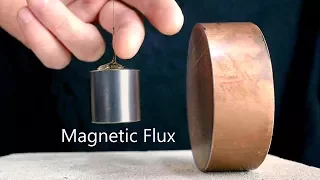
field remaining an interesting side effect of this opposing magnetic field is that diamagnetic materials can be levitated by magnets called magnetic levitation additionally there's nothing particularly special about the atoms that exhibit diamagnetism in fact everything is diamond water wood animals you all atoms exhibit diamagnetism because it's just about the way the electrons orbit the atom and provided there's an electron to orbit the atom diamagnetism can exist scientists have in fact demonstrated this by magnetically levitating certain animals both frogs and mice have been magnetically levitated in extremely large magnetic fields the scientists that have done this
won the ignoble prize technically we could even magnetically levitate humans however the fields required to levitate these frogs and mice were already extremely large and over very small volumes so the amount of energy required in these magnets to levitate a human is just impractical because we are much more massive than these animals the next form of magnetism is paramagnetism this originates from the electrons atoms having a magnetic moment or a spin when there is an even number of these electrons the spins tend to point in the opposite direction and thus cancel out but when there
is an odd number of electrons this rogue electron is free to point in whatever direction it so pleases and as the electron can generate a magnetic field this gives the atom a magnetic field when paramagnetic materials are exposed to a magnetic field they align with the magnetic field any dire magnetism that the atom has is overcome by the far stronger paramagnetic effect and the material increases the magnetic field however just like with diamagnetic materials when it is removed from the magnetic field it returns to normal the last main type of magnetism is ferromagnetism this is
when paramagnetic atoms are closely interacting for example in solid materials and these interactions lead to many of these atoms electrons deciding to point the same direction as one another forming domains of like magnetic states this is usually what people are thinking about when they talk about magnets when they're exposed to a magnetic field they tend to align with the magnetic field just like with paramagnets however when they're removed they maintain this magnetization becoming a permanent magnet this is because the paramagnetic atoms in the material act together to reinforce the magnetization forming these domains of spins
that are orientated in the same direction ferromagnetism leads to standard magnets that we see in our everyday lives but it can also lead to some pretty interesting materials like ferromagnetic liquids that can form the patterns of the magnetic fields that they're exposed to another form of magnetism that is actively investigated in science today is exotic forms of ferromagnetism one such exotic form of ferromagnetism is when ferromagnetic particles get down to the size of around one micron or smaller when they are this size they become super paramagnetic this is where the particle acts as a single
domain however it oscillates in the direction that it's pointing just like a paramagnetic atom would this is really important because it tells us that we can't just miniaturize magnetics below a certain threshold they no longer behave the same way they did when they were bulk materials another interesting form of ferromagnetism is anti-ferromagnetism this is where rather than the atoms action together to form domains they actively work against each other pointing the opposite direction to one another this can vary in the way that it forms depending on in-plane or outer plane anti-ferromagnetism this leads to only
atoms that are on the edge of the material contributing to the magnetic field so they act as if there's only a single layer of atoms that is magnetic similar to anti-ferromagnetism is fairy magnetism it's essentially the same principle but the opposing atoms have a different field strength so that the magnetic field is not completely cancelled rather it is just weakened remember the oldest magnets that were recorded by the ancient greeks lodestones well they were made of magnetite and this is actually fairy magnetic not ferromagnetic so not all magnets are actually ferromagnetic weak magnets can be
very magnetic and some can be anti-ferromagnetic finally there's one other form of exotic ferromagnetism and this is called spin glass this is where the spins of the atoms in the solid act as if they're disordered where the spins don't align in a regular pattern this is called spin glass because the magnetic structure resembles that of amorphous structure of glass that is that it's not crystalline just like quartz is the crystalline form of glass ferromagnetism can be looked at as the magnetic crystalline form of a spin glass so there's many forms of magnetism and there may
be even more that we don't know yet and that's what's exciting about science is you never quite know what you might find thanks for watching