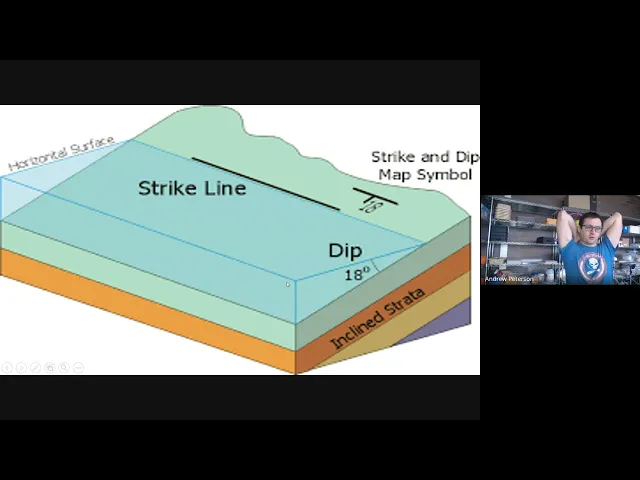
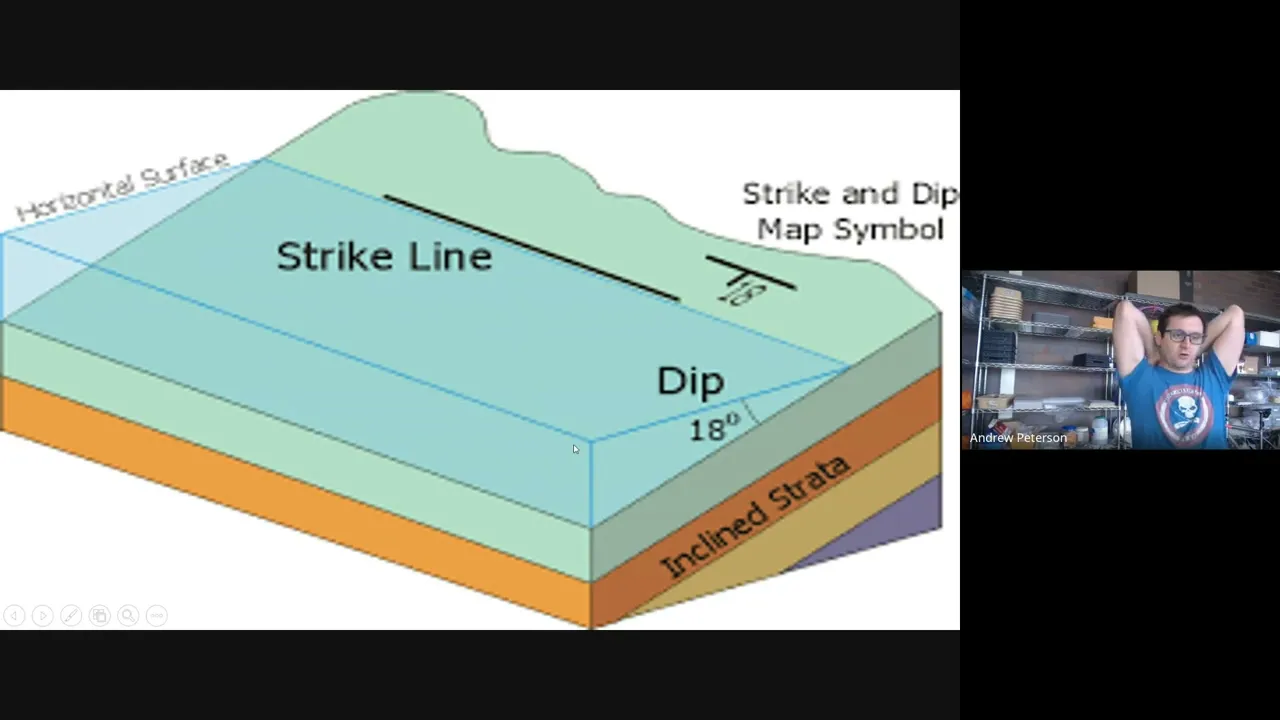
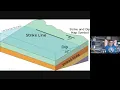
welcome to unit five uh notes compasses and tilting this is video two strike and dip and so we're going to be talking about how we measure strike and dip so uh dip is the angle between the horizontal plane and the angle The Rock and The Rock the and the angle the rock is at so imagine this is my horizontal plane right the dip is this amount so it's like a vertical measurement so if I look at this as side uh the dip is the the angle between here and like wherever my rock is dipped to
so it's like this angle up and down up and down dip is up and down okay it's measured on a 0 to 90 scale um so side not point is dip is always which way it's going down some people sometimes think it's going up no dip is this is the dip angle and why that's important is because it's always measured on a z to 90 scale because at some point if it's dipped more than 90 degrees then this would be my dip so once again 0990 if I pass 90 then this becomes my dip so
a lot of times on the test somebody be like oh the dip was like 210 degrees and I know it's wrong because it's impossible to be dipped more than 90 degrees so this is a 90 degree dip and if I go past 90 once again this Angle now becomes my dip okay side note on this uh cross-sections are drawn along dip to better images so whenever we draw a crosssection of an area we always try to draw it in line with the dip and or perpendicular to the strike by that is is essentially if I
had a let's say a tilted layer like this um if I had a tilted layer like this and I drew a crosssection line like this perpendicular that parallel to strike then as I image this thing it would appear that the rock layer was remaining the same height because it's the same height here same height here same height here same height here same height here okay so whenever I do a a cross-section I try to remember make my cross-section perpendicular to uh strike and parallel to dip because once again if I drew a cross-section line like
this way parallel to dip perpendicular to strike I would see a change in height so as I come towards the screen my rock layer Goes Down and Down and Down and Down okay my strike is a horizontal measurement perpendicular to the dip directions so my strike is uh a horizontal line perpendicular to my dip Direction so here would be like so uh that would be like my strike line so if I look at it this way it is perpendicular in this case it's going this way and my dip is down this way okay this is
on a 0 to 360 scale measured as a horizontal so the strike my strike could be like this on a 0 to 360 scale or if you look look at it a small scale my rock could dipped in any direction like my rock could be my strike could be in any horizontal Direction okay on a 0 to 3 se0 scale this lines up with the cardinal directions so once again uh my dip is the is a a measurement between a hor an imaginary horizontal surface in this case in this image it's lined up with the
the water they use like clear blue layer to represent water and that water then makes a flat surface so my dip is the angle the vertical angle between horizontal and my rock layer and then my strike line is perpendicular to this and now it's not really shown because of how this is drawn in 3D once again my strike is is flat and is pointing in different cardinal directions okay so my strike is measured along a horizontal plane so when you go to measure strip and dip get my compass out when you go to measure strike
and dip keep the compass uh so when you're going to measure strike keep the compass horizontal inside the scale there's the little Bullseye level which is the circular one you want that one to be level because remember strike is a horizontal measurement so I'm going to hold my compass horizontally a lot of people I see like trying to measure strike like this or like this or like this and that makes no sense because my compass needs to be horizontal okay side note the comp the the directions in the compass are the the numbers in the
compass are actually counter are actually counterclockwise well will you spin clockwise essentially what happens is actually I'm pointing North right now so let's say this is my arrow pointing North if I I spin to the right if I spin clockwise my arrow needs to spin counterclockwise to keep pointing North so once again I'll show that as I spin to the right my my needle which is pointing North has to spin opposite of me so it's always playing North so the scale in the compass is opposite of the scale in real life uh because of how
you are spinning relative to the Earth okay we are reading the outside scale so once again we're reading the outside scale the 0 to 360 scale because strike is measured on a 0 to 360 scale the sight of the compass the sight of the compass should point in line with the strike so like here okay and that is perpendicular to dip so once again my dip is like down this way my strike is I'm trying to get a good image of this but it's not great but I'll show you the next remember for strike there's
two possible uh numbers uh North or South um uh you for strike there's North you could use the north Arrow or the strike or the South Arrow because you could get two different numbers side note when you're doing orientation work only measure from the north Arrow so when if you're like trying to go somewhere you only use the north arrow for strike you could use the North or the South because every strike produces the two different values right if the strike is north the strike could also be South the strike is East if the strike
is East the strike could also be West okay because it's a line it's a line so it goes in two directions uh so once again uh measure use the outside of the compass and then you could use the North or the South Arrow because the North and the South Arrow are 180 degrees apart from each other when you're measuring dip the compass lays on its side the compass Lays on its side okay um and we're going to make sure it's pointing straight down the slope I see some people sometimes like if the slope is straight
down like this they'll like have it like like this or like this no you need it so it goes straight down the slope how a ball would roll down it when you're measuring strike make sure you're using the 0 to 90 scale so it's the little one that makes a smiley face inside the circular scale and make sure it points down a lot of people will have the compass upside down and it will give you a rain rainbow no you don't want a rainbow you want a smiley face a smiley face with the 0 to
90 or 90 to Z 0 to 90 scale okay remember you're going to use the back of the compass a lot of people on the test forget about this little lever they are going to use the back of the compass to make the pill level level okay in our Compass we have a little uh a little white line on side of something that looks like a it's shaped kind of like a triangle or like a a piece of candy corn we have a little white line in in there that you're going to use to measure
the on the 0 to 90 scale some the biggest mistake people make is they'll try to use the north south Arrow to measure dip okay so they'll try to use the north south Arrow to measure dip no it has its own little special measurement in there so once again uh you're going to make the make use the back of this to make sure that the dip or the dip the pill levels level you're going to use the 0 to 90 or 90 to Z 0 to 90 scale and you're going to make sure it's U
making a smiley face once again a lot of people have it some people have the compass upside down and the the the numbers will be up here and then the pill level will be down here nope and lastly you want to use the um you want to use the little white line inside of here a lot of people once again try to use the north Arrow South Arrow so on the test I'll get a lot of people that says oh it's like you know it's like 210 degrees or they'll measure the dip over here using
this so they're like oh it's like 57 they'll say oh okay the South Arrow they'll either say it's like 215 degrees or they'll say like oh it's a 55 degrees because the that's where the South Arrow crosses the 9090 scale nope I'm using the little white line and here it looks like my dip is about 50.5 degrees what's nice on the test I am going to accept you know a range of an you know if you say 50.5 and I thought it was 51 you're still going to get points for that okay um sorry my
scanner just went off there we go and that is the end of the notes so once again just remember the little white line in there is what you're using the little white line in there is what you're using on the scale to measure dip