hello my name is Bill Rudolph one of the Writing Reading and Speaking Center instructors welcome to lecture number two for writing 101 joining the conversation where we'll talk about how we might allow our thesis statements and supporting paragraphs to start talking and keep talking to each other the main focus of this week's lecture is actually three-fold to discuss thesis statements to discuss body paragraphs and to discuss how a thesis and its supporting paragraphs can help one another find their best versions of themselves along the way I hope to also show how many other elements are
interconnected in the early stages of academic writing assignments in addition this week's lecture intends to build upon last week's Topics by showing that not only should your academic writing tasks begin earlier and continue more pervasively than you may have realized but also that the next early steps the development of a working thesis statement and the drafting of early exploratory body paragraphs are part of a similar recursive often messy process the good news is if you have followed the advice from our first lecture you are arriving at today's lecture ahead of the game having already been
intellectually engaged by in one form or another having generated some early writing having done so you won't have to face the daunting blank page without plenty at your fingertips to help you to improve upon it while it's important to acknowledge the importance of writing to demonstrate knowledge after all that's how you prove to your professor that you get it and the purpose of contributing to a scholarly conversation remembering that we're joining conversations that are already in progress this lecture will emphasize the importance of intellectual engagement by writing to learn I am convinced that the others
are natural nearly inevitable outcomes when writers write with the goal of making intellectual discoveries during the writing process and so therefore if we look at Sir Isaac Newton's quote in which he says if I have seen farther than others is because I have stood on the shoulders of giants which is often what we do in Academia it begs the question how can writing allow us to see farther I'd argue that one way is through writing to learn in brief the cyclical method I'm encouraging is as follows once you have a vague working thesis draft early
exploratory body paragraphs doing so will help you contextualize your best supporting evidence more fully and effectively grappling with each supporting piece of evidence in the context of making a specific point within each of those paragraphs will lead you to rethink and more effectively revise your thesis that rethinking of your thesis will help you identify and clearly and clarify additional points that will become additional supporting paragraphs Etc this cyclical process will let you write to learn in a way that you will make new discoveries the word thesis originates from a Greek word meaning something put forth
yet in academic writing we must do more than just put forth a topic we must do more than summarize as you might do in a report while summary of something specific can provide important context summary should not be should be minimized to what your audience needs to be reminded of sometimes when working with students on literary analysis papers I'll repeat the mantra more point less plot therefore a thesis that suggests summary alone is not enough you might also put forth your opinion as in social media and relevant opinion used carefully may effectively extend an argument
yet opinion must be appropriate for the argument and the audience and it must be positioned thoughtfully and supported most importantly it must be supported objectively therefore a thesis that suggests opinion alone is not enough we must put forth in academic writing some sort of argument to paraphrase the Grinnell guide a strong thesis statement should not only present an argument but also respond to the prompt and demonstrate that you know your topic if you have not yet read pages 52-55 in The Grinnell guide I I'd encourage you to do so especially the link to Professor Eric
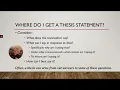
Simpson's five ways of looking at a thesis He suggests that your thesis should also say something a little strange which is really important give the paper a direction that your reader can follow be related to the magic thesis State sentence which he explains and says something exclusive to the particular text not something general as well as making a lot of information irrelevant which has a lot to do with specificity so this brings us back to the question where do I get a thesis statement if you reflect back on the first lecture you'll have many many
more places from which to draw but at this point you might consider what does the text say or what does the author say what can I say in response to that and specifically why am I saying that why am I responding the way I am under what circumstances or in what context am I saying that and lastly to whom am I saying it audience is always important lastly given all of that how can I best say it often a thesis can arise from our answers to some of these questions here's an example should all residents
of a hall be required to pay for damage to to lounge areas when the persons responsible can't be identified think about that your answer might be yes because or it might be no because or it might be both yes and no depending on etc it's more complicated than that but that's where you might begin notice this question should all residents of a hall be required to pay is complex enough that a reasonable person could support not only the affirmative the yes and the negative the no but also they would be compelled to explore the interesting
gray areas and that's where we want to spend most of our time in academic writing of course all along the way we want to consider our readers' needs and it all begins with that essential question that a thesis should answer what's your point yet not only does a thesis suggest an answer to what's your point but also how will you make your point therefore there are three types of thesis statements that you may end up developing organizational argumentative and delayed an organizational thesis says to the reader I have surveyed this material and this is how
we will travel through it it identifies the structure your paper will follow such as chronological order main divisions recurrent themes or perhaps compare and contrast just to name a few some research papers may call for an organizational thesis when in doubt as with everything ask your professor during office hours an argumentative thesis makes a claim serves as an implied contract with the reader saying I will prove this arises from a specific point of view answers an interesting debatable question again it should be strange perhaps is succinct and clear so very concise very clear with only
the context of what they've read in the introduction its scope should be narrow or broad enough to fit the reader's expectations it should evolve as you write it is not a person opinion or belief too big or too small in scope two grandiose two general or vague the third type of thesis statement the delayed thesis is the exception to the rule it's best used when a topic clearly has two sides allowing a writer to present both sides objectively and then waiting for the conclusion to indicate the claim or the belief about which side has the
strongest evidence if you look at the notes I point out that this inductive essay structure is so uncommon that you would want to check with your professor before using it and if you were to submit a paper that uses a delayed thesis or an induct or a inductive sort of reasoning you would definitely want to identify that within the paper when we talk about the goals of a finished thesis you should keep in mind that it's a process once you have a finished essay that is when a thesis statement should create clear focus by announcing
your main ideas and identifying the organization of your supporting ideas evidence and overall discussion early on it may not accomplish all those things so eventually an effective thesis statement should be specific limited and direct one of the aspects of a finished thesis is that should be specific if you look at the specific example the first one you'll notice that the writer has identified four specific parts of the paper when talking about a good ex Community exercise program in the vague example the writer simply says that a community exercise program is good which is vague in
itself when it has room for people who want to exercise for all sorts of different reasons those specific different reasons should be identified in the finished thesis now one caveat early in writing a paper we often begin from a vague thesis statement and that is entirely acceptable we may not know the parts of the paper when we begin your eventual thesis should also be limited if you look at the first example it covers use of fossil fuels for 75 years which actually is quite large in scope it could be the chapter in a book but
if you compare that to the two broad thesis statements that could be a book in itself with each part the use of fossil fuels and transportation the development of cities and agriculture Etc could be a chapter in itself a thesis should of course be direct if you look at the first example despite all their protests to the contrary people tend to Value appearance likelihood of success and similarity of background in choosing a mate and then you read the second one in which I would need to take a big breath people may say they look for
Spiritual qualities rather than looks in choosing a mate yet research points out that they are more likely to be influenced by some traditional factors and these are likely to include how a person looks whether or not a person is likely to succeed financially or in Social terms and the extent to which the people's families experience in social class are similar the two thesis statements say relatively the same thing the second one is too bogged down in language so in addition to being specific Limited Direct rather than being vague too broad or bogged down a thesis
should be debatable compare within American capitalism small towns in the midwest provide the highest quality of life by fostering a culture that de-emphasized de-emphasizes the pursuit of wealth and social climbing while encouraging tradition family and other interpersonal Community relationships that is certainly more debatable than the more self-evident thesis to have a high quality life relationships are important the point of the last one is we do not argue what is obvious we argue what another thoughtful person could reasonably argue against yet remember effective thesis statements seldom start out specific limited and direct or perhaps even debatable
they begin as tentative thesis statements that provide Focus for planning as you draft and revise they become clearer and more sharply focused eventually taking final form in the finished essay one of the tools I want to provide you is for the strategy of keeping track of your thesis Evolution as you work on your papers so I will send you a copy of this along with the homework this week you might write down your initial working thesis statements at the beginning of the writing process then keep track of how it changes to a modified working thesis
statement somewhere in the middle of the drafting process you'll notice that it may get a little longer as it becomes more specific then you might write down your revised thesis statement close to how it might appear in the final draft of the essay you'll notice it's also longer being more specific but perhaps not longer than the modified working thesis because it may have become even more concise and clear there after that you might check yourself by asking the question or by identifying how the revised thesis is more specific more limited more direct and ultimately more
debatable than it was when you first began the process so here's a few final questions to consider is your working thesis statement evolves although your thesis statement is likely argumentative like a research paper statement does your working thesis statement hints at an organization and if so what organizational strategy is implied do you think this paper would be effective utilizing a delayed thesis why or why not keeping in mind that that's kind of the exception to most academic papers does the statement make a claim that answers an interesting debatable question is the statement provable yet does
it avoid Reliance on opinion is the statement specific rather than vague is a statement limited rather than Broad and is the statement direct expressed clearly and succinctly rather than being bogged down throughout this course I hope you will continue to ask the question what works for me and after saying everything I've said so far given that it's all but certain you've written thesis statements in the past I encourage you also to consider what has worked well or hasn't worked well for you within your prior writing processes perhaps you are taught to think of a thesis
as a statement of purpose or a central claim or a foundational premise lean into those particular Concepts if those terminologies resonated with you in the past perhaps you were taught first to narrow the focus of your topic early on by asking an essential question then you were told to flip that question into a statement that asserts a claim perhaps those questions startled you or bothered you or thrilled you sometimes those are the best kind if you don't remember what worked or didn't work for you during previous writing assignments I'd encourage you to keep to start
to keep track of that now by recording and reflecting on what went into your most and least successful writing attempts you can save yourself a lot of time efforts and repeated frustrations in the years to come no matter the method you use to begin to develop a working thesis as you read in the Grinnell guide as you read in the Grinnell guide one of the most common mistakes one can make is to start too large remember it is better to begin with a narrow Focus because as you may already have discovered it is much easier
to expand the scope of your arguments later if necessary than it is to begin from a thesis that is overly Broad once you begin digging in you will find much more than you knew was there it only makes sense then that the most authentic Theses often arise from particularities perhaps a single provocative quotation from a reading that struck you in such a way that you couldn't help writing a short but charged notation a startling annotation or near paragraph length Connection in response to it a strong case can be made for beginning from a specific intriguing
piece of supporting material sometimes we need no more than that to provide the spark for which we can begin to write likewise remember to begin drafting exploratory body paragraphs you do not need to have written a complete thesis that identifies each of the aspects you will explore or all of the parts of your paper after all you probably cannot know what those will end up being during the early stages of refining your paper's focus rather once you have a vague thesis perhaps a general claim related to a specific topic you should ask what is the
one piece of supporting information that is essential to asserting my claim or you might ask what is the most intriguing unique or complex aspect of my assertion and therefore the most essential aspect for me to explore or you might ask what aspect of this claim am I most excited to delve into the point is you only need one element that you are confident you want to include in order to begin to draft exploratory body paragraphs so again what works for you just as we must figure out what works best for us we must remember that
ultimately our readers do need structure as we consider the art of paragraphing as the next level of an essay structure each of us should ask whether we find the structure for our writing in our head or on the page are we able to fully conceive of our essays best structure or do we need to write and revise our way toward it if you like me harbor some prejudices against structure imagining it is confining I have more good news for you just as more freedom exists within a clearly defined structure that emit chaos it's true in
all parts of life as writers our thinking can amply can find ample freedom within the clear structure our readers need and before I go on I would be remiss to pause here and remind you that as we know there's no single linear writing process that works well for everyone also I must admit that it's likely that teachers who are also writers tend to teach toward what they have found works best for them yet I maintain that beginning to write exploratory body paragraphs soon after settling on a vague working thesis statement is an approach that works
well for many I must acknowledge that while the approach I'm promoting may seem to bypass developing an outline or a similar structural pre-planning that is not necessarily the case while I've encountered a handful of scholars unlike yours truly who are able to to quite comprehensively envision a viable structure for a writing task before putting pen to paper or fingers to keyboard in my experience they are the exception of the rule if you are one of them congratulations thank you so before focusing on paragraphs I want to remind you of the five paragraph essay form that
you may have encountered in the past and say that learning this form is a helpful step in writing development at least to teach young writers that an essay needs a logical structure but one that I wish teachers would help students move beyond after about eighth grade because of how it encourages over packing paragraphs yet to move beyond it is simple just think in terms of sections instead of paragraphs perhaps three sections there's something nice about threes rather than bot three body paragraphs then accept that you will need a number of likely shorter paragraphs within each
section the number depending upon the number of points you need to make within each section of the paper I'm always asked but what about longer papers say a paper of 25 pages I always say we don't write 25 page papers we think in sections and write five five page papers seamlessly woven together and you likely have written many you will likely have written many five-page papers before you're asked to tackle a long one so to answer the question about whether there's a place for an outline in the process I've been promoting I would first point
out how the Grinnell College guide provides many different examples of outlines that range from very formal detailed ones to more informal less detailed ones on pages 23 to 30. so look back to that as you're making your outlines the important thing to me is that you should avoid just as you should avoid falling in love with your first draft you should avoid being married to your outline for most of us even though we allow the writing process to be a recursive messy endeavor that promotes discovery an outline can be helpful as long as this is
seen not necessarily as an accurate skeleton upon which our finished writing task will hang but rather as an act of structural brainstorming through which we can see one possible version of the argument's many potential logical progressions considered in this way rather than feeling married to an outline a writer can draw from it or any other pre-writing throughout the inevitable surges and hesitations that occurs as we draft body paragraphs say for example your early structural experimentation leads to something like this you've taken your topic and your working thesis statements and you brainstorm off of those possible
supporting points from sources and statistics from personal experiences or examples that have different purposes either to confirm or to refute from lecture perhaps and off of the lecture you notice there are sub points that you can make what happens at this stage is you may start thinking in terms of sections perhaps off of that lecture all of those could come together into a section perhaps you see that the quotations from the two sources belong in accompanying paragraphs in one direction or the other so you end up beginning to create sections out of what was initially
just possible supporting points or you may end up with an outline that looks something like this identifying where your introduction will be and how it ends with your working thesis which you would be able to write down at this stage it might identify your sections and in one section you might have several points that you know you want to include perhaps you write these as possible topic sentences each point representing a possible paragraph so in this example to show the evolution of plant this planning one might decide that in section one the outlines plan third
paragraph contains the point that it at the start at least seems essential in supporting the thesis so the writer might then write that third paragraph first after writing that paragraph the writer might be able to see thanks to the outline that the point of the outlines planned fourth paragraph has become irrelevant but a logical point that hadn't been apparent when they wrote the outline could be developed into a new fourth paragraph that would connect well with the outlines planned fifth paragraph and after drafting those three paragraphs able to see the outlines planned first two body
paragraphs differently perhaps they are necessary perhaps they clearly belong later in the essay or perhaps they could be condensed and revised toward an eventual introduction the point is not only can an outline help you contextualize early possibilities for where your argument might go but also it could offer useful reference points throughout the evolving drafting process remember throughout that process we should be looking back and modifying that working thesis allowing it to evolve as the thinking we are doing within our body paragraphs is evolving also don't forget now and then to look back to the prompt
to ensure that the evolution of your thesis and the development of your thinking through writing continues to address the questions and other parameters of the assignment embracing what may initially seem to be a messier process than the typical linear writing process may feel uncomfortable yet this process actually simplifies the drafting stage by allowing you to focus on clarifying extending and internalizing your understanding for yourself prior to worrying too much about whether you are clearly articulating them for your readers sometimes trying to do both at once can tangle our thinking into knots you may also find
that many of your attempts to write for your own understanding end up in the long run being more clear for others because you have worked to make them clear for yourself and of course if they remain a bit unclear that's what later stages like revision and editing are for finally how does it make any sense then to write your assignments out of order such as waiting to write the introduction until last the way I explain this is imagine a famous Grinnell alumnus is visiting campus next week you have been asked to introduce her to the
student body you've heard her name but don't know much else about her can you write that introduction knowing her name is analogous to knowing your topic for a paper if you happen to know a bit more you might be able to write a vague working thesis but until you have a complete idea about who she is or what your paper is you won't be able to introduce either one of them well as with any piece of academic writing before you can successfully introduce your guest you will need to research her life select what's most important
about her analyze why what you've selected is important to your audience and convince them of her significance of course as with all analogies this one is imperfect because lightning does strike and happy accidents do happen within the writing process if you get a great idea for an introduction don't feel like you have to wait until all the body paragraphs are drafted before drafting that introduction and if it helps you clarify your thinking by writing it first go for it well keeping in mind that it will probably need a significant revision later on after you have
fully fleshed out precisely what it is you are introducing so again I encourage you to try jumping directly from a working thesis to drafting body paragraphs so what should those paragraphs accomplish for your readers to paraphrase The Grinnell College guide to writing research and speaking powerful paragraphs should provide organizational coherence one central point cohesive contents support unified with the paragraphs points a clear relationship with the thesis and full development through the paragraph's point and what should those paragraphs look like PIE the PIE method is as easy as well you know one way your body paragraphs
are likely to look can be described through the acronym PIE stands for the point which is usually the topic sentence of the paragraph the information which are the illustrations that support that point and the explication which comes from the writer and could range from anything from explanation evaluation analysis synthesis Etc all of which clarify how the information supports explains expounds upon and or relates etc the information in the paragraph to the point of the paragraph so where do we find the points usually the paragraph begins with an effective topic sentence that contains that point it
segues naturally from the previous point of the previous paragraph introduces the new paragraphs point by establishing it as a secondary claim implies an answer to that secondary claim a sort of mini argument that the paragraph proves illustrates or otherwise addresses yet rather than standing alone as what I sometimes call a paragraph label usually the topic sentence should do more than just tell what the paragraph's about it should extend into the paragraph a bit sort of touching the heart of the paragraph by connecting to an illustration the illustrations are simply the evidence that proves or otherwise
supports the point of the paragraph these can be presented through quotations paraphrasing summary or a combination of those explication explains how the illustrations prove the point there are many many ways to explicate I will hand out to you a more detailed version of the PIE method as one of the resources that I hope you will look back to and spend time with as well as an exercise in which you apply your understanding of the PIE method and how it works in practice to demonstrate the simplicity of the PIE method let's look at an example paragraph
where is the point in this paragraph if you said the first sentence the topic sentence you're correct where's the information begin or the illustrations obviously this has a big giveaway with for example it continues giving information or illustrations by talking about The Writing Center for three sentences ending with the Writing Center also has tutors available to help me with my homework when the writing center is closed but at that point something different happens the writer isn't just giving information any longer and the last sentence or two functions as explication explaining the importance the significance of
all of the information that has been given within this simple structure there's a lot of variations that occur if I were to ask the question how many pieces of information or illustrations must you have in a paragraph and how much explication should you have in a paragraph it's not a fair question because each paragraph is going to is going to need more or less of one or the other in some paragraphs you might just have one piece of information and a whole and a great deal of explication required another paragraph might be filled with information
they require very little expectation so even though this does seem somewhat formulaic you can see that within this form you have a lot of freedom one other point that I mentioned a minute ago that this example illustrates is that the topic sentence is not just a paragraph label if it were to end here and simply say another reason Texas City College is a good school or there is another reason Texas City College is a good school that would be a paragraph label but in this case it goes on and says why right there in the
topic sentence extending into the paragraph effectively well within each of your body paragraphs your professors want to find clear concise topic sentences and well selected naturally presented illustrations what they want to see most is your original thinking within the explication portions of your paragraphs to succeed in developing paragraphs that start with effective topic sentences many of those topic sentences will likely need to evolve much like thesis statements as you wrestle with explicating your supporting examples also to succeed in moving with a logical progression of thoughts especially to create a cohesive structure between paragraphs you will
need to draw upon a variety of transitional strategies the writing guide can help with that I want to leave you with some questions for checking drafted bodies or supporting paragraphs did you avoid excessive summary what types of supporting examples did you use did you use a variety of those do you have at least one citation indicating specific outside information within each body paragraph and did you cite them as you drafted it's important to cite as you draft so you don't forget to cite something which could get you into difficulty with academic honesty did you include
ample explication finally does at least one paragraph introduce a reasonable claim that runs counter to your arguments thereby allowing your argument to be more balanced through refutation what I've tried to do in this lecture is what we often do in Academia we break things down in order to understand them in their parts but we hope to also put them back together again and understand them holistically therefore while this lecture has explored two distinct elements within the academic writing process I hope it is also demonstrated like all parts of the writing process how your theses and
body paragraphs are dependent on one another


![Hands-On Power BI Tutorial 📊Beginner to Pro [Full Course] ⚡](https://img.youtube.com/vi/5X5LWcLtkzg/maxresdefault.jpg)