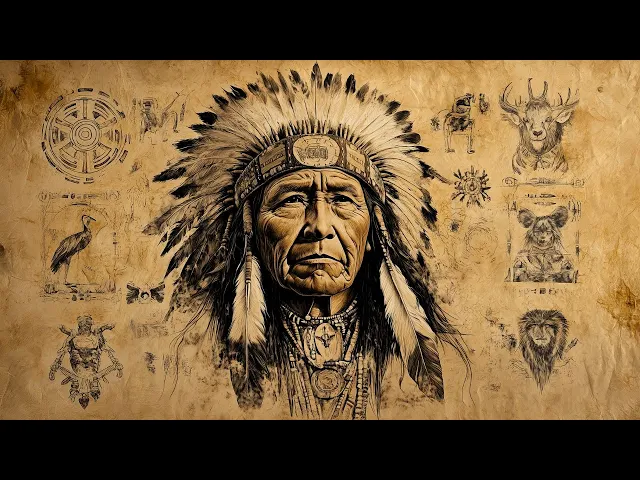
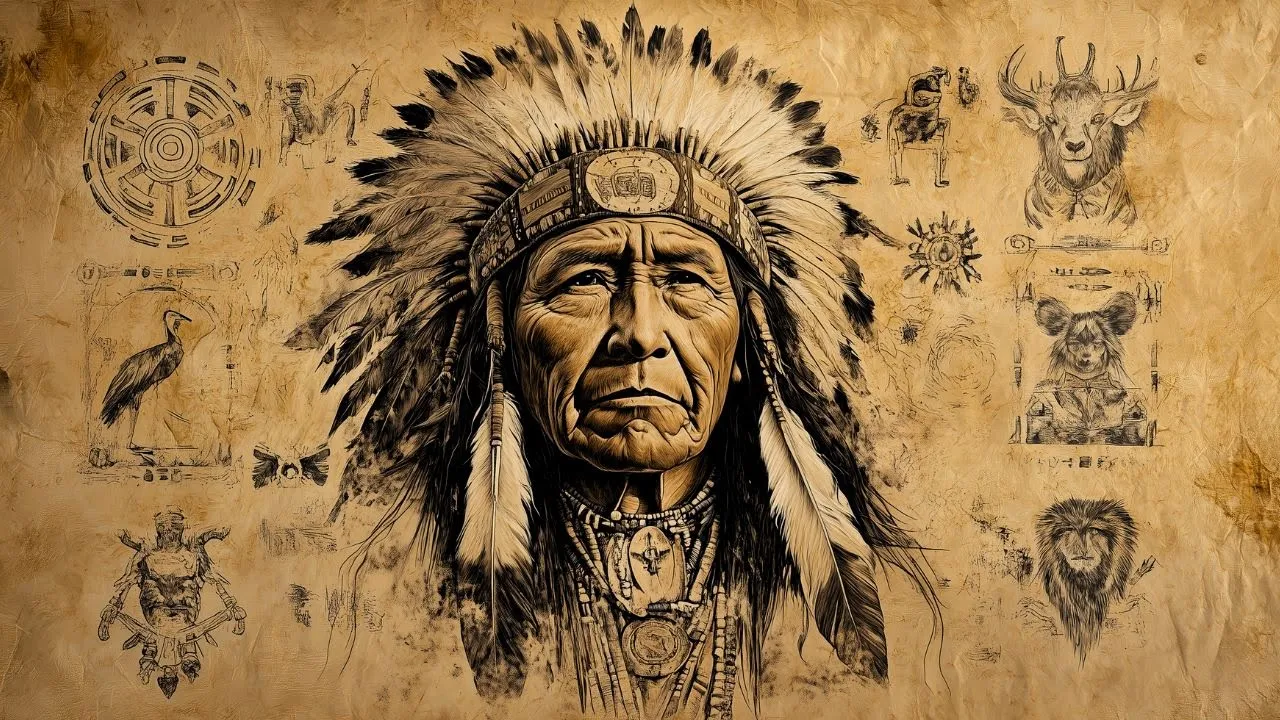
A long time ago, before paved roads and skyscrapers, the American continent was a living mosaic of tribes and nations. These were peoples who walked in harmony with the earth, honoring every river, every tree, and every animal as part of a vast spiritual tapestry. For thousands of years these cultures thrived, creating social, spiritual, and ecological systems that reflected the depth of their wisdom.
They observed the stars to guide their journeys, listened to the winds to understand nature's messages, and sang to celebrate the very act of existence. But with the arrival of colonizers, much of this knowledge was lost. This is the story of wisdom that time almost made us forget, yet still echoes in the land, the rivers, and the hearts of many.
Prepare for a journey through time, where the voices of elders and the whispers of the earth can still be heard. This is a story of respect, harmony, and spirituality. This is the story of the indigenous peoples of the Americas.
Before any border was drawn by foreign hands, the American continent was a vast mosaic of life. From north to south hundreds of nations flourished, each with its language, traditions, and unique way of interacting with the natural world. These lands were not contested territories, but sacred homes, carefully protected by those who believed the earth belonged to no one, and all belonged to the earth.
On the plains of Central North America, the Lakota followed the movements of great bison herds, recognizing in the animals the gift of sustenance and balance. In the west, the ancestral Puebloans built stone cities that seemed to grow from the very mountains, harmonizing architecture and landscape. Further north, the Haudenosaunee, known as the People of the Longhouse, created one of the world's first democratic systems, a confederation uniting five, later six, great nations in peace and cooperation.
Each people had its unique relationship with the land. For the Tupi Guarani of the southern tropical forests, nature was a reflection of the sacred, and every river and mountain carried stories of gods and ancestors. Meanwhile, the Inuit of the glacial regions demonstrated their deep wisdom by adapting to the harshest climates, finding food and shelter where others saw only ice and desolation.
These nations did not merely survive, they thrived. Trade networks connected distant tribes, enabling the exchange of goods, ideas, and stories. The Atlantic shells found in the Great Plains and obsidian from the west discovered in the east testified to societies interconnected long before modern globalization.
Yet more impressive than their trade routes or constructions was the shared philosophy among them, a profound respect for the interconnectedness of all things. They believed humanity was but one thread in the web of life, and breaking that balance would bring chaos to all. The American continent was not a wilderness to be conquered.
It was a vibrant, complex world shaped by those who understood that true greatness lies in living in harmony with everything around them. One continent, a thousand peoples, and a lesson humanity still struggles to learn. Native American tribes and nations were far more than mere human groups.
They were complex societies, each with its governance systems, codes of conduct, and rituals ensuring internal harmony and collective survival. These organizations reflected profound wisdom about communal life, where each individual had their place and their contributions were recognized. Among the Haudenosaunee, known as the Iroquois Confederacy, governance was an impressive example of balance between central authority and local autonomy.
This confederation, formed by six nations, was based on a system of consensus where tribal leaders convened in a grand council. Every decision was made not only with the present in mind, but also considering its impact on the next seven generations. This long-term vision reflected respect for the continuity of life and nature.
It was also a system that avoided tyranny and ensured every voice was heard, regardless of status or position. In the southwest, the Hopi maintained a deeply spiritual and decentralized society. Each village was governed by a council of elders who collectively decided important matters.
Their governance was intrinsically linked to spirituality, with many decisions guided by ceremonies and signs from nature. For the Hopi, leadership was not imposed but recognized as a sacred duty. Moreover, their oral traditions ensured that spiritual and practical teachings were passed from generation to generation, preserving the essence of the community.
In the heart of the Great Plains, the Lakota divided their societies into smaller bands, each with a leader chosen by merit. Major decisions, such as war or collective hunts, were made in larger councils where every warrior and elder's voice was heard. This fluid organization allowed the Lakota to adapt to seasonal changes and environmental challenges.
Their ability to quickly reorganize in times of need was one of their greatest strengths, reflecting the adaptability that ensured their survival. Meanwhile, the peoples of the northwest, such as the Tlingit and Haida, created social hierarchies marked by clans. These clans not only organized social life but also dictated rights to land and natural resources.
Each clan had its origin stories, emblems and spiritual lineage, celebrated in elaborate ceremonies like potlatches, feasts where wealth was distributed to reinforce alliances and demonstrate generosity. This practice strengthened social bonds, balanced resources, and ensured no one hoarded excesses. The common thread in all these organizations was the same.
One wavering respect for cooperation and interdependence. Among Native American tribes, decisions were rarely made by a single individual. They resulted from collective debate and often had a spiritual character.
Leadership was seen as service, a responsibility to the community and ancestors. Additionally, there was an emphasis on constant learning, where every tribe member contributed their knowledge and skills for the common good. Native American tribes and nations had an organization that transcended politics.
They demonstrated that true leadership is born from respect for life, community, and the earth. A teaching that, though lost to many, can still serve as an example for us and future generations. The spiritual practices of Native American peoples were a celebration of the interconnectedness between the physical and spiritual worlds.
To them, the earth was not merely a place to live, but a living, sacred being whose divine essence could be felt in every mountain, river, forest, and animal. This spiritual vision permeated all aspects of their lives, from rituals to daily activities. Among the Lakota, spirituality revolved around the concept of wakantanka, the great spirit or great mystery.
This divine force was not represented by a single entity, but by the sum of all energies in the universe, connecting everything that exists. Rituals such as the sun dance symbolized sacrifice and renewal, linking the individual to the cosmic order. During the ceremony, participants would dance for hours in devotion, connecting with natural cycles and praying for harmony within their communities.
The Hopi, on the other hand, believed they were the guardians of balance between the physical and spiritual worlds. Their ceremonies, conducted by the kachinas, spiritual beings representing aspects of nature and ancestors, sought to bring rain, fertility, and prosperity. Every dance, every mask worn during rituals, was a manifestation of respect for the sacred and a way to communicate with the divine.
Balance and harmony were maintained through strict observance of rituals passed down through generations. Among the Amazonian peoples, such as the Tupi Guarani, spirituality was deeply connected to the concept of terra sem mals, land without evil, a state of spiritual purity and balance. They believed that through songs, dances, and the ingestion of sacred plants and forest medicines, such as ayahuasca, they could achieve visions to guide their communities and connect with the gods and spirits of the forest.
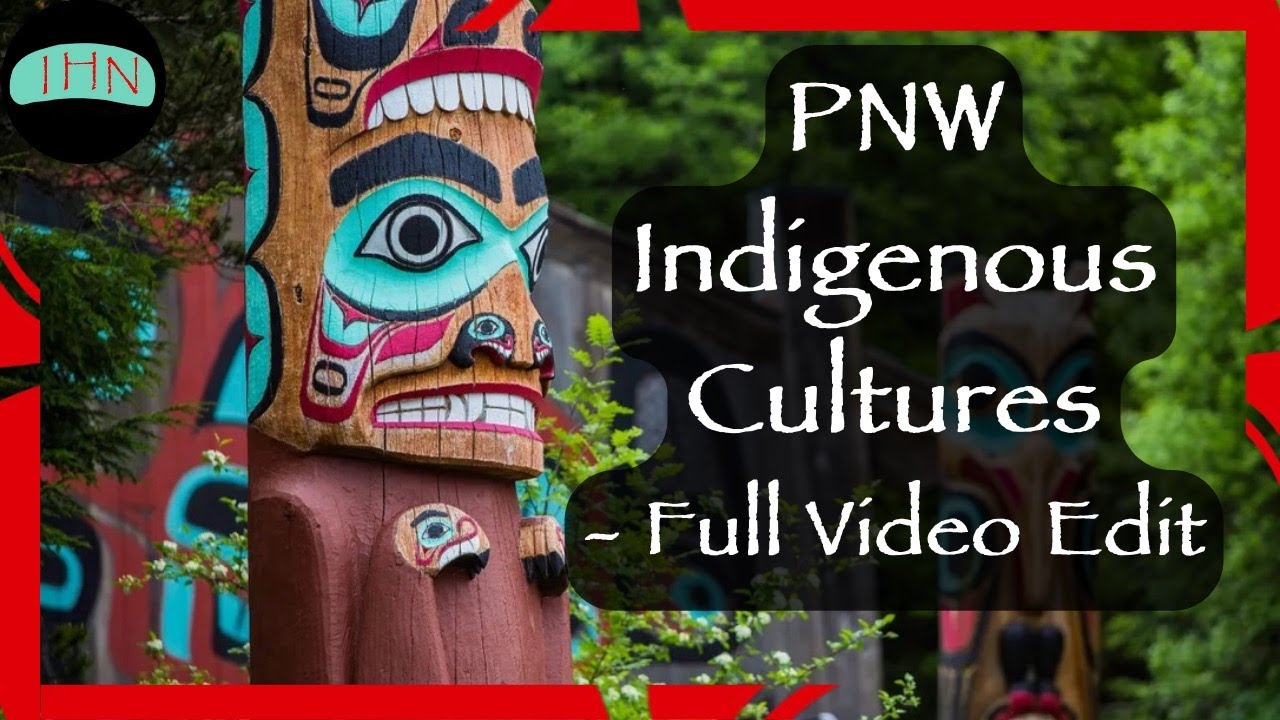
These rituals were also moments of healing, where body and spirit were treated as an inseparable unity. The peoples of the Northwest, such as the Haida, incorporated spirituality into their art, particularly in the creation of totem poles. These monuments were far more than sculptures.
They were living stories representing lineages, myths, and relationships with the sacred. Each carved figure carried profound meanings, symbolizing connections with ancestors and the natural forces that shaped their lives. In all these cultures, spirituality was not an isolated practice, but something that permeated everyday life.
Before hunting, fishermen and hunters would offer prayers and offerings, thanking the spirit of the animal for its gift. When planting, farmers would sing to the earth, asking for its blessing and fertility. Even the acts of building a shelter or lighting a fire were surrounded by rituals that acknowledged the sacredness of each action.
Spiritual practices also played an essential role in healing. Shamans, seen as bridges between worlds, used chants, medicinal plants, and dances to treat illnesses viewed as spiritual imbalances. These healers not only restored physical health, but also reconnected the individual with the web of life.
The wisdom of these spiritual practices transcends time and invites us to reflect. What if we lived in a world where every act was an act of devotion? Where each step was taken with gratitude, and every word spoken carried the weight of the sacred?
Perhaps, like the Native American ancestors, we could rediscover our own connection with the divine. The philosophy of interdependence was at the core of the Native American way of life. They viewed the world as a vast web, where every being, every element of nature, was interconnected and played an essential role in the harmony of the whole.
This vision was not just a spiritual belief, but a practical philosophy that guided their decisions and their relationships with the Earth and each other. Among the Great Plains peoples, such as the Lakota, the concept of Mitakuye Oyasinja, all my relations, symbolized this connection. It did not refer only to human relatives, but to all forms of life, from the bison to the wind blowing across the prairies.
The Lakota believed that harming any part of the web of life meant harming oneself. This belief was reflected in their respectful use of natural resources. Every part of a hunted animal was utilized, and rituals of gratitude were performed before and after the hunt.
The Hopi, known as the People of Peace, lived this interdependence through their relationship with water and the arid lands of the southwest. For them, survival depended not only on human labor, but on a sacred partnership with nature. Therefore, their agricultural practices were based on rituals that invoked rain, recognizing that without the help of natural elements, life would not be possible.
This understanding shaped how they planted, harvested, and even shared food, always in harmony with natural cycles. This philosophy of interdependence also permeated their relationship with past and future generations. For Native Americans, time was not linear, but cyclical.
Ancestors were not distant. They lived in stories, rituals, and the land itself. Similarly, every decision was made with future generations in mind, aiming to preserve resources and balance for those yet to come.
This concept of intergenerational responsibility is encapsulated in the Iroquois practice of considering the impact of every decision on the next seven generations. Moreover, interdependence was lived daily in the sharing of responsibilities within communities. Everyone had a role, from the youngest to the elders, who were seen as living libraries of wisdom.
Survival was not an individual endeavor, but a collective one, with each person contributing to the well-being of the group, whether by hunting, farming, teaching, or healing. The Native American philosophy of interdependence offers us a vital lesson. We are not isolated islands, but part of a vast web of relationships.
They show us that caring for one another and for the earth is not just an ethical duty, but a necessity for survival and prosperity. In a world where disconnection and selfishness prevail, perhaps it is time to rediscover this ancestral wisdom and remember that, as they said, everything is connected. With the arrival of the colonizers, or rather the European invaders, the Native American peoples faced centuries of dehumanization and cultural loss.
Cultural lands were invaded, destroyed, and desecrated. Languages were silenced, and spiritual practices were banned. The overwhelming force of colonization led to the destruction of countless traditions, yet it could not entirely extinguish the essence of the wisdom these peoples carried.
Despite the hardships, many of their teachings still echo in the modern world, inspiring movements for justice and sustainability. During the 19th century, government policies such as native boarding schools in the United States and Canada had the explicit aim of eradicating indigenous cultures. Children were forced to abandon their languages, customs, and spirituality.
Yet in secret, many families continued to pass down their traditions. The Lakota, for instance, kept alive the practice of the Sundance, a spiritual ritual symbolizing renewal and cosmic connection. Today, this ceremony stands as a powerful example of cultural resistance and a bridge between the past and the future.
The Hopi preserved their prophecies, which warn of the dangers of ignoring humanity's interdependence with nature. They believe that the environmental and social imbalances we face today are the result of straying from sacred paths. These prophecies have become a guiding light for those seeking to restore harmony with the earth, offering a vision of hope rooted in respect and collective responsibility.
The ancestral wisdom of the original peoples of America invites us to reflect on our own choices and priorities. Their teachings show us that true progress lies not in reckless exploitation, but in creating a balance that honors all forms of life. It is a call to listen to the echoes of the past and walk forward with greater awareness and gratitude.
After all, as many of these cultures believed, what we do to the earth, we do to ourselves. Thank you for watching.