let's start with a question so if you're running a race and you pass the person in second place what place are you in your mind says well if I pass the person in second place I'm in first place and that's a good cue up for talking about scientific thinking in Toyota kata that is not to believe everything we think what to test it to test those things and that gets at the scientific thinking idea so what's Toyota count about me a little bit of an impression here number one a way of working and a way
of working together how it advantageous it is if everyone has a somewhat common way of thinking a somewhat common language a somewhat common way of working and that that is a scientific way of thinking so we don't plop into a new team and start arguing about your idea versus my idea instead we all know that ideas need to be tested and we know how to test ideas and we know how to test them quickly and so we have a conversation about what's our next experiment and how can we run that experiment really quickly number two
scientific thinking as an ingredient that makes some teams and organizations particularly effective when the path is unclear when the conditions are dynamic and changeable when we just don't know then just planning is not enough so scientific thinking actually kind of a vital skill for the conditions we find ourselves in in this early 21st century and finally what's Toyota count about it's an aspect of your thinking of your behavior and even of group thinking and behavior which would be organizational culture that you can develop through practice and I think this third one is still a little
bit of a theory and a hypothesis I think that's kind of the ground where we're at and the Toyota kata experimentation is kind of at can we change organizational culture team culture family culture classroom culture can we you know change is actually the wrong word like modify can we modify the culture and you know if you read the Toyota kata practice guide that's a one-on-one book that's you coaching me to change my skills to change my mindset then the Toyota kata culture book is one where we're like okay how would you do that to scale
but at that point I think our knowledge is pretty thin on the ground experimentation potential quick review just a quick review of the Toyota kata research findings again the book came out 10 years ago now but from 2003 to 2009 we studied specifically Toyota's management approach we basically went back and said you know we know a lot about Toyota but it doesn't seem to stick when we try it here so here's what we found there's all that visible stuff about Toyota which is their astonishing results which continue which is what attracted us to Toyota in
the first place but also as you know as well as anyone all the lean tools and practices just a few examples here the list could be much longer shop floor techniques you shaped cells hey junka Kanban and on and so forth gimbal box is very popular subject team leaders the whole problem solving efforts that kind of thing practice problem solving and so forth all of these things there's they're visible and you can go there and you can see them and you can come home and try to implement them in your organization which is what we
try to do many times what we found and this is really what Toyota kata is about is underneath that is something that's a little less visible and it is number one there's a systematic scientific way of thinking and acting that they practice that they train they don't want their people to jump to conclusions at Toyota if you don't know they want you to say I don't know they don't want you to fake it I thought working it try to be easy you know you're in a meeting and they say Mike what do you think we
should do I don't know you know that was my contribution for the day all right you know turns out it's not quite so easy the Toyota manager says good I'm glad you said you don't know now explain to me how you're gonna figure it out what's your next experiment you know show me getting a three going you know what do we know about where we are and when did you go to the gimbal and see what's actually happening so a systematic not jumping to conclusions a scientific way of thinking and acting and number two because
that way of thinking and acting is not our natural mode you have to practice it you have to teach it you have to practice it almost every day and if you're going to practice every day you need a coach and there's only one person who can coach you and that's the manager the lean promotion department can't coach everyone every day it's physically impossible and it is a Homer Simpson adult slap moment you'll sort of look at the lean promotion department you start figuring out oh this is what they're doing it's a systematic scientific way of
thinking acting and they're and they're practicing it every day hmm the lean the promotion department can't be out there watching everybody practice everyone there's only one person who can do that and that's your boss your manager your team leader it also explains a little bit why they have team leaders at Toyota there are other reasons somebody pulls the N on chord somebody's got to come you know if you have 30 people and they're pulling the N on chord all the time you know you can get there but the other thing is to help inculcate this
way of thinking the other thing that happens is we occasionally get this question I'm sure you've gotten it oh now there's this kata thing do we have to do lean or do we have to do kata you know and it's like oh that's interesting it's not either/or it's not the top or the bottom they go together and notice that the bottom part is not about Toyota it's about human beings it's about capability that's latent but they're things that human beings can do and so let me just go back to the first slide katakana five this
was the opening slide developing and utilizing human capabilities by practicing scientific thinking so what we also found it was kind of a thinking pattern now this is a model this is a model made by a researcher this picture does not hang anywhere at Toyota and if you follow different Toyota managers around you'll find different versions of it there's a lot of variation but the cool thing is that if you look long enough you begin to see a pattern and that's what this is this is an attempt to write down this is how they tend to
work and this is what they tend to teach and it's just four basic steps get the direction or challenge where are we going what's the big goal we're shooting for they tell me what are you trying to achieve where you trying to go that's that's actually an important question important enough that they have you know annual challenges within the company the second step on the lower corner grass the current condition where are you now maybe relative to that challenge you know there's a statement that if you understand the current situation well enough you'll almost know
what you need to do next the third step is what do we need to get to next the target condition right where do we want to be in a week or two or three and the fourth step is attacking the obstacles and experimenting against the obstacles and it's a kind of a scientific thinking pattern the thing is though it's a very practical scientific thinking patter it's a scientific thinking pattern that you can use in your everyday life if you look at this everybody thinks step four is what makes it scientific experimenting it's not just experimenting
that makes this scientific if you look at scientists they're not just experimenting they have a research topic they're working on is just like a challenge they do secondary research what's already been done what do we know about this subject they establish a research question very analogous to a target condition and then they actually have research problems which are the obstacles which are the actual what are you working on right now I asked a scientist let's talk about scientific thinking briefly again is kind of a background for your participation in the conference think of it maybe
as an antidote to our natural jump to conclusions nature and the word natural there is very important we come by it honestly and it serves an important function and we'll talk about that number two it's a process of learning from I like this word mismatches when what we think is going to happen doesn't happen when something else else happens or an error because the errors reveal what we need to work on they show us what we need to work on to reach our goal I think a lot of people still think scientific thinking means you're
going to do an experiment to validate your idea and you go yep the experiment went just like we thought hooray my idea worked that's not really the whole deal that may even be the smaller part of it the more interesting part is to do the experiment and go oh interesting what we expected isn't happening that's telling us what we need to focus in on that's what we need to focus in on so again learning from errors learning from mismatches and finally bringing it up a notch from the world of science it's useful for navigating toward
goals as I mentioned earlier in complex dynamic unpredictable conditions we can use it scientific thinking maybe you can think of it this way basically what we take in the information we take in whatever matches our existing neural habits is what we see that's what we pick up at first glance but if you practice scientific thinking and test things and keep digging and you get things wrong and you say oh that's interesting you adjust you begin to dig deeper into objective facts a reality reality is out there we don't see it we get an interpretation of
reality our brain only gets electrical impulses there's not a glass tube between your brain and your eyeball there's a wire that's interesting the light is not shining onto your brain like a projector you know upside down but you know there's a wire and the brain is getting little did it today attitude today it's a little impulses right and the brain is taking those impulses and deciding what that means he's wearing a blue shirt I'm 99.9% confident that I'm correct they're right but there are other things it makes interpretations so if you start digging you're going
to see more and more and more of reality and that's going to help you navigate I like this diagram I also like the fact that the green never fully fills the reality we don't get to see full reality so it's like navigating with a compass not a map it may be the best means we currently have for navigating through complex dynamic I'm particularly toward challenging goals and and here's an interesting corollary you can establish challenging goals for people if the people have practiced an effective way of navigating their way this is different than the empty
empowerment we had in the 1990s where he said your self-directed work team go forth right and then that didn't work we backed away from that pretty quickly what Toyota is doing is teaching its people an effective way of navigating a kind of a scientific thinking way of navigating which means people are more able to handle bigger challenges in other words this may be teaching a form of scientific thinking may be a prerequisite for empowerment it gets even more interesting these days you can read articles about boy you know with conditions as unpredictable and dynamic and
we need adaptation we need innovation we need to get more people involved a few people in the organization can't make all the decisions so if you need to distribute the power the the empowerment in the organization to get more adaptation you want experiments happening over here they're working on this little piece of our overall strategy they're working on this little piece of our overall strategy and they're working on this piece and they're all working on different experiments and learning we don't want them jumping to conclusions and going forth based on their beliefs we want them
to try things and adjust and beat the competition because we're we're adjusting we're getting to our goal we have to teach them how to do that so this really is about teaching your team leaders and your supervisors and your managers how to make their people work in a way that's adaptive innovative and so forth so you this is what we found at Toyota they've got more entrepreneurial spark than other organizations that are that age so it's a mature company that for some reason is able to maintain a little bit of entrepreneurial spark through what we're
talking about this at this conference what do we mean by entrepreneurial spark not assuming that the current situation is permanent people are able to welcome a challenge even though the answers are unknown I'm not saying people are Toyota go yay Wow another challenge we have no idea we're gonna get there I love it you know that's not Toyota but people are a little more open to ok we've done this before we don't know how we're gonna get there my boss can't tell me one of the things we heard a lot and the early Twitter kata
research was if you set a challenge or even target condition and you don't know how you're gonna get there people say why don't you tell me how that's supposed to be possible why don't you tell me how we're gonna do that and we would try to answer that question come up with ideas right and we realized the best answer for the manager is I have no idea all I know is how to work in order to get there and if we already knew the answer then somebody else had already be doing it right so my
job here is not to tell you how to get to someplace we both don't know how we're going to get to my job here is to train you in a way of thinking and acting that will allow us to get there as a team or back to culture again being okay with some uncertainty able to move forward in the face of uncertain and big ewis can circumvent or - well I'm not going to do anything until you tell me how this is supposed to be possible right and viewing barriers more as obstacles I love the
word obstacles this is from Hendrick Newberg it just kind of shows you that if what you need to deliver or how you want to deliver it the less clear and stable it is the less appropriate a predictive process is the more you need an adaptive process so if you can see in the lower left hand corner things are pretty clear and stable any process is going to get you where you want to go but the less stable those become the more you need some kind of adaptive process and the point he's trying to make is
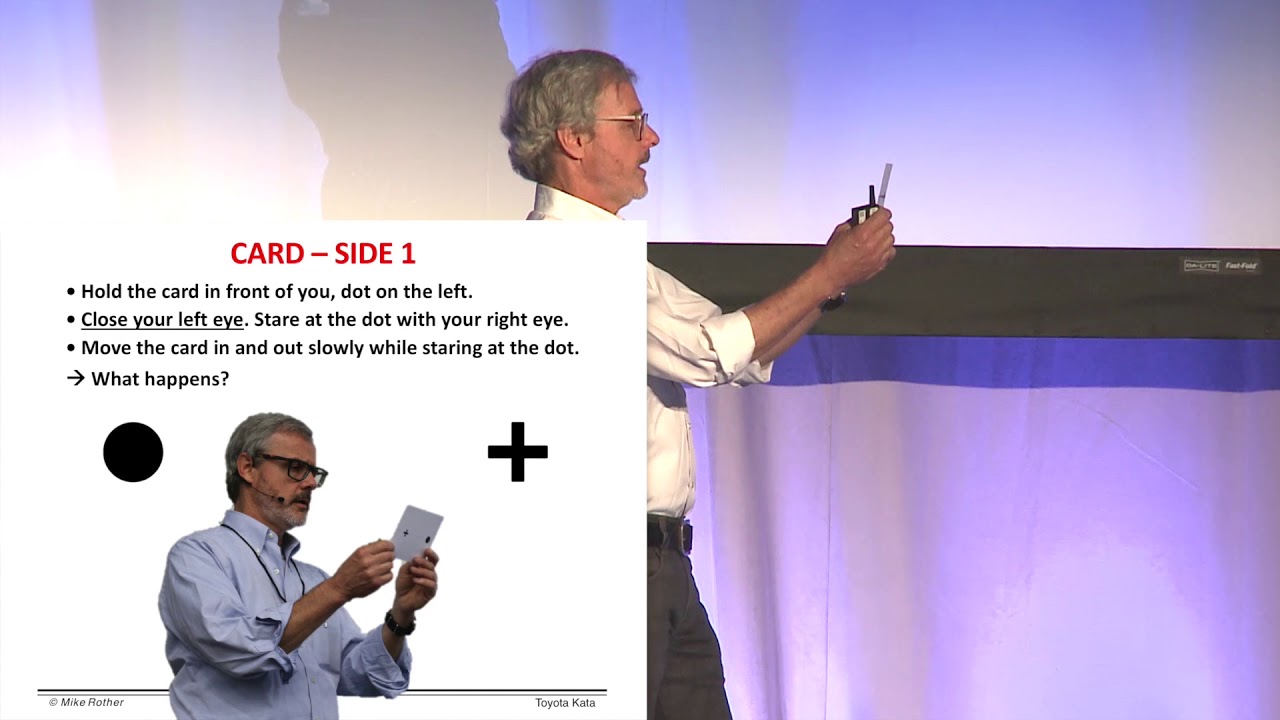
the world is moving this way at least currently we're in kind of a dynamic condition what the problem is our brain makes assumptions and why don't we prove that our brain sees that current jumps right over the knowledge threshold you should all have a card that looks like this in your lanyard how many have seen this okay who wants to do it with me Julie you wanna you don't want to co-facilitate Michael are you here it's Michael lumbar here you wanna it's no good if I do it because I've done it a hundred times so
get your card out and Michael come on up and we'll we'll do this together it's a trait called a teach-back michael lombard everybody mmm all right what are they supposed to do with this card okay I think you are supposed to hold it out like this with I'm using the side first put the down on the left with the dot on the left yeah across on the right yeah hold it out like that uh-huh they start bringing I close the right eye close your left eye close your left eye dots on the left on the
left and you close your left eye your left eye pay attention to the cross on the right no stare at the dot this is the dot all right my first time doing this this this is this is it this is it great he's figuring out what's it what he needs to work on so all right the dot on the left close left eye pay attention to the dot on the left and slowly slowly move it towards your face and then back out a few times at about eight inches or something right something happened about like
this eight inches something happening anybody's seeing what's happening okay so some of you have the car out pretty far so again stare at the dot with your right eye left eyes closed dots on the left what happens stick around we're going to do the other side all right what happens the Cross disappears how come very strange very strange how come the Cross disappears what's that it's your blind spot right how come we have a blind spot I've learned this that's where the wires go in literally the wires on your eyeball are there and they can't
put any sensors there they've you know our evolution hasn't figured that out yet so it's called your lacunae you have no visual receptors in your eyeball there that is you physically cannot see the cross now if you have both eyes open right we've lost Michael yeah yeah if you have both eyes open the other eye sees it and to pick your brain picks it up right but if you close it you find that blind spot we've established now that you physically cannot see the cross okay so lead on there's there's instructions yeah I guess yeah
it's not fair okay what should they do now I'm card in front of you with dot on the left side I'm using this side now the side with the line to put the dot on the left okay and then you can close your left eye uh-huh start at the dot with the with your right eye stare at the dot with your right eye okay it's like we did before yeah move the card in and out until the Cross disappears something to sit that same spot right to that blind spot find your blind spot again okay
is something happening what happens the vertical line disappears but the horizontal line stays contiguous Wow Michael thank you that was beautiful [Applause] did you notice that by doing it wrong he learned how to do it right and that Michael has seen me do this how many times you seen me do this Michael yeah too many times wait a minute so just telling people what to do right practice coach okay so the the horizontal line continues but yet we have proven that you physically can't see what's there whew that's weird what's going on what's going on
the brain is filling it in as a service the brain you know now look none of us maybe there's a brain scientist here I'm not a brain scientist so beware okay but we think what's happening is the brain sees the line on the left and the right of the hole and the brain knows you got a hole there in the back of your eye says you know I think that line continues I'll fill that in for you don't you worry yourself you go on and drive in your car where I'm going to fill in that
line for you right so the brain is not showing us unfiltered reality it's showing us an interpretation a quick explanation of reality now that sounds kind of negative right jumping to conclusions is actually a negative phrase but look I'm here to say really important that we have this mechanism there are neuroscientists who say it's the reason we're still here you know the prehistoric humans have said gee I wonder what that rustling in the bushes is we didn't get those genes you know and the ones who imagined all sorts of horrible things because of the rustling
and the bushes and ran away those are the genes we got they jump to conclusions thank you very much imagine trying to navigate traffic and your brain would say you know that car might be coming into your lane but don't worry we got to get some more data we got to test that some more we got to be scientific about this don't jump to conclusions you know you're just not going to get to work that day right you're gonna get to the hospital so it's a better safe than sorry cognitive mechanism I think it's beneficial
when fast reaction is more valuable than deep understanding and there are lots of situations like that so I think on balance for our survival as humans it's really good to have that mechanism but it causes some problems right so what is your brain see here for a moment your brain says she's floating and then it takes you a while you know a little bit of experimentation to go oh okay it's just a shadow from a flag right so your brain quickly you can't turn it off so an antidote to the dangerous side of our useful
jumping conclusions mechanism is scientific thinking so I said earlier it's knowing that any idea needs to be tested right but we can say a little bit more about scientific thinking it's learning I highlighted the word learning on purpose it's learning to compare what you think will happen with what actually happens and learning to adjust based on what you discover from the difference you laughed when Michael struggled with the card but that's exactly what's supposed to happen that's the learning process you make a prediction reality happens and if there's a difference you learn from it this
is kind of a visual of that signs of a thinking process moving toward your target condition what you learn in one step may influence what you do in the next step and you sort of iterate your way to your goal now do it fast right these experiments if you're doing one experiment every two weeks you know you're not going to beat the competition you need to be doing experiments everyday some take longer you know you can queue those up and then do them but what you need to experiment experimenting rapidly excuse me so interestingly here's
that improvement counter pattern here's where we make the plan so we're back here at our current condition we know where we want to go so we make a plan for how to get there what's fascinating about this we're that person with the binoculars is standing before they embark on their journey that is the point of maximum uncertainty about how that trip will actually go you will never be more uncertain than you are at that point and that's where we make the plan and this was hard to square with what we saw at Toyota because Toyota
plans like crazy they won't let you go go again your plan isn't detailed enough look again make a plan make more detailed plan it was hard to square with scientific thinking which says you can make a plan but life ain't gonna roll out that way right and what we learned was that they make a plan but they use the plan as a prediction and they use it as a yardstick they say this is how we think it's going to go but then they adjust along the way based on what they learn so then Puma cada
is a different pros you can see that threshold of knowledge moving forward as we experiment it moves closer and closer so that's our discussion about scientific thinking to prepare you for this conference but there's another discussion how do you acquire this way of thinking we've been saying it's not our natural way of thinking and kind of a corollary to that is what should managers and supervisors do we're talking about the business world so if I want my team or my organization to acquire this way of thinking and this way of working what am i need
my managers and supervisors to do the little guy at the bottom here a model alone is not enough just showing someone how to use the the blind spot card is not enough you got to get them to do it you got to give them some coaching feedback we have lots of models Design Thinking solution focused practice system thinking look we're not hurting for scientific thinking models there are tons of them out there and the fact that we still don't really think scientific in the broad population tells me that it's not just a model we need
how do you actually transition to what the model depicts and that's the other side of the coin of what this conference is about it's about a practical approach of scientific thinking and working but it's also about how do you acquire that way of thinking through deliberate practice so scientific thinking is not something we're born with little kids kind of explore like scientists but we lose that the more we build up our neural library of experiences we then see the world through those experiences like that Green Zone and that one slide that says you you basically
see whatever resonates with your existing pathways so adults are bad at scientific thinking due to our many learned neural paths that's the end of the conference and we wish you a safe trip home it's not quite that bad we can't change so so it's something you learn and you learn it through practice so here's an answer to the question and this is what Toyota Cod is about this is what this conference is about number one a scientific thinking pattern which is what we've been talking about and combining that with ten techniques of deliberate practice and
professor Anders Ericsson in Florida has probably been the name associated with the concept of deliberate practice how many been reading about deliberate practice fascinating topic it's funny in sports and music deliberate practice is totally accepted if you were going to learn a new instrument or a sport you want to learn how to ride a BMX bike you know you're gonna have to practice but somehow in the business world you know you come in and they send you over to work with Bob or Mary the supervisor and you know you'll figure it out as you go
no deliberate practice so Toyota kata brings these two things together scientific thinking pattern a practical one and techniques of deliberate practice let's talk about deliberate practice what does it take to learn new skills and modify our thinking you guys know this one fold your arms and now you know what's coming please fold your arms the other way all right and of course the question is how did it feel the second time compared to the first awkward unnatural strange what was it uncomfortable I had to think about how to do it and I think that is
kind of the point right you've seen this before here here are some words from from groups awkward slow awkward comes up first almost always unnatural stiff uncomfortable difficult feels wrong had to think about it by the way these are the same words that you get with any change effort anything you introduce new and your family in your team and your company you're gonna get the same exact words so the same things happening this is important for us to know what's happening why does it feel so odd the second time it's wired in right so our
thinking patterns are in kind of a loop you've practiced folding your arms one way for decades check out this diagram it's sobering neuroscientists say every time you think or do something you're more likely to do it that way again so you think or do something and that lays down a little track in your brain you're recruiting some neurons to think more that way if you do it again and again its recruiting more and more neurons so the more neurons you recruit the more you're likely to do it that way again your brain doesn't want to
think about how to fold its arms because your cognitive capacity is limited right when you drive a car for the first time where you're driving parking lot why so you know I hit anybody because your brain is occupied we think we've got this big cognitive capacity we have very limited cognitive capacity and if you're worried about where the brake pedal is and the mirror and the head check don't forget to turn to oh yeah yeah you know you're done you're not seeing what's outside going on outside the car so but after a while of this
process your brain puts those things into automatic behavior so now you can concentrate on what's going on out on the road mark Rosenthal is in the back you've got to watch his video about coaching he says yeah the first time I started doing coaching Codd I'm standing there right mark with the five question card all I can do is to read the five questions oh there's a learner here you know but after you practice those scientific thinking fundamentals and they get ingrained in your brain you can throw the card away and you know the questions
you have to ask and you might ask them in a different way you might ask him in a different order but you know what information you're trying to get so your your brain doesn't want to think about folding its arms I don't want to waste neural capacity on this imagine you're at a party right you stand there like this we're talking can we stop talking Foreman I got a full bear arms the other way you know I just not good you know could we stop driving everybody cuz I gotta look for where the brake pedal
is okay you know 60 miles an hour it's not gonna work so the second time feels different because anyone reading condom on stuff system one system to thinking getting very popular the brain is getting popular it's fascinating stuff it's the owner's manual we didn't come with the brain favors those practise neural pathways to conserve energy and for safety you know that car may be coming to your lane move don't even think about it so system one thinking the brain throws a lot of stuff the stuff that we repeat the stuff that we do again and
again and again it throws that into habits and systems to thinking or slow unconscious anytime you learn something new crossing your arms the other way is the picture on the right it's like hacking your way through the jungle you don't have very many neurons recruited for that activity so here is advice from neuroscience on changing or modifying or transforming your culture don't fight existing neural highways you cannot win that game they are so strong you can tell people all day what Toyota does you can tell people all day how to use a blind-spot card whatever
just explaining a different way doesn't work the learners will almost always stick with or revert back to their established habits it has nothing to do with being hostile it's those established strong neural habits they're always going to win what the neuroscientists say don't bother fighting those explaining different ways develop new ones and if you practice new habits over time the old ones will fade a little bit what would happen if you practice folding your arms the other way signing your name with the other hand brushing your teeth with the other hand but what if you
practice that every day for a month what would happen you'd get it so what can work is is deliberately practicing new neural pathways and they replace the old ones so here's what practicing Toyota kata is about what you're doing is you're moving some scientific thinking fundamentals like I need to test the idea it's a system one so that you can react more scientifically and cognitive capacity is freed up to focus on the things that are situational we're never going to make grasping the current condition automatic that is never going to be automatic because every current
condition is different you're gonna have to go and see you're gonna have to put on your thinking cap you're going to have to deliberately look you're going to have to make run charts you're gonna have to measure times that's just the way it is you're going to have to get on a plane and go to the sales department in Omaha and see what's going on there you're never going to get away from that but the idea that you have to grasp the current condition yes that becomes automatic that's what Toyota kata is about so basically
you're practicing with system to your slow mind to put some scientific thinking fundamentals into system one when you read the five questions card for the first time you're in system two what is your target condition what's a target condition right where are you now you know what did you do on your last step I mean it goes literally like that you're in system two very deliberate but you're trying to turn that into system one so that's practice which turns into performance and performance is actually just being able to do those things off the cuff so
this is where starter kata come in what the heck is kata-kata are just practice routines you practice at the beginning it's like playing scales and music so we change the name we call it starter kata did that about two years ago and so there's that perpetual loop every time you do something you're more you recruits more neurons and that makes you more likely to do it again this is the worst screwed loop and this right here is the way to free will that is you inject a starter kata with coaching coach does play these scales
I want you to learn the fingering of the instrument you're trying to learn so start a kata are just things you do at the beginning they get you going they're not something you implement the five question card is a starter cog kata to introduce it's a practice routine to introduce a pattern into your head once you got that fundamental pattern then you can build on that and develop your own style so what we have is not just a scientific thinking model the four steps of the improve Mikado which is based on what we observed at
Toyota we have starter kata for each step and that's a big experiment that you are part of to try to make scientific thinking something that's learn about teachable transferable in any group your team your family your organization and there's also a kata for coaching because coaching is a skill you have to learn like any other starter kata again very common in sports and music see the dance steps at the beginning you actually have painted steps on the floor why are they on the floor what what are those painted steps for get the basic pattern in
your head then you don't need them anymore do the dancers who are accomplished do they go like this mm-hmm they don't they have their own style but they started with this that's a starter code you can't implement starter kata it's just to get something going check out this swimming pool here the learners on the left very structured okay I want you to learn how to kick and so forth right and they're all doing exactly the same thing and the coach is very instructive this is the starter kata zone down on the left end of the
pool to internalize the basics of swimming but after a while the coach doesn't even need to be in the water they're out here they're still given some instructions right and this is where we're trying to get to everybody's swimming in their own way and they're having a good time and they're able to swim and the coaches just watch it two errors that we see all the time with kata number one people practice the kata the starter kata can you come back two years later they're still reading the card like oh I'm sorry that wasn't really
the point the card they're all still down the left end of the pool and everyone in the pool is gone I just wanted to swim you know I still read this damn card you know so that's an error don't practice starter kata forever but the other error you get off the kata too soon they immediately ad-lib they immediately change the questions they want to be on the right end of the pool right away if you try to get to the right end of the pool too quickly and you not willing to practice your starter kata
you're not going to get anywhere you're going to be a beginner forever and we have Tim Hall Tim are you here from nice pack I don't know if he's gonna talk about it but if he doesn't then you should basically corner him with a cup of coffee because Tim what do you say you you've moved on from the starter kata right you've moved off quite a bit develop your own style and if you have a new learner what do you do they go back to the left side of the pool read these questions you know
I want it you're not gonna do that forever you know I want to play with the other guys the other end of the pool that's where we're heading right I love this picture I think this picture describes it better than I ever did so again starter kata only take you so far over time you have to develop your own style building on top of the fundamental patterns you learned with the starter kata the fundamental patterns are supposed to get automatic now here is a cool trick starter kata especially useful when you want to create a
shared culture because everybody starts with the same basics now look your style may be different I want that I want my team to have different styles of testing I want you to have a better idea than me about how we could test this idea but I want both of us to say we need to test this idea that's fundamental so everybody starts with the same fundamentals and you can build on top of that and I think this slide essentially is what Toyota's doing on that less visible part on the slide I showed earlier and they
don't even use starter kata because they have the team leaders and the managers who have the pattern in their head so they're able to have quite a bit of variety but if you don't have that starter cutter helpful one thing of course we talked about this I'll skip over it it needs to be daily practice don't fool yourself if you're practicing something every now and then and the rest of time it's business as usual the neuroscientist would basically look at you and say you're practicing business as usual whatever you practice daily is what you're creating
that's your habit that's your culture early practice does require coach as we've said a couple times now so I don't mean to dwell on this otherwise you're gonna practice your existing habits they're much more powerful so you need the coach to say hold on you're doing it wrong let me let me show you a different way to do that it's very normal and then you can go on to be a master and as daily with practice with a coach so who's the coach the managers because they're the only ones who can be there every day
so we are in a way modifying the role of the manager so here's a Homer Simpson dope slap moment you know those those ways of the the second time folding your arms felt that's what you're supposed to hear if you're working with a team or anyone learning something new if they don't say these things they're probably not learning something new it's supposed to feel awkward it's supposed to feel like the other way of folding your arms if you're not getting pushback if you're not getting people saying I don't want to read this card this feels
weird awkward I have to think about it it's slowing me down just let me go back to the way I did it before I'll get the results you want if you're not getting that push back then you ain't practicing something new and I find that interesting because as a coach I always stood in front of people and when they were saying these things like oh I'm doing something wrong no you're doing something right and you can tell them that say hey you know that's that's how it's supposed to feel feels weird you're on the right
path so Toyota kata combines two things a practical scientific improvement pattern we call it the improvement kata and with techniques of deliberate practice to make scientific thinking a skill that can be learned by anyone here's a question I got recently I think it's good to conclude someone literally actually said Mike will implementing Toyota kata improve our profit and that's kind of where we've been in the lean world we're gonna implement these things that it's going to improve our profit and the only answer the answer is no not directly Toyota kata is a way of developing
scientific thinking skills that will make you better at moving toward whatever your goal is but just implementing Toyota kata a you can't implement it it's practice is not going to improve your profit if you want to prove profit it'll make you better at pursuing that so knowing isn't the same as doing benchmarking other companies is not enough to make change happen just showing someone how to do something isn't enough scientific thinking is a great way to navigate but it's not our default mode skills habits and mindset are wired in our brain you can practice starter
kata with some coaching to help wire your brain for scientific thinking that's what we're about and the last bullet here which is a little bit the experimenting ground right now you can also modify an organization's culture this way with the manager as the coaches and we think that's kind of what Toyota's doing so thank you [Applause]

![Harvard Professor reveals the Science of Happiness in 15 minutes | Arthur Brooks [ARC 2025]](https://img.youtube.com/vi/w8a0T5XLrXc/maxresdefault.jpg)