It's funny that philosopher Kirkagard, you don't usually hear a joke that starts like that, by the way. [snorts] Um, he wrote 150 years ago and he was one of the first people who really wrote about anxiety. He was one of the first psychological philosophers and uh he regarded himself as rather useless all things considered.
and he wrote a section in one of his books about all the industrialists that were operating in Europe at that time trying in every possible way to make life easier and easier and more efficient and productive for everyone which was definitely happening during the Victorian period and and Europe was rapidly transforming into an industrial powerhouse. And he said someone as useful useless as him with an orientation towards being a student who liked to sit and contemplate ideas and talk in cafes and smoke cigars and drink could never do anything to make anything easier for anyone than everyone was already trying to make it. And so he thought that his task would be to make things more difficult for people because there would come a time when what people wanted wasn't more ease but more challenge and more difficulty.
And that's really smart you know and it's witty and it's true. And one of the things that I've come to understand I believe is that and dsioski do this too. He wrote about this in notes from underground.
It's a great book very short book. Brilliant. absolutely brilliant uh compelling dark read.
Uh it's the confession of a miserable, resentful, like murderously genocidal bureaucrat who evaluates his own soul, I suppose, and confesses his his his sins. And it's also a critique of the idea of kind of utopia oriented towards security. and DSTVski who was dealing with the the set of ideas that are really tearing us apart culturally right now.
This idea of a eventual utopia based on something like security and safety. Dossier really objected to that back in this like 1860 a long time ago. He said, 'You know, the thing about people that you don't really understand is that, he said, fundamentally, we're ungrateful and we can curse.
That's what distinguished us from the animals, which I thought is pretty damn comical. But he said something very interesting. You know, he said, "If you set up a utopia so that all people had to do was eat cakes and uh busy themselves with the continuation of the species that uh Yeah, right.
[laughter] Russian Russian humor, you know. um that after a surfite of that, after enough of that, which would happen quite quickly, people would just go mad just to break things just so something unexpected and remarkable could happen. And that we're not built for security and safety, but for something well, let's call it adventure, something like adventure.
That's a good thing to know, you know, because you don't want to suffer unduly. That seems reasonable and you might think because of that that really what you want is happiness. But then Soljen Nitsson for example he wrote about what happened in the Gulag archipelago under Stalin and said you know if your goal is happiness what are you going to do when the jack boots hammer down your door at 2 in the morning and haul you off to the prison camp because you're not going to be happy there.
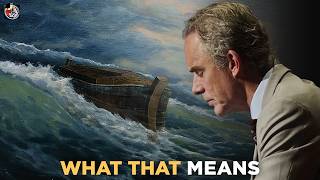
And so you know happiness is a boat that's easily capsized and the waves are always there. And so if your philosophy is one of say impulsive happiness same sort of thing dski was pointing at and kagard then uh you're not prepared when all hell breaks loose and all hell it will absolutely 100% break through at some point in your life and you're lucky if it won't be decades. You know, it'll certainly be some of it.
And it might be a lot of it. And for some of you, it's going to be damn near the whole thing. And so, if what floats your boat is happiness, you're you're going to be capsized by the first decent wave.
And so, then you might ask yourself, you know, what do you have instead of happiness that might be even more reliable? And I do think that adventure is more reliable than happiness. And in in the Old Testament story of Abraham, founder of the Abrahamic faiths and obviously a what would you call it?
A crucial figure in the development of world culture. Abraham is presented as a late bloomer to say the least. He's like 83.
People lived longer back then, at least so the story goes. And he had a very rich father by nomadic standards. and he could just sit around in the tent all day and you know a doing mother and a rich father he could just sit around in the tent all day and eat peeled grapes and busy himself with the continuation of the species and um but you know God appears to him and says get get away get out of your get out of your security get out of your comfort leave your family leave your community leave your nation go out into the world and it's a very interesting it's a very interesting story.
It's very interesting to contemplate it from a both a psychological and a religious perspective because what God is presented as in that book which is a crucial book for the as I said for for world culture is God is presented as the manifestation of the spirit that calls even the too secure and pampered to adventure. And then Abraham has a pretty rough time when he goes out and has his adventure. It's not all, you know, Skittles and roses from then on in.
Quite the contrary. I mean, he runs right away into like a conspiracy of elites to steal his wife. He runs into tyranny, runs into starvation.
He encounters war. It's like he goes out in the world and he has the whole tragedy of his life both on the social and political front and individually, you know. But the but the promise is the promise of adventure.
And the implication is that if you have a sufficient adventure, then that cannot so much protect you from suffering because perhaps that is impossible. but to justify it. And because you you kind of know this in your own life when you look at your life, you might look back on travailes that you've undertaken, you know, and and they've done end of life surveys with people and ask them what they regret.
And you know, people don't regret what they did that didn't work. They regret what they didn't do that could have worked. You know, they regret the chances they didn't take.
And you know, even if you do an evaluation of your biography, one of the things that you want to be able to say to yourself is something like, maybe there's nothing better you can say to yourself than this. You can you can think about this for yourself and see if it's true. That was extraordinarily difficult, but it was worth it.
And you know, it's it's not like you can have one of those without the other cuz you can't imagine that you could have some confidence in what you've managed to accomplish, right? the kind of confidence that would instill you with a genuine a certain genuine sense of self-regard despite your fundamental inadequacy. To to to have that fundamental sense of self-regard that's grounded in something real, it has to be based in a narrative that approximates that was extremely difficult but it was worth it.
You have to have both of those. And so that's interesting because one of the questions we always ask ourselves, this is the theodysy question technically. You see the suffering in the world, you see the suffering of children, you see maybe your own children or your suffering.
And you wonder, well, how can reality be constituted so that I can have faith in its essence when there is so much suffering? And one answer to that is something like, well, how much suffering do you want? And you might think, none.
It's like, yeah, I don't think so. I don't think that's right. You want at least you want something approximating optimized challenge.
So, you could say at least you want to be pushed to your limit. And maybe you find the most exciting times in your life. In fact, you'll pay for this.
You'll pay to have this experience to be pushed to your limit. like not beyond it or maybe even a bit beyond it, you know, and maybe not so far beyond it that you crumble and break and things fall apart, but you know, could you be pushed to your limit optimally if there wasn't the possibility of falling apart and breaking? Like, that's an open question.
How are you ever going to take something seriously if the consequences aren't actually serious, you know? And there's something delightful about dancing on the edge. That's why Hawaiians believed that surfing was sacred, you know, and it's because to surf you have to be on the edge, right?
And the waves can come and take you out at any moment. But without the possibility of the waves rising to take you out, then you can't dance on the edge. And maybe that's exactly what you do want to do, you know.
And there's there's good evidence from the neuroscience literature that consciousness itself is something akin to dancing on the edge. So technically when you're when you're conscious, when you're awake, your brain is occupying a position between something. It's a position that's something like between chaos and and order.
And if your brain's maximally ordered, well, you're just bored. Nothing is changing. And if you're chaotic, then it's anxiety and catastrophe.
But you want to be positioned right between those two. And that's when your consciousness is optimized, you know. on.
When your consciousness is optimized, then you're deeply engaged in life and everything seems alive and meaningful. And maybe that's maybe that's maybe that's the solution in some profound sense to the problem of suffering. It's that you optimize your interaction with chaos rather than being protected all the time from everything that could hurt you.
You kind of know this too if you have kids because you [snorts] don't want to keep your kids in an infantile state and because when they're infants pretty much what you do with them say they're 6 months and younger is you just keep them secure and safe right you just provide everything that you can for them. You have to do that because well what are they going to do? They just lay there fundamentally and squawk now and then.
I mean they're it's not like they're ambulatory. They can't go out and do things for themselves. And so it's up to you and your goal is to keep them secure and safe.
But once they start being able to move around, then increasingly it's sort of up to them. And if you have any sense as a parent, the psychoanalysts used to say the good mother necessarily fails. And what did they mean by that?
They meant well, if you're committed to your infant, when you're a mother for the first 6 months, it's like it's all the kid 100% full self-sacrifice devoted towards the infant. That's the right attitude. But even by 9 months, child can crawl around quite a lot.
They're developing something of an independent will. You start handing them challenges. You start handing them responsibility.
And you keep them on the edge. And some of your kids are going to be able to be pushed harder than others. And part of the reason you have to develop a relationship with your kids and your husband for that matter is so that you know you can keep them dancing on the edge on the proper edge.
And that's that's even better than the mere provision of security.