we're going to keep talking now a little bit more about vacuum uh and I want to talk a little bit now about specific best practices how to actually apply vacuum to get the results that we get quickly there's a big difference between pulling a vacuum when you have a brand new system going in and pulling a vacuum when you're in service so you're replacing a part within the refrigerant circuit okay okay um a couple things that aren't vacuum related that you need to think about at least like we talked about flushing the line sets there's
different techniques they can be used to do that there's no one bad or one good technique you will get different results depending on the technique you use but when it comes to using flushes I just encourage you to look at what is coming out of the end if nothing's coming out of the end then the flush didn't do anything right so you you get that right it all stayed in there now it evaporates out the flush will the solvent will at least it should hope um but whatever it tried to scrub off the walls it
just left in the lines and that actually can make it worse does that make sense what I'm saying so if you use a solvent and it scrubs stuff off the lines but nothing comes at the end where is the stuff that it scrubbed off the lines still in the lines right you get that so that's why I like the the pig system the system where you shoot a projectile through because you know that it all comes out you can watch it all shoot out at the end okay makes sense um the other thing that uh
what was the other thing I want to mention oh line dryers um line dryers obviously are really important and you can get away with a lot if you have properly installed line dryers now you guys are in a straight cool Market you're also in a coastal Market which means that you should be putting your line dryers when I say should follow what your leaders tell you here I'm not trying to oppose anybody but they they really need to be going inside they need to be going as close to the indoor metering device as possible that
helps protect it from weather keeps it from corroding out and it protects the metering device from whatever's actually already in the lines so if you have it at the condenser so imagine you have you have install your line dryer at the condenser now I'm not saying if it's factory installed you leave it with a factory installed it okay like whatever but you guys install a lot of Bryant which means that they're shipped with the line dryer so you have a choice of where you want to put it you can put it inside you can put
it outside on the liquid line if you put it outside it's exposed to weather it's exposed to more salt salt air and anything that's in that liquid line is not going to protect the metering device which is going to be the first thing it hits right so when you start that system up it's going to be flowing the direction towards the metering device and it's going to be more likely for stuff to get in there if you put it outside I'm not judging you okay I'm not I'm not saying it's terrible but I know the
reason why most people do it is because it's harder to braze on the inside but you're already brazing on the inside if you're doing a uh evaporator coil or a new system which are by far the two most common things that you braze in right that make sense go ahead is is there a reason why it comes with the condenser or not air on um well is there uh the reason is that in MO in much of the country and in much of the world um condenser swaps without changing air handlers or coils is very
common so they want you putting a new line dryer in even if you're just changing the condenser the outside unit um but if you look at the installation instructions where does it tell you to put it inside on Carrier at least uh the vast majority tell you to put it inside now you have some Brands like d and Goodman that put it in inside the condenser why do they do that well they do it to ensure that you get a new line dryer in because even though we know you're not supposed to have line dryers
in series you're not supposed to have more than one the reality is it's better to have them than not to have them in the liquid line right suction Line's a different story right when we'll talk about that a little bit later but in suction line and actually I don't even know if we have that content in here but we'll talk about it anyway at some point the suction line any sort of pressure drop in the suction line is really bad for the compressor like it increases compress ratios overheating all that stuff really bad liquid line
restrictions all that happens is your system performance decreases and then eventually um eventually you'll start freezing your evapora coil if they plug up so it's not like it's not good but it's not really bad uh if you get a suction line that plugs up you'll take a compressor out in no time make sense cool all right so back to back to evacuation best wor practices so uh changing swapping a unit the first thing you have to worry about is just is my line set as clean as as I can get it did I blow everything
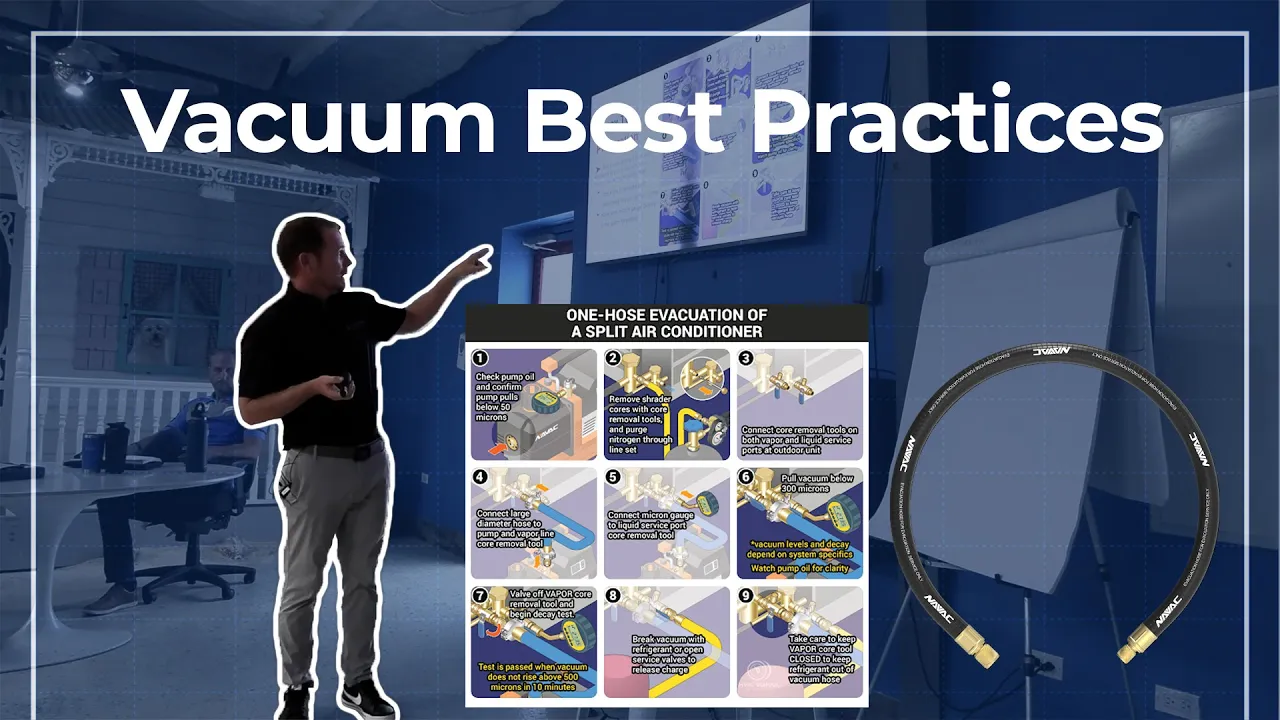
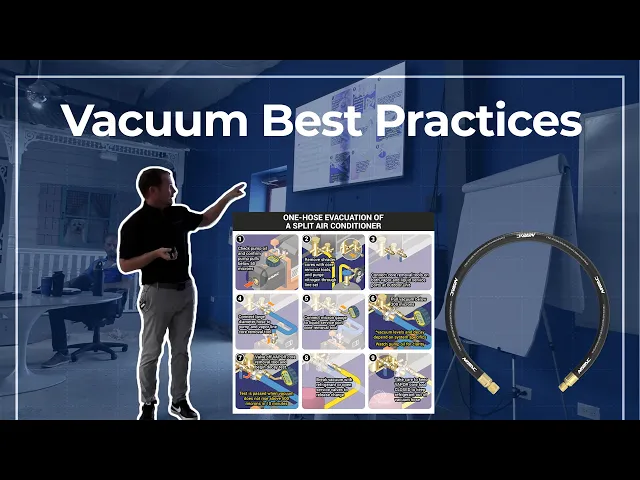
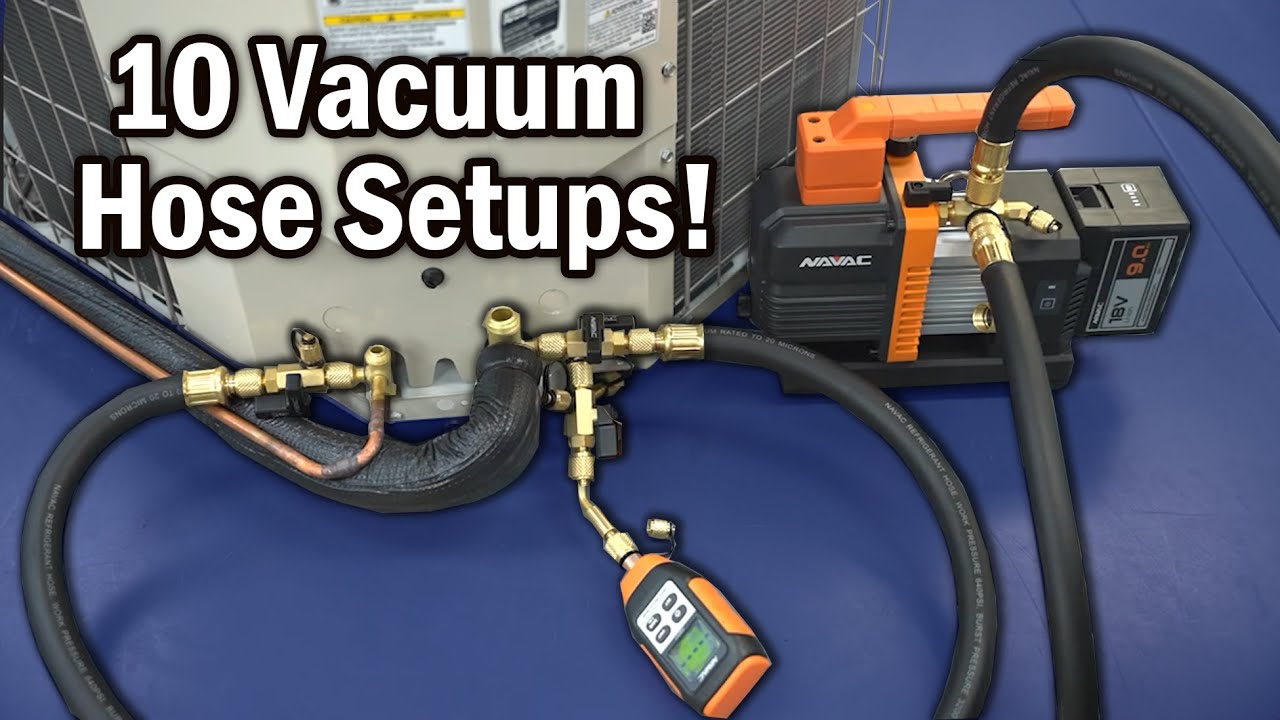
out as best I can try to get it try to get it clear uh but generally speaking on a change out you can pull a vacuum like I said in under 20 minutes uh to under 200 microns and I know that we or 200 microns or less and I know you can because we do it every single day of the week um and the way we do it is do we have this picture here I think we do we can back up to this the way we do it is we first verify that our pump
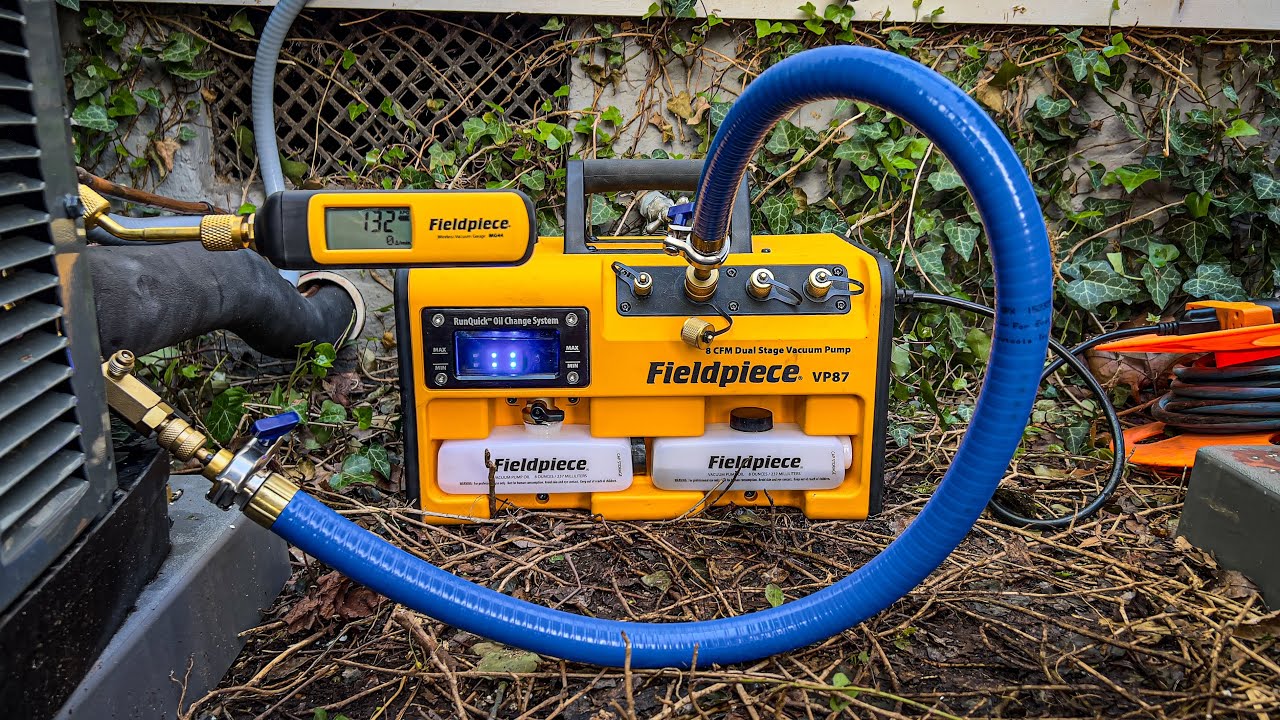
is working that it's pulling down deep we know our pump does its job uh number two we remove the cores so the cores come out of the system now um if you're doing this in new installation we actually do leave in the liquid line core so opposite of what I just said we leave in the liquid line core and we connect our micron gauge right to that liquid line core now this is after we've already brazed in we've already purged we've already done all that stuff that we've already talked about right follow so now we're
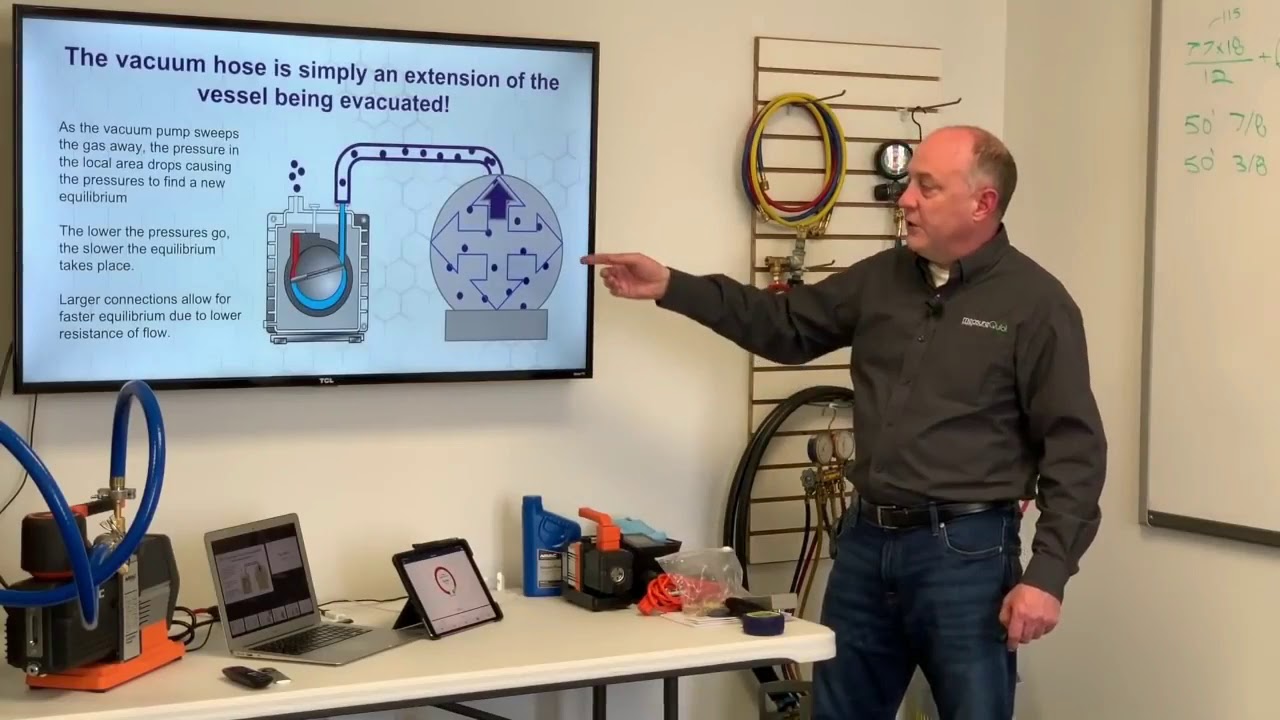
just ready to pull vacuum um in this picture here we I we actually show it connecting to a uh a core remover tool and you can do it this way with the core out but you can also do it with the core in and just use the core depressor on the micron gauge on the liquid line and then all we do is one big hose right to the pump on the suction line with no core in does that make sense is that complicated one big hose it can be the big blue hose that we show
here it can be the 3/4 inch navak hoses that they just came out with it can be/ inch appon hoses that they just came out with one big hose they're not that expensive because all you need is one this is for installers okay goes straight to the pump that's it now at that point where are you measuring your vacuum you're measuring it on the complete other side right so it's on the liquid line you're pulling on just the suction line just I'm just going to keep saying this we one hose suction line to pump no
core other side liquid line core is still in this is the way we do it you can do it this way either way it's fine with a micron gauge and you're pulling down when that micron gauge hits 200 that means that you're 200 on the furthest point of the system that means at the pump you're lower than that you're even better off at the pump if you measure at the pump you don't know what you are on the other side of the system you've got no clue in fact you're not even going to be close
here's the cool thing if you've ever struggled with pulling a vacuum where you pull it and then you valve off and it the starts jumping up on you you pull it jumps up on you does this when you do it this way when you valve off when you finally valve off a lot of times your vacuum will go down a few points before it actually stabilizes right because you have again Lower vacuum closer to the pump the pump is pulling uh lower deeper vacuum closer to the pump and that's the F this point does that
make sense so it just it it eliminates the false negatives it eliminates all the issues that you get with installers all they got to do is get it to 200 and then what do they do to all what do they have to do to isolate it to do an isolation test one ball valve Boop let it sit does it go up any significant amount now again it will go up a little tiny bit our standard our our standard thing and this comes back to carrier used to have a um a standard that said pull below
500 microns and then in 10 minutes if it doesn't go above a th000 you're good we pull to 200 and if it doesn't go above 500 in 10 minutes you're good and that's a pretty for a residential system it's got to be pretty tight like it's if it like I said if it was a Giant grocery store or something like that then that isn't enough but for us you don't have any significant leaks if you've hit that number do that make sense now why is it taking longer for some of you that's the question what
do you think don't pull thees use ches right don't pull the cores use quar choses use your manifold hooking it up multiple places a lot of those connections leak you don't get nearly the flow rates through those quar choses and again a lot of it comes down to misunderstanding the core science of it okay because people are like why on Earth do I need these big hoses that doesn't make any sense the ports are only a/4 inch but again all of the rules of how we think about flow and pressure and all that stuff they're
very different when you get down to these very very low pressures where you have very few molecules left they don't behave um like they do when you have a lot of pressure and you have more lamin or flow everything's moving and the best example is imagine a a toll booth do they have toll boots here is that even a thing so a toll you guys know what a toll booth is though right you got to go down and you pay somebody to go on the road right okay so yeah that's right you guys don't pay
taxes like you don't you don't pay for anything here that's amazing I I grocery store good point I have been to and we went to we went to the wrong grocery store the first time what's the real expensive one uh that's like Whole Foods the first one we went I don't remember which but we went to the first one was like holy moly we're not going to be able to make it out of here and then we went to a cheaper one and it was okay so um anyway yeah you pay for groceries that's true
uh and Power and Gas and everything else um so imagine if you have a toll booth okay you got a big Highway that goes in you got a toll booth and then you get a big highway coming out people a lot of people say well it doesn't matter what size the hose is because if the port's quarter inch that's the smallest point it might as well hoses might as well be quarter inch that's the same as saying well if a toll booth is only yay wide then the whole highway should just be that wide because
it's just the same it's not molecules behave very much like cars on the road where they're moving around they're bouncing they're changing lanes they're doing this and if you have more space there's less friction with less friction you get a lot more flow it can move a lot faster so even if you choke it down if you open it back up again you're going to get better flow and that's huge when it comes to vacuum massive it's also again in our where we are we do it with recovery too around here that's not much of
a of a conversation about recovery so uh so we want to get as much of those molecules out as quickly as possible to get to that really deep vacuum and the way we do it is by creating a lower the lowest possible pressure point we can which is the pump you need a good functioning pump to get a low pressure point and we want minimum resistance no cores big short hoses right big wide and short hoses we're going to leave that there um so any other questions about why go ahead really is there an advantage
or disadvantage to using two big hoses so here's where there's the advantage the advantage is when you're really trying to maximize degassing the oil so if you're working on a if you're if you're you're doing a service call you replace some sort of part inside the system and now you're going to pull a vacuum on something that previously had refrigerant in it right like was operating with refrigerant in it now pulling on both sides is advantageous and a change out we're only pull we're not pulling on the condenser we're not pulling on the compressor you
know we're pulling on a new evaporator and a line set that we just cleaned right so and again if you're using flushes it's going to take a little longer because when you're using flushes you're also evaporating the flush out so you're actually dealing with getting that flush boiled out and you're pulling that out of the system um but in that particular case it's more advantageous to have the micro gauge on the other side of the system when you pull with two hoses now you've got that same effect where you're not the micro gauge isn't on
the furthest point and so you're going to see a number jump down real quick but if you valve it off it'll jump right back up so you have to kind of do that dance before you actually hit the number that you're looking for does that make sense cuz cuz now you've got it teed off and so that's why I don't like even even if you have two hoses I don't like using it on change outs um installers it's just an easier process to use the one hose it's like hose pump I've got no T's I've
got no trees I've got no manifolds I've got no leak points I've got it's really really straightforward um the next thing that I do advise for those of you who are struggling CU sometimes when you've got older hoses or whatever A little dab anog can help on the threads and everything in order to help tight it up a little bit so you don't get as much jumping around the only downside to nyog is it's sticky and it'll get sand in it and dirt in it and everything else so then you have to be really careful
to protect the ends of your hoses after you use it so then you have to have a process for that um that's the only downside if you don't want to use that you can just use a little bit of refrigerant oil and that will have a not quite as good of an effect but it'll have some effect on helping get it tight um so those are the only things you really have to pay attention to make sure your hoses have seals in them uh make sure your uh core mover tools aren't leak not all core
mover tools are the same those are the those are the issues that most people run into and people say it doesn't work or it adds time it's usually because you're missing one of the steps it's almost like if you miss one of the steps you might as well miss all of the steps like if you're going to leave a core remover in I mean you know like you're not going to get the you're not you're going to barely get any benefit out of this because you can only pull through a CRT core remover with standard
size hoses you can only pull a half of a CFM so if you have a six CFM pump you're not it's not doing you any good you might as well have a one CFM pump CU you can only pull half a CFM through that when you get and you're pulling through uh one hose right to the pump you can pull five CFM through estimated about 5 CFM when you go to double hoses that's where you can get up to like 10 12 CFM and that's where in service that's handy because now you're trying to get
that refrigerant out of the oil does that make sense that I lose you guys there seeing some blank faces I think it's the I think it's the KFC I think I think it's the KFC say so I I got the one hose set up and I was doing service and uh and I hardly did any installs and so it it was hard for me to see I would get down to like 1,000 microns and it would just sit there forever and so um but I've been doing a lot more installs recently and it is really
true like one hose on a new system 30 minutes yeah 30 minutes and then I just got a second hose um and I did a a compressor and uh and it was probably 45 minutes and I was under 500 micr yeah so it it does work but yeah it's like it's it's just like there are some Kinks You have to kind of figure out but you're just knowing why it's stalling is key it's stalling mostly because refrigerants in the oil it's not and that's not really that big of a deal releasing a charge okay so
here's I'm I'm going to I'm going to commit heresy right now okay if you're working on service and you replaced a part inside the system and you put a new liquid line dryer in it and you use the processes that I'm telling you to use and it's stalling out at 12200 microns that's well below the boiling point of water you do not have you do not have liquid water in the system at that point check your sight glass on your pump you know your pump's working it's not creamy you know you look for creamy oil
on the sight glass all that and you're getting you're stalling out at 12200 microns just just go like release the Char you charge it and go you're fine that's not a big deal um you're not you you have hardly anything in that system it's just taking forever now again my guess is the reason it's stalling on you though is you didn't do the nitrogen Purge the way I told you just thought it said you said so that's fine for you guys that's fine again half of you aren't even using Micron gauges right now so so
let's be real honest like let's not again the the line that I really like there's a guy um his name is Russ King and he he runs a company called quick model where they you can do 3D designs and work and his phrase is we're so busy splitting hairs when we should be shaving heads right and that's a really really good line some of you here don't even need to shave your head anymore I don't think I'm not naming any names but uh no but the the the term means that like basically if you're getting
down to 1200 1500 in that range you're getting into that range you're you're well below the point where you're contaminated with water anymore like you're in good you're in good shape it's just you've got some molecules that are still making their way out of the oil okay now if you purge nitrogen first and in certain cases you use heat right so if you're pulling if you're pulling on a compressor especially and you can use some heat on the compressor that'll really speed it up big time use a heat gun if you can energize the crank
case heater um if it's got a crank case you guys probably don't have crank case heaters down here very often do you they if you do we don't if you do you can energize just the crank case heater and that'll heat it up pretty quick and that'll help you drive that moisture out of the oil um cuz that's what's doing it guaranteed if you're pulling on a compressor that's what's doing it compressor just takes forever to get that out and it's also hard because even when you put nitrogen in you can't flow through the compressor
it's like you're pressurizing and depressurizing you're not going to push nitrogen through those compressor valves so um but again follow those processes if you get a little stock and it's stalling on you and you're down there and your oil's clean and all that and you got a micro engage on it you did all this okay fine you know you're you're okay don't don't get too worked up about it it's on install that I really really care about it that's where if I was going to start anywhere with you guys I wouldn't even focus on service
right now I would focus on install get the one hose get the micron gauge get that process in place because that doesn't just solve the problem of Clean dry and tight or or clean and dry it also solves the issue of tight it helps you ensure that you're not leaving leaks which that's a big deal on install that say I mean leaks cost a lot of money uh if you leave them uninstall and I don't know that you guys have a problem with that necessarily but it's just a good part of the process a lot
of times it doesn't seem like a saving time because if you're used to using a mon for sometimes you think you're at 500 you're 1500 right correct right or 15,000 you know like no I'm not kidding I mean like it's it's it's 700 atmospheric pressure is 760,000 microns right that's what we're sitting at now that gives you an idea of how far away we are from Deep vacuum right so if you get down to, 1500 versus 760,000 you're doing pretty good right now if you guys are doing the listening to the pump thing you may
be getting down to 20,000 microns and and thinking it's good and that's not good um 1,500 is fine go ahead s start doing a different method where you can actually see especially us one hose and you can see what's written on the G is more accurate if you're not doing the gate test it can probably look it doesn't look as important that's way is important correct start doing this cuz you really realize that you're not right right and that is what and that's what I that's the path I took so this was in 2005 um
we nobody had micro engages um I we were lucky if guys were even pulling vacuums half the time and then 410A came out Poe oil this is how I know the difference we put in the first couple Poe systems in new construction and they were just blowing compressor terminals out right and left like it was happening that quick because we realized that the installers were pushing line sets without even sealing the ends and this is underground so they were pushing underground Lin sets through PVC through Lin sets that were full of water and they were
just filling these suckers up with water and in the past with 22 who knows they were probably failing in two years but with Poe they were failing like that they would just blast oil out so I was like okay I know I know how to do this and I was smart I read the books oh yeah I'm going to get a micron gauge so I got Micron gauges to started trying to do it and it just wasn't working like we had the old Robin air Micron gauges where the lights would go off as it got
down to deeper vacuum I think they still sell the things and it would never even make it the first light would never even go off I was like you know so I thought the I thought the gauges were broken so I went back to the rep and I'm like these these gauges are broken they don't work and at that time nobody knew how to do it right we were actually pulling vacuum through the gauge and so their solution was yeah mount the gauge right on the pump and then it works better well of course it
does because now I'm just measuring what the to the pump I'm like oh it's great and then we were trying to do hold test Decay test nothing was holding so we eventually just gave up on it like we didn't until I you know learned about a lot of this lost information which Jim Bergman and the guys from Aon and all those uh taught us uh and and you know now we understand how it works but it's the same thing around here if you start doing it you're going to realize oh crap like this isn't actually
going great but then you'll figure it out uh and then in the end you'll end up getting better results and the end result will be the systems you install last longer now you're you're in this salt environment you know so is it as big of a deal as some places cuz these units probably have a hard time lasting 10 years as it is is it as big of a deal maybe not and that's okay for you to make those judgment calls but you want to make those with information not with lack of information right you
don't want to be the reason why people's units aren't aren't holding up right make sense go ahead so so sounds like the difference is and when you're saying installed service work is because the condensor locked off that's what makes the difference correct the oil again when refrigerant is present with oil um that oil picks up the refrigerant it entrains that refrigerant and holds it and it doesn't release it easy and again that's not a scientific explanation uh but I know for a fact that happens and you can see it like I mentioned when we're pulling
these Vacuums in commercial applications you can actually watch the the refrigerant boiling out of the oil in the sight glasses um so it just it hangs on to it and it's even worse with modern with Poe oil it's worse when comess ter yeah so there's an arc there's an arc flash right behind that terminal cuz if you've ever looked it um it's really weird have you ever done a cutaway on a compressor when you take it open literally there's there's that glass fusite little orange plug and those are just studs that go through that so
there's connectors on the outside and there's connectors on the inside that connect to those studs like the same same same and so when there's an when eventually it eats up and there's an arc there it'll actually you know create a little mini explosion and it'll it'll just blow out just getting to the to him I remember um we didn't install C we lost four compressors right now Sol 10 yeah wer sure what happened saying it's or something that was the conclusion we came yeah yeah and again there's actually a unit one of the things we're
going to do is we're going to go do a uh a group uh diagnosis on this condenser that's sitting out back that that caught on fire out the side and my guess is that's probably what happened I'm a terminal vending situation but we'll we'll talk about it together and come up with some hypothesis um but that is but what you said is actually not false there have been some cases of um false fake refrigerant that had propane in it coming in from overseas that's the thing and my guess is you guys because of your lack
of Regulation you can probably direct import um from China is that is that true can you direct import refrigerant yeah um like I tried to do I didn't know the rules one time and I went on Alibaba and I was like look at how cheap 410A is I can just I can just get it straight from China and and I was talking to somebody they're like yeah yeah no they'll ship it to you and then when you get to the port they'll arrest you and throw you in prison I'm like oh okay I guess I
won't do that then yeah and fire it up with nitrogen in it yeah yeah yeah that is a that is a thing dry ship units yeah yeah right yep dry ship units was a thing and especially oh yeah yeah I know your head pressure will go really really high um yeah it's yeah you do not want any nitrogen in the system nitrogen of the things that you could have in there it's one of the least at least it isn't going to like ruin anything um but it yeah it'll totally mess up your pressures and your
head pressure will be Skyhigh and you've got no choice but to start over so cool any other questions that I saw go ahead not a question but I wanted to say we had a place where we receiv like 3 4 a and so every other time we didn't have the refrigerant test yet so we were told that if you take K light and you take out the liquid and if it BS the kite is f and so we had quite a lot we received and it back and it went through the government and it sent
back H interesting yeah like I've heard I've never personally seen it I've never personally seen it but I have heard of it it and especially in more unregulated um areas so they'll yeah send it in cuz again like as an example propane is an amazing refrigerant like you can put propane in an R22 system it'll work great the problem is it's dangerous you know and it'll you know blow your face off but um yeah it's it is something we need to watch for for sure and uh that yeah that may be something to something to
do more of uh what else Gilbert you had something yeah um why does The Bu smoke exhaust yeah so that's actually that smoke that you're seeing is actually condensation it's actually discharging water vapor so especially that early because again even if the system has no liquid water in it whatsoever it still has a lot of water there's water vapor in the air so when that initially comes out that's what you're seeing as water vapor yeah so when it stop that's when everything well that's when it's likely that you have removed all of the water VAP
or at least most of the water vapor you're still going to have some molecules p ponging around in there but yeah most of the water vapor you think people like system could blow up of thetion uh not just not if it does not have um oxygen present and so this is actually kind of another important thing to mention if you've seen if you've watched some videos where the guy will be working on a unit and then all of a sudden the unit's not there there's a Flash and he's not there anymore um like it happens
I mean people get totally blown up and that happens because of something called diesel effect where you have uh A flammable refrigerant present with oxygen together in the compressor so that compressor again if it doesn't have oxygen present there's not really a way for it to combust um it can combust once it leaks out and now it starts to burn but while it's in there but it's when you don't pull a good vacuum and you have a flammable refrigerant then it becomes more of a factor which is another reason why pulling good vacuums as we
get more and more flammable refrigerants like I said you guys are going to be working on R32 in the next 6 months assuredly you will be um there just manufacturers are going to start shipping it to you and that is a more flammable refrigerant than 410A uh a lot of people don't know this but 410A is actually half R32 it's 50% R32 50% R 125 125 yeah yeah all right fun keep going um this just talks about the Decay test what you look for and again that's where we say uh pulling below again we we
say at Kaos below uh 300 we try to get it to 200 hold it for at least 10 minutes that's standard um like I said carrier standard which they still have in a lot of their literature is pull below 500 or pull 2 500 and hold uh to below a th in a 10-minute period of time so uh if you're if you're doing it this way you're going to be you're going to be uh better than what the industry requires and again whatever you guys come up with in terms of your own process any process
is going to be better than no process um and I and I encourage people to not be too overly again I'm the guy who tells people all this stuff that sounds so extreme to everyone but just remember I have to say that publicly because you have to like you know I have to put that out there in more private conversations do what works for you so long as you know you're not going to um you're going to give your client a good product good end product thanks for watching if you're willing give this video a
thumbs up and drop us a comment don't forget to hit that Bell icon to stay updated with all of our future videos and as a quick reminder HVAC school isn't just a YouTube channel dive deeper with us at our main website hvacr school.com curious for more knowledge on the go we've got you covered tune in the HVAC School podcast available on all your favorite podcast apps and while you're at it join our thriving Facebook group also don't miss out on our free mobile applications available for both iPhone and Android we're all about Community vortex byx
![Best Practices for System Evacuation [2024 Version]](https://img.youtube.com/vi/QJTFESe2VhM/maxresdefault.jpg)