all right welcome to uh unit four notes Oceanic Oceanic Oceanic continent conversion once again oo means Oceanic Oceanic OC means ocean Continental convergence uh right now we're going to be talking about plate density so essentially what we're going to be looking at what causes the difference in density between lithospheric plates and then essentially why does one that why does that lead to one being subducted well one stays on top so uh the oceanic continental difference we've already talked about in unit 2 and then in unit 3 once again almost like I purposely made sure I
would be previewing the stuff in this slide in previous units almost like it was part of a plan so Continental lithosphere uh is made out of granite and riy granite and riy are high in silica since silica is a very has a low density is a low density mineral continental crust and Continental lithos here tends to be not very dense right around 2.7 grams per milliliter oceanic crust um Basalt and gabro remember B Sal and gabro tend to be high in magnesium and iron those denser Metals um and so B oceanic crust tends to be
um right around three grams per milliliter so whenever I have a piece of oceanic crust and a piece of con of uh continental crust Collide the oceanic crust is going to be denser because of its silica concentration as that uh as that Oceanic uh lithos here since the oceanic lithos here is denser it will subduct down what's fun is I've asked you a question about this in unit two all the way back there was a question about this in unit two um so yeah two two oceanic continental plate meat the ocean one is going to
subduct down because it is denser it is denser because it's maic it's mic because it has less silica concent less silica so here is a image of oceanic a piece of oceanic lithosphere meeting a piece of continental crust so once again that continental crust is going to be Fick that continental crust is going to be felic and be low density and the um the oceanic crust is going to be maic and have a higher density so when they Collide that oceanic crust is going to bend down and go underneath the continental crust side note we
get some flux melting and then we get a volcano and literally what's going to happen is over time it'll the continental crust will just keep going and going and going and more and more oceanic crust will be pushed down so much so that eventually you could eventually essentially get rid of the ocean okay this is actually happening in the p uh the Pacific the United States North American Plate and the Eurasian plate are moving towards each other as they do that what ends up happening is the Pacific Plate which is in the middle is denser
than both the plates denser than the North American Plate and the Eurasian plate so as those come together the oceanic crust just gets getting pushed down and down and down and eventually the oceanic the Pacific oceanic crust will completely destroyed as North American Plate and the Eurasian plate run together so this just it doesn't go like this and stop it goes like this and then it just keeps going and going going going and subducting more and more oceanic crust underneath it so why is then there so um the the difference between oceanic crust and uh
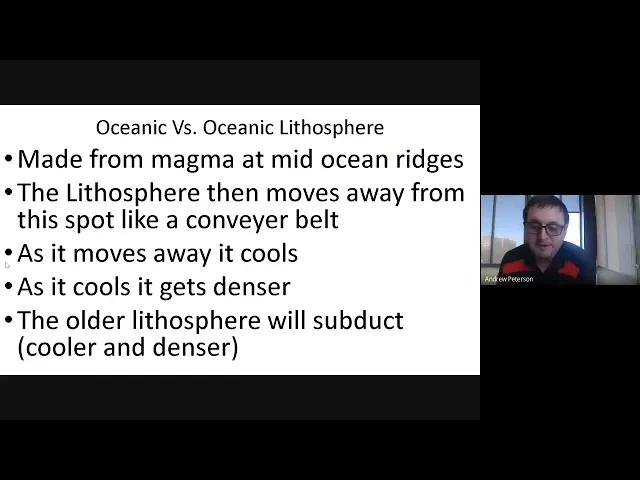
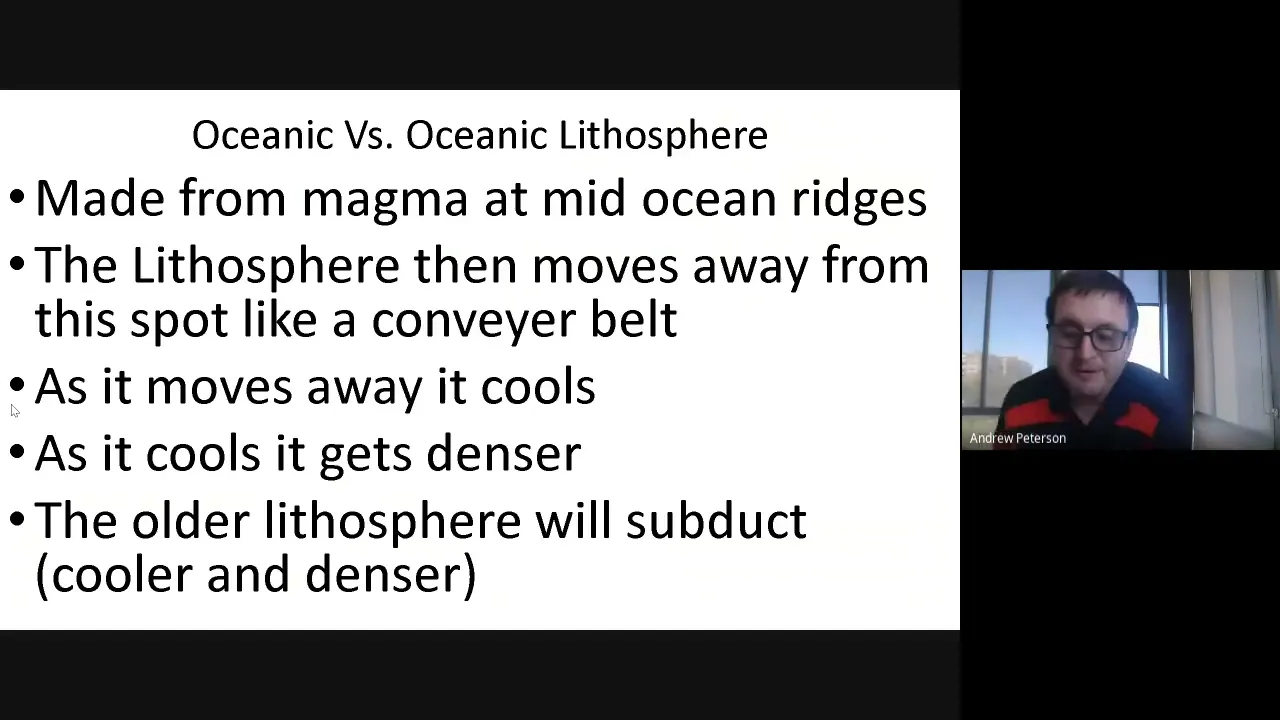
Oceanic lithosphere and Continental lithosphere have already been previewed why is there a difference between two pieces of oceanic lithosphere this has actually been previewed in unit one so a little bit just a little bit um so Oceanic myth lithos here is made from magma mid ocean ridges which we will talk way way more about when we talk about divergent plate boundaries okay so there's a spot in the middle of the ocean where you have a volcano that is making new crust that new crust then slides away from that mid ocean ridge okay so it's making
new crust so Magma's coming up from the middle of the ground there's a volcano there it's making new and crust the lithosphere is sliding away from that the crust and the lithosphere is sliding away from that mid ocean Ridge wa once again way way more on this when we talk about Divergence as it cools as it moves away it cools okay so I have I'm taking a hot magma cooling it into Solid Rock but it doesn't instantly cool it doesn't just go you know from its maximum temperature to its minimum temperature instantly it cools to
the point that it becomes a rock and then gradually over time as it moves away it still cools and cools and cools fun fact about this that I think I mentioned in a previous video the Moon is actually shrinking because of this so when the moon was first formed it was formed when a giant asteroid hit the earth and broke off a part of the earth and destroyed the asteroid that collided those asteroids bounc were bouncing into each other in the middle of space forming the moon and the bouncing caused heat and so the moon
when it was first formed was really hot the same reason the Earth was really hot when it first formed the Moon is currently shrinking because it's it's getting colder and colder with time and as it gets colder and colder colder it density increases because its volume is decreasing volume decreasing meaning getting smaller and keep in mind this has been happening for you know like you know couple billion years so the Moon is still cooling after a couple billion years oceanic crust tends to be on the age of a couple million years okay so as the
crust moves as that oceanic crust moves away from the mid ocean ridge it's gets colder and colder and colder as it gets colder and colder and colder it gets denser and denser and denser because it's volume is decreasing so if I have two plates that Collide it's going to be the colder denser oceanic crust that subduct so you can actually tell which plate is old which crust is older based on which plate is subducted okay so here's a quick map of uh the two things I was talking about uh well here first is a an
image of a mid ocean ridge so here I have a piece of oceanic crust moving to the right and here I have a piece of oceanic crust moving to the left and in the middle there I have an upwelling athenos spere that comes up and fills in this void and makes um makes new crust side note on this side on the right side of the mid ocean ridge there is a convection current in the clockwise Direction and what would be on the left side there would be a convection current in the counterclockwise direction that pulls
the crust away from that mid ocean ridge as the crust moves away from the mid ocean ridge more magma comes up and fills in the Gap and then new rock is formed okay so in this image I have two pieces of oceanic crust the oceanic crust from what let's say is the west and the oceanic crust from the East please note that in this example this piece of lithosphere has both continental crust and oceanic crust okay so this would be like an example of like um like the Eastern side of the Eurasian plate so you
get like China which would be continental crust and then it turns into oceanic crust and then you would get like Japan more on Japan later we'll talk more about that but Japan is not actually made out of continental crust it's sitting on Ocean it's made out of oceanic crust and it is on and it's thin there the crust is thin there so here I have a piece of oceanic crust comp hitting a piece of oceanic crust and I could tell that this crust is older and denser because that is the one subducting underneath once again
just like um our continental crust o Continental Oceanic um as these Collide uh the Collision continuously happens so once I start subducting it just keeps going subducting more and more and more one thing I want to point out is just note how similar this image is to this image so a plate subducts melts makes a volcano in this case the volcano is on continental crust because it is continental crust that's sub subducting the oceanic crust in this image I have an oceanic crust running into another oceanic crust it subducts and makes a volcano the only
difference is in this case the volcano is in the ocean because it was oceanic crust that was there in theory if I could somehow you know delete this area in the middle this oceanic crust here this right side of the oceanic crust and just move the continental crust over so was an oceanic continental Collision I'd be getting the exact same process right where one plate subducting under making a making a volcano and now those volcanoes would be on land instead of in the ocean so there's really no difference between oceanic continental collision and oceanic Oceanic
collisions it's just a matter of are do the volcanoes form on oceanic crust because the oceanic crust is there or the volcanoes form on Continental CR cuz that is what's there or that's the thing making the other plates abduct