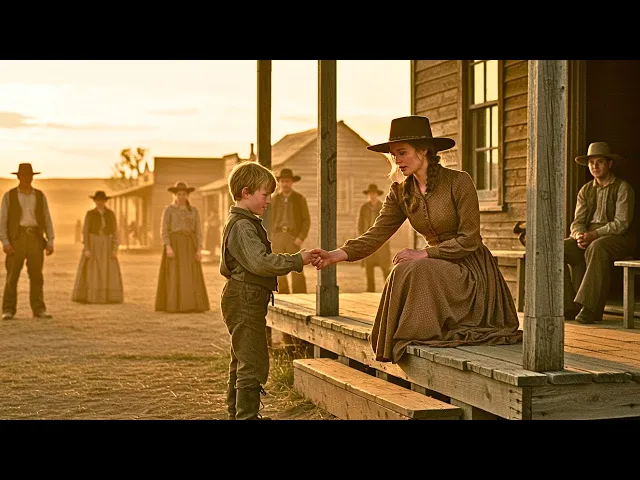
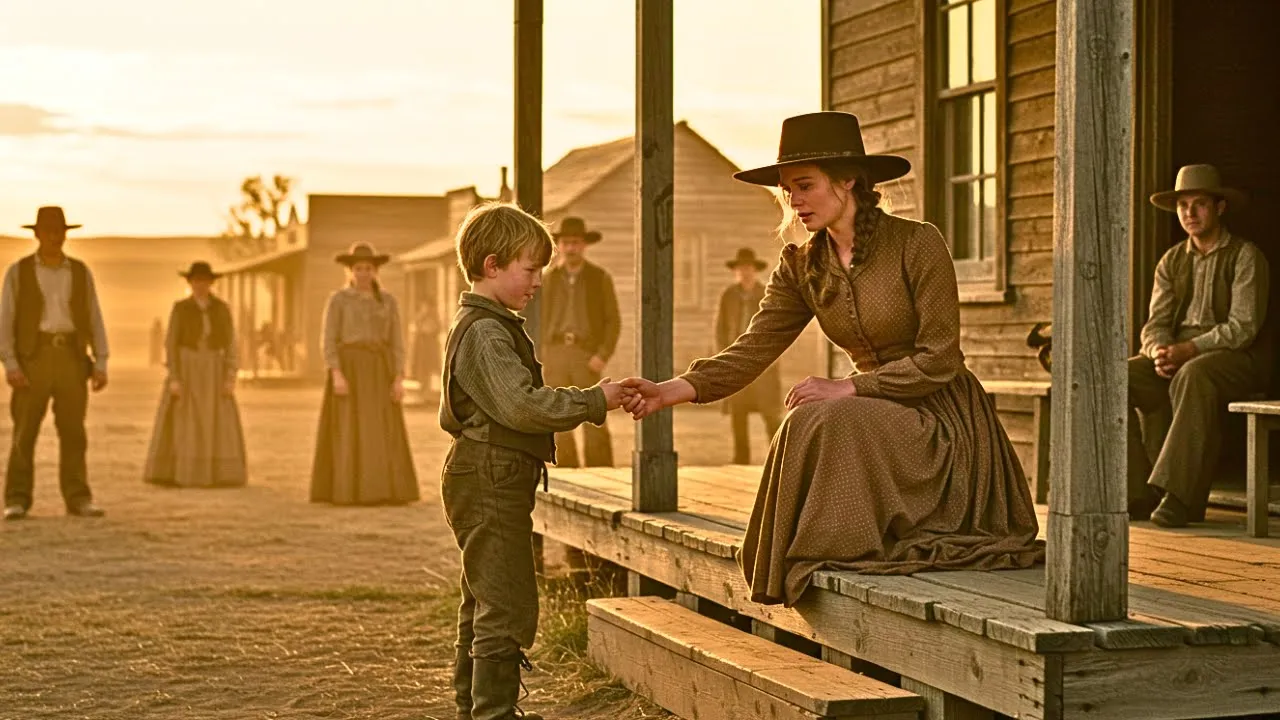
The widowerower's son wouldn't speak to anyone until a woman, everyone rejected, took his hand. The school bell rang across the dry, dusty plane, but Noah didn't move. He sat on the edge of the porch steps outside the one room schoolhouse, hands gripping his knees, boots still on the cracked wood.
The other children ran past him, kicking up clouds of red earth, laughing and shouting like colts let out of a pen. But Noah didn't laugh. He didn't even look up.
Miss Halbrook stood in the doorway, arms crossed tightly over her blouse. Her eyes softened as they fell on the boy. She tried everything, gentle words, warm smiles, even letting him draw instead of read, but the silence inside him was like a canyon.
No matter how far her voice reached, it never touched the bottom. "Noah," she said softly, kneeling beside him. Her skirt gathered dust at the hem.
"Would you like to come in today? " He didn't answer, didn't blink. His brown eyes stared forward, empty of mischief, sorrow, or fear, just blank like a boarded up window.
Not angry, not broken, just gone. Inside, the other children sat in their desks. The room filled with chalk dust and the smell of old books and ink.
A few of them peeked through the window at Noah, whispering behind cupped hands. They tried to be kind once. One girl had offered him half her cornbread.
A boy named Paul had tossed him a smooth pebble as a gift. But after weeks of being met with silence, they'd given up. By mid-afternoon, the sound of wagon wheels rolled up the dirt path.
Caleb Halt stepped down from the seat, his shoulders heavy beneath the weight of a simple linen shirt, and a life too tired for its age. He tipped his hat to Miss Hullbrook, who met him near the gate with a sigh. Same as always," she said, offering a tired smile.
He didn't cry, didn't smile, just sat. Caleb nodded and looked over at the boy, still frozen in place like a statue that no one dared to touch. "He used to talk to squirrels," he murmured.
"Couldn't get him to shut up some days," she smiled faintly. "I remember. He told me once that the moon followed him home.
There was silence between them, the kind that always settled when two people shared a memory of someone who no longer could. Caleb turned toward the porch and crouched before his son. He didn't try to force a word or a hug.
He just said gently, "Let's go home, son. " Noah stood, obedient as always. No protest, no glance back.
The ride home was quiet. The horses trotted with the same tired rhythm as Caleb's thoughts. Trees flickered past in the dying light, and the sky bled orange and rose.
Caleb stole a glance at the boy beside him. He sat stiffly, hands on his lap, lips pressed shut, not in anger, but as though words themselves had been buried with his mother. Back at the homestead, Caleb helped him down.
Noah walked toward the cabin, shoulders hunched like he was bracing for a storm that never came. He disappeared inside without a sound. Caleb didn't follow immediately.
He stood by the fence post, eyes fixed on the horizon. The wind rustled the dry grass at his feet. "Lord," he whispered, "if you're still listening.
I'm no good at this. " That night, Caleb sat by the fireplace, the flicker of flames casting shadows on the worn floorboards. Noah sat across from him, staring into the fire, eyes glassy.
A bowl of stew sat untouched in his lap. I know it ain't the same without her, Caleb said. I ain't her.
I can't sing like she did or read stories the way she did, but I'm trying, son. No answer. Not even a flicker in those dark eyes.
Days passed like dust drifting through the air, slow, weightless, dry. Every morning, Caleb took Noah to school. And every morning, Noah sat outside on the porch, wordless.
People in town had begun to talk, not out of cruelty, but out of habit. "That boy ain't right," someone whispered at the general store. "Might be touched in the head.
" Another woman, more sympathetic, shook her head. "It's the grief. Poor child ain't got his mama no more.
" Miss Halbrook didn't give up. She'd started leaving picture books by Noah's side, hoping he'd look at them. Sometimes he did.
He traced the shapes with his fingers, but never turned the pages. Then one particular morning, he didn't sit in his usual place. He stood just barely beside the porch post, watching someone.
A stranger had entered the schoolyard. A woman with a wide-brimmed hat and a dress faded by the sun, dragging a bucket and rag. Her sleeves were rolled to the elbows, revealing arms marked with sun and work.
She looked unsure, stepping lightly as if the ground might reject her. She wasn't from there. That much was obvious.
Noah watched her with unusual stillness. His eyes, always vacant, narrowed slightly. He didn't speak, but for the first time in weeks, he paid attention.
Miss Hullbrook came outside and greeted the woman with a polite but distant tone. The woman asked if there was work, any work at all. Cleaning, scrubbing, hauling water.
She didn't ask for money, just for a place to do something useful. Halbrook hesitated, but finally gestured toward the schoolhouse windows. As the woman began to clean the glass with careful circular motions, Noah stepped closer to the edge of the porch.
He didn't speak, he didn't smile, but he didn't look away. And for a boy who'd been lost in silence, that was the first crack in the wall. The town's folk didn't know where she came from.
One morning, she was just there, walking slowly down the dusty road that split the heart of town like an old scar. Her steps were careful, as if each one might be her last. And yet there was something steady about her gate.
She wasn't running. She wasn't hiding. She was simply arriving.
Her dress was plain and worn at the hem, the color of dried earth. She wore no jewelry, no bonnet with frills like the town ladies, just a faded shawl tied tight around her shoulders, and a hat pulled low over her brow. Her boots were scuffed, and her hands bore the marks of someone who had scrubbed more floors than anyone cared to admit.
The first to notice her was Martha Weaver, who ran the bakery. She watched through her window as the woman stopped to look at the bulletin board near the church steps. "I know that look," Martha whispered to herself.
"She's desperate. " By noon, whispers had already begun. The general store clerk said she asked for a broom and offered to clean for a loaf of bread.
At the livery stable, she offered to wash the horse's stalls for nothing more than water and soap. She didn't ask for a room. She didn't beg.
She just kept offering herself quietly, plainly. No one took her up on it. By the second day, she returned.
This time she headed toward the schoolhouse. Miss Hullbrook had just finished her lesson and was preparing to sweep the porch when the woman approached. Mom, she said, voice steady but soft.
I noticed the windows could use a good cleaning. I can do that. No charge.
Miss Hellbrook was caught off guard. She looked the woman up and down. There was no menace in her, no stench of liquor or sign of madness, just a kind of tired dignity, the kind that made you feel ashamed for turning someone away.
What's your name? The teacher asked, still holding the broom. The woman paused for just a beat too long.
June. Miss Halbrook nodded slowly. All right, June.
There's a bucket and rag in the back. June nodded once and went straight to work. She didn't ask questions.
didn't make small talk, just dipped the rag into the water and began to wipe the windows in firm, even circles. From his place on the porch, Noah watched her. He didn't move, but something behind his eyes seemed less distant, less fogged.
He followed her with quiet intensity as she moved from one pain to the next. June never looked his way. She didn't force a smile or try to coax a word.
She didn't even acknowledge him, but she was aware, acutely aware, of the still figure watching her every motion. Inside, Miss Hullbrook observed the strange connection with quiet wonder. It wasn't much.
It wasn't anything really. But after weeks of Noah sitting like a ghost, this simple act of observation felt like the first raindrop after a long drought. After the last window was cleaned, June set the bucket down and wiped her hands on her dress.
Miss Halbrook offered her a glass of water, which she accepted with a quiet nod. They stood in silence for a moment, the heat of the afternoon settling in. "Are you from around here?
" the teacher asked casually. June shook her head. "No," Miss Halbrook hesitated.
"Looking to stay? I go where there's work? " That was all she said.
As June walked away, the town's people took notice. A few mothers at the well clutched their children closer. An older man outside the saloon narrowed his eyes and spat on the ground.
Someone said she looked familiar. Someone else swore she'd seen that same woman leave another town under a cloud of shame. She's not right.
One woman muttered. Something about her just not right. She's hiding something, another added.
By the end of the week, rumors had grown teeth. She's the daughter of that woman who died in the county jail. someone whispered in church.
"You know, the one accused of poisoning her husband. Maybe she's the same kind of trouble," said another. None of it was proven.
But it didn't need to be. In a town where reputations were carved into stone faster than names on gravestones, June had already been tried and sentenced. She was the kind of woman folks avoided, not because of what she'd done, but because of what they feared she might have done.
And yet the boy kept watching. Noah didn't speak. But each day June returned to wipe a window or sweep the porch.
He would shift just slightly toward her. Sometimes he'd glance at her hands. Other times he followed the motion of her rag across the glass as if memorizing the way she moved.
Caleb noticed. He'd ride up in the afternoon and find his son not staring blankly at the ground, but watching her instead. At first he said nothing, but curiosity had a way of clawing at Caleb's mind like a dog at a fence post.
One evening, as he hitched the horse and glanced toward the porch, he asked Miss Halbrook, "Who's that woman? " "She calls herself June," the teacher replied, wiping chalk from her hands. "I think the town's already decided not to like her.
" Caleb narrowed his eyes. "And you? I think she's quiet.
She works hard. Doesn't bother anyone. " She glanced over at Noah, and he watches her every day.
That night, as Caleb sat by the fire, he thought about the silence that filled his cabin. He thought about the empty chair where his wife once sewed, about the song she used to hum while stirring stew. He thought about how those songs stopped, and so did Noah's voice.
And now this woman, this stranger the town rejected, was being watched by his boy like she carried the last ember of something that might matter. He didn't understand it yet, but he knew enough not to turn his back on it. June returned every morning now, always before the school bell rang, always without speaking to anyone.
She moved like someone used to being invisible, swift, quiet, careful not to step where she wasn't welcome. And yet she kept showing up. Some mornings she carried a broom tied together with twine.
Other times she brought her own bar of soap, a small square worn thin from too much use. The town's folk noticed, of course, but they didn't speak to her. They didn't offer thanks.
They just let her be. Half out of caution, half out of the hope she'd eventually disappear. On that particular morning, a light rain had fallen during the night, leaving the earth soft and slick.
Puddles gathered in the low spots between the steps and the dusty yard, and muddy tracks painted the school porch like faded ghosts of the children who had come before. June knelt by the garden bed near the school's side wall. It wasn't much of a garden anymore, just patches of weeds and hard stems.
But she worked with focus, her bare hands digging into the mud without complaint. Her dress darkened at the knees. Her sleeves were already rolled past her elbows, exposing arms strong from labor, scarred from quiet battles no one ever asked about.
Noah sat in his usual place, arms around his knees, chin resting on top. But today he wasn't staring at the ground. He was watching her hands carefully, quietly.
A sudden sound broke the silence. A soft clink followed by a roll. From Noah's coat pocket, a red marble escaped and bounced down the wooden step.
It teetered for a moment on the edge, then fell into the mud near June's foot. She paused. Without looking at him, June reached down and picked it up.
Her fingers were slick with brown clay, and the marble glistened in her palm like a drop of fire trapped in earth. She turned toward the porch. Noah flinched, but June didn't speak.
She approached slowly, her boots sinking into the damp soil, her eyes on the marble. When she reached him, she crouched low, not too close, not too far, and opened her hand. The marble sat in the center, surrounded by mud.
Noah's eyes flicked from her hand to her face. She didn't smile. She didn't offer words or gestures, just the marble.
After a moment that felt like it stretched forever, Noah reached out. His fingers touched the mud, then closed around the marble. Their hands didn't touch, but the space between them pulsed with something unspoken, something alive.
He looked up at her. His face remained expressionless, but his eyes were alert, present, aware. June gave a slight nod, almost imperceptible, and returned to her task.
From inside the classroom, Miss Hullbrook had seen everything. She didn't breathe until June turned away. The teacher's fingers trembled as she lowered the curtain.
Later that afternoon, when Caleb arrived to collect Noah, the boy was still holding the marble. He gripped it like something fragile, precious, like something that hadn't been in his world for a long time. Caleb lifted him into the wagon and noticed the streaks of dried mud on his son's fingertips.
"Where'd that come from? " he asked, nodding toward the red sphere in the boy's hand. "Noah didn't answer, but he didn't look away this time either.
" That night, while they sat at the dinner table in silence, Caleb watched his son roll the marble back and forth between his palms. There was something in the movement, a rhythm, a thoughtfulness that hadn't been there before. After the plates were cleared and the fire was lit, Caleb sat beside Noah and leaned back in his chair.
"That woman," he said, voice low, "the one at the school. She's got strong hands. You notice that?
" Noah's fingers froze over the marble. Then slowly he set it on the table. He didn't nod.
He didn't speak. But he looked up straight into his father's eyes. It was the first time in months.
And Caleb, stunned silent, swallowed hard and whispered, "Thank you, Lord, for whatever you're doing. " The days stretched longer as spring crept in slow and reluctant. The sky hung low over the plains, pale and wide, and the wind carried the scent of thawing earth.
Life returned to the land in stubborn patches, first in the green blades sprouting beside the steps of the schoolhouse, then in the distant song of morning doves at dusk. June kept returning, her presence like an echo no one wanted to admit hearing. She swept without being asked.
She carried firewood to the classroom before dawn. She patched a torn flag above the door with a stitch so clean it looked new. Still no one spoke to her.
No one offered help, but she remained. Noah's world, once silent and unchanging, had begun to shift in ways too small for most to notice. He still didn't speak, still didn't laugh, but he was moving again, just a little.
He'd shift closer when June approached. He'd lift his gaze when she passed. And one morning something changed.
It happened at the edge of the creek behind the school, a place where children sometimes played before the lessons began. The stepping stones there were half sunk in mud, slick from rain two nights before. June had gone to refill the water bucket, unaware that Noah had followed at a distance.
She didn't see him standing behind the willow tree, watching her crouch beside the bank, sleeves rolled, arms bare, skin dusted in sunlight. She dipped the bucket and stood, but as she turned, her foot slipped. She stumbled forward, catching herself just before falling into the water.
Noah stepped out from behind the tree. She looked at him, startled, but said nothing. He didn't move at first.
Then slowly he walked toward her, step by hesitant step, like approaching a wild animal that might vanish. When he reached her, he didn't speak, but he extended his hand. June stared at it.
It was a child's hand, small, pale, dirt under the nails, but steady. She took it just for a moment. Their hands met, warm and real, and so painfully human that it made her throat close.
She didn't squeeze. She didn't smile. She just let her fingers rest against his, allowing the weight of that trust to pass between them like current through water.
Noah helped her up, then let go. He walked back toward the school without a word. June remained by the water, her chest rising and falling as if she had run a mile.
She wiped her hand on her skirt, not to clean it, but to remember the feeling. Inside, Miss Halbrook noticed Noah arriving earlier than usual. He sat by the window.
He didn't hold his knees. He didn't look down. He just sat.
Quiet, yes, but no longer absent. When June passed the window with the bucket in hand, Noah's eyes followed her until she disappeared behind the doorway. And for the first time, the boy's mouth parted, not to speak, but to breathe differently, as if he remembered how.
By the end of the week, the town noticed. They didn't say it aloud at first, but they noticed. Someone saw Noah walking closer to the edge of the porch when June arrived.
Someone else saw him leave a wooden bird he had carved resting beside her wash bucket. The carving was simple, rough, and uneven, but it had meaning. A small thing that spoke louder than words.
That was all it took. Rumors, once lazy and aimless, sharpened like barbed wire. Mothers began pulling their children away more quickly at the schoolyard.
A shopkeeper crossed the street to avoid her. At church, her name was whispered between verses wrapped in frowns and thinly veiled scripture. "She's worming her way in," someone said.
"She's gotten too close to that boy," another added. Caleb heard it, too. At the feed store, a man he hardly knew leaned over the counter and muttered, "You'd best be careful with that one.
Women like her. They don't settle for just a child. " Caleb didn't answer.
He didn't even blink. But that night at dinner, he watched Noah more closely. The boy had begun eating again.
Slowly, still in silence, but no longer untouched by the world around him. And when he finished, he placed the wooden bird on the table between them like an offering. "That for her?
" Caleb asked, his voice calm. "Noah didn't move, but he looked at the bird, then nodded. It was the first answer he'd given in 3 months.
" The next day, Caleb hitched the wagon early and drove to the school. He didn't tell Noah why, just told him they'd ride together today. When they arrived, June was already there, scrubbing the back steps.
She turned when she heard the wheels, drying her hands on her apron, unsure whether to greet them or step aside. Caleb walked over alone. His shadow fell long across the dirt.
You've been kind to my boy, he said plainly. June didn't speak. I appreciate that, he added.
Still, she said nothing. But I need to ask you something. Her back straightened.
Why do you come here? He asked. Day after day, you clean, you sweep, no pay, no welcome.
Why? Her voice when it came was dry and steady. Because it's the only place that doesn't tell me to leave.
Caleb nodded slowly. He wasn't a man who trusted words, but he understood that kind of truth. He looked back at Noah, who was watching them with wide, unreadable eyes.
There's talk, Caleb said. Plenty of it. Some folks want me to pull him back, keep him away.
Jun's face didn't change, but I saw him take your hand. I saw the way he followed you with his eyes. That boy hasn't looked anyone in the face since we buried his mama.
He paused, the words caught in his throat. I don't know what you did. Maybe it wasn't anything, but something in him moved.
June met his eyes. I ain't got much, Caleb said. But I'll protect what's mine and right now he wants to be near you.
He tipped his hat and turned to go. So let him talk. That afternoon when the school bell rang, Noah didn't wait on the porch.
He walked beside June to the bucket and helped her carry it back inside. Miss Halbrook didn't interrupt. She simply closed the lesson book in her lap and whispered, "Amen.
" The wind rose that evening, low and mournful across the prairie like an old song sung through broken teeth. The fire in Caleb's hearth had burned low, casting long shadows across the wooden floor. He sat in his usual chair, one hand holding a mug of coffee gone cold, the other resting on the armrest, fingers twitching like they were searching for something that wasn't there anymore.
Noah was already in bed. He no longer resisted sleep. the way he used to.
Since June had come into his quiet orbit, something inside him had loosened, barely, but enough to shift the silence into something less heavy. Still, he had not spoken until that night. It was sometime past midnight when Caleb heard it.
At first he thought it was a dream or the creaking of the cabin in the wind, but then he heard it again, a cry sharp and terrified, rising through the house like a flare in the dark. June. Caleb dropped his mug.
It shattered on the floor. He rushed to the small bedroom where Noah slept. The boy was sitting upright, eyes wide, chest heaving.
sweat clung to his brow and his small hands gripped the blanket like it might fly away. Caleb knelt beside the bed. "Noah," he said, voice low but urgent.
"I'm here. You're safe, son. It's just a dream.
" Noah stared at him. His mouth trembled and then, clear as rain, he whispered, "She fell. " Caleb blinked, "What?
" She slipped by the creek. "I I saw it. " Caleb felt the air leave his chest, not just because Noah had spoken, but because the boy remembered the moment, the hand, the connection.
Noah's voice broke into a sob, quiet and shaking. She was all muddy. She didn't get mad.
Caleb wrapped his arms around him, unsure of what to say. He hadn't held the boy like that in months, not since the funeral. Not since they had both gone silent in their own ways.
Noah leaned into his father's shoulder and whispered again. "Don't let them send her away. " Caleb closed his eyes.
"I won't," he said, his voice rough. The next morning, Noah woke early. He got dressed on his own.
He even ate the porridge without being told. When Caleb hitched the wagon, the boy climbed up beside him without hesitation. They rode in silence, but not the kind that used to hang like grief between them.
This silence had shape, purpose. When they reached the schoolhouse, June was already there, kneeling by the porch, scraping mud from the boards. Her hands were raw, her dress wet at the knees.
Caleb helped Noah down and watched as the boy walked, quiet, but steady toward her. He stopped just beside her. She didn't look up right away, but when she did, her expression froze.
Noah extended his hand the same way he had by the creek. June blinked, caught off guard, and then slowly, as if afraid the world might end for accepting kindness, she reached out and took it. Neither said a word.
But inside the schoolhouse, Miss Hullbrook watched through the window and covered her mouth with her fingers. Tears welled in her eyes, not out of sadness, but because she had just seen a boy rise from silence, and a woman cast out by all, be received without question by the one soul too broken to pretend. The calm didn't last.
A week passed with small miracles. Noah began to hum under his breath softly, almost like remembering a sound from far away. He no longer flinched when other children ran past him.
He still didn't speak much, but when June was nearby, he seemed more anchored, less like a boy drifting alone in a silent sea. That was enough for Caleb. More than enough, but not for the town.
It started with a folded note on the schoolhouse door. No name, no handwriting to recognize, just four words scrolled in dark ink. She doesn't belong here.
Miss Hullbrook crumpled the paper before the children arrived, her jaw tight, eyes burning. She didn't show it to June. Not then, but more signs followed.
June returned from cleaning the water pump behind the church to find her rag bucket kicked over and broken glass at the bottom. No one claimed responsibility. No one needed to.
Whispers grew bolder. Some women crossed the street when she walked by. Others pulled their children behind them like shields.
"She's got the boy under some kind of spell," they said. "I saw her touch him," said another. "Caleb heard every word.
He ignored most of them until the pastor himself came calling. It was a Saturday morning. Caleb was chopping firewood when Reverend Mathers approached, hat in hand, concern etched into the lines of his face.
" "Morning, Caleb," he said. Mind if I speak with you a moment? Caleb nodded, setting the axe aside.
The pastor cleared his throat. This woman, June, she stirred unrest. Parents are uneasy, and I've had elders ask whether it's proper for her to be so close to your boy.
Caleb crossed his arms. My boy didn't speak for 3 months, pastor. You remember that?
I do. And now he's eating, sleeping, walking like he's got weight in his boots again. That's her doing.
I don't doubt her intentions, the pastor said gently. But perception matters. If she stays, the town may decide you're not fit to raise him.
Caleb's jaw tightened. Let him try. But that night, long after the fire died down, Caleb stared at the coals and thought about Noah's future.
He'd fought in war, buried a wife. He could take hardship. But Noah, he was just a boy, and the town's cruelty had no breaks when fear took the reigns.
The next morning, June was gone. No goodbye, no trace. The school steps were dusty, the windows left unwashed, the garden untended.
Noah waited all morning on the porch. He didn't move, didn't blink, just stared at the road as if willing her to appear. By noon, his hands were clenched in fists.
By evening, he wouldn't eat. That night, Caleb sat beside his bed and tried to explain. She left because they made it too hard to stay.
Noah turned his face to the wall. She didn't want to hurt you, son. Still nothing.
But when Caleb reached over to tuck in the blanket, he found something beneath it, the wooden bird. The boy had snapped it in two. Caleb rose before the sun the next day.
He saddled the horse in silence, his movements methodical, steady, like a man heading into weather he couldn't avoid. He loaded a blanket, a water flask, and a pouch of coins. Noah stood in the doorway, boots on, arms stiff by his sides.
"You sure? " Caleb asked. The boy nodded once.
They rode west, following the river trail until it split toward the smaller towns and camps that dotted the outskirts of the county. Caleb asked questions at weigh stations, showed June's name at supply stores. Most folks shrugged.
One woman in a roadside inn finally said she might have seen someone like that. Quiet, alone, hands red from scrubbing. She's working out back, the woman said, cleaning pots and getting no thanks for it.
The place was a low roofed boarding house on the edge of nowhere. Smoke curled weakly from its chimney, and the smell of boiled turnips clung to the door. Caleb dismounted and walked around the side.
Noah followed behind him like a shadow. June was there kneeling beside a stack of coal bins, her apron stained with soot and water. She didn't look up when she heard them approach.
Maybe she thought it was just more orders, more work. Caleb cleared his throat. We came to bring you home.
She froze. Slowly she stood and turned. Her face was different now, paler, wearier.
the lines around her mouth drawn tight from too many nights without sleep. But her eyes her eyes softened when they fell on Noah. He stepped forward before Caleb could say another word.
The boy didn't speak. He didn't offer anything grand or dramatic. He just walked up to her and took her hand.
She looked down at him, tears rising without shame. One hand over her mouth, the other holding his, trembling. I didn't want to leave, she whispered.
Caleb took off his hat. I didn't want you to, he said. But I let fear make a decision that wasn't mine to make.
She shook her head. They won't want me back. I don't care what they want.
Silence fell between them, not heavy, but full. She looked at Noah again. His grip was small, but firm.
You've got a home, Caleb said. One where my boy speaks your name in the dark when he's afraid. Her lips parted at that and something cracked in her eyes.
"I can't promise much," he continued. "But I can promise you won't be turned away at my door. " June looked at the sky, blinking fast.
"It's not your door I worry about. I'll stand in front of it," Caleb said simply. "And that was it.
" Noah held her hand all the way back to the wagon. Caleb helped them both up, and the three rode in silence through the hills, the shadows of clouds drifting over the road like memories. She didn't ask where they were going, because somehow she already knew.
When they returned to town, no one said a word, but everyone noticed. June stepped off the wagon with her eyes low and her hands steady. She didn't wear a smile, didn't meet any gazes.
She simply followed Caleb and Noah into the cabin and closed the door behind her. That act alone was enough to set off whispers. At the general store, two women paused mid conversation.
At the church gate, a man muttered under his breath. No one knocked on Caleb's door. Not yet.
But they were watching like prairie dogs in tall grass, heads poking out, waiting to pounce. Inside, the house was quiet, familiar. June didn't ask where to go.
She found the wash tub by the back door and filled it without a word. She washed Noah's socks, then Caleb's shirts, then her own apron, scrubbing until her knuckles reened again. She didn't say much.
Neither did Noah, and that was the strange beauty of it. Their silence didn't feel hollow now. It was shared, accepted, peaceful.
Caleb sat by the fire that evening, watching the two of them string beans for supper. Noah handed them one by one. June placed them in the pot.
No words passed between them. Yet everything that mattered did. That night, Caleb laid out a bed for June in the corner near the stove.
"It ain't much," he said, rubbing the back of his neck. "But it's warm," she looked at the blanket, then at him. "I've had less," she replied quietly.
Noah fell asleep with the wooden bird, now glued back together, resting on his chest. Over the next few days, routine returned. June kept to herself.
She didn't go into town. She cleaned, cooked, and sewed. She helped Noah with his letters.
Sometimes he would hum when she braided cord or peeled potatoes. Sometimes he would hum while she sat nearby and read from an old Bible missing half its cover. But she still didn't speak much.
She didn't need to. Miss Halbrook visited once. She brought an old book of fables for Noah and left a jar of honey wrapped in cloth for June.
I'm glad she came back, the teacher whispered to Caleb as she left. Not just for him, for all of us. Still, the world outside their cabin hadn't changed.
At church, people avoided eye contact. In town, June's name was barely spoken, but behind closed doors, voices grew louder. One afternoon, as Caleb hammered boards into the barn wall, Noah came running from the house with wide eyes and a folded paper in his hand.
Someone had left a note on the front step. It read, "Send her away or we will. " Caleb read it three times before folding it back up.
He looked toward the window where June stood in silence, eyes on the floor. She had seen it, too. But she didn't speak.
She didn't argue, didn't beg. She simply returned to the stove and stirred the pot with trembling hands. And when Noah sat beside her, resting his head on her arm, she let herself cry without sound, without words, because even if the world outside hadn't changed, the world inside that cabin had, and neither of them wanted to lose it again.
Winter's Edge came early that year, frosting the windows and whitening the fields in silence. Inside the cabin, the fire burned longer, and the light stayed on later. Life, once fragile, had become routine again.
But this time, it breathed. Noah now spoke in small bursts, mostly to June. Can I help?
He'd ask, as she needed bread. You forgot your shawl, he'd say on colder mornings. His voice was still soft, but it had returned, and every word carried the weight of something healed.
Caleb watched them closely. Each evening after supper, they would sit near the fire, Noah curled beside her, June stitching something in her lap, often humming in a way that echoed the memory of his mother, but not to replace her, only to remind them that songs didn't have to die with the one who first sang them. The town, however, remained bitter and cold.
No one dared confront Caleb again. Not directly. But notes kept appearing.
Nailed to fence posts left on the school steps, slipped between crates in the wagon. This isn't right. She's hiding something.
Children copy what they see. But Caleb didn't flinch. He built a new fence, taller.
He walked beside June to the well. He kept his hand near hers during Sunday sermons, even when the pews around them emptied one by one. Then came the Christmas gathering.
Each year the school hosted a small celebration. Parents packed into the schoolhouse. Children sang verses.
Miss Hullbrook read scripture. Cookies were passed around on chipped plates. This time Caleb hesitated to go, but it was Noah who insisted.
"He wants to do something," Miss Halbrook had said days before, stopping by with an envelope. He asked to read a line. Just one line.
Caleb looked at his son. "You sure? " Noah nodded.
"She'll be there, right? She'll be there," Caleb promised. On the evening of the event, June wore a pale shawl over her simple dress.
She didn't try to blend in. She didn't pretend to belong. She simply stood near the back, hands clasped, eyes focused on Noah.
When his turn came, he walked to the front alone, holding a small page with shaking hands. The room quieted. Caleb rose slightly in his seat.
June didn't move. Noah cleared his throat and said, "Clear and firm. Thank you for the one who stayed when no one else did.
" That was all. Silence followed. Then a few claps, then more.
Miss Hullbrook wiped her eyes. Caleb's chest swelled. And June June looked down and smiled.
The first real smile since she arrived in town. Afterward, no one stopped her when she walked past. No one moved away.
One of the mothers even gave her a soft nod. They walked home under a sky full of quiet stars. Caleb carried a lantern.
June held Noah's hand. Near the porch, she paused. I don't belong anywhere, she said barely above a whisper.
Caleb looked at her for a long time. You do now, she blinked. He extended his hand, not out of pity, not out of duty, but with the same quiet strength his son had shown weeks ago.
June took it, and in that moment, three broken lives stood whole. Not because the town had changed, but because they had chosen each other anyway. Sometimes the quietest bonds are the ones that save us.
If this story touched something deep within you, something forgotten, or something still healing, share your thoughts in the comments below. And if you believe the world still needs stories like this, stories of grace, of second chances, of hands held when no one else would, consider subscribing to the channel. We'd be honored to have you with us.
[Music] Heat. Heat.